The Body of Christ

I Cor. 12. 12-14, 27-31 In writing to the Christians of Corinth, Paul says they have divided loyalties. Some say they belong to Paul, some to Apollos, some to Cephas– all high profile personalities–and by their divided loyalties they divide the church. In our reading today at Mass Paul uses the image of the human body to remind the Corinthians that high profile personalities aren’t the only ones who count. Like the human body, the church is made up of many parts and they all count. The image of the human body Paul uses is not unique to him. Many writers and speakers of his time– Greeks, Romans, Jews– explained  the unity and complexity of the empire, the community, the family and individuals through this image. The body has many parts and they’re all needed to form one body. Our lectionary today leaves out much of Paul’s use of this image, perhaps too much, because you see the concrete way the apostle must have taught the people of his day.

“Now the body is not a single part, but many. If a foot should say, “Because I am not a hand I do not belong to the body,” it does not for this reason belong any less to the body. Or if an ear should say, “Because I am not an eye I do not belong to the body,” it does not for this reason belong any less to the body. If the whole body were an eye, where would the hearing be? If the whole body were hearing, where would the sense of smell be?But as it is, God placed the parts, each one of them, in the body as he intended. If they were all one part, where would the body be?

If [one] part suffers, all the parts suffer with it; if one part is honored, all the parts share its joy.”(1 Corinthians 12, 15-29) What a simple, effective way to speak of the unity and diversity in society and ourselves. Through the images of the body, Paul goes on to speak of the different gifts there are in the church, apostles, prophets; teachers; some have the gifts of healing, assistance, administration…but not everybody has the same gifts. What’s unique in Paul’s use of the image of the body is where he sees the body come from and what it is now. The body comes from the one Spirit, he says. We drink from the one Spirit; we’re all baptized into the one Body, which is Christ’s Body. We’ve been given different gifts from the Spirit, we don’t all have the same gifts, but what we have are meant to build up the Body of Christ.

It’s interesting  when we receive the Bread of the Eucharist, the priest says simply  “Body of Christ.” We receive Christ; we also receive his Body, the church, with its gifts, its strength and its weaknesses, but it’s Christ’s Body, and so we say “Amen.” “Yes.”
“Wait for One Another”

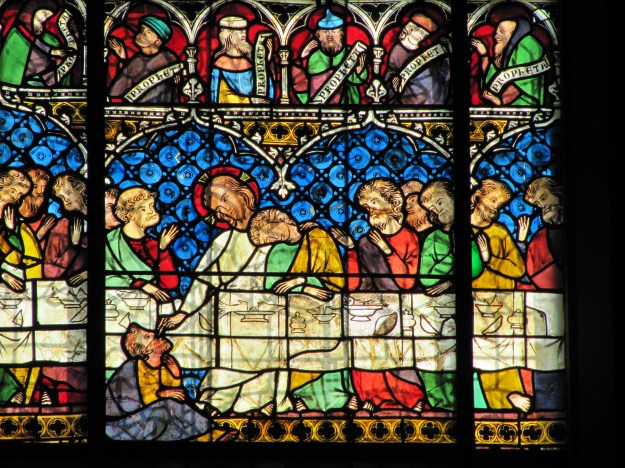
In today’s reading at Mass from 1 Corinthians ( 11, 17-26.33) we have the earliest written account of the institution of the Last Supper in the New Testament:
“For I received from the Lord what I also handed on to you,
that the Lord Jesus, on the night he was handed over,
took bread and, after he had given thanks,
broke it and said, “This is my Body that is for you.
Do this in remembrance of me.”
In the same way also the cup, after supper, saying,
“This cup is the new covenant in my Blood.
Do this, as often as you drink it, in remembrance of me.
For as often as you eat this bread and drink the cup,
you proclaim the death of the Lord until he comes.”

The simple account stresses that Jesus, taking bread and wine, gave himself, Body and Blood, “for you.” He gave himself for all. When we do this “in remembrance of me” we are called to be like him, to give ourselves for all.

Paul warns the Corinthians that by what he hears of their divisions and factions they’re failing to do what the Lord commands. Instead of imitating what Jesus d, they’re driving others away in their celebrations and thus bringing judgment on themselves.

Therefore, my brothers and sisters,
when you come together to eat, wait for one another.

A beautiful phrase Paul uses, “wait for one another.” A phrase that comes from the family meal in Paul’s time, when someone might miss the meal if the family did not wait for them. “We have to wait for them.”

So we wait for the grace Jesus offers at the Eucharist, to see all at the table of the Lord, loved by God who loves all.

24th Week of the Year b

SEPTEMBER 16 SUNDAY TWENTY-FOURTH SUNDAY IN ORDINARY TIME
Is 50:5-9a/Jas 2:14-18/Mk 8:27-35 (131)

17 Monday
[Saint Robert Bellarmine, Bishop and Doctor of the Church]
1 Cor 11:17-26, 33/Lk 7:1-10 (443)

18 Tuesday
1 Cor 12:12-14, 27-31a/Lk 7:11-17 (444)

19 Wednesday
[Saint Januarius, Bishop and Martyr]
1 Cor 12:31—13:13/Lk 7:31-35 (445)

20 Thursday Saints Andrew Kim Tae-gŏn, Priest, and Paul Chŏng Ha-sang, and Companions, Martyrs
Memorial
1 Cor 15:1-11/Lk 7:36-50 (446)

21 Friday Saint Matthew, Apostle and Evangelist
Feast
Eph 4:1-7, 11-13/Mt 9:9-13 (643)

22 Saturday
[BVM]
1 Cor 15:35-37, 42-49/Lk 8:4-15 (448)

Thursday, celebrating the Korean martyrs, is an opportunity to recognize the church in that part of the world:
https://video.search.yahoo.com/yhs/search;_ylt=AwrEwSjPiJ1b0egACII2nIlQ?p=Korean+martyrs&hsimp=yhs-perfecttab&hspart=flowsurf&fr=yhs-flowsurf-perfecttab&fr2=p%3As%2Cv%3Ai%2Cm%3Apivot#id=15&vid=b50cfb7027bfd5c182f70f23ea654f6d&action=view

24th Sunday b: Who is the Messiah?

For this week’s homily, please play the video below.

Are you ready?


By Berta Hernandez

In the “Word Among Us” there is a reflection for Wednesday, September 12, 2018, that leaves us with the question: “What would you do if you knew Jesus was coming today?”. That question comes from Paul’s concern in 1 Corinthians: “I tell you brothers, the time is running out. For the world in its present form is passing away.” (1 Cor: 29,31) Paul would like all of Jesus’ followers to be ready for the coming of our Lord. He was convinced that Judgement Day was just around the corner.
I decided to pray on that question today. As I sat in my own “Secret Place” I relaxed and started imagining what my reaction would be to the question of Judgement Day. How would I act? What would I do?
I would be very excited, nervous, happy, and somewhat fearful! But I think I would also be singing His praises, I would be dancing and rejoicing while also thanking Him for finally bringing Heaven here on earth! If I had the chance I would go directly to the Passionist Monastery in Jamaica, NY and try to find a priest that I could confess to, but I imagine they would have known the Good News and be out there singing and rejoicing with everyone else! In the case there is no priest or if I have no time to see one, I would just ask for forgiveness and repent for all I’ve done that has not been pleasing to Him. I would renounce Satan, all the evil spirits and their works! I want nothing blocking me from my Lord Jesus, my Savior, my King, my Light!
I would go out in the street and yell out the Good News to every passer-by! I would visit all my friends, if possible, or call them on the phone! But I would also like to sit quietly in prayer and anticipation. So many things to do, but all of them good!
But You know what, my Lord Jesus? I really don’t know how I would react! The thought of You finally coming to get us is really overwhelming!
I want to thank You, my Lord Jesus and Your Holy Spirit, for the beautiful message that I received from You through my readings today and through my prayer. There’s nothing and nobody like You! May I be ready when it really happens in my time on earth or when my time comes . I love You! I adore You! God, the Father, God, the Son, God, the Holy Spirit!
Are you ready? What would you do?

I would like to share a prayer by Fr. Richard Rohr titled “Trinity Prayer” that I find brings me very close to our God . It might help you get ready. Read and ponder!
“God for us, we call you Father.
God alongside us, we call you Jesus.
God within us, we call you Holy Spirit.
You are the eternal mystery that enables, enfolds, and enlivens all things,
Even us and even me.

” Every name falls short of your goodness and greatness.
We can only see who you are in what is.
We ask for such perfect seeing—
As it was in the beginning, is now, and ever shall be.
Amen. (So be it.)”

Extreme Weather: Why?


A very solid scientific consensus indicates that we are presently witnessing a disturbing warming of the climatic system. In recent decades this warming has been accompanied by a constant rise in the sea level and, it would appear, by an increase of extreme weather events, even if a scientifically determinable cause cannot be assigned to each particular phenomenon. Humanity is called to recognize the need for changes of lifestyle, production and consumption, in order to combat this warming or at least the human causes which produce or aggravate it.

A rise in the sea level, for example, can create extremely serious situations, if we consider that a quarter of the world’s population lives on the coast or nearby, and that the majority of our megacities are situated in coastal areas.

Some studies warn that an acute water shortage may occur within a few decades unless urgent action is taken. The environmental repercussions could affect billions of people; it is also conceivable that the control of water by large multinational businesses may become a major source of conflict in this century.23

Pope Francis. Laudato SI 24, 31.

The “extreme weather” the pope describes not only calls for getting evacuation plans ready, but we need to do something more: “Humanity is called to recognize the need for changes of lifestyle, production and consumption, in order to combat this warming or at least the human causes which produce or aggravate it.”

The Secretary General of the United Nations, Antonio Guterres, said recently we have reached a critical point and called on the leaders of nations to address climate change as the overriding issue we face.


Hurricane Florence is Coming

We not preparing for the disasters brought by climate change, an article in USAToday by Rick Hampson says. “Will repeated exposures to vivid scenes of natural disaster–Western wildfires, a global heat wave, Hawaiian volcano eruptions, the 2017’s hurricane’s anniversary and a suddenly active 2018 season” prepare us to do something? “Experience counsels skepticism. So does human nature.”

“Experts say people aren’t really motivated by disaster until it come to, or through, their door.” Hampson writes.

We forget that “America, the Beautiful” is vulnerable to climate change as other parts of the world are, and our political system doesn’t help us face the change either. The earth doesn’t get to vote.

“Democracies are creatures of the present, because the public focuses on the here and now, not some future hypothetical problem… Our political system makes us vulnerable to distant crises, because we don’t try to anticipate or diffuse them.” (Robert J. Samuelson)

In a previous blog Pope Francis asks us to hear in the changing climate cries of “Our  Sister, the earth” groaning from the abandonment and mistreatment received at our hands. Is Hurricane Florence a cry of creation?

“Save us, Lord, from becoming simply ‘creatures of the present.’ looking after ourselves. Let us hear our earth and sky and sea when they cry out from our abuse and lack of care. We ourselves are dust from the earth, we breathe her air and are refreshed by her waters. May we hear the cries of our Sister, the earth,  and care for her.”


Praise be to You, My Lord.

DSC00154


“LAUDATO SI’, mi’ Signore” – “Praise be to you, my Lord”. In the words of this beautiful canticle, Saint Francis of Assisi reminds us that our common home is like a sister with whom we share our life and a beautiful mother who opens her arms to embrace us. “Praise be to you, my Lord, through our Sister, Mother Earth, who sustains and governs us, and who produces various fruit with coloured flowers and herbs”.

This sister now cries out to us because of the harm we have inflicted on her by our irresponsible use and abuse of the goods with which God has endowed her. We have come to see ourselves as her lords and masters, entitled to plunder her at will. The violence present in our hearts, wounded by sin, is also reflected in the symptoms of sickness evident in the soil, in the water, in the air and in all forms of life. This is why the earth herself, burdened and laid waste, is among the most abandoned and maltreated of our poor; she “groans in travail” (Rom 8:22). We have forgotten that we ourselves are dust of the earth (cf. Gen 2:7); our very bodies are made up of her elements, we breathe her air and we receive life and refreshment from her waters. Pope Francis, Laudato Si, 1-2

23rd Week of the Year b


September 9 SUNDAY TWENTY-THIRD SUNDAY IN ORDINARY TIME
Is 35:4-7a/Jas 2:1-5/Mk 7:31-37 (128)

10 Monday
1 Cor 5:1-8/Lk 6:6-11 (437)

11 Tuesday
1 Cor 6:1-11/Lk 6:12-19 (438)

12 Wednesday
[The Most Holy Name of Mary]
1 Cor 7:25-31/Lk 6:20-26 (439)

13 Thursday Saint John Chrysostom, Bishop and Doctor of the Church
Memorial
1 Cor 8:1b-7, 11-13/Lk 6:27-38 (440)

14 Friday The Exaltation of the Holy Cross
Feast
Nm 21:4b-9/Phil 2:6-11/Jn 3:13-17 (638)

15 Saturday Our Lady of Sorrows
Memorial
1 Cor 10:14-22 (442)/Jn 19:25-27 or Lk 2:33-35 (639)

Two celebrations this week, the Exaltation of the Holy Cross and Our Lady of Sorrows are closely connected celebrations.

The feast of the Exaltation, celebrated by churches of the east and west, originated in the Basilica of the Resurrection in Jerusalem (Church of the Holy Sepulcher) in the 5th century where the wood of the cross was exposed for veneration by the faithful. Its complicated history should not prevent us from seeing the essence of this feast: the One who died and was buried, rose from the dead. His Passion and Resurrection are celebrated in this one feast.

Similarly, the memorial of Our Lady of Sorrows sees Mary following her Son, “who emptied himself” in coming among us, even to the point of dying on the Cross, but God exalted him.
Through her life, Mary embraced the “emptying “ sorrows of her Son”, finally sharing in his death as she stood by his Cross. But she saw her sorrows–her “seven sorrows”– turned into joy.

“O Lady Mary, thy bright crown is no mere crown of majesty, for with the reflex of his own resplendent thorns, Christ circled thee.” (Thompson)

23rd Sunday b: Hear and Speak

For this week’s homily please play the video below.