Fixing Our Eyes on Jesus


We’ve been reading the Letter to the Hebrews at Mass for two weeks now. It’s a good example of how time-conditioned our scriptures are. Those who listened to the letter long ago knew more about the temple in Jerusalem and its round of worship than we do today.  They were more familiar with the story of the exodus and they knew “the great cloud of witnesses” better than we do.. We’re far removed from their times.

We’re people of our age, wired to the absorbing images of our time. Hard as we try, the language of the bible can be hard to appreciate.

Still, one image from those times stands fresh and strong.. It’s the image of Jesus on the Cross.  We must “keep our eyes fixed on Jesus, the leader and perfecter of our faith,” the Letter to the Hebrews says. “For the sake of the joy that lay before him, Jesus endured the cross, despising the shame, and has taken his seat at the right of the throne of God. Consider how he endured such opposition from sinners, in order that you may not grow weary and lose heart.”

The passion of Jesus  speaks to every time and place. It’s a book anyone can read, a sign to get the attention of every age, for it makes  a startling claim. The Son of God, through whom all things were made, endured the shame of dying on a cross.  Jesus, wise and powerful, fell into the hands of his enemies. And it was all because of a wondrous love.

Fixing our eyes on him, our faith in God grows, the Letter to the Hebrews says. If we keep this mystery before us we won’t tire or lose heart. Fixing our eyes on Jesus means fixing our eyes on the eternal God.

So utterly simple. Beyond past images and time.


Document on Human Fraternity for World Peace and Living Together


Screen Shot 2019-02-06 at 8.49.53 AM

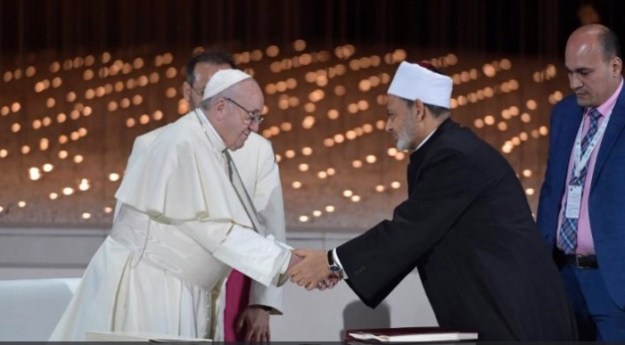
Pope Francis and the Grand Imama of Al-Azhar, Ahmad el-Tayeb,

“Something is happening.” That’s the way the great reading for our Holy Saturday liturgy, taken from an ancient homily, begins. We don’t see clearly yet, but something is happening.

And that’s the way I felt yesterday watching on YouTube a Mass at Abu Dhabi in the United Arab Emirates where more than one hundred thousand Christian migrant workers in the Middle East celebrated their faith with Pope Francis. Christianity is alive in the Middle East.

In the “Document on Human Fraternity for World Peace and Living Together” signed on Monday afternoon in Abu Dhabi by Pope Francis and the Grand Imama of Al-Azhar, Ahmad el-Tayeb, a path for the two religions and the world itself opened. Something is happening.

The document from leaders of these two great religious traditions, Christian and Muslim, is worth reflecting on.

It begins:
“In the name of God who has created all human beings equal in rights, duties and dignity, and who has called them to live together as brothers and sisters, to fill the earth and make known the values of goodness, love and peace,”

The document speaks for innocent human life, the poor, the destitute and the marginalized, the victims of destruction, calamities and war. It invokes the name of freedom, fraternity, peace and justice, the name of all people everywhere:

“In the name of God and of everything stated thus far; Al-Azhar al-Sharif and the Muslims of the East and West, together with the Catholic Church and the Catholics of the East and West, declare the adoption of a culture of dialogue as the path; mutual cooperation as the code of conduct; reciprocal understanding as the method and standard.”

“We, who believe in God and in the final meeting with Him and His judgment, on the basis of our religious and moral responsibility, and through this Document, call upon ourselves, upon the leaders of the world as well as the architects of international policy and world economy, to work strenuously to spread the culture of tolerance and of living together in peace; to intervene at the earliest opportunity to stop the shedding of innocent blood and bring an end to wars, conflicts, environmental decay and the moral and cultural decline that the world is presently experiencing.”

One commentator Tuesday said a meeting like this takes time for its meaning to be felt. “Something is happening.”

Facing “Unclean Spirits”

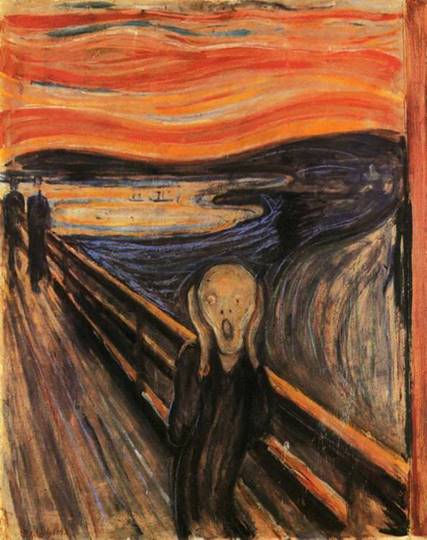
Edvard Munch: The Scream


When Jesus and his disciples cross the sea into pagan territory– an important new step in his ministry– they meet a man in the tombs and Jesus drives the unclean spirit out of him. (Today’s reading: Mark 5, 1-20) 

Throughout  his ministry “whenever unclean sprits saw him they would fall down before him and shout, ‘You are the Son of God.’ (Mark 3,11) Unclean spirits were favorite targets for Jesus in his ministry.

What’s an “unclean spirit”?

In their fine commentary on Mark’s gospel John R. Donahue, SJ, and Daniel Harrington, SJ, say “In this context ‘unclean’ (akatharton) primarily connotes not a moral (even less a sexual) fault), but something opposed to the “holy.” In the command of the Old Testament to be holy (Leviticus 11,44) it implies life, wholeness and completeness,( Leviticus 21, 17-21) whereas uncleanness implies something that should not be, something out of place ( e.g. soil in a farmer’s field is productive, while in a house it’s dirt). The opposite of the realm of the holy is the demonic, hence the spirits there are “unclean”. Physical defects or psychological aberrations can make a person “unclean”in a sense of incomplete, imperfect and out of order.”
(The Gospel of Mark, Sacra Pagina, Liturgical Press 2002 page 80.)

Jesus did not focus on the intellectual establishment or the religious establishment in his ministry. He engaged the chaotic world of the “unclean spirits.” He set up a “field hospital” to use a phrase dear to Pope Francis.

That can be a messy, scary world, as we see in Mark’s gospel. Just think of the poor man in the tombs, chained and hurting himself. Who wants to deal with him? But Jesus gives his disciples “authority” over unclean spirits. His followers have the power to take them on.

Jesus commissioned  his apostles for this ministry. He summons “the twelve and began to send them out two by two and gave them authority over unclean spirits.” (Mark 6, 7) We’re not out of place in our chaotic world today.

4th Sunday c: Nazareth

For this week’s homily, please play the video below.

Presentation in the Temple, February 2nd


DSC00129

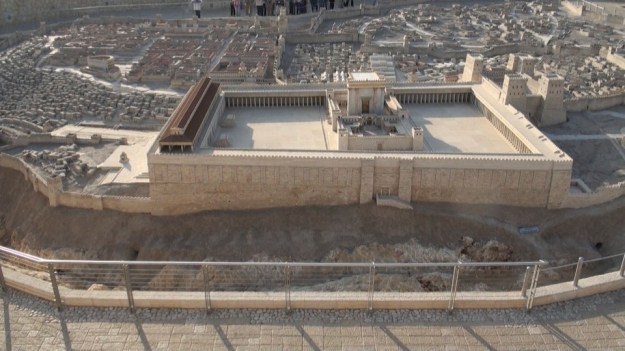
Temple of Jerusalem, 1st century, Israel Museum

The Presentation of Jesus in the temple, forty days after his birth, is a Christmas feast, even though our Christmas decorations are put away. It’s part of Luke’s Infancy Narrative.

The temple of Jerusalem– a reproduction is pictured above– plays a big part in Luke’s Infancy Narrative,  even more important than the stable to which the shepherds came.  The angel announced John’s birth to Zachary in the temple, and there Jesus is presented after his birth. Later, he will come to the temple as a young boy and  impresses its teachers, as he listens to them and asks them questions.

Luke doesn’t dwell on the rituals or appearance of the temple– he may not know much about them–but the temple for him is where God is present, and so it’s the place where Jesus would be recognized. Forty days after his birth, two elderly Jews, Simeon and Anna, recognize him. They’re  faithful believers who  represent the generations waiting for the Messiah.

Old Simeon takes the child in his arms:

“Now, Master, you may let your servant go
in peace, according to your word,
for my eyes have seen your salvation,
which you prepared in the sight of all the peoples:
a light for revelation to the Gentiles,
and glory for your people Israel.”  (Luke  2,22-40)

Afterwards in his gospel Luke describes the rejection of Jesus by his neighbors in the synagogue at Nazareth– neighbors who saw him so frequently but don’t recognize him. Here in the temple two faithful Jews, Simeon and Anna, waiting for years, receive him. The long wai in the temple has not dulled their eyes. In fact, it has made them sharper. They see salvation in this little child, ” a light of revelation to the gentiles, and the glory of  your people Israel.”

Presentation

So true, isn’t it, waiting can dull our eyes? Year by year can diminish what we expect and hope for. Day after day, faith can get tired. Prayers can become rote, sacraments can become routine. A holy place can become just another place.

It wasn’t so for these two elderly Jews. Their steady presence in the temple made them sharper, quicker to recognize the light that came to that place. We bless candles today, to burn in our church this year, and we pray that our church may never be dark but a place where we see the light of Christ and recognize his will for us and for our world.

“Outwardly Jesus was fulfilling the law, but in reality he was coming to meet his believing people. Prompted by the Holy Spirit Simeon and Anna came to the temple. Enlightened by the same Spirit, they recognized the Lord, so let us also gathered by the Holy Spirit, enter the house of the Lord and encounter Christ and recognize him in the breaking of the bread until he comes again, revealed in glory.”  (Feast of the Presentation)


Faith like a Mustard Seed.

We would like a stronger faith, like the apostles, “Increase our faith,” they ask Jesus, faith that understands everything immediately and sees everything clearly–right away! We can hear ourselves asking for faith like that.

In response, Jesus offers a mustard seed. Look at this tiny seed, he says. With faith like this, you can accomplish the most impossible things. What does he mean?

A mustard seed is so small that you hardly can see it in the palm of your hand, Yet once in the ground it grows into a full sized tree, through cold and heat, nights and days, all kinds of weather. But it takes time.

Faith is like that. It grows, but its growth takes place over time, day by day, through the common experiences that come our way. God dwells in the ground of daily life and it’s there we meet him most of all. That’s why the psalm insists: “If today you hear his voice, harden not your hearts.”

Today in countless little things, in unassuming moments, God speaks to us. God acts. And even as the moments slip by, God’s plan unfolds. We need a daily faith, a patient faith, a faith like the mustard seed, to wait until it reaches its completion.

“The vision still has its time, presses on to fulfillment, and will not disappoint. If it delays, wait for it, it will surely come, it will not be late.”
A daily faith that watches God’s plan unfold in the course of things.

Body of Priests


By Orlando Hernandez

About 10 years ago, I was working out my new-found faith as a Christian Catholic. At a family party in Florida, the men smoking outside were having a conversation about religion. I was asking some life-long Catholics why they were no longer going to Mass. This man said, “Look at these abuse scandals. I don’t need any priest to tell me what to do, or to ‘show’ me God ! Why do you,” he asked me, “go to Mass?”

I had never read the Letter to the Hebrews. I was still working on the Gospels, but I found myself telling him, “My priest is called Jesus Christ. I go there to be with Him, that’s all. He is the one celebrating the Mass, otherwise, why the heck go?” (I did not know anything about Flannery O’Connor either.)

As some of you know, the key moment of my conversion centered around the Eucharist. I was looking at a Host, raised by the priest, and I was struck by Jesus’ invitation to follow Him. The Living God manifested Himself to me in His full splendor, power, and love. No-one can convince me otherwise. That’s why I go to Mass as often as possible. It is the best thing I do. I have met so many wonderful priests, servants of Jesus. I owe them so much, but I firmly believe that “the Son of Man is Lord even of the Sabbath.” I believe that, in humility and fully in the power of the Holy Spirit, my priest friends have the right to say in Jesus’ name, “ This is my Body” and “This is my Blood .” But I think they would tell me in all sincerity that it is actually Jesus the High Priest, the Living God, right then and there, who is saying these words.

This is my faith. My faith in the reality of this incredible blast of joy, love, grace, light, wonderment, and so much more that I feel before the Blessed Sacrament. And again I say, this is why I go to Mass as much as possible. Try it out. You might get a BIG surprise.

For the first four weeks in Ordinary Time, we have been reading from the Letter to the Hebrews in our weekday Masses. The author of this Holy Book talks about the High Priesthood of Christ Jesus. Our Lord is compared to Melchizedek, an ancient priest who offers bread and wine, a king of Salem (saalam,shalom,peace). More importantly Jesus is presented as the ultimate, definite, Jewish High Priest, giving as offering for the final atonement for our sins, His own flesh, His own self, His life. He is the prime example for all the men who choose to completely follow Him, to give up just about everything, and go out and be His Apostles, His attendant priests in our Catholic Church.

Our Lord instituted the Eucharist not only so that we could remember and honor His saving sacrifice, but also so that He could be with us in the most intimate, physical, and spiritual way. This can only happen through the men He has chosen over the centuries, an army, a multitude of Apostles who have given the vows of poverty, chastity, and obedience to Him, and have kept these vows. These men are our champions, our examples, teachers, and bringers of Christ. To do this they gave themselves in a way similar to what it says in Hebrews 10: 5-7 :
“Sacrifice and offeringsYou did not desire but a body You prepared for me; in burnt offerings and sin offerings You took no delight. Then I said, as is written of me in the scroll, Behold, I come to do your will, O God.”

I believe it is this total, humble, selfless surrender to the will of God that gives our Catholic priests the right to celebrate the Eucharist in all Its power and holiness. At the same time, we lay people are not left off that easily. Our Lord suffered His Passion so that we too can approach the Holy of Holiest like those ancient priests. The Temple of His Holy Spirit is now in our hearts. We can find Him there. Do we dare? In our baptism we have been saved, but we have each been declared “priest, prophet, and king/queen”, servants of His Kingdom. Boy, do I feel unworthy of these gifts! But I am not about to reject the gifts of the One I love. No way. I want to please Him. I want to be with Him, and in Him, and He in me. Therefore, to prayer, surrender, and work!

“Brothers and Sisters: Since through the Blood of Jesus we have confidence of entrance into the sanctuary by the new and living way He opened for us through the veil, that is , His flesh, and since we have ‘a great priest over the house of God’ let us approach with a sincere heart and in absolute trust, with our hearts sprinkled clean from an evil conscience and our bodies washed in pure water. Let us hold unwaveringly to our confession that gives us hope, for He who made the promise is trustworthy. We must consider how to rouse one another to love and good works. We should not stay away from our assembly, as is the custom of some, but encourage one another, and this all the more as you see the day drawing near.” (Hebrews 10: 19-25)

Oh Great High Priest! Guide your Church in the path of righteousness and love. Strengthen us with your Presence. Help us show You to the world. Keep us united in your Mercy. Bring back your children who have strayed. Help us to be instruments of your Good. In gratitude we lift our eyes to You. Amen.

Orlando Hernández
January 28-February 3rd


The feast of the Presentation of Jesus in the Temple, one of the last events in Luke’s Infancy Narrative, is celebrated this week on February 2nd. It’s also called Candelmass Day because candles are blessed this day. Candles bring light to the house, Jesus Christ brought light to Simeon and Anna, waiting in the temple representing all who wait for the light that is Christ.

Two saints, Thomas Aquinas and John Bosco, are remembered this week.They couldn’t be more humanly unlike. Thomas Aquinas, a thinker, John Bosco, a doer. Bless them all.

The readings this week show two worlds. Mark’s Gospel takes us to the Sea of Galilee, as Jesus heals and teaches and meets opposition from the scribes and Pharisees. The Letter to the Hebrews tells us to lift our eyes to heaven. Another world awaits us.

JANUARY 28 Mon Saint Thomas Aquinas, Priest and Doctor of the Church
Memorial Pss III
Heb 9:15, 24-28/Mk 3:22-30 (317)

29 Tue Weekday
Heb 10:1-10/Mk 3:31-35 (318)

30 Wed Weekday
Heb 10:11-18/Mk 4:1-20 (319)

31 Thu Saint John Bosco, Priest
Memorial
Heb 10:19-25/Mk 4:21-25 (320)

FEBRUARY 1 Fri Weekday
Heb 10:32-39/Mk 4:26-34 (321)

2 Sat The Presentation of the Lord
Feast
Mal 3:1-4/Heb 2:14-18/Lk 2:22-40 or 2:22-32 (524)

3 SUN FOURTH SUNDAY IN ORDINARY TIME
Jer 1:4-5, 17-19/1 Cor 12:31—13:13 or 13:4-13/Lk 4:21-30 (72)

3rd Sunday c: Go to Church

For this week’s homily please watch the video below.

The Conversion of St. Paul

January 25th is the Feast of the Conversion of St. Paul. It came in a blinding moment, so different than the call of Jesus’ other apostles.

Caravaggio’s dramatic painting of Paul on the flat of his back, arms outstretched, helplessly blind is a vivid picture of humanity before God.

Conversion is God’s work; God alone gives the gift of faith.

The first reading for his feast tell the dramatic story of his conversion. (Acts 22, 3-16)  In the gospel of Matthew,Jesus announces why he was called – to preach the gospel to all nations.(Matthew 16,15-18)

“May the Spirit fill us with that light of faith.”

For St. John Chrysostom  “Paul, more than anyone else, has shown us what we really are, and in what our nobility consists, and of what virtue a human being is capable. Each day he aimed ever higher; each day he rose up with greater ardour and faced with new eagerness the dangers that threatened him. He summed up his attitude in the words: I forget what is behind me and push on to what lies ahead.

“When he saw death imminent, he bade others share his joy: Rejoice and be glad with me! And when danger, injustice and abuse threatened, he said: I am content with weakness, mistreatment and persecution. These he called the weapons of righteousness, thus telling us that he derived immense profit from them…

The most important thing of all to Paul was that he knew himself to be loved by Christ.”

May God give us that grace .

Today ends the Week of Prayer for Christian Unity.

May God give us all that grace.