The Easter Season: a School of Faith

Nicodemus

Nicodemus reminds us that faith doesn’t depend on how sharp our minds are or how many books we’ve read. Faith is God’s gift to us. We are all still in the school of faith.

On Friday of the Second Week of Easter we begin reading from John’s gospel about Jesus multiplying the loaves and fish near the Sea of Galilee. (John 6) There’s a lot of unbelief in the crowd that Jesus feeds, according to John. “Many of his disciples drew back and no longer went about with him,” . Besides those who radically reject Jesus’ claim to be the bread come down from heaven,  others appear to have little appreciation for this great sign. Commentators suspect this this section of John’s gospel may indicate there were troubles over the Eucharist and over the identity of Jesus in the churches John is writing for.

Most of the gospel readings for the last weeks of the Easter season are taken from the Farewell Discourse in John’s gospel. There too the disciples seem far from perfect. They’re fearful, they seem to understand Jesus so little. He calls them “little children,”  not far removed from the children making their Communion this season.

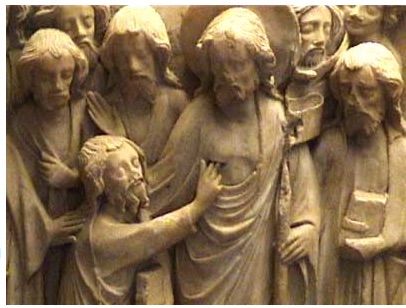
There are no perfect believers  in the gospels of our Easter season. Plenty of imperfect believers, like us, which tells us that faith is something to pray and struggle for. More importantly, they reveal the goodness of Jesus, who showed the wounds in his hands and his side to Thomas, who never dismissed Nicodemus to the night, who came to table with his disciples and fed them again, who called them “his own” and prayed that they would not fail.

We’re in a school of faith in the Easter season where the Risen Christ speaks to us in signs like water, bread and wine, words that promise a world beyond ours and teach us how to live in our world today.  He is our Teacher and Lord.

At Peace

 One of my favorite expressions is “Shalom Aleichem” : “Peace be with you,” or “Peace be on to you.” Even as I pronounce the Hebrew words, a strange tranquility comes over me. The word “Shalom” itself has so many rich meanings: peace, prosperity, welfare, tranquility, harmony, wholeness, completeness. It seems almost like an invitation to taste the wholeness and completeness of God Himself, a wishing of the good for the other person.    

 This expression has become more of a casual “Hi, how are you” in modern Israeli society. Saying “ Shalom” has become similar to saying “Aloha”: “Hi, bye.” And yet, I find such power in these words. A few years ago, after our interfaith Thanksgiving service at my parish in Bayside, NY,  I found myself talking over cookies with the wise and gentle Rabbi Weitz. I told him about my upcoming trip to Israel the following week, and he told me that he was also going there then. We were both very excited about it. As we were leaving I dared to try out my little Hebrew and told him, “Shalom Aleichem”. In the holy environment of my church the expression seemed to have so much meaning. My eyes met his shining eyes, and it felt like we shared something beyond ourselves. When he smiled and answered “Aleichem Shalom (Unto you peace),”I felt I was truly being blessed by this man of God. 

     Every year I spend the Easter Triduum in retreat at the Passionist Spiritual Center in Jamaica, NY. I usually go there without any expectations. I always know it’s going to be great. But from the beginning of Holy Week I had been asking the Lord for much-needed peace. The Morning Prayer that I recite begins by asking the Lord for peace, wisdom, and strength. I usually get stuck at “peace,” trying to measure on a 1 to 10 scale how my state of peace is.

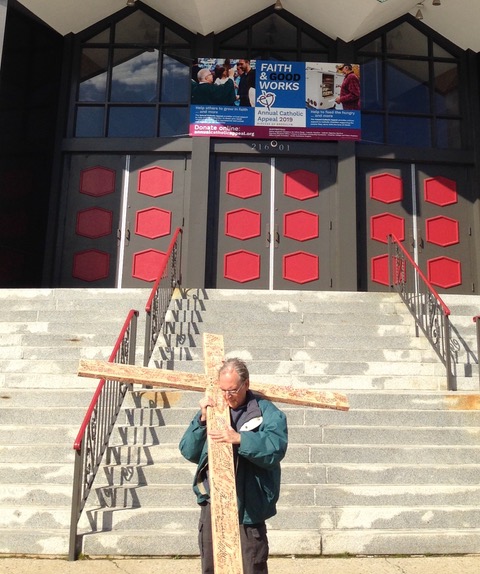
This week I was at a 4-5 level ! I was worried about all the jobs I had to do to help out during the retreat, especially with regard to this big cross that I had built. When would there be time to have the retreatants write their prayers on it? Would it be an imposition? Was there any room left on the cross to write on? Would anyone be interested in carrying it outside to pray the Stations of the Cross? Would anyone get splinters on their hands? Would it fall on somebody’s foot?   

 My lack of peace went a lot deeper than that. I was going through a senseless feeling of unworthiness. I had become a little worn out by the people I serve in my different ministries. There was a heaviness in my heart that I could not explain.     And then, as soon as I had figured out where to put the big cross, and I was able to sit before the Lord at chapel, the most blissful sense of peace descended on me. Talk about a quick answer to a prayer!

Throughout the four days I just never worried about anything. All the retreat events unfolded before me in mysterious, delightful ways. Nothing and nobody bothered me. There was no need to assess whether my prayers, or the experiences, or presentations, were devout, inspiring, or spiritual enough. Everything just was. I usually had a smile on my face. My fellow retreatants were not like strangers; they were beloved children of God, good and gracious company. The peace of God enveloped us.     

Dear readers, why am I writing about this? I guess I really want to share this peace with you. I want to sort of wish it, pray it upon you! Shalom Aleichem!     In the Gospel (John 20: 19-31) for the Octave Sunday of Easter (also adequately named Divine Mercy Sunday), our Resurrected Lord appears before His fearful disciples (that’s us!), and tells them, “Shalom Aleichem.”

This is much more than just a “Hi, what’s up.” The Living God blesses us with the power of His love. The soothing breeze of His Holy Spirit is breathed upon us. We relish in His love. As we touch His wounds our wounds are touched and relieved. We are home. Our guilt over the times we have deserted Him is calmed. He invites us to stop retaining our sins, and through His power,  to forgive ourselves for all those sins that He has already forgiven. And then He puts us back to work. He tells us, “so I send you!”

I hope that peace of His holds out within me. And even if it goes down to a 4 or 5 again, there is a bountiful storehouse of it in His heart within our hearts, just for the taking! We are His ministers, His agents in this troubled world.     Like the psalm says: “Lord send down Your Spirit and renew the face of the Earth.”     Shalom Aleichem!

By Orlando Hernandez

Signs That Lead Us On

After his resurrection Jesus appeared to his disciples, but his appearances are occasional and fleeting. None of the resurrection accounts say he stayed long with them. He appears to verify he is risen. “Do not cling to me,” he says to Mary Magdalene, who hears him call her name.Thomas puts his finger in the nail marks and his hand in his wounded side; then he is gone. The disciples eat with him, but he doesn’t stay with them. The words of scripture remind them of him.The two at Emmaus know him mainly in the breaking of the bread.

Now they will see him in another way–through signs, like bread and wine, water, in gatherings where they remember him, in reading the scriptures which speak of him, in the poor and suffering, wounded like him. It’s as if he were weaning them away from seeing him bodily. That will be the way he remains with them–through signs– and that’s the way he remains with us now.

Christian teachers like Cyril of Jerusalem emphasize this way of knowing Jesus, through signs. We are told not to miss their importance:

“When we were baptized into Christ and clothed in him, we were transformed into the likeness of the Son of God…we are rightly called ‘the anointed ones.’”

God’s Spirit rested on him and sent him forth. Now God’s Spirit dwells in us and sends us on a mission. We don’t have a mission that weighs us down. The oil that anointed us at baptism is an “ oil of gladness,” raising us up.

These Easter days offer a world of signs that lead us to Jesus Christ; they also make us one with him.

What about the “signs of the times?” Don’t forget them.They lead us on too. I like what Sister Elizabeth Johnson, CSJ, says about them. “The signs of our time propel the living tradition forward.”

Jesus Abandoned

In the gospels for Monday to Thursday in Holy Week Jesus is not with the crowds in the temple area, sometimes hostile, sometimes friendly. He is with “his own” at a meal.  In Bethany six days before Passover he eats with those he loved: Martha, Mary and Lazarus, whom he raised from the dead. In Jerusalem before he dies he eats with the twelve who followed him. “His own.”

During the meal in Bethany, Mary anoints his feet with precious oil in a beautiful outpouring of her love. At the meal in Jerusalem, on Thursday, he meets betrayal. The gospel readings for Tuesday and Wednesday offer a harsh picture. Judas betrays him for thirty pieces of silver and goes out into the night; Peter will deny him three times; the others flee. Jesus faces suffering and death alone. Friends that followed him abandon him.

The gospels are not just about long ago; they’re also about now. We are “his own” to whom he gives his life on a cross, in the waters of baptism and in the Bread at the table.  Are we unlike the others?  Are we sure we will not go away?

We think saints exaggerate when they say they are great sinners and question themselves, but they know the truth. That’s the way St. Paul of the Cross described himself in his account of his forty day retreat as a young man:

“I rejoiced that our great God should wish to use so great a sinner, and on the other hand, I knew not where to cast myself, knowing myself so wretched. Enough! I know I shall tell my beloved Jesus that all creatures shall sing of his mercies.”  (Letter 2)

Be my rock of refuge

a stronghold to give me safety.

For you are my rock and my fortress,

O God, rescue me from the hand of the wicked.  Ps 71

LET’S CELEBRATE HOLY WEEK

APRIL 15  Monday of Holy Week

Is 42:1-7/Jn 12:1-11 (257) Pss II

16 Tuesday of Holy Week

Is 49:1-6/Jn 13:21-33, 36-38 (258)

17 Wednesday of Holy Week

Is 50:4-9a/Mt 26:14-25 (259)

18 Thursday of Holy Week (Holy Thursday)

Chrism Mass: Is 61:1-3a, 6a, 8b-9/Rv 1:5-8/Lk 4:16-21 (260)

Evening Mass of the Lord’s Supper: Ex 12:1-8, 11-14/1 Cor 11:23-26/Jn 13:1-15 (39) Pss Prop

19 Friday of the Passion of the Lord (Good Friday)

Is 52:13—53:12/Heb 4:14-16; 5:7-9/Jn 18:1—19:42 (40) Pss Prop

20  Holy Saturday

Vigil: Gn 1:1—2:2 or 1:1, 26-31a/Gn 22:1-18 or 22:1-2, 9a, 10-13, 15-18/

Ex 14:15—15:1/Is 54:5-14/Is 55:1-11/Bar 3:9-15, 32—4:4/Ez 36:16-17a, 18-28/ Rom 6:3-11/Lk 24:1-12 (41)

21 EASTER SUNDAY OF THE RESURRECTION OF THE LORD

Solemnity

Acts 10:34a, 37-43/Col 3:1-4 or 1 Cor 5:6b-8/Jn 20:1-9 (42) or Lk 24:1-12 (41) or, at an afternoon or evening Mass, Lk 24:13-35 (46) Pss Prop

Most of us are home, no place to go. Why not celebrate Holy Week? There are no church services, but we have the church readings each day. How about celebrating Holy Week looking at them? .

The gospel readings for Holy Week are mostly from the Gospel of John, the gospel least like Mel Gibson’s movie “The Passion of the Christ.” We may want to know exactly what happened to Jesus on the days of Holy Week, but the evangelists, who knew the basic facts, wanted to know more. What was behind it all? Why did Jesus, the Son of God, suffer and die. They turned to the Jewish scriptures, the Old Testament, because that was how Jesus explained what happened after he rose from the dead.

On Monday we’re in Bethany. where Martha, Mary and Lazarus who was raised from the dead.

Tuesday and Wednesday, his betrayal by Judas is recalled but, as our readings indicate, all his disciples abandon him. 

On Thursday, Jesus brings his disciples to the table and as a servant washes their feet. We continue reading from this part of John’s Gospel, which explores the mystery of our union with Jesus Christ, throughout the Easter season.  Our second reading from Paul’s First Letter to the Corinthians, recalls that on this night he was betrayed, Jesus took bread and wine and gave them to his disciples as his body and blood. The Eucharist is an enduring gift by which Jesus remains with his church.

The Good Friday readings from Isaiah tell of the Suffering Servant who gives his life for others, and Psalm 22 which recalls his suffering. Jesus is our High Priest in Jesus who always intercedes for us, the Epistle to the Hebrews says. The Gospel of John sees Jesus as a King who conquers as he suffers and dies. For a commentary on the Passion Narrative of John by Fr. Donald Senior, see here.

On Holy Saturday evening parts of the scripture are read, from Genesis on, that speak of Jesus and his mission to save us. On Easter the various gospels, beginning with John announce his resurrection. He has risen! And the waters of baptism are honored as a sign that we shall rise too.

Palm Sunday: A Triumphal Journey

Jesus was troubled as he entered Jerusalem on Palm Sunday, the gospels say. And why not? The fear he felt so intensely in the garden was already seeping into his soul. 

He disturbed Jerusalem’s religious establishment by his words and actions; they noticed the people flocking to him and worried it would threaten the delicate balance they negotiated with the Romans who occupied their land. He had just raised Lazarus to life; his popularity was growing–one more reason for stopping him.

Entering the city, Jesus could see patrols of Roman soldiers brought in to keep peace during the Passover feast; he knew how harshly the Romans treated those who threatened their peace.

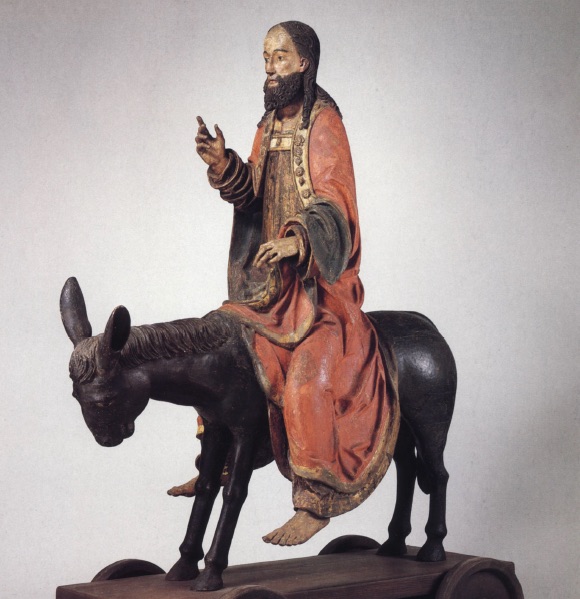
Yet, as he entered the city’s gates, crowds of people, ordinary people, greeted him with shouts of joy: “Hosanna, blessed is he who comes in the name of the Lord.” They scattered palm branches before him as he rode in on a donkey, carrying their hopes that God’s kingdom was coming.

Holy Week begins with this triumphal procession and it will take us into days of suffering and sorrow, when Jesus will be arrested, judged unjustly, scourged and beaten, made to carry a cross, and then die on a hill outside the city gates. 

But the journey will go on. Those who welcomed him on Palm Sunday were right. Death will not claim him. Rising from the dead, Jesus promises life to the world.

Speaking the Truth

Our previous lenten gospels record Jesus’ words during the Feast of Tabernacles in the temple area. It was hardly a public square, an open space where you could say anything; certainly not the freer space of Galilee or other places where Jesus taught and did great works. 

The temple area was under the tight control of the authorities and his audience was often hostile. At times, they cry out to arrest him and they pick up stones to kill him. 

Yet, Jesus will not be silenced. “Amen, amen, I say to you, before Abraham came to be, I AM,” he says to them. He proclaims fearlessly his divine status:  “I am always there.” Jn 8, 51-59

Are we fearless enough to tell his story, to repeat his message, to proclaim him everywhere, even where he and his works are rejected? “I know him,” Jesus says about his Father, “and if I should say that I do not know him, I would be like you a liar. But I do know him and I keep his word.”

The world today, especially our western world, can be hostile to Jesus Christ. Are we brave enough to witness where his name is ridiculed or ignored?

Lord Jesus,

you speak the truth,

even when others rejected your word.

Make me your zealous witness,

never fearful to speak your name 

and help me live according to your teaching. 

Lazarus Raised from the Dead

Lent 1


Readings (Please read further for Spanish and Swahili versions)

The wonderful story of the death and resurrection of Lazarus (John 11,1-45) leads us to the mystery of Jesus’ death and resurrection. Lazarus belongs to an influential family that welcomed Jesus to their home in Bethany, a village about two miles from Jerusalem. Martha and Mary were his sisters. Jesus stayed with them when he visited the Holy City.

When Lazarus died some days before the Passover, Jesus had left Jerusalem because of threats to his life and was staying in the safety of the Transjordan, the region where John the Baptist had baptized. Notified of his friend’s death, Jesus returned to Bethany, unconcerned for himself.
Death in its many forms was what Jesus came to take away, our gospel wants us to understand, and the dead Lazarus was a sign of what he wishes to do for all humanity. Lazarus was his friend, but Jesus, the Word made flesh, befriends the whole human race.

In the stirring conclusion of today’s gospel, Jesus calls the dead Lazarus from the tomb and “the dead man came out,” bound with the burial cloths that claimed him for death. “Untie him and let him go,” Jesus says. Those powerful, hopeful words are said to us too. We are called, not to die, but to live.

Later, on Calvary Jesus himself becomes our sign. A painful death does not claim him, nor will the grave hold him. He is our hope.

Spanish

The same hope nourished Paul of the Cross: “ You ask me how I’m doing. I’m more sick than well and full of ailments. I can hardly write this…(but) I find it very good. Bearing the chains, the ropes, the blows, the scourges, the wounds, the thorns, the cross and death of my Savior, I fly to the bosom of the Father, where the gentle Jesus always is, and I allow myself to be lost in his immense Divinity.” (Letter 1925)
Like Martha, the sister of Lazarus, O Lord,
I believe you are the Resurrection and the Life.

5to domingo de Cuaresma, Año A
Juan 11, 1-45

El maravilloso relato de la muerte y resurrección de Lázaro nos ayuda a apreciar el misterio de la muerte y resurrección de Jesús, Lázaro pertenecía a una familia con influencia que le dió la bienvenida a Jesús a su hogar en Betanía, una aldea a unas dos millas de Jerusalén. Marta y María eran sus hermanas. Jesús se quedó con ellos cuando él visitó la Ciudad Sagrada.

Cuando Lázaro murió algunos días antes de la Pascua, Jesús había dejado a Jerusalén debido a las amenazas contra su vida, y estaba aguardándose en la seguridad del Transjordán, la región donde Juan el Bautista había bautizado. Notificado de la muerte de su amigo, Jesús retornó a Betanía, despreocupado por sí mismo.

Nuestro Evangelio quiere que nosotros comprendamos que la muerte en sus muchas formas era lo que Jesús vino a remover, y que el Lázaro muerto era un signo de lo que Él quiere hacer por toda la humanidad. Lázaro era su amigo, pero Jesús, el Verbo hecho carne, es amigo de toda la raza humana.

En la conmovedora conclusión del evangelio de hoy, Jesús llama al difunto Lázaro de la tumba y “el muerto salió” atado con las vendas funerales que lo habían atrapado en la muerte. ” Desátenlo y déjenlo ir,” Jesús dice. Esas poderosas palabras, llenas de esperanza, son dichas para nosotros también. Somos llamados, no a la muerte sino a la vida.

Después en el Calvario Jesús mismo se convierte en un signo para nosotros. Esa muerte dolorosa no lo reclama, ni tampoco la tumba lo aguantará. Él es nuestra esperanza.

La misma esperanza sustentó a San Pablo de la Cruz: “Tú me preguntas como me va. Estoy más enfermo que bién y lleno de dolencias. Casi ni puedo escribir esto…[pero] encuentro esto algo muy bueno. Soportando las cadenas, las ataduras, los golpes, los latigazos, las heridas, las espinas, la cruz y muerte de mi Salvador, yo vuelo hacia el regazo del Padre, donde el dulce Jesús siempre está, y me dejo perder en su inmensa Divinidad.”

Lent

Como Marta la hermana de Lázaro, O Señor, yo creo que tú eres la Resurrección y la Vida.
Amén

Padre Evans Fwamba Cp

Jumapili ya tano ya kwaresima Yohana 11:1-45
Hadithi nzuri sana kuhusu kifo na kufufuliwa kwa Lazaro inatuonyasha fumbo la kifo na ufufuko wa Yesu Kristu. Lazaro alikuwa katika familia maarufu na ya ushawishi mkubwa sana. Walimkaribisha Yesu nyumbani kwao kule Bethania, kijiji kilicho kuwa umbali wa maili mbili kutoka Yerusalem. Marita Na Maria walikuwa dada zake Lazaro. Yesu alibaki nao alipotembea mji mtakatifu.
Lazaro alipokufa siku chache kabla ya karamu ya mwisho, Yesu aliondoka Yerusalem kwa sababu ya vitisho viliyotishia maisha yake. Alibaki kwenye sehem ya amani Transjordan, eneo ambalo Yohana mbatizaji alimbatiza yesu. Baada ya kupata taarifu ya kifo cha rafiki yake, Yesu alirudi Bethania, bila kujali usalama wake.
Yesu alikuja kuondoa aina zote za kifo, injili inataka tuelewe kifo cha Lazaro ni alama ambayo Yesu alifanya kwa ajili ya wanadamu wote. Lazaro alikuwa rafiki wa Yesu aliyetwaa ubinadamu wetu. Amekuwa rafiki wa wanadamu wote.
Kwa ujumla katika injili ya leo, Yesu anamuita Lazaro aliyekufa kutoka kaburini na “mtu akatoka nje,” akiwa amefungwa sanda za kuzikwa zizoanyesha alikuwa mfu.. “Mfungue na mueche aende” Yesu alisema. Haya maneno yenye nguvu, matumaini yanasikika kwetu pia. Tumeitwa ili tuishi na siyo kufa.
Badae katika mlima wa kalvari Yesu mwenyewe alikuwa alama. Kifo na maumivu hakimtangazi Yesu wala kaburi halitamsuia Yesu, ni matumaini yetu.
Kwa hayo matumaini yalimuimarisha Mt. Paulo wa Msalaba.
“Unaniuuliza ninaendeleaje. Niko mgonjwa kuliko mwenye afya, nimejaa na maradhi. Ni vigumu kuandika haya… lakini naona vizuri kubeba pingu, kamba, ngumi, mijeledi, vidonda, miiba, msalaba na kifo cha mkombozi wangu, nakimbia kwenye kifua cha baba, kwenye undani wa kimungu.
Kama Marita dadake Lazaro.
Ee bwana,ninaamini ufufuko na uzima.” Barua1925, November 26, 1770

The Man Born Blind

Lent 1


The story of the blind man receiving his sight (John 9,1-41) is a dramatic gospel, not only because of the miracle, but because of the heated exchanges found in it. Jesus and his disciples, the blind man himself, his parents and neighbors and a divided group of Pharisees all interact vigorously in the story. It’s one of the most important of the gospels to be read during lent.

Unlike others, the blind man did not approach Jesus. Rather, Jesus approached him. And remarkably, the miracle did not just restore the man’s sight. Blind from birth, he never before had the power to see. Could he represent those who can do nothing for themselves? Nothing at all, except wait for the power of God? He could be all of us.

At the sight of the woebegone beggar, Jesus’ disciples wondered: did he do something to deserve it? Some sin he or his parents had committed? No, Jesus replied. “He was born blind so that God’s power might be displayed in curing him.”

It was Jesus’ message always: God wills to display his power in the poor. God’s power — healing, restoring, creating — goes out to the blind man and others like him. And as Jesus dispensed this power, so too he told his disciples “to carry on while daylight lasts the work of him who sent me.”
God’s power, not our own, is given to the poor. As Jesus’ disciples, we must work to share it with others. Then, perhaps, some of its blessing will fall on us. After all, aren’t we poor too?

“Humbly see your nothingness, never lose sight of it. Then, when His Divine Majesty makes it disappear in the Infinite All that is himself, stay there lost without seeing who you are any more. It’s not important. Follow his divine inspirations. The less you understand, the more ignorant you are in this school, the more learned you become. Neither you or any creature can know the grandeur of God and the divine impression he makes on humble hearts because he delights in them.” ( St. Paul of the Cross: Letter 929)

Lord,
I am blind;
Help me to see.