Gospel for the Fourth Sunday of Lent

    This long, dialogue-filled Gospel (John 9: 1-41), can take the mind and soul into diverse directions. It is filled with so many different symbolic meanings and historical insights. So many theological reflections have been written about it (for example, the wonderful one by Fr. Victor Hoagland). I don’t have much to add except my own personal feelings.


    Shortly after my conversion twelve years ago, what touched me the most, and still does today, was the statement by the cured blind man: “One thing I do know is that I was blind and now I see.” (Jn10: 25b) I had   recently discovered, to my delight, the lyrics to “Amazing Grace”, after so many years of regarding the song as mere background music, or a much-used symbol of American culture. Suddenly, this song was about ME: “I was once lost, but now I’m found, was blind but now I see.” This was exactly how the mercy of God had affected me. The eyes of my soul had been opened to a new spiritual reality that was impossible for me to deny. This is the supernatural gift of Faith. “How precious did that grace appear the hour I first believed!”


    This miracle had been personally done to me by Jesus Christ Himself. After months of going to Mass to “try it out,” one blessed Sunday, when I saw that shining white Host raised by the priest at Consecration, 


I believed.  The Host shimmered like a sun and I had to close my eyes. Within my head, it still glowed and I heard Him tell me : “I claim you. You are mine. I love you and I will never let you go.” And He has kept His word.


    Which reminds me of my other favorite line in this Gospel: “I am the light of the world.” (Jn 9: 5) He certainly came as a bright, powerful light into my eyes. Even now, in the darkest moments, in the nights of insomnia, I look within my mind as through a bleak, black forest and I still discern in the distance, that light, calling me, giving me hope and strength. The Light is not an abstract “It” . It is a Person. It is my Beloved. 


    With the coronavirus crisis, we, the Body of Christ, find ourselves isolated from each other. My beloved prayer group, “The Cloud of Glory” has not been able to meet for Mass and prayers for the last two Sundays. We miss the Liturgy, the tangible Bread of Life, and each other, so much that it hurts. All we can do is communicate by text and phone conversations. We console each other . We share uplifting messages from all over the internet. We listen to our situations and anxieties. We decided for this past Sunday to try and remember each other at our usual Mass time, 11:00 a.m., and praise God , thank God, and pray for us  and for our threatened Humanity. We did this. I had the image of small candles, glowing within each of our separate homes, all of us in our Church, shining with the Light of the World in His love and comfort. Luminous threads of light spread like a web over our planet, reminiscent of those pictures from outer space that show the surface of the Earth at night with all those shining cities connected in the darkness.


    OK, in a way we are like the healed blind man after he was “thrown out” from the Temple. We might not be able to physically get back in for a while, but the Nazarene most certainly comes to find us, like He did for that man in Jerusalem. He fills our hearts with His Light and leads us to joyfully exclaim: “I do believe Lord.” 


    Dear Brethren, stay home safe and healthy in the hands of our shining, loving God. Reach out to each other. Share His Light.

Orlando Hernández
March 23- March 29: Readings and Feasts

March 23 Mon Lenten Weekday6 [Saint Turibius of Mogrovejo, Bishop] Is 65:17-21/Jn 4:43-54 (

24 Tue Lenten Weekday

Ez 47:1-9, 12/Jn 5:1-16 

25 Wed THE ANNUNCIATION OF THE LORD Solemnity

Is 7:10-14; 8:10/Heb 10:4-10/Lk 1:26-38 

26 Thu Lenten Weekday

Ex 32:7-14/Jn 5:31-47

27 Fri Lenten Weekday

Wis 2:1a, 12-22/Jn 7:1-2, 10, 25-30 

28 Sat Lenten Weekday

Jer 11:18-20/Jn 7:40-53 

29 SUN FIFTH SUNDAY OF LENT

Ez 37:12-14/Rom 8:8-11/Jn 11:1-45 or 11:3-7, 17, 20-27, 33b-45 

In these days of social distancing we can still pray with the church by following the Mass readings, the feasts and prayers of the church day by day at home. Our churches may be  closed, but God is still close. 

“I rise before dawn and cry for your help. I hope in your word. My eyes watch through the night, I ponder your promise. You, O Lord, are close.”  (Psalm 119, 145ff)

We need help. We need the hope God’s word gives. That word can be found in the readings, feasts and prayers of the church. They can help us through the night that’s now. They can give us the wisdom and strength we need

Our gospel readings this week and for most of the remainder of lent are from John’s gospel. Jesus leaves Galilee for Jerusalem where he teaches and works some significant miracles before being arrested and crucified. 

Our Sunday gospels from St.John offer two important miracles Jesus performs in Jerusalem. : Jesus gives sight to the man born blind (last Sunday) and life to Lazarus who has died. (this coming Sunday)  

The world itself needs help to see right now. We’re also facing the mystery of death. So let’s reflect carefully on these two signs before us. We also need to reflect on the mystery of the passion, death and resurrection of Jesus. That’s the great book we need to read these days.

The Feast of the Annunciation, this Wednesday, is a feast of hope. “The Lord is with you,” the angel says to Mary, “Do not be afraid.” The angel announces to her that a Child will be born to her who will bring God’s kingdom to us. The Lord is with us, do not be afraid.

The readings for this week of lent and the feast of the Annunciation can be found at www.usccb.org .  I’ ll  offer some reflections at this site for each day.

The Art and Imagination of Duk Soon Fwang

COVID 19: A Call to Recalibrate

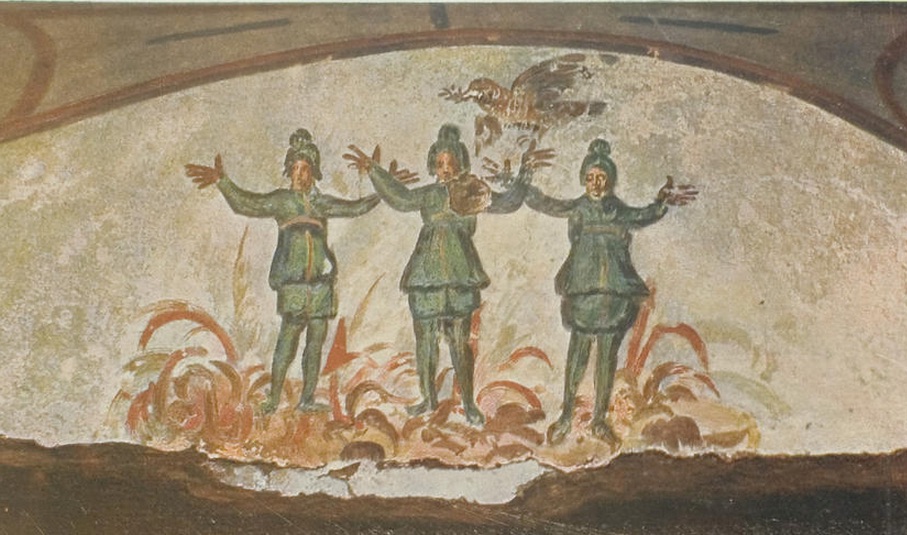
Three Children in the Fiery Furnace. Roman Catacombs

In the light of COVID 19 businesses are recalibrating,  financial reporters say.  “Recalibrating” is GPS language. More that assessing the situation once, changes have to be implemented ongoing, quickly, to get us where we’re going. It’s not business as usual. 

Every institution in society has to recalibrate. What about religious institutions? Right now, we’re absorbed in the immediate changes we have to make because of COVID 19. We’ve shut down our churches, our sacramental system, and there are still changes ahead. This is a call for lenten conversion we didn’t expect.

What shall we do? Certainly religious people have to respond now and in the future to the loss of hope people are feeling because of COVID 19.. Not only are people losing hope in their institutions. They’re wondering about God. Where is God in all this?

Faith helps people not to lose hope in the journey we’re on as a human community and the journey of creation itself. We need to turn to it and question it.

“We believe in God, the Father Almighty, creator of heaven and earth.” 

God’ creation is good. There’s a purpose, a destiny in this world of ours.

But if you look at our world from its beginning 13.5 billion years ago, It’s a world almost impossible to comprehend. It doesn’t evolve in any orderly way that we can understand. It has a bewildering way of developing. A bewildering complexity. 

We’re not living in a tidily planned world we sometimes preach or teach about in our catechisms and sermons. The Coronavirus is an unexpected reminder how little we know about this world of ours. 

“Where were you when I laid the foundations of the world?” 

That’s the question God asks Job in the Bible. Job’s suffering, trying to make sense out of things. As God ends a long litany of the mysteries of creation, Job humbly admits there’s something bigger than himself and the human family here.

“Where were we when the foundations of the world were laid?”  God asks us now.. We have to be humble before the world we live in. And science itself doesn’t have all the answers either.

Besides humility, we need to appreciate the glory of the world we live in, especially in dangerous times, like today.  Yesterday we read from the Book Daniel, about Azariah praying in the fiery furnace,  part of that long prayer of the children who praise sun and moon, stars of heaven, every shower and dew, snow and rain – in a fiery furnace. 

Their prayer is one the the key canticles we pray every Sunday and feast day in the morning prayer of the church. Creation, as well as being mysterious, dangerous at times, sustains humanity in the fiery furnace.

Religious institutions are going to have to recalibrate. Just think about what going on now. Our churches, our parishes, our sacraments, our retreat centers  our shrines are shut down. Were there times before like this? I think of times of persecution for Christians. 

I also think of the destruction of the temple of Jerusalem in 70 AD. Jewish worship was shut down. Jewish leaders then, the scribes and Pharisees we hear about in Matthew’s gospel, recalibrated and kept Judaism alive. 

As this crisis goes on, I think we’re going to have to think a great deal about our church and our community. We have to recalibrate.

In our first reading today from the Book of Deuteronomy,  Moses prepares his people “for the land you are entering to occupy.” “Therefore, I teach you the statutes and decrees as the LORD, my God, has commanded me,” he says, “Give evidence of your wisdom and intelligence to the nations,” he tells them, so that they may say, “This great nation is truly a wise and intelligent people.”

That’s directed to us. We’re going to occupy a new land.

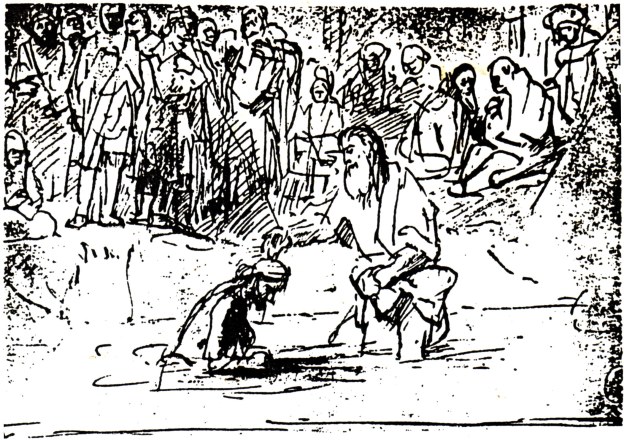
The Baptism of Jesus, by Rembrandt van Rijn

We are at a point along the lowest level of the earth’s surface, at that solemn moment in time when God’s own Son is about to begin his ministry of salvation. 

Along the farther bank, a small group of people are observing the men in the river. Jesus crouches down into the water, head bowed, as John the Baptist pours a shell full of water upon our Lord’s head. John’s face radiates loving admiration, while that of Jesus is one of utter humility.

This, of course, was not the sacrament of baptism. It was a simple ritual washing for repentant sinners who were invited to be symbolically cleansed of their moral defilements.

John’s “baptism” was one of many previous such ritual washings which, in fact, go on to this day in the River Ganges.

We believe that God’s Son, though born of a woman, was sinless. Why, then, did He submit to what must seem an indignity upon His holiness?

He entered the water and submitted to this “baptism,” not to be cleansed (of sin), but, symbolically, to be defiled by it. It was a prophetic action familiar to the non-verbal preaching of the great prophets of Israel.

Jesus was claiming (as far as it was possible to do so) His solidarity with our sinful race, since He was already, through Mary and by the power of the Holy Spirit, one with us in our humanity.

This was as close as Jesus would come to sin—not to be invaded by it, but to share its unhappy consequences in the pain and death He would endure for us.

From Meditations on Some Art I Have Loved

By Fr. Hilary Sweeney, C.P.

Saturday 2nd Week

Lent 1

Luke 15

Scripture Readings
The story of the prodigal son, one of the longest in the gospel, is also one of the most important. It’s not just about a boy who goes astray, of course, it’s about the human race gone wrong.

“Give me what’s mine,” the son says boldly to his father, and he takes off for a faraway country, a permissive paradise that promises power and pleasure, in fact, it promises him everything.

But they’re empty promises, and soon the boy who had so much has nothing and ends up in a pigsty feeding pigs, who eat better than he does.

Then, he takes his first step back. He “comes to himself,” our story says; he realizes what he has done. “I have sinned.”

How straightforward his reaction! Not blaming anybody else for the mess he is in: not his father, or the prostitutes he spent so much of his money on, or society that took him in. No, it’s his own fault.

He doesn’t wallow in his sin and what it’s brought him, either. He looks to the place where he belongs, to his father’s house. It wont be an easy road, but he takes it. He starts back home.

His story is our story too.

How easily we leave your side,
Lord God,
for a place far away.
Send light into our darkness,
and open our eyes to our sins.

Unless you give us new hearts and strong spirits,
we cannot make the journey home,
to your welcoming arms and the music and the dancing.

Father of mercies and giver of all gifts,
guide us home
and lead us back to you.

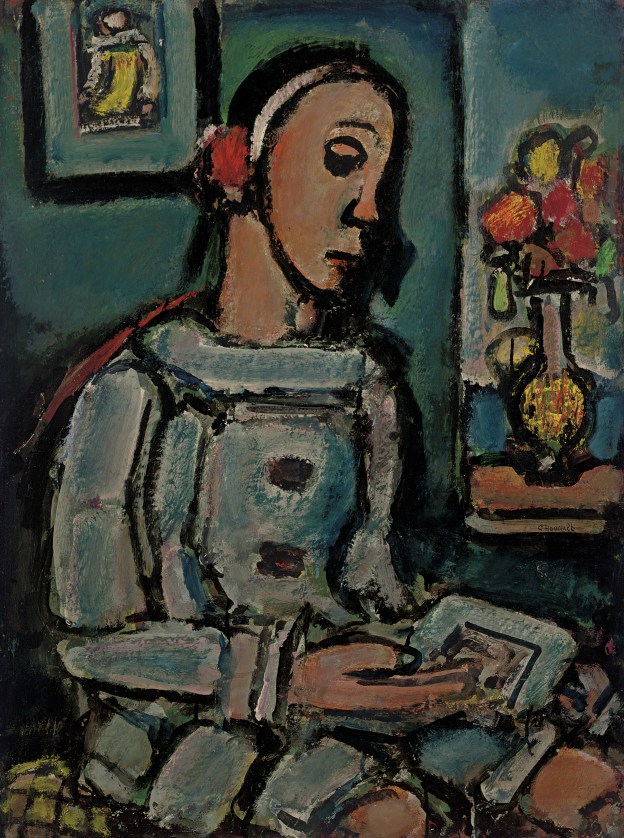
The Wise Pierrot, by Georges Rouault

Is this clown wise because he is reading a book? Are the illiterate necessarily stupid? Are books the best source of truth? Not at all. 

In this life, the true medium of the best message has been, is and always will be—sorrow. Carl Jung and Rollo May are emphatic on this point. Add St. John of the Cross, and Melville too: ‘The truest of men was the Man of Sorrows.’

So don’t pity this sad clown. He is learning, and Shakespeare put it well: ‘Knowledge has a bloody entrance.’

Painless learning is a delusion—especially that learning which must begin with self. ‘Lord,’ cried St. Augustine, ‘May I know myself, may I know Thee.’ A courageous prayer and a necessary one, for anyone who would really know God.

For, to look into one’s heart and search out one’s true motives; to face, as in a mirror, the real blotches, wrinkles and wastes of one’s spirit is not a discipline for a fool. And only he is truly wise who sees himself as nearly as he is, and accepts his gifts without smugness, his handicaps without regret.

Yes, indeed, wisdom is what’s left, when all your courses and readings are forgotten.

From Meditations on Some Art I Have Loved

By Fr. Hilary Sweeney, C.P.