by Howard Hain
(Note: This post was originally published on December 24, 2011.)
We have not put up a tree in years.
For nearly a decade we have been moving—no longer than two years in any one house and no less than ten different not-so-humble abodes. Between and during the moves we were very much engaged with the world. A seemingly endless movable beast.
This December marks one year in our current house. I am happy to say it is our home. The Lord has blessed us with great peace. And with that peace comes a tree. A simple, well-shaped tree. Fittingly, a dear friend offered it to us as a gift.
Francesca could not be more ready to be initiated into the act of trimming. Before the tree arrived, her two-year-old fingers pointed out every tree, artificial or real, that graced the pages of a holiday flyer or the commercial floor of a Rite Aid or Dollar Store.
Up the stairs came the evergreen, into the old stand that has been in storage since my father last used it several decades ago. I cut off the mesh and out popped the branches.
We hung the lights and old glass ornaments that my mother-in-law washed a few days before.
The main attraction for Francesca was the Nativity.
Not since St. Francis of Assisi assembled the first Nativity in Greccio in 1223, has there been such admiration for each and every witness who Our Lord assembled to adore His Son that first Christmas two millennia ago. Francesca kissed and hugged every shepherd, sheep, donkey, angel, and king. Most of all she adored the Holy family, calling Mary and Joseph, Ma-ma and Da-da, respectively. And Jesus, He was simply called: “ba-be.”
She carried them around the apartment. I did not want to ruin her fun, but they are ceramic. I explained a few times to be very careful.
“Gentle, Francesca…gentle…”, I harked a host of times.
Boom. To the wood floor went the shepherd. Amazing, grace held him intact. I took that as a great sign to put an end to her carrying the animals, angels and representatives of mankind.
I was fixing my coffee when I turned to see Francesca with Baby Jesus in her tiny hands. But He is so small, so tiny, what harm could come from holding Him? So I let her get away with carrying the Savior.
As I stirred my spoon Christ crashed to the floor, the tile floor. Francesca immediately looked at me, as if expecting all hell to break loose. I think I sighed but that was about all. It is Christmas, right? And it is, after all, only a ceramic figure purchased at Target.
After assuring Francesca not to worry and guiding her toward a few coloring books in the living room, I bent down to retrieve the broken Christ.
———
St. Francis was told by a Crucifix in an old abandoned chapel: “Restore my Church.”
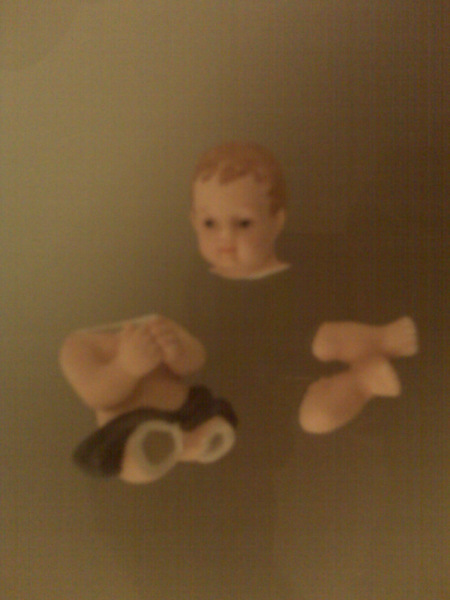
In my small one-bedroom apartment, I found Baby Christ, broken into exactly three: The Head, the Torso, and the Crossed Legs.
“Restore the Trinity,” was spoken to me.
———
For half of my forty years I can honestly say I have tried to pursue Truth, wherever it lie. In philosophy, in scripture, in literature, in art, in nature, in history…
Now, the entire Gospel of Christ lie naked on my kitchen floor.
We separate, we distinguish, we categorize, we breakdown. The Fall of Adam was a fall into denomination.
Christ’s body is One. His Church cannot be broken. Only mere men can get things so wrong.
I think of the great “Angelic Doctor” of the Church, St. Thomas Aquinas, who after spending a lifetime in unparalleled pursuit of human understanding, said after glimpsing a vision of what Our Lord has in store for those who love God:
“All that I have written seems like straw compared to what has now been revealed to me.”
Yes… “straw”…my brother Thomas…merely straw. Straw that lines the manger within which Our Savior is laid bare.
———
It is tradition to leave the crib empty until Christmas morning. Only then do we place the figurative baby Jesus into the scene, after all until that moment he was not yet brought forth from Mother Mary’s womb.
This Christmas morning I will glue together a Broken Baby Christ. The Head, the Torso, and the Crossed Legs will again be One.
Like the world after the birth of Christ, I will never be the same.
For what has now been revealed to me, no fall can break apart.
Howard Hain is a contemplative layman, husband, and father. He blogs at http://www.howardhain.com





 The Victor's Place