I learned something lovely this week–
that the Feast of the Presentation
of Jesus, as written in Luke’s Gospel,
is also called Candlemas Day,
when candles are blessed for the year.
Mary and Joseph brought Jesus to the
Temple in Jerusalem to be consecrated
to the Lord according to the law, by the
parents of a first-born male child.
Their sacrificial offering was a pair of
turtle doves, as the law required.
Inspired by the Spirit, a man named Simeon
came to the temple to pray at the same time.
The Prophetess Anna, who worshiped God
day and night in fasting and prayer was
also there.
Simeon and Anna recognized Jesus as
God’s Anointed One and praised God
that their years of waiting were over,
and their prayers had been answered.
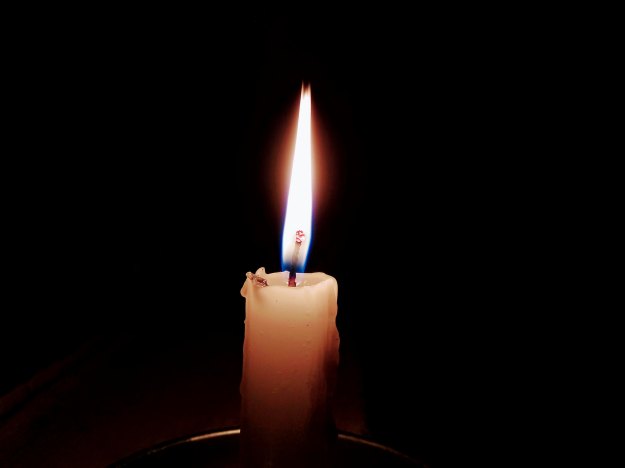
Candlelight reminds us that Jesus is the
Light of the world.
Gloria Ziemienski
January 2019
WAITING
We wait and pray
for a child to be born
We wait and pray
as a loved one slips
away from us
into God’s arms.
We wait and pray
(if we’re wise)
standing in line or
stuck in traffic.
We wait and pray
that the job interview
ends in employment.
We wait and pray
for school graduations,
expecting each one
to lead us further
into the grown-up world.
We wait and pray for recovery
from illness and its burdens,
our own or of someone dear to us.
We wait and pray for
the safe return of a loved one-
from a journey,
from the hospital,
from war.
We wait and pray
for so many things
and so many people
so many times in our lives.
Waiting is the hardest prayer.
Gloria Ziemienski June 2005
The ancient fresco in the catacombs of Saints Peter and Marcellinus in Rome shows the woman who is healed by touching Jesus’ cloak. Her story in Mark’s gospel is placed in the middle of the story of Jesus raising the daughter of Jairus the synagogue official from the dead.. We read the stories of the woman and the dead girl today at Mass. (Mark 5,21-43)
You wonder why the woman’s story interrupts the very dramatic story of the dead girl? Could the fresco in the catacombs where Roman Christians were buried offer a clue? Did they see her pointing to a way they could know Jesus and the mystery of death?
She doesn’t approach Jesus and speak to him face to face as the little girl’s father does. She just touches his cloak and power goes out from him and cures her. In a sense, the woman is like every believer after her who knows the Risen Jesus, not face to face, but through signs.
Those buried in the catacombs were like her. They were baptized with water and received the body and blood of Christ in signs of bread and wine. Like the woman, they touched his garments in the sacraments, and he welcomed them in sacraments. He sees their faith and gives them new life.
When the Catechism of the Catholic Church was issued after the Second Vatican Council, the publishers of the book were instructed to put the picture of the woman touching the cloak of Jesus at the beginning of its section on the sacraments. She’s our guide to sacramental faith.
She tells us to believe and touch the signs that Jesus gives us. We know him through signs and sacraments. They give us his life.
3 Thu Weekday [St Blaise, Bishop and Martyr; St Ansgar, Bishop]
1 Kgs 2:1-4, 10-12/Mk 6:7-13
4 Fri Weekday Sir 47:2
-11/Mk 6:14-29
5 Sat St Agatha, Virgin Martyr Memorial 1 Kgs 3:4-13/Mk 6:30-34
6 SUN FIFTH SUNDAY IN ORDINARY TIME
Is 6:1-2a, 3-8/1 Cor 15:1-11 or 15:3-8, 11/Lk 5:1-11
The 4th week of ordinary time this year begins with a memorial of St. John Bosco, founder of the Salesians, one of the largest religious communities in the Catholic Church.
Mark’s Gospel returns to accounts of the marvelous cures Jesus works on both sides of the Lake of Galilee, the gentile side and the Jewish side. (Monday and Tuesday) It continues with Jesus sending out his disciples.(Wednesday and Friday) and the account of John the Baptist’s death, (Thursday) which reminds us that Jesus also was destined to experience the mystery of the Cross.
The Old Testament readings from 2 Samuel recall David’s loss of his son Absalom, his death and Solomon assuming his throne.
The Feast of the Presentation of Jesus in the Temple is an important feast inspired by the infancy narrative of St. Luke. The Temple is a symbol of God’s presence in the world, in the church and in ourselves in St. Luke’s Gospel and the Acts of the Apostles.
St. Agatha, February 5, is one of the principal women martyrs of the Roman world. Her story is similar to that of St. Agnes, another early Christian woman martyr.
28 Fri St Thomas Aquinas, Priest, Doctor 2 Sm 11:1-4a, 5-10a, 13-17/Mk 4:26-34
29 Sat Weekday 2 Sm 12:1-7a, 10-17/Mk 4:35-41
30 SUN 4th SUNDAY IN ORDINARY TIME
Jer 1:4-5, 17-19/1 Cor 12:31—13:13 or 13:4-13/Lk 4:21-30
31 Mon St John Bosco, Priest Memorial 2 Sm 15:13-14, 30; 16:5-13/Mk 5:1-20
We’re ending January reading weekdays from Mark 3- 5. Facing opposition, Jesus teaches in parables and then goes to the other side of the Sea of Galilee where he casts out demons.
The readings from 2 Samuel are stories of David.
Important saints celebrated this week: Francis de Sales, Thomas Aquinas, Timothy and Titus, John Bosco, Angela Merici.
The readings from Mark this week show growing opposition to Jesus as local officials, scribes from Jerusalem, officials from Herod Antipas and even his own family oppose him. After an enthusiastic beginning of his ministry, Jesus faces the mystery of the Cross.
The Old Testament readings from the Book of Samuel speak of the rivalry between Saul and David.
The feast of Anthony of Egypt, a key figure in monasticism, is celebrated on Monday. St. Agnes, an early Roman martyr, is remembered on Friday.
For this week’s homily please watch the video below.
After his Baptism in the Jordan River Jesus began his ministry in Galilee. The four gospels offer three different places where Jesus began his ministry. Matthew and Mark say it was in Capernaum, a town along the Sea of Galilee where Jesus performed a series of outstanding miracles.Mark’s Gospel emphasizes the miracles he worked there, Mathew his preaching.
Luke indicates Jesus began his ministry in the synagogue at Nazareth when he read from the Prophet Isaiah and proclaimed he was fulfilling what the prophet promised.
John’s Gospel today has Jesus beginning his ministry at a marriage feast in Cana in Galilee when Jesus changed water into wine.
Cana and Nazareth are two small towns in Galilee a few miles apart, yet closely related.They played an important role in Jesus’ early life. He was raised in Nazareth and he performed the first sign of the promised kingdom to come in Cana. (John 2, 1-12)
The two towns weren’t thought much of in Jesus’ day. “Can anything good come from Nazareth?” The same could be said about Cana. Nazareth is located on top of a mountain in upper Galilee; Cana is just down from it on the plain of Esdraelon.
The couple whose wedding Jesus, his mother and disciples attended were probably farmers from Cana, relatives or friends of Mary and Jesus. It was a wedding in a small town that took place over some days. like other weddings then. Those who came had to be put up and fed. It was a family embarrassment if anything spoiled the occasion.
It looks like that was about to happen when the wine for the celebration ran out. “They have no wine,” Mary said to Jesus, her Son.
Jesus turned large jars of water into wine and it was a better wine than before. The “first sign” John points to in his gospel is a miracle, yes, but it doesn’t seem to compare to the other “signs” in John’s Gospel, like the raising of Lazarus from the dead or new sight given the blind man.
Did others notice what happened besides the head waiter? Did most think, perhaps, the new wine was from choice reserves the family drew upon?
The celebration probably took three days, at least, and Jesus must have been there with his mother and disciples all those days. Just part of the celebration.
Were they signs of God’s ordinary presence in life, God’s unnoticed presence? Is the wedding feast of Cana a sign of God love for places like Cana, for its ordinary people, for couples who names we do not know?
God loves everyplace, everything, everybody, small as they are. God delights in the Canas of this world and the people living in them. Jesus not only brought good wine to that wedding, but he stayed for the feast as a sign of the ordinary presence of God.
Our reading from Isaiah today seems to indicate that. It describes God as a bridegroom taking Israel, small as she is, as a bride:
“No more shall men call you ‘Forsaken’
or your land ‘desolate’.
But you shall be called ‘ My delight’
and your land ‘espoused’
for the Lord delights in you
and makes your land his spouse.
As a young man marries a virgin,
your builder shall marry you,
and as a bridegroom rejoices in his bride
so shall your God rejoice in you.”
Those words were fulfilled when Jesus came to the wedding feast at Cana in Galilee. He was a sign of God rejoicing, delighting in his people, at home with them. He was a sign of the ordinary presence of God.
10 Mon Weekday (1st Week in Ordinary Time) 1 Sm 1:1-8/Mk 1:14-20
11 Tue Weekday 1 Sm 1:9-20/Mk 1:21-28
12 Wed Weekday 1 Sm 3:1-10, 19-20/Mk 1:29-39
13 Thu Weekday [St Hilary, Bishop, Doctor of the Church] 1 Sm 4:1-11/Mk 1:40-45
14 Fri Weekday 1 Sm 8:4-7, 10-22a/Mk 2:1-12
15 Sat Weekday 1 Sm 9:1-4, 17-19; 10:1a/Mk 2:13-17
16 SUN SECOND SUNDAY IN ORDINARY TIME Is 62:1-5/1 Cor 12:4-11/Jn 2:1-11
The Christmas Season ends with the Baptism of Jesus. The Christmas celebrations are over. Ordinary time begins. Does that mean there’s nothing to do till Lent and Easter?
Sure there is. Ordinary Time is a time for daily prayer, and daily prayer is never over. The Second Vatican Council’s Constitution on the Liturgy said that daily prayer is at the heart of the Christian life and created a daily lectionary of scripture readings so “ the treasures of the bible be opened more lavishly for the faithful at the table of God’s word.” (SC 51)
The daily lectionary is a treasure for praying with the scriptures, but don’t take it for granted. Treasures, Jesus said, are usually hidden and you have to dig for them. That’s what we do in daily prayer. The liturgy is always a “work”, our daily work, an important work, a daily prayer. It’s the “summit” of the Christian life. We’re always at the beginning, not at the end.
We begin Monday to read the Books of Samuel and the Gospel of Mark from our lectionary. There are also feasts of the Lord and his saints to celebrate in the days ahead. It’s a lifelong learning we’re into, a school God provides, and we learn day by day.
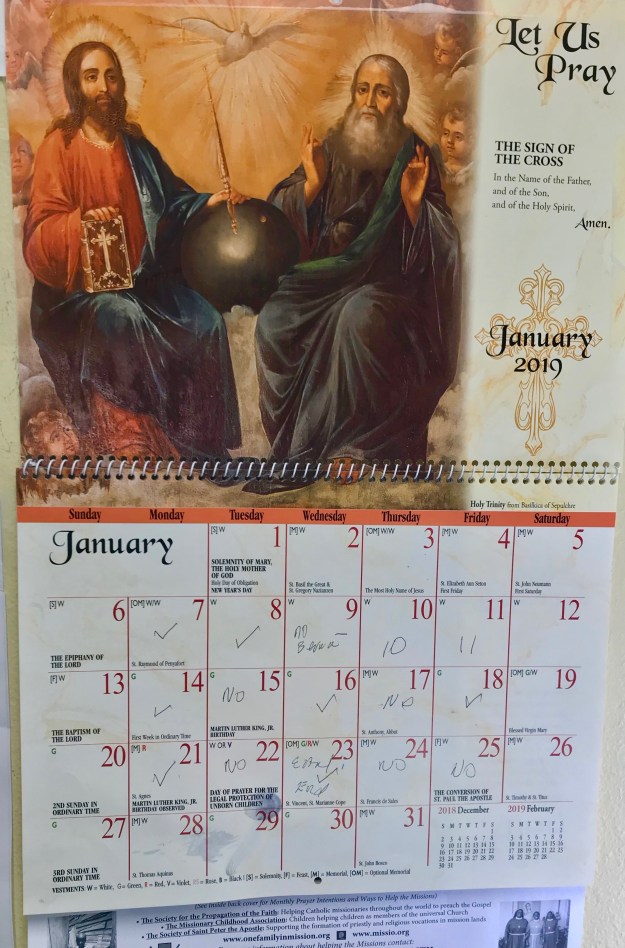
About this time every year when I was a boy, my mother would put up on the kitchen door the calendar we got from church. She marked down the anniversaries of family deaths and birthdays and other celebrations coming along, and she added other dates as the days passed. The pictures on the calendar interested me most then. When we put up the calendar, we were ready for the days ahead.
The calendar’s still a good way to get ready for the days ahead. “Teach us to number our days aright, that we may gain wisdom of heart,” one of the psalms says.
Our calendars today may be on our computers instead of the kitchen door. They’ve also changed in a number of ways since the Second Vatican Council. For one thing, our church calendars today list the scripture readings read at Mass for the weekdays and Sundays throughout the year. They open the treasures of our faith for us.
Our calendars alert us to the main feasts and seasons, Christmas and Easter, advent and lent, celebrated by the whole church throughout the year. The general calendar also lists the days for celebrating saints honored the world over, such as Mary, the Mother of Jesus, the apostles, St. Francis of Assisi, St. Theresa of Avila and others.
The council left countries and regions to decide on some celebrations of their own. In our particular calendar here in the United States, for example, we celebrate Thanksgiving Day and American saints like St. Elizabeth Seton, St. Elizabeth Cabrini and St. John Neumann.
The calendar’s still a good way to keep our lives in order, not only doctors’ and social appointments, birthdays and anniversaries, but our spiritual lives as well. They go together. We’re meant to live from day to day, from feast to feast, and be formed by the mysteries of Christ, his saints and the scriptures.
It’s my kitchen door. Through the week I reflect on the feasts and seasons and saints on that blog. The calendar’s a teacher helping us to “number our days aright.” It’s our daily catechism.
For this week’s homily please watch the video below.
The story of the Magi who come from the East to pay homage to the Child Jesus, whom they call king of the Jews, is an important part of the Christmas story. It’s found only in the Gospel of Matthew.
Matthew’s gospel was written for Jewish Christians in Galilee and Syria sometime after Jerusalem was destroyed by the Romans in the year 70. They were shocked by the complete destruction of the temple and the city itself, because these were places where God’s promises would be fulfilled, they believed. The Messiah would appear there. All nations would stream to Jerusalem, prophets like Isaiah foretold. Now they’re gone.
Matthew’s gospel reminds his hearers–and us too–that before he comes again Jesus must be known by all nations. “Go and make disciples of all nations,” are his final words in Matthew’s gospel, “baptizing them in the name of the Father and of the Son and of the Holy Spirit, teaching them to observe all that I have commanded you. And behold, I am with you always, until the end of the age.” (Matthew 28, 18-20)
Can we see the story of the Magi at the beginning of Matthew’s gospel his reminder that even as Jesus is born, even as innocent children are being killed by King Herod, messengers, strangers, wise men from afar, approach him and acknowledge him as their king and their God.
Jesus Christ came, our gospel story says, not for only one people or nation, he came for all. His ministry was first to the Jews, but Jesus wishes to make the world one. God doesn’t wish to save a few. He wants to save all, all the world.
The Magi came, our story says, from the east, so they may come from Iran or Yemen; two places we hardly view positively today in our country. More and more, today as we look at the world through the lens of politics and economics, we fear the stranger, we reject the immigrant, we create enemies. We reject people who are not like us. We’re becoming tribal, not global. As the old song said, “With someone like you, a pal good and true, I’d like to leave it all behind and go and find, a place that’s known to God alone, and let the rest of the world go by.”
Why aren’t we more jealous to bring our faith to others? Why are we so slow to see the promise our faith brings to the world? Why do we hesitate to talk about Jesus Christ, his teachings and the example of his life? We can’t let the rest of the world go by. We’re living in a big world and God wants it to be one.
That’s what the story of the magi reminds us. We have a commission on this Feast of the Epiphany to receive them. Next Sunday is the Feast of the Baptism of Jesus. “Go to the whole world, baptizing them in the name of the Father, and of the Son, and of the Holy Spirit,” teaching them to observe all that Jesus commands. And he will be with us, even to the end of time.
And the newcomers come with gifts.
I like Pope Benedict’s reflection on Matthew’s account of the Magi i: “The key point is this: the wise men from the east are a new beginning. They represent the journeying of humanity toward Christ. They initiate a procession that continues throughout history. Not only do they represent the people who have found the way to Christ: they represent the inner aspiration of the human spirit, the dynamism of religions and human reason toward him.”
Benedict, at the end of his study reflecting on the historicity of the infancy accounts notes a changing attitude favoring their historical reliability. The evangelists do not wish to deceive their readers, but inform them concerning historical facts.
“ With this view I can only agree. The two chapters of Matthew’s Gospel devoted to the infancy narratives are not a meditation presented under the guise of stories, but the converse: Matthew is recounting real history, theologically thought through and interpreted, and thus he helps us to understand the mystery of Jesus more deeply.”
Pope Benedict XVI. Jesus of Nazareth: The Infancy Narratives . The Crown Publishing Group. Kindle Edition.

 The Victor's Place