I have been thinking about imperfections this lent. They can be dangerous.
We can forget our nothingness and the reality of our own imperfect nature.
We’re creatures of God who have lost the capability of being perfect due to original sin. We’re lukewarm in faith and proud. We’re not able to do any good deed or work without the bountiful grace of Christ sustaining us.
Lent is a good time to face our lukewarm faith and turn to Christ with humility. It’s a virtue that can change us– humility. So many of us lack this crucial virtue. We can forget we going to die as we pursue empty pleasures.
St. John Marie Vianney, a great saint, patron of diocesan priests, and a perfect model for catholic priests throughout the world, commented on Saint Peter’s cowardice during Christ’s passion and said, “Alas! To show him how man, left to himself is nothing at all.” Peter during the passion of Jesus is a good example to remember in lent.
Let’s pray for the grace of profound humility during lent. It’s what we need now and for the rest of our lives. So instead of giving up some drink or food at this time, how about praying for humility?
The liturgy is the primary catechism of our church. ( Second Vatican Council, SC 2) The liturgy’s more important than any church document, or theologian, or devotion, or church council. It’s more important than going to a university or taking an online course in theology. The liturgy is the daily bread that feeds and nourishes faith.
Lent and easter are especially important times in the liturgy for feeding and nourishing faith, for those entering our church and those already baptized.
The Old and New Testament readings for this 1st week of Lent offer a complete catechism on prayer, for example. The gift of prayer is like rain and snow come down from heaven, the Prophet Isaiah says, completing Jesus’ teaching on the Our Father. (Tuesday)
Thursday’s reading from Ezekiel says that the wicked can become good and the good can become wicked. As we come before God’s altar we all know weakness. “The Eucharist is not a prize for the perfect but a powerful medicine and nourishment for the weak.” ( Pope Francis) We’re all weak. We all pray for mercy.
Wednesday’s Old Testament reading from the Book of Esther is a timely reminder that prayer can save a whole people. Prayer’s not limited to ourselves and our own needs. Prayer can change society. It can change the fortunes of people. It can prevent genocide. It can change the situation in the Ukraine.
A lot of people question that.
Queen Esther was a very beautiful Jewish girl chosen for the harem of a Babylonian king, but she was changed by the threatened extinction of her people. She prayed for them and worked to save them.The Jews celebrate Esther in their Feast of Purim, celebrated in late February to March.
Our Old Testament reading this Wednesday recalls, not her clever way to get into the king’s graces, but Esther’s prayer. She prostrated herself on the ground for a whole day and pleaded with God in her nothingness.
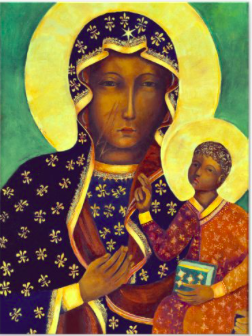
Our Lady of Vladimir, Russia
The Christian peoples of eastern Europe and Russia have a great devotion to Mary, the Mother of Jesus. Most of the icons of Mary they honor, like Our Lady of Czestochowa and Our Lady of Vladimir are associated with wars when Mary saved their lands. The Ukrainians have an icon in Liev, in Western Ukraine, closely associated with Fatima and the conversion of Russia, their powerful eastern neighbor.
Icons like that of Our Lady of Vladimir (above) picture the tenderness between the Christ Child and his mother as their cheeks press together. Tenderness is the grace God must give to the world, lest it fall into hatred and violence. It’s a grace we need today. So lacking today.
Interestingly, according to the Book of Esther it’s the grace felt by the Babylonian king when he received her into his court.
I was looking recently through a New York Times’ section explaining the situation in the Ukraine to children. Lesson plans for teachers. Nothing about religion.
How can we understand what we see in the Ukraine without recognizing religion and the questions religion asks?
Hail Mary, full of grace, the Lord is with you.
Blessed are you among women and blessed is the fruit of your womb, Jesus.
Holy Mary, Mother of God, prayer for us sinners, now and and the hour of our death. Amen.
I spoke yesterday at Mass in our monastery chapel to our First Saturday Prayer Group, begun after the 2nd World War by returning American war veterans anxious over the threat of nuclear war arising after that war. They were praying to Our Lady of Fatima for the conversion of Russia, source of that threat then. Now we’re praying for the threat leveled today.
When I look online for news of the war in Ukraine today, I look for interviews with retired American military men, like Generals Petraeus, McMaster, McCaffery, who have been to war and led armies. They’re not only knowledgeable about war, but very cautious about it, learned no doubt from bitter experience.
The other day an excited interviewer asked one of the generals, “Why don’t we send in missiles to destroy that 40 mile column of the Russian army outside Kiev?” The general immediately rejected the suggestion. Probably bring on World War III, he said, but also we need to leave room for diplomacy to work. We can’t let an enemy feel like a trapped animal.
So different from what someone playing video war games online might say. More like what our gospel response Saturday says:”I take no pleasure in the death of the wicked man, says the Lord, but rather in his conversion, that he may live.” (Exodus 33;11)
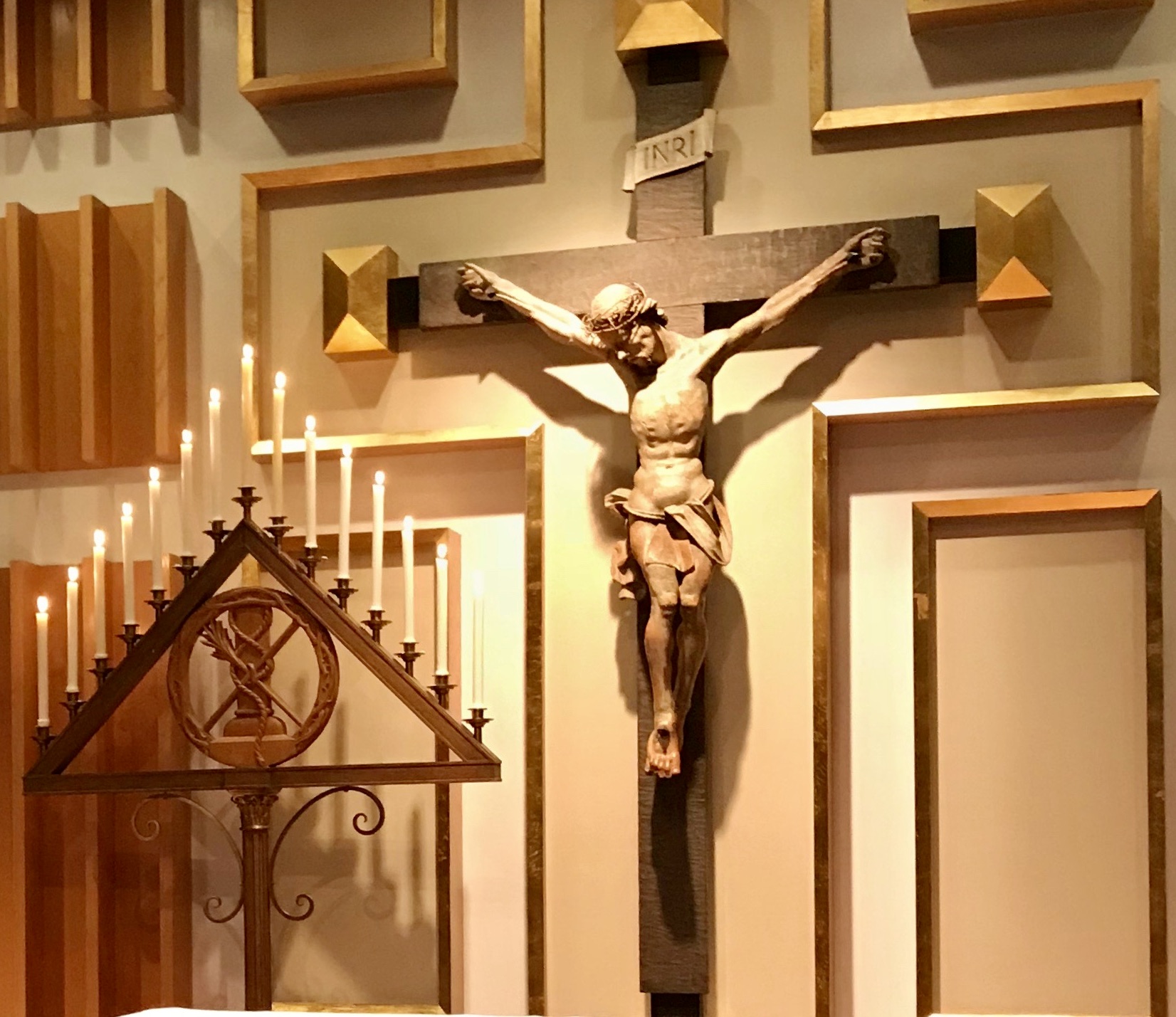
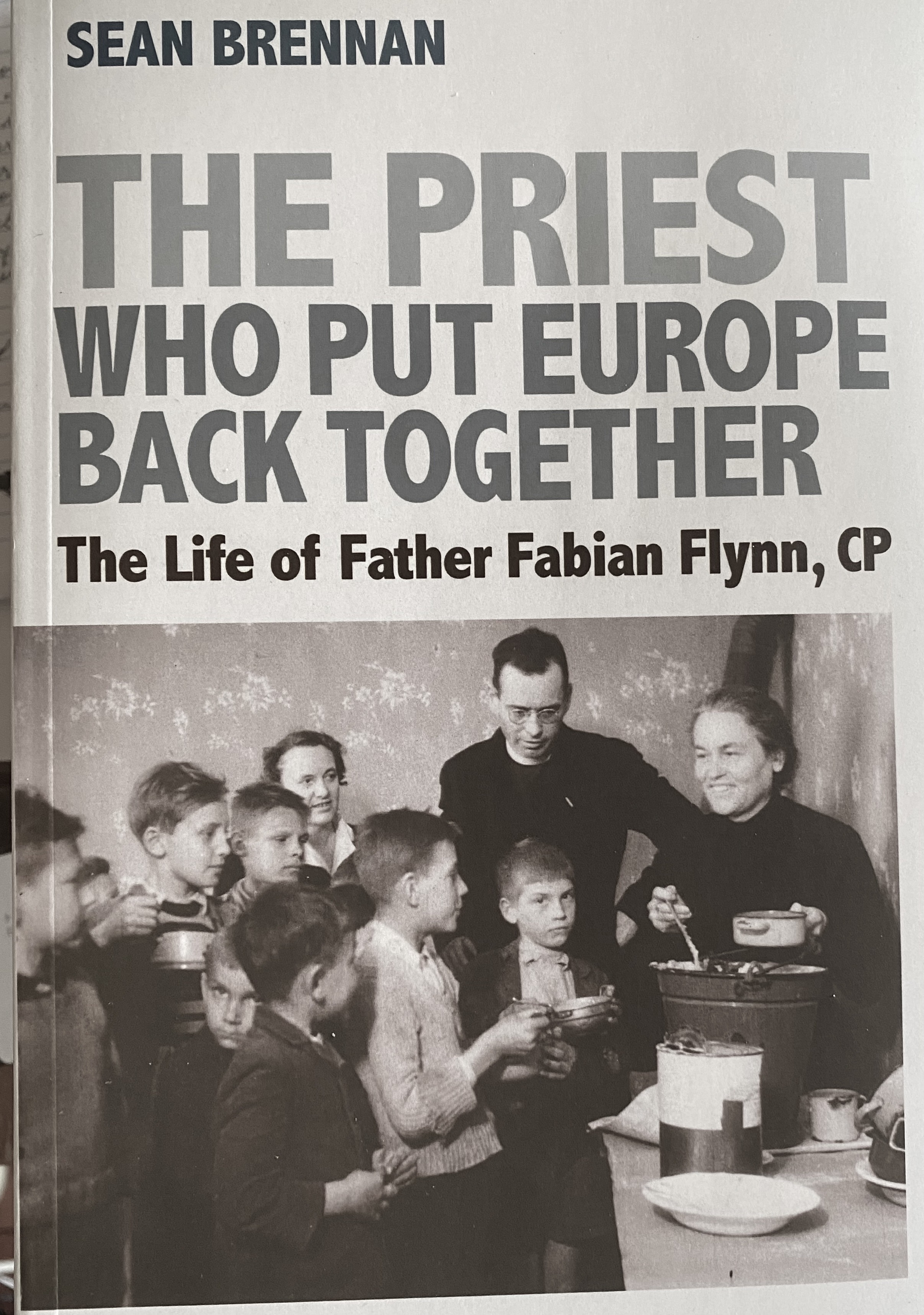
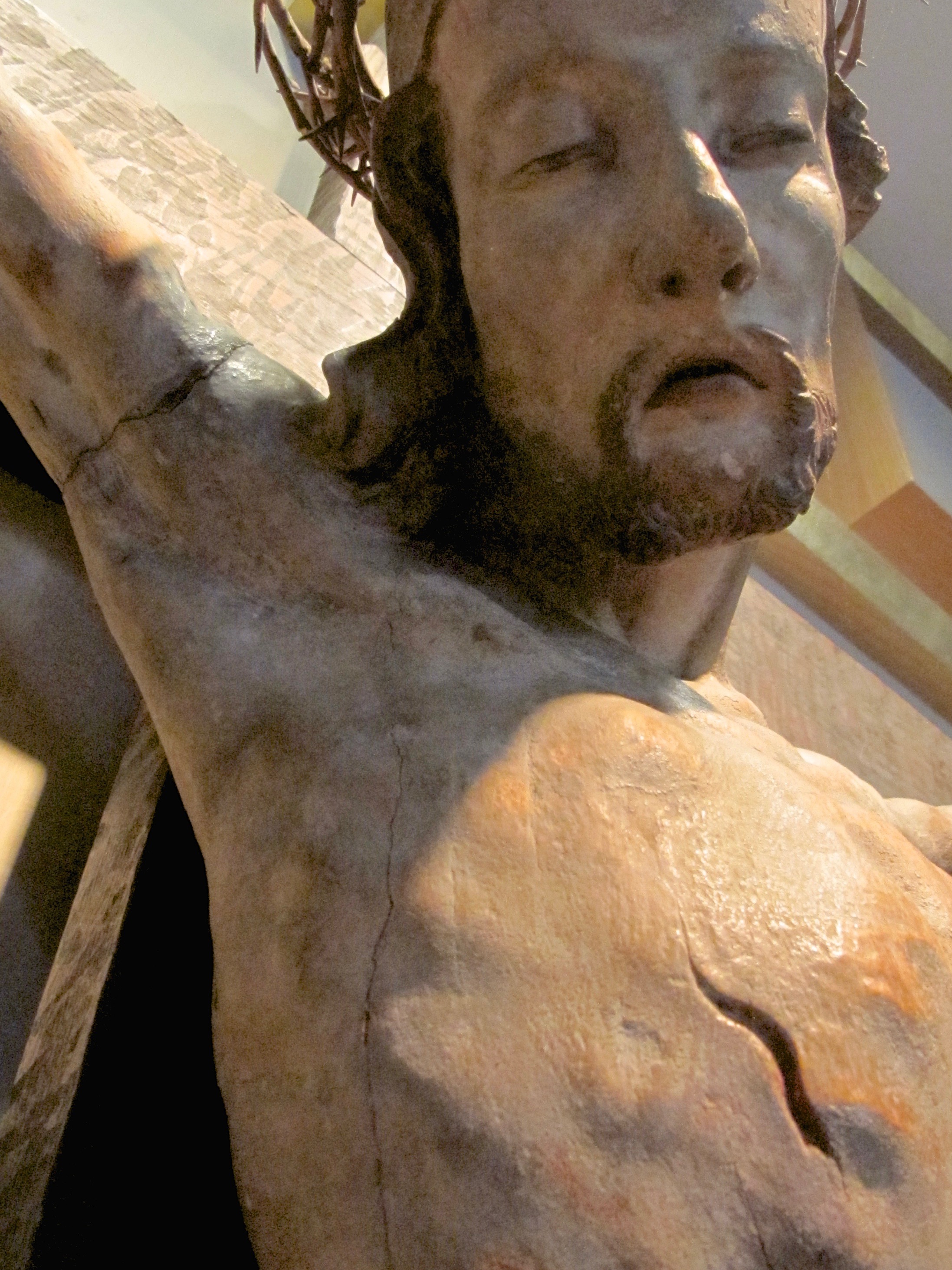
We have an extraordinary crucifix in our monastery chapel (Above), gift of the German bishops of Bavaria to Fr. Fabian Flynn, a member of my community, for the life he brought to a broken Europe after the 2nd World War. There’s a book about him and his work “The Priest Who Put Europe Back Together” by Sean Brennan, (Washington, DC, 2018)
Father Fabian was ordained here in our monastery in 1931 and served in our retreat house after ordination, then he went on to become an editor for The Sign magazine, a Passionist publication.
He became an army chaplain with the 1st Infantry Division in 1943 during the 2nd World War and served in combat in North Africa, Sicily, France and Germany for 16 months. His unit ended up in Nuremberg, Germany at the time of Nuremberg war trials; Fabian became chaplain for the Allied participants in that trial. He also ministered to the Germans in Nuremberg, including those on trial as war criminals.
During the trial, he celebrated Mass in one of Nuremberg’s war-damaged Catholic Churches, for Allied personnel and German Catholics together.
After army service, he became Director of Catholic Relief Services in Germany and Hungary from 1946-49, and until his death in 1973 he worked for the relief of millions of refugees displaced by wars and other tragedies in Europe and elsewhere.
The crucifix given in gratitude to Fr. Fabian at the end of his service by the German bishops is an old crucifix. I think it may come from a bombed out German church. It’s a fitting expression of the work he did then, and the work we have before us now as we look at this war in Ukraine.
How shall we look at this war? What shall we do?
Jesus looked from his cross and said “Father, forgive them for they know not what they do.” His plea for mercy was a plea for his world then and a plea for our senseless world now. We need to pray for our world: “Father, forgive us for we know not what we do.”
In Jesus on the cross we also see those who suffer most in this war, refugees, mothers holding their children, the old, the sick, the wounded, the dying. They are all there.
On the cross Jesus is a sign of all who suffer. “What you do for the least, you do for me,” he says. We must help when we can.
The generals tell us military solutions won’t do it. Neither will economic sanctions. The Cross of Jesus tells us the human heart must be touched and changed, and so we pray to God to touch and change our hearts.
Lent is coming. Let’s join those disciples in our picture above following Jesus. One way to follow him is by reflecting on the lenten scriptural readings recommended for the Sundays and weekdays till Easter. They’re the basic book for lenten reading.
On the 1st Sunday of Lent, this coming Sunday, Luke’s gospel takes us to the Jordan River where Jesus is led into a deserted place by the Spirit and tempted for 40 days after his baptism. Our journey begins in a desert. Readings from Luke’s Gospel lead us through the Sundays of Lent this year.
The weekday gospels for the first three weeks of lent are mostly from Matthew, the early church’s favorite gospel for catechesis during Lent. Matthew brings us to Galilee where Jesus speaks “the words of eternal life” in his Sermon on the Mount. (Matthew 5-7) Be faithful to prayer and you will grow in wisdom, Jesus says. ( Tuesday and Thursday, 1st week of Lent) Love your neighbor, even your enemies and “the least,” whom we easily overlook. ( Monday, Friday, Saturday, 1st week of Lent)
Peter’s confession at Caesaria Phillipi is the highpoint of the first part of Matthew’s gospel. “You are the Christ, the Son of the living God,” Peter says to Jesus. “You have the words of everlasting life.” Lent invites us to join him in that same confession.
Yet, can we possibly love and believe that way, so lofty and challenging? We’re rather weak disciples. Jesus doesn’t call perfect disciples, the reading for Saturday after Ash Wednesday reminds us. He called Matthew the tax collector and people like him–not very good keepers of the law. Outsiders and sinners like them tell us we belong in the lenten season. (Luke 5, 27-32)
Matthew’s gospel takes us up the Mount of the Beatitudes. Like most sacred writers, Matthew likes mountains; you see ahead more clearly from them. On the 2nd Sunday of Lent, we go up to the Mount of the Transfiguration to glimpse the glory found ahead.
By the 4th week of Lent, we arrive in the Holy City, Jerusalem, to the temple mount and then the Mount of Calvary. Starting with the 4th week most of the weekday lenten gospels will be from the Gospel of John. I’ll say something about them before we get there.
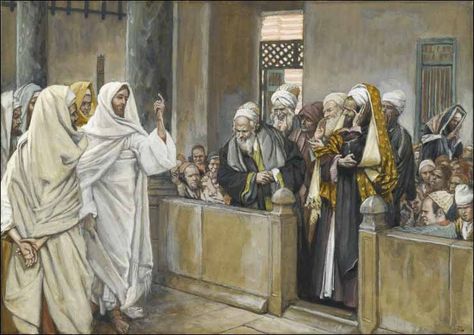
Often Mark’s Gospel offers little clues to help us interpret one passage in the light of another. For example, Jesus is sharply questioned by the Pharisees whether it’s lawful for a husband to divorce his wife. The questioning takes place as Jesus “came into the district of Judea and across the Jordan,” on his way up to Jerusalem where he will meet his death.
Mark’s not altogether accurate in his geography but “Judea across the Jordan” was where John the Baptist was put to death for questioning the validity of Herod’s marriage to Herodias, who divorced Herod’s brother Philip to marry him. Mark tells that gruesome story a few chapters before in great detail. (Mark 6, 14-29) The site of John’s death, east of the Dead Sea in what is now the country of Jordan, was lost for more than a thousand years after it was destroyed by the Romans at the end of the First Jewish Revolt in 71/72 A.D. It was definitively identified in 1968, when a German scholar discovered the remains of a Roman siege wall. Since then, the Hungarian architect and archaeologist Dr Győző Vörös has been excavating the site.
Perhaps the Pharisees thought that questioning Jesus here might have two outcomes. Either it might incite Herodias and Herod to do to Jesus what they did to John, or if Jesus didn’t answer the delicate question about divorce, the crowds gathered around him might see him less brave than the Baptist.
Jesus’ answer is brave, and it’s not an abstract one. Marriage is not to satisfy human ambition, like Herodias’ ambition. From the beginning God willed that man and woman be one flesh. The final lines of our gospel, spoken at this time and place, is also a strong judgment on the man and woman who engineered John’s death:
“Whoever divorces his wife and marries another commits adultery against her; and if she divorces her husband and marries another, she commits adultery.”
The Passionists believe the passion of Christ should always be in our hearts. We should keep it always in mind. St. Vincent Strambi in our previous blog called the passion of Jesus a “ book of life, it teaches the way to live and communicates life. The one who reads this book day and night is blessed.”
How can we read such a book? Three questions help open the book of the Passion of Jesus for us:
What happened?
Who did it happen to?
Why did it happen to him?
If you asked anyone at the time of Jesus what happened when someone was crucified, they would tell you immediately. Everyone in the Roman world knew what crucifixion was. Someone was arrested, imprisoned and judged. If you were found guilty of a major crime and not a Roman citizen, you could be scourged and then crucified publicly, often dying painfully hanging there for days.
The Romans used scourging and crucifixion as a deterrent, a warning. They made sure everybody knew about it. They deliberately publicized it. Those to be crucified were marched through the streets to a public place of execution. In Jerusalem the place of execution where Jesus was crucified was right outside the city gates on a main road. It took place on a raised spot of ground the shape of a skull, Calvary.
People going in and out of the city had to see it. They were meant to see it. The crown of thorns the soldiers put on Jesus was an added touch: Don’t try to be a king here.
Crucifixion was abolished in the Roman Empire in 337 by Constantine, the first Christian emperor, but even before some Romans were critical of the practice. The Roman orator Cicero called it “ a most cruel and disgusting punishment” and he suggested “the very mention of the cross should be far removed not only from a Roman citizen’s presence, but from his mind, his eyes, his ears”. (Verrine Orations 2) In polite society, art and Roman literature at the time of Jesus crucifixion is hardly mentioned.
We’re not acquainted with crucifixion today as the people of Jesus’ time were. Today people may know it from Mel Gibson’s popular film “The Passion of the Christ”, which explores the passion of Jesus in grim visual detail. Gibson has none of Cicero’s qualms about crucifixion. He shows what happened, but doesn’t answer those two other questions much, if at all. Who is this? And why was he crucified?
Bill O’Reilly’s recent book “Killing Jesus ” (2017) also looks at the facts of the crucifixion of Jesus but doesn’t dwell on them as Gibson does. Like other reporters, O’Reilly is interested in the facts. Get the facts, but also find a scoop, something sensational, that might surprise people by your investigation.
Facts are important in our world. We’re living in the period of the Enlightenment that began in the16th century, when science told us to look for facts. But facts aren’t the only thing. Meditation on the passion of Jesus goes beyond the facts.
Mark, Matthew, Luke and John, our primary sources for the story of the passion of Jesus, certainly knew the facts of his crucifixion and death. Their audience also knew what happened then. But the gospel writers and those they wrote for were also interested in those other questions. “Who did this happen to?” And “Why did it happen to him”?
The gospel accounts are not simply same day reports of what happened. They were formed over a period of time involving three levels of development. The first level occurred when Jesus was arrested, judged, crucified, died and was buried.
The second level took place in the decades that followed the resurrection of Jesus, when his followers questioned, reflected and preached on why this took place. This level can be seen, for example, in the story of the two disciples on the way to Emmaus in Luke’s Gospel ( Lk 24:13-35) and in the Letters of St. Paul.
The third level occurred in the last decades of the 1st century when the gospel writers wrote for a particular Christian community of their own time and place . They took into account the life and ministry of Jesus, his death and resurrection, and also the questions, reflections and preaching that followed. They wrote, finally, for people of their day, to strengthen them in their faith. Commentators today, using modern biblical scholarship, are interested especially in this final level of gospel formation.
The Second Vatican Council urged Catholics to read, reflect and pray on the scriptures using these new tools.The four gospels, even the three synoptic gospels of Mark, Matthew and Luke that appear so similar, have their own distinct voice. Instead of harmonizing the accounts, we can learn from their differences.
“Each of the gospels revolves around the crucifixion of Jesus,” Fr. Donald Senior, a Passionist scriptural scholar, notes in his book “The Passion of Jesus in the Gospel of Matthew,” (Collegeville, MN, 1985) Their interest “was not simply in the dramatic historical fact that Jesus of Nazareth was executed by crucifixion. Rather, the evangelists sought the meaning of all this, not only for Jesus’ life, but for all human life. How could this happen? And what purpose might it have? These were the questions that drew Christians to Jesus’ death. Discovering coherence in the sufferings of Jesus might yield the meaning of suffering in their own lives.” ( p 8)
Each gospel writer tells the story of the passion of Jesus in his own distinct way for his own Christian community, and for all the world.
“When we speak of Christ’s passion,” Fr. Senior continues, ‘we refer to the suffering and death he endured. But “passion” has other connotations in English. It can mean intense emotion, feeling, even commitment. People can do things “with passion.”
Both of these meanings are present when we say Jesus “took up his cross.”
The Second Vatican Council, besides approving current biblical scholarship, directed that the treasures of the scriptures be available more widely in our liturgy. We now have, in a lectionary for Sundays and weekdays, an extensive yearly exposure to the gospels and others scriptures. Daily reading of the scriptures for us today is not only a way to grow in faith but also a way to “keep his passion in mind.”
The gospels, which “revolve around the crucifixion,” are also daily meditations on the passion of Jesus, because the mystery of the cross falls on every part of them, from his birth, to his ministry of healing and teaching, to time he is arrested and condemned to death.
In Matthew’s Gospel, for example, Herod haunts his birth, killing infants in Bethlehem, John the Baptist is arrested after his baptism, leaders of the people oppose him as he teaches and heals. Signs of what awaits Jesus appear even before he’s seized and put to death. The same ominous pattern is there in all the other gospels.
For this reason, as we read from Matthew and Luke in the Christmas season and from Mark from the feast of his Baptism by John till Ash Wednesday beginning Lent, we keep his passion in mind. As we read in Lent from Matthew and then from John from the 4th week of Lent till Holy Week, we are reading the book of his cross.
We are best prepared to meditate on the passion narrative itself by meditating on the entire gospel along with the rest of the scriptures. Jesus, in fact, told his disciples at Emmaus they all speak of him.
The scriptures are the best place to learn what happened, who did it happen to, and why did it happen to him. They help us keep his passion in mind.




 The Victor's Place