Category Archives: Travel

Poor Haiti

Father Enzo, one of our Passionists in Haiti, went recently to Dame Marie, La Serengue and Jeremie, places devasted by hurricane Matthew, where the St. Luke Foundation for Haiti has schools and clinic.

“The duration of the flight to Dame Marie is one hour by helicopter.  Half way to Jeremie today rain was hitting the windshield of the helicopter, and we started to worry that we had to abort again, but fortunately we were able to go through.  The raindrops on the windshield seemed to me like to many teardrops and while we were flying, I was thinking of how many tears Hurricane Matthew had provoked.

“Just before arriving to Jeremie, the helicopter turned slightly inland to reach Dame Marie, where the eye of the hurricane passed.  I remember visiting previously the past two years, and remember that compared to the rest of the country the province of Grand Anse had very lush vegetation.  What struck me immediately as soon as we turned inland was to see how Hurricane Matthew chopped acres and acres of trees.

“The province of Grand Anse is particularly isolated, and paradoxically one of the most vegetated places that remained in the country, which has otherwise been so heavily deforested.  The hurricane is always a natural disaster, no doubt.  But with our human hands we can increase the disaster by not treating the earth as the common home given to us by God, through deforestation, pollution, poor building construction, lack of urban planning, so often the result of poverty.

“When we arrived to Dame Marie, we saw houses spread throughout the vegetation without their roofs, and rivers grown three times their size. It was heartbreaking.  When we were approaching Dame Marie, it was hard to understand even what we were looking at arriving by helicopter.  From the air we could see the roof of the parish church blown away and so of the houses, but we saw many colors.  Getting closer, we saw that it was clothes hanging everywhere to dry after all those days of rain.

“We landed on the football field.  The pilot was afraid to land, thinking that the people would assault us in search for food, and just wanted to go from one place to another by air.  We are well known in the area, and Nebez is originally from there, so we landed.  The pilot gave us 15 minutes on the ground because of the weather conditions.  As we landed we were surrounded by hundreds of people who began to clap hands, sing and praise God for our arrival.  It was almost like they were visited by God.  More than bringing food, blankets, clothes or water, I think today it was very important to them to know that they were not abandoned, they are not alone and that they belong to a bigger family.

” We visited the community hospital and that’s when I cried as I saw people laying on the floor crying and abandoned. I was impressed while we were walking with the Bishop how people stopped him saying, “praise God that the Lord has visited his people” and asking him with concern how things were in Jeremie. On our way back to the helicopter it was amazing to see women washing clothes, cooking, drying the corn or the rice in the sun, to see the notebooks and books of the children drying in the sun hoping to go back to school as soon as possible.

“Once at the helicopter, it was beautiful to see the children playing on the field doing cartwheels around us. Before we left, the Bishop prayed with the people he said that our houses have been destroyed, our lives have been disrupted, our tress and crops have been chopped off, but we are all alive, and this is already a grace.  All the people began to shout “Amen, hallelujah!” The next few weeks are going to be critical, and we are thinking not only to bring supplies, but also to set up a hospital tent. It is worth mentioning that we were first people to reach Dame Marie after the hurricane.

“While we were flying over Jeremie before landing we saw the cathedral completely open on the top.  The roof had been blown off, and was heartbreaking to see.  But mostly it was heartbreaking to see the people with houses destroyed, built so poorly and with such poor materials to begin with.  When we landed in the football field, the people recognized the Bishop and started to run towards him.  It was beautiful to see.  What came to mind was when Jesus said “I am the good shepherd; I know my own sheep, and they know me” (Jn 10:14). But again, I saw more a lamb than a shepherd, who was ready to carry on his shoulders the burden of his people.  We had to leave him quickly, but promised him that we would return to help him and his people.

“I would like here to talk about the resilience of our Haitian brothers and sisters.  They are like a boxer in a boxing ring.  Knocked down, and the count to ten is on, but they are always able to stand up before the final countdown.  Not even the hurricane can knock them out.  It makes me think too of what is now a prophetic image of Our Lady of Sorrows, the patroness of our congregation, that we had painted on the side of our new residence which bears her name that will face the entrance of the new St Luke hospital.

“Our Founder, Paul of the Cross used to compare Our Lady of Sorrows to a rock on which the waves slam but cannot move her.  As I contemplated this, I saw Our Lady holding Christ’s shroud firmly but gently as a mother holds her child.  The wind and the waves batter her as she appeals to God on behalf of the Haitian people.  There is sorrow in her face but confidence too.  Why else would she be on that sharp rock but for her faith!

“On our way to Jeremie the sky was full of rain drops that reminded me of tears. On the way home the sky was clear but my eyes were full of tears. It is an obligation to have been the eyes and ears on behalf of our friends and supporters who are so concerned for those affected by this disaster, and now to be their voice to you on their behalf.  These are people who are already so vulnerable of being invisible to the outside world, and I am humbled today to have had the chance to help share their story.”


Fr Enzo Del Brocco

St Luke Foundation and

Passionisti Haiti Mission of Our Lady of Sorrows
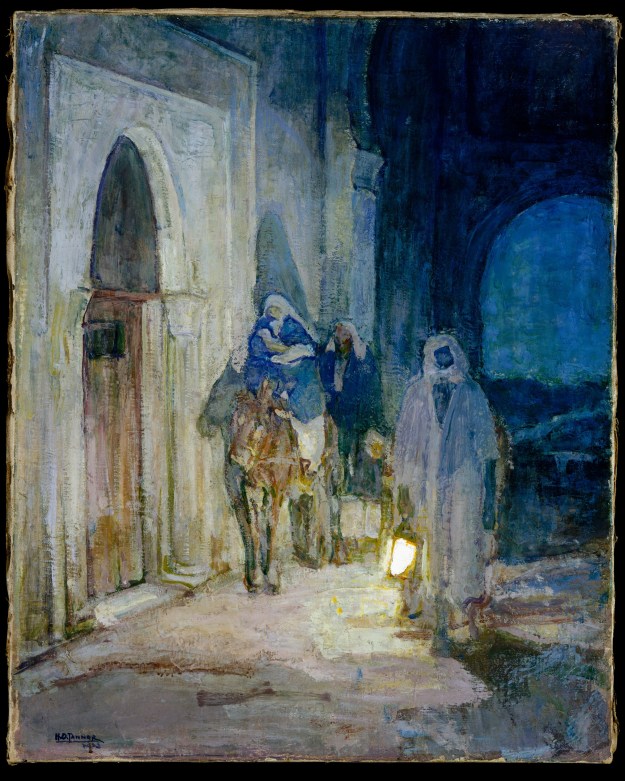
Friday Thoughts: Flight Into Egypt

Flight Into Egypt Henry Ossawa Tanner American 1923 Met

Henry Ossawa Tanner, “Flight into Egypt”, (1923) (Metropolitan Museum of Art)


.

A young lady and a good man. A tiny precious child. A tired donkey. An angel of God leading them by the lantern in his right hand.

You are one of them. You travel by night. Your party is small. But you are not alone.

The streets are empty. At least as far as you can see. Strange lands this side of the Red Sea.

Jesus is with you. He sleeps in your arms. He takes your family name. He rides upon your back. You walk a few feet ahead of Him to ensure the right and safe path.

You too are Jesus. Born a few days before. Completely wrapped up. Yet totally exposed.

Beyond the frame an onlooker more than watches. He paints the picture. He steadies the easel. He knows exactly where the finished work will hang.

.


.

—Howard Hain

 .

http://www.metmuseum.org/art/collection/search/16947

..

21st Sunday C: “Will Only A Few Be Saved?”

To listen to today’s homily please select the audio file below:

“Lord, will only a few people be saved?” someone asks Jesus on his journey from Galilee to Jerusalem, described in Luke’s gospel, our Mass reading today. He doesn’t answer the question, but instead tells his listeners to respond immediately to God’s call when they hear it.

Why was the question asked anyway, you wonder? Was it because the response wasn’t great when Jesus made his way to Jerusalem? In our first reading Isaiah predicts people from all nations will flock to Jerusalem when the Messiah comes. Were those who followed Jesus few in number then?

Will the response to Jesus sometimes be the same?

The journey of Jesus to Jerusalem never ends, we believe. It goes on through time as Christian missionaries go through other towns, places, even continents. It took place when European explorers, settlers and missionaries brought faith in Jesus Christ to peoples in North America who never knew him.

“Lord, will only a few people be saved?” Early Christian missionaries may have asked that as they reviewed their attempts to evangelize the native peoples of North America. Historians estimate about 50 million Indians lived in North America before the arrival of Europeans. A hundred years later, only 10 percent survived, mainly because of diseases brought by the newcomers. In a hundred or so years, as European settlers increased in number, most of the native tribes in eastern North America were forced westward or destroyed by war or small pox brought by the Europeans.

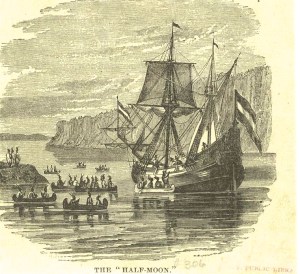
H.Hudson halfmoon

Coming to the new world, Catholic missionaries like the Jesuits and Franciscans hoped, not only to convert the native peoples to Christianity, but some thought they might create a fresh, vibrant Christian civilization, without the ancient antagonisms and rivalries of Europe. They looked for new Pentecost, but it did not seem to come.

Their harvest wasn’t great. The two civilizations were very different. The sense of superiority the Europeans brought, colonialism, and the diseases that decimated the native population made the native peoples question Christianity. It seemed to be a faith that brought death not life.

I hope to visit soon the National Museum of the American Indian, located in the old customs house across from Battery Park near the ferry in New York City, a good place to remember the native peoples in the story of America. They were the first the Europeans traded with; they were their guides into an unknown land. The native peoples provided new foods for growing populations in Africa, Europe and America. They had a greater respect for the land than those who came after them. Their story is now largely forgotten.

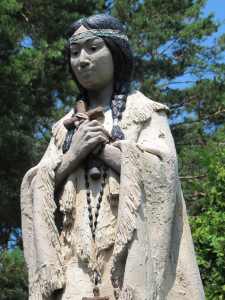
At the museum I’ll remember St. Kateri Tekakwitha, a native American who lived along the Mohawk River past Albany, New York. She offers an insight into the culture and social world of the native peoples. Smallpox brought by the Europeans disfigured and partially blinded her. Other diseases like tuberculosis, measles and malaria brought death to large numbers of native peoples, who were diminished further by wars and greed for Indian lands.

She came to believe in Jesus Christ.KATERI

At the museum I’ll also remember Father Isaac Jogues, the fearless Jesuit missionary, who was eventually killed by the Mohawks at Ossernonon (Auriesville), past Albany on the Mohawk River. A strong faith in Christ brought him to the New World where he experienced the clash of cultures as Christianity entered a native American world. Fleeing from Indian captivity, he came here to New Amsterdam (New York) in 1643 and was put on a ship for France by a kindly Dutch minister. A few years later, he returned still eager to bring the Christian faith to the native peoples, but was killed in 1646.

He wanted them to know Jesus Christ.

What do these old examples say about our mission today as disciples of Jesus to make him known? “Go, therefore, and make disciples of all nations, baptizing them in the name of the Father, and of the Son, and of the holy Spirit, teaching them to observe all that I have commanded you. And behold, I am with you always, until the end of the age,” Jesus says. (Matthew 28,16-20) What does that mean today?

Some today tell us to think more positively of cultures like that of the American native peoples. Some say Christians should simply be present in these cultures and silently profess their faith and work for the common good. Some even say we should not evangelize at all.

Certainly, the Spirit of God has been active in humanity from the beginning and we have missed God’s gifts in cultures and religions not our own. The church today recognizes the good in other religions “The Catholic Church rejects nothing that is true and holy in these religions” (Nostra Aetate, 2) . Still, it regards them as a “preparation for the gospel.” (Lumen gentium 16)

“The church is missionary by her very nature.” (Ad gentes 2) She is called to both dialogue respectfully, work for the common good and proclaim her belief.

We’re not only speaking of other cultures and religions, of course.  What about our own culture, which is becoming increasingly resistant to Christian belief? How do we dialogue respectfully and proclaim our belief to our own, our young people, those who are drifting away?

“Lord, will only a few be saved?”

Friday Thoughts: Walled Garden (2)

(Please note: This is part 2 of a piece entitled “Walled Garden”. To read part 1, simply click here: Friday Thoughts: Walled Garden (1))


pissarro orchards at louveciennes 1872

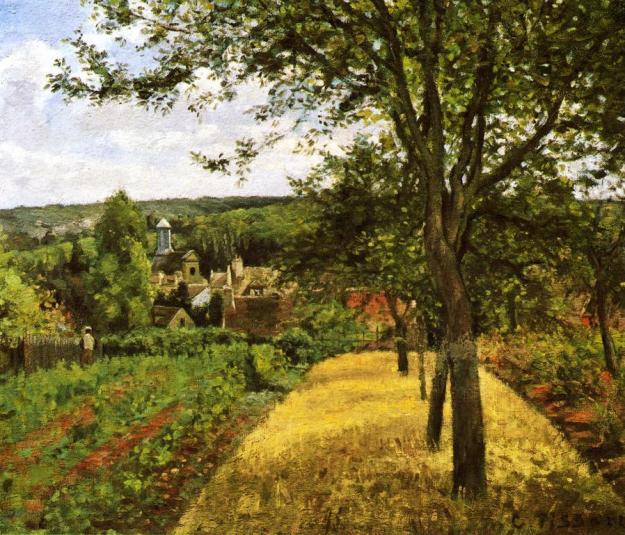
Camille Pissarro, “Orchards at Louveciennes”, 1872

.

And from that hour the disciple took her into his home.

—John 19:27


.
On leaving the convent I came upon the friar I noticed on my way in. The little dog was no longer around. We approached each other as if we had met before. He was kind. He was middle-aged. He was simple. And then the strangest thing occurred. He took me by the arm, the way men stroll in Italy, arm-in-arm, during the evening passeggiata—the evening stroll.

But I had never met this man before.

Yes, it is certainly strange to have an unknown man approach you and link his arm in yours.

He led me toward a dirt path. We strolled. We spoke little. He didn’t speak English and my Italian was tiny. But it was nice. Peaceful. It didn’t feel strange. I only now use that word, for from a somewhat forced “objective” perspective, it seems that it had to be.

He was a man of God. And he saw I was too, before I had any idea God had undeservedly entrusted me with such a gift. The gift of loving God. The gift of wanting Him more than I could ever explain. The gift of being an outcast here in this world of time, a wanderer, a pilgrim, a crusading knight of Lady Poverty—of being—in yet again, some strange kind of way—a lady-in-waiting—patiently and painfully anticipating the exuberant arrival of the one and only eternal groom.


.

He brought me to what appeared to be an old foundation. I understood from what few words we exchanged that this was the remains of an abandoned orphanage. And then we began to head back toward whence we came. I remember offering him some bread that I had in my bag, purchased that morning in the city of Assisi up above. He lightly touched his stomach with one hand and shook his head “no”—a kind, polite, gracious, and utterly grateful, “no-thank-you” kind of “no”.

When we arrived at the door of the convent I understood from his gestures that he was inviting me to see something inside. It was clearly something that I had not yet seen. I motioned “yes” and we entered. We climbed a staircase and walked down a hallway. We were in an area not open to the public. The walls revealed its age. And we approached a door. A wooden door. And he unlocked it with an old large skeleton key. He opened the door and motioned for me to go inside, quietly informing me that this is Saint Clare’s cell. I entered and he remained outside. He gently pulled the door closed.

I wasn’t sure what to do. I was safe. I knew I wasn’t locked in. I was pleasantly confused. I looked around. It was small. It was literally a cell. Enclosed. All stone. A low tight arched ceiling. Bright. Dark. Cozy. Warm. Beautiful.

A tabernacle. A womb. A virgin’s womb.


At the end of the somewhat rectangular shaped room was a small alter-like shelf. I knelt before it. I have not the slightest recollection of what I prayed.  Of what I thought. Of anything spiritually taking place. I was just there. And I remained a few minutes. And then I left. I opened the door and I was all alone. No friar. I closed the door behind me and made my way back down from where I had come.

It seemed as if nothing extraordinary had happened. It was all so normal. So everyday. Yet it was nothing of the sort. It was extraordinary. It was an encounter. I think. Perhaps.


I think of little Mary. Alone in her room. I think of a gentle breeze and the sight of a bowing angel.

“Hail, full of grace…”

What a name, what a title to be given!

Gabriel holding the key that opens the door.

The young, chosen, highly-favored virgin agrees to hear his message, to walk arm-in-arm with him, to accompany him to she knows not where. She agrees to accept God’s invitation.

The Holy Spirit comes upon her simple life, her simple way, her simple manner.

The power of the Most High overshadows her daily existence.

Our Father confirms her trusting posture, her grace-filled instinct to utter the purest of prayers:

.

“Behold the handmaid of the Lord; be it done to me according to thy word.” (Luke 1:38)

.

Jesus entered a private, off-limits room. He made His home there.

And He never left.


.

“…when you pray, go to your inner room, close the door, and pray to your Father in secret…”

—Matthew 6:6


.

—Howard Hain

.

13th Sunday C: On the Journey

To listen to today’s homily, please select the audio file below:

We’re reading the Gospel of Luke the Sundays of this year. At the beginning of his gospel, St.Luke promises to put down in an orderly way the events that have been fulfilled in Jesus Christ. As we listen to his account he wants us to realize that what we hear Jesus say to his disciples and to others he says to us. When we hear what happens to Jesus we are also hearing what happens to us.

In the 9th chapter of his gospel, part of which we read this Sunday, Luke describes a crucial turning point in the life of Jesus. After teaching and healing and performing wonders for a time in Galilee, Jesus asks his disciples, “Who do people say I am?” Then, he asks them, “Who do you say I am?” Of course, Luke wants us to face that same question too. “Who do we say Jesus is?”

Jesus then announces he must go up to Jerusalem. Listen to the way Luke describes his decision “When the days for Jesus’ being taken up were fulfilled, he resolutely determined to journey to Jerusalem, and he sent messengers ahead of him.” This is a journey when the days for Jesus being taken up were fulfilled. In other words, this is a journey when Jesus will pass from this world to his Father. He is journeying to Jerusalem to suffer and die and rise again. He will be “taken up.”

And he doesn’t make this journey alone. At this point in the gospel, Jesus calls his disciples to follow him, Luke says, but the evangelist wants us know that he’s calling everybody to follow him, not just a designated few. Greater than Elijah, Jesus gives his mantle to many followers who’ll share his journey and they’re taken up with him to share his reward, and he sends messengers ahead of him to gather as many as they can.

There’s a simple criteria Jesus gives for following him. “Take up your cross daily and follow me,” he says in Luke’s gospel. It’s an everyday cross he wants us to take up, not the cross of wood that he himself bore; it’s not nails in our hands and feet or scourges on our back that we’re asked to bear. It’s the everyday cross that we carry all the time, wherever we are. It’s the cross we carry on our journey of life, all our life. Sometimes it comes from ourselves, from sickness, or old age, or disappointments, or worry, or the constant pressures of living everyday. Sometimes it comes from the world we live in with its violence and uncertainties. It’s always there and Jesus tells us to carry it.

In today’s gospel the Lord says something more about following him; some of what he says we may find hard to understand. For example, what does he say to the man who wants to bury his father before following him? “Let the dead bury their dead.” What does he say to the one who wants to say goodbye to his family first? “ “No one who sets a hand to the plow and looks to what’s left behind is fit for the kingdom of heaven.” Sounds hard and unreasonable, doesn’t it?

Hard and unreasonable, until we see how important it is to follow Jesus. If life is a journey, and it is, where are we going? Do we think this is all there is? If life is a journey, do we make it alone? If life is a journey, does it stop at death? If it doesn’t stop at death, who will take us beyond it? If life is a journey from this world to another world, who will be with us all days to bring us to that world?

We can see how important it is to follow Jesus Christ?

Some, of course, think he makes no difference. They can go it alone. Some think Christ is just a “back-up,” when you need him he’ll be there. Some think he brings power and success for living here and now. But look at what he says in today’s gospel: “Foxes have dens and birds of the sky have nests, but the Son of Man has nowhere to rest his head.” Jesus doesn’t assure us of a nice house or a good living. In today’s gospel, too, his disciples want to set fire on the Samaritans who refuse them hospitality, but Jesus turns his back on them.

For the next four months our Sunday gospels are mostly from the journey narrative of Luke. We will be hearing what Jesus says to those he meets on the journey. Let’s listen as if he’s speaking to us. On the way to Jerusalem Jesus calls followers. None of them are perfect, by any means. In Luke’s narrative it’s the lost sheep, the prodigal children, the forgotten poor, a blind man on the road, a crooked tax collector who follow him. He calls us too. Let’s listen to him.

We’ll hear warnings in the weeks ahead which we should take to heart. “You are a fool,” God says to the man who thinks only about building bigger barns. Let’s listen to him. We’ll hear about stopping and helping others, as the Good Samaritan did. Let’s listen to him.

Friday Thoughts: Walled Garden

Francis and Clare from the movie Brother Sun, Sister Moon Franco Zeffirelli

Saint Francis and Saint Clare from the movie “Brother Sun, Sister Moon”, (Franco Zeffirelli) (1972)


.
A garden enclosed, my sister, my bride,
a garden enclosed, a fountain sealed!

—Song of Songs 4:12

.


.
From memory it is not easy to recall. I do have a clear image, but if it is accurate that remains to be seen. Here we go.

It was downhill. A sloping path. As I approached the stone church, a few people wandered around out front. There was somewhat of a courtyard, well not a courtyard, more like a little wall hugging into existence a welcoming space. This wall was about bench height, made also of stone, and extended outward from the building. It created what I would normally call an out-front patio space, but in Italian terms, perhaps it would be called a terrazza, or maybe even be considered a piazza, or perhaps most accurately, a piazzetta. Then again, maybe it is just a patio to Italians too.

Well, sitting on this low wall was a friar. And running around the open area was a small brown dog with a shaggy little beige beard.

I entered the church. It was small, almost cave like. A curved ceiling. Dark. Old. There was the cross, a crucifix. Not the actual one that spoke to Saint Francis—no, that one was moved up into the Basilica of Saint Clare located in the central part of the still small but no-longer medieval town of Assisi.

The reproduction spoke to me.

I’m an early companion of Francis.
.


.
I remained in the chapel for a while. I’m not sure if I was praying or not. I’m pretty sure I got on my knees. But from that day’s perspective, prayer was not known to me. So from that perspective, I wasn’t praying. But from today’s perspective, I most certainly was. For I was there. I was in Italy, in Assisi, in the Church of San Damiano. I was there intentionally. I was lost but I was found. I was looking, and I was obeying. Obeying what I didn’t know. I had no idea why, but I wanted to be there. And I felt something. It was heavy, literally. I remember feeling bent over. I remember thinking about all the prayer that must have taken place in that small space over the past thousand years. I remember thinking that all that collective belief must have an effect. It did. It does. It will. I was certain that I felt it. It bowed me down. It bent me over. And I remember liking it.

Faith is common.

I was a pilgrim and didn’t know it.
.


.

I don’t remember much about the convent itself. I do remember walking from room to room, the communal rooms where Saint Clare and her companions, her biological mother and two sisters among them, ate and prayed and cared for their sick. I remember the small warm inner garden, with it’s old well. And the spot marked as the place where Clare liked best to sit. I’ve always loved internal courtyards. The thought of being outdoors and yet enclosed. Architecturally, it best represents the beauty of true solitude. Open. Yet safe. Free. Yet sheltered. Alone. Yet surrounded by those who believe the same.

In that sense, solitude—when it’s truly interior, truly spiritual—is like love: you can never get enough of it, and once you have it, once you truly live within it, you’re never again alone.

Solitude is love. And love is never solitary.
.


.

Therefore the Lord himself shall give you a sign. Behold a virgin shall conceive, and bear a son, and his name shall be called Emmanuel.

—Isaiah 7:14

.

.

—Howard Hain

Third Sunday of Easter: Forgiveness

audio homily here:

I think I know where this gospel took place– Tabgha, a quiet, wooded area on the Lake of Galilee just south of the ancient town of Capernaum. Easy walking distance from the town that was the center of Jesus’ ministry.

The name Tabgha comes from the seven springs of water flowing into the lake there. When I visited some years ago, flocks of birds were singing in the trees and drinking from the streams of water.

For centuries fishermen must have pulled in for fresh water from the springs, and perhaps fry some fish over a fire on the beach. It’s a likely place where Jesus would come to pray. Two centuries-old churches are on the site; tradition says he met his disciples here after his resurrection.
DSC00042

John’s gospel says that Peter and other disciples of Jesus came to Galilee after the Lord’s death and resurrection and went fishing. Through the night they caught nothing, but at dawn they heard a call from the shore to cast their nets out again.
“… Jesus was standing on the shore; but the disciples did not realize that it was Jesus.”

They caught a large catch of 153 fish. Jesus then called from the shore to come eat some fish at a fire he had started and he gave them bread and some fish to eat and revealed himself to them.

Peter has a leading role in this story. He jumped into the water to get to the shore. Then after they have eaten, Jesus takes him aside and three times asks the disciple who denied him three times, “Do you love me?” A beautiful statue marks that moment.
sinful man
Three times the apostle who cursed and swore in the courtyard of the High Priest that he did not even know Jesus answers “Yes, I do. I love you.” And Jesus tells him “Feed my lambs. Feed my sheep.”

A great example of forgiveness . No scolding words or recriminations. No “I told you so.” No warning, “You do that again and …” No demotion, no putting on parole. Rather, Jesus gives Peter new responsibility. “Feed my lambs” as I do. A beautiful picture of God’s mercy.

Instead of punishing him, God calls Peter to new things. The mercy of God always calls us to something new, some new life.

Tabgha, along the Lake of Galilee where Jesus met his disciples, is a wonderful place to visit. I wonder if Jesus prayed here during his days in Capernaum and called his disciples to rest awhile. Here he communed with God his Father; here he prayed and forgave. His memory lingers at this lovely place besides the Sea of Galilee.

Prayer and forgiveness go together Jesus taught. “Forgive us our trespasses as we forgive those who trespass against us.” Today’s gospel tells us to pray and forgive. Maybe someone has hurt us, maybe there’s some situation we’re facing now. A job we don’t like, a home situation we’re angry about, something in society that upsets us.

Pray and forgive.

Immigration, Now and Then

Immigration is a hot political topic today. It’s not just an issue here in America; it’s a world issue. Millions of people all over the world are on the move today because of wars, violence and because they can’t make a living on lands affected by climate change.

Our first reading today at Mass is about Abraham, the “wandering Aramean” whom God blessed as he went from place to place. May God bless those wandering from place to place today.

Today also is St. Patrick’s day. This was a big day in the place where I was born and raised, Bayonne, NJ, a city of immigrants, many from Ireland. The Irish went to church today to thank God for the faith brought to them by St. Patrick and for being able to live in a country where they could make a living and bring up their families, hoping for a better life.

Years ago, I visited the place where some of my relatives came from in Donegal, in northern Ireland. I saw the little abandoned farm house, with no roof, where some of them lived. An old man in the neighborhood remembered the day they left for America, three young people carrying away their simple belongings. It was all they had. There was no work for them there anymore.

When they came to America they took whatever jobs they could get. It had to be hard for them making their way in a new land and another way of living. But they helped one another, and that’s one of the things I remember about that immigrant generation. They helped one another.

I took a picture of that abandoned house in Donegal and gave it to my relatives. I see it’s still hung proudly in their house when I visit. We have to remember where we come from. We’re children of Abraham, on our way to a place that’s still before us. We have to stick together.

3rd and 4th Sunday C; His Own Turn Against Him

Audio homily here:

Luke begins his account of Jesus’ public life by recalling his return to Nazareth after his baptism by John in the Jordan. This Sunday and next Sunday we read from Luke’s long account of that event.

Mark and Matthew tell this story later in their gospels, but Luke, who concentrates more on Jesus’ early life than the other evangelists, puts the beginning of Jesus’  public life in Nazareth, in the synagogue where he worshipped, among those who knew him best. (Luke 4, 14-21)

Luke paints the coming of Jesus into this world in broad, sweeping terms in his gospel. Caesar Augustus was the world’s ruler, Herod ruled in Palestine, others ruled under them. At the same time, he focuses on Jesus’ own personal history. Born in Bethlehem, Jesus’ first home is an obscure village in northern Galilee– Nazareth, where he grows “in wisdom and age and grace, before God and man.” There he was brought up.

The synagogue at Nazareth was probably like other synagogues in the towns of Galilee. Some, like that at Magdala on the Sea of Galilee, have been excavated in recent times. It was a small one story rectangular building, with two tiers of seating all around its walls, made for a town of no more than 500 people. In the middle of the synagogue was a stand holding copies of the various books of the scriptures. The synagogue was the center of life in those towns.

Jesus has returned to Nazareth after beginning his ministry “all through Galilee, teaching in their synagogues and praised by all. (Luke 4, 14-15) Now, back home, he goes into the synagogue on the Sabbath, “as he was accustomed to do.”

He gets up from his place to read the scriptures. (From the same place where he sat for years? Was Mary his mother there with him?) He’s “ handed a scroll of the prophet Isaiah.

He unrolled the scroll and found the passage where it was written:

The Spirit of the Lord is upon me,

because he has anointed me

to bring glad tidings to the poor.

He has sent me to proclaim liberty to captives

and recovery of sight to the blind,

to let the oppressed go free,

and to proclaim a year acceptable to the Lord.

Rolling up the scroll, he handed it back to the attendant and sat down,

and the eyes of all in the synagogue looked intently at him.

He said to them,

“Today this Scripture passage is fulfilled in your hearing.”

A short sermon, and a powerful statement. “This scripture passage is fulfilled in your hearing.” The Spirit of the Lord is upon me, Jesus says. I’m anointed to bring glad tiding to the poor. Jesus claims a messianic calling.

His neighbors, who have known him for years, are first impressed, then question him, then deny his claims, then threaten to put him to death.

In their gospels, Mark and Matthew describe opposition to Jesus coming first from the scribes and Pharisees, the leaders from Jerusalem, but Luke sees opposition to Jesus coming first from his own hometown, from family, neighbors and friends. He knows how important this rejection is.

It’s true, isn’t it? When we enter this world, we enter the small unit of human life, a family, and beyond the family, the people and places that shape us early in life. We’re subject to this important smallness, our “Nazareths” where we grow “in wisdom and grace.” We’re first nourished there; we look for lasting love and support there. It means so much to us.

Throughout his ministry, Jesus will know opposition. Leaders of the people, public officials will oppose him.  In his final days, his own disciples will abandon him. Only a few will stand by his cross. The physical sufferings he endured were great. He was scourged, his head was crowned with thorns, his hands were nailed to a cross, he died hanging there long hours alone.

But rejection from his own at Nazareth will weigh heavily on him. It was a big part of the mystery of his cross. “He was amazed at their unbelief.” Yet, Jesus who embraced humanity with love, embraced Nazareth too. He loved it with God’s great love.

We have to pay a lot of attention to where we’re born, where we’re brought up, our families, the people we live and work with. Nazareth is important to us.


New York Harbor

Container

I went on a boat trip on Sunday into New York harbor, one of my favorite places. We followed a giant container ship from Singapore under the Verrazano Bridge.

Indian tribes were the first here to fish and to trade. The Dutch and the English followed them. It’s a great harbor with a great history. The fishing’s gone, unfortunately, and I wonder what happened to the Indians? Their story never seems to be told.

Indian fishing

Indian fishing

The Hudson River reaching north was a trading dream. Early on, furs and timber and raw materials were brought here from the interior to be shipped all over the world. The Eire Cana only increased the river’s reach.

liberty stat - Version 2Millions of immigrants, looking for work and a place to live, sailed into this harbor from distant places. The sign welcoming them, the Statue of Liberty, and the place where many of them were processed, Ellis Island, are on the left of the harbor as you come through the Narrows from the open sea.

Many of our ancestors, my own included, first saw the New World here. Many never left the area. On a recent TV program on Italian immigration, the question was asked “Why did so many Italians choose to live in New York City and New Jersey?” “That’s where the work was, “ someone said. My ancestors–Irish and Swedes– chose to live and work here too. Skyline medium

Skyline close

As you look at the impressive skyline of New York, look also to Brooklyn on the right and Jersey City and Bayonne on the left, Staten Island behind you. Those places were where the immigrants who built the city lived–and still do.

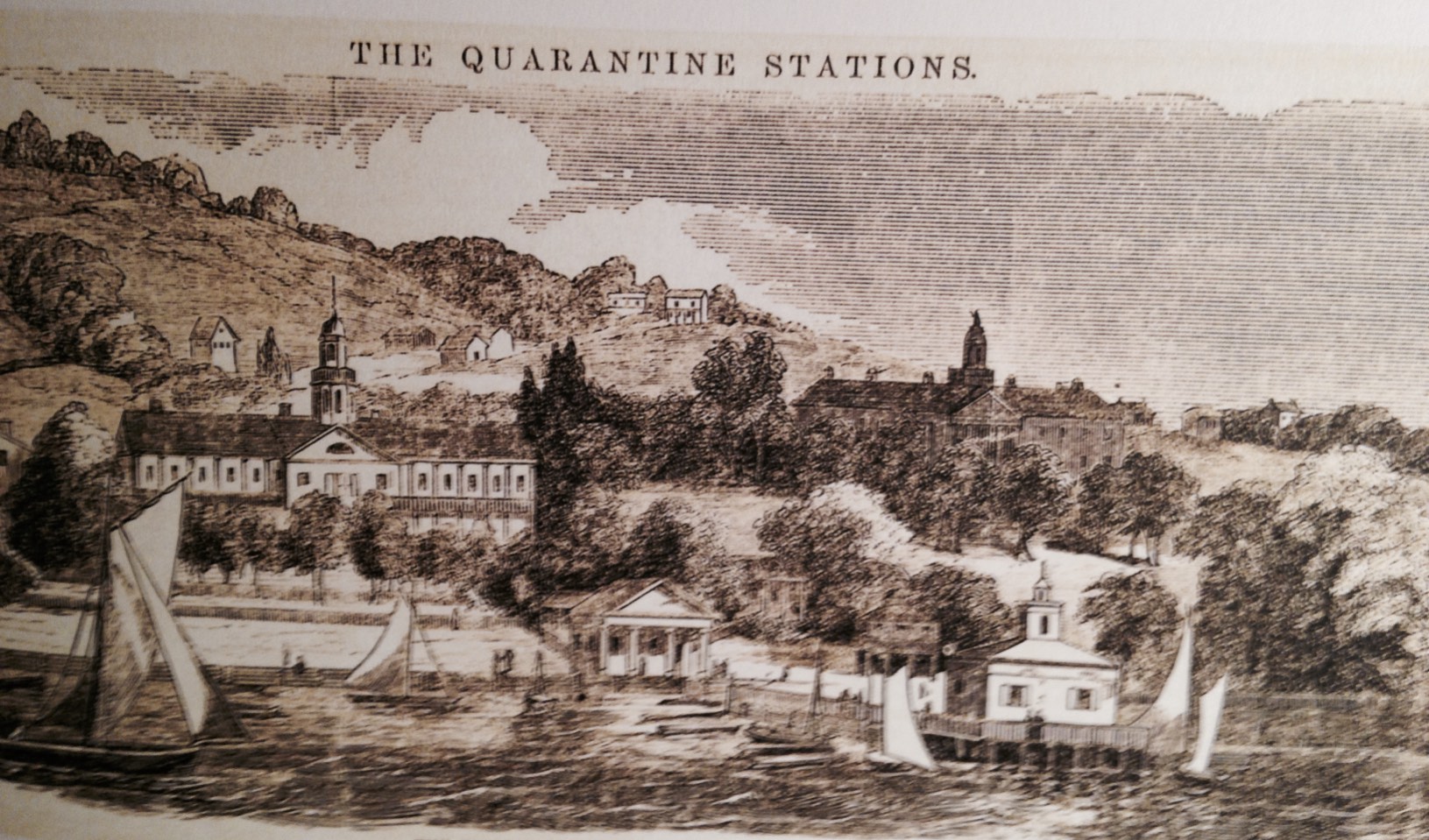
Quarentine station, staten island,

Quarentine station, staten island,

The Quarantine Station built in 1799 by Doctor Richard Bayley, father of St. Elizabeth Seton, was located near Stapleton on Staten Island, just south of the Staten Island Ferry terminal at St. George. Passengers with infectious diseases like small pox, cholera or yellow fever were detained and treated there, and sometimes returned to their own countries.

In the summer of 1801, Elizabeth Seton was staying with her father at the quarantine station when a boatload of sick Irish immigrants were brought in. She describes what poorer immigrants faced coming here:

“I cannot sleep–the dying and the dead possess my mind. Babies perishing at the empty breast of the expiring mother…Father says such was never known before: twelve children must die for want of sustenance…parents deprived of it as they have lain for many days ill in a ship without food or air or changing…There are tents pitched over the yard of the convalescent house and a large one at the death house.” (Letter July 28, 1801)

That same year, Richard Bayley died from yellow fever contacted while caring for a boatload of Irish immigrants at the Quarantine Station. He’s buried in the family plot next to the Episcopal Church of St. Andrew in Richmond, Staten Island.

Too bad no remains of the quarantine station are left to remind us how difficult an immigrant’s journey could be. There’s no quarantine station in the harbor now; sick immigrants and travelers go to nearby hospitals, as far as I know.

People in ancient times looked at travel over the uncertain sea as a perilous challenge. You never knew when you would arrive or the welcome you would get. No cruise ships then to make the journey a pleasure. An anchor was the sign the ancients used to symbolize their arrival, safely reaching port. Some ancient Mediterranean seaports like Alexandria and Antioch adopted the anchor as a symbol of their city.

Early Christians used this same sign on the burial places of their dead to symbolize their hope in Jesus Christ. The anchor closely resembles a cross. Jesus would bring them safely home, to harbor, to the New Jerusalem.