Category Archives: Travel

The Mary Garden

OLYMPUS DIGITAL CAMERA

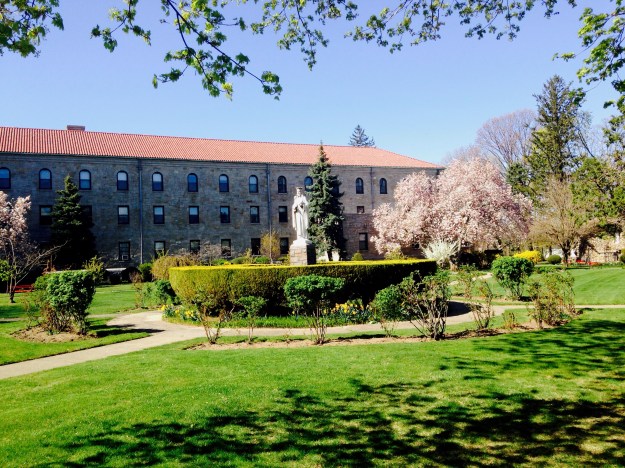
On the Feast of the Visitation of Mary to Elizabeth, May 31, we began our Mary Garden at Immaculate Conception Monastery in Jamaica, New York.

Mary Gardens, dedicated to Mary, the Mother of Jesus, appeared in 14th century Europe following the Black Death, a pandemic that caused millions to die in that part of the world. The gardens, usually found in monasteries and religious shrines, brought hope to people who feared the earth was bringing them death.

God gave Adam and Eve a garden, the Book of Genesis says. (Genesis 2, 8-28) Rising from the dead, Jesus proclaimed eternal life in a garden. (John 20,11-18) For early and medieval Christians, Mary, the Mother of Jesus, was like a garden enclosed, flowers, plants and trees surrounded her, “our life, our sweetness and our hope.” As the “Mother of the living” she brought the promise of life to our world, Jesus, her Son.

Can a Mary Garden bring hope today to our world that faces climate change and environmental degradation? Mary reminds us creation is a gift of God’s love. A Mary Garden teaches reverence for creation, for the soil, for plants that feed and bring us healing, for flowers that nourish our sense of beauty.

Yes, science and technology play their part in an environmental crisis, but faith has a part to play. We’re planting a Mary Garden!

A Reading from the Book of Genesis
This is the story of the heavens and the earth at their creation. When the LORD God made the earth and the heavens there were no plants on the earth, no grass on the fields, for the LORD God had sent no rain and there were no human beings to till the ground, but a stream was welling up out of the earth and watering all the surface of the ground and the LORD God formed a human being out of the dust of the ground and blew into his nostrils the breath of life, and he came to life.
The LORD God planted a garden in Eden, in the east,* and placed there the one whom he had formed… to cultivate and care for it. (Gen 2, 4-15)

Let us Pray

Praise the Lord who is good,
Sing to our God who is loving,
To the Lord our praise is due.

Who covers the heavens with clouds
and prepares the rain for the earth.
And makes mountains sprout with grain
and plants to serve our needs

You know the number of the stars
and call each one by name.
Bless the earth we break open today
O Lord,
to be a garden in praise of your name,
where we honor Mary, the mother of your Son.

We remember your blessings here
which you never cease to send
through Jesus Christ our Lord.

At The Waterfall


By Orlando Hernandez

A good Passionist priest once told me not to be suspicious of the images that come to my mind’s eye during special moments of prayer. He said that God gives us those “pictures” to help us understand the power and mystery of His love. The fragment from verse 5 of the 5th Chapter of
St. Paul’s letter to the Romans has always had such an influence on my imagination (or vision?) : “ The love of God has been poured out into our hearts through the Holy Spirit that has been given to us.”

At my son’s Parish in Florida which has a large, powerful, Pentecostal-style choir, I often find myself in the middle of Mass feeling as if a glorious waterfall is raining over all of us in that church, especially on my beloved grandchildren, who see me crying and try to “console” me! During many prayer meetings at the Passionist Monastery in NY, as we sing, praise, and pray over people, I have “seen” this unbearably bright, milk-like substance fall upon us and splash all over the chapel. At times of great peace I can actually feel the grace of God falling upon the world like mist from a waterfall.

Last month, Fr. Chris Cleary CP, spoke to us on a Day of Reflection at Bishop Molloy Retreat House in Queens, NY. He was talking about the Holy Spirit in our everyday lives, how the Spirit leads us to see God in everyone around us. It was a very moving presentation. It truly spoke to me, sometimes I tend to ignore those around me. And then, at the end, he invited us to close our eyes and let him lead us through a meditation. He took us through green pastures, hills, and forests until we got to a lovely waterfall. He invited us to sit on a rock and within that “holy space” imagine Jesus coming and sitting with each one of us. I enjoy these meditations. They can be interesting or even entertaining, but that day, oh boy, I was TAKEN by it. I really met my Lord at the waterfall. It was so overwhelming and mysterious that I do not have the images or words to describe what I saw, heard and felt. I guess the Lord decided to hit me hard that day, and He did !

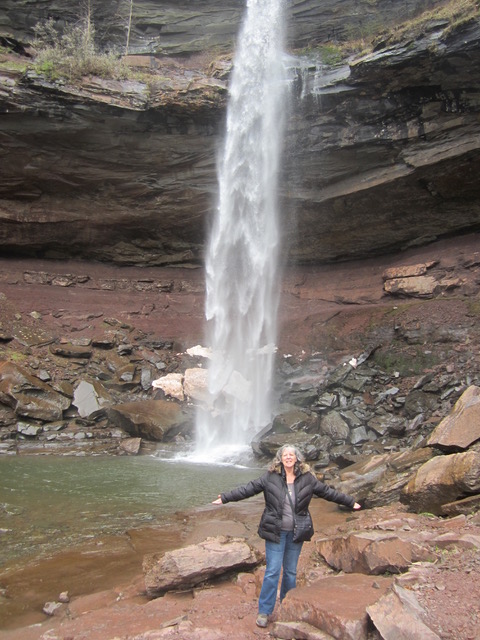
The waterfall in the vision was an actual place that I love, The Upper Falls of Kaaterskill Creek in the Catskill Mountains of New York state. My wife Berta loves the place too, so the next week we drove the three-plus hours to the place. I wanted to “meet” Jesus there to re-live the meditation experience. The one-mile hike is not that hard, but I still had to use my cane. My wife and I held each other as we negotiated the slippery rocks on the trail. We finally got there and it was awesome. Because of the recent rains the water was roaring over the edge of the 100 feet-high cliff that was looming over us. Cool midst would fog up my glasses within seconds, but we found a fairly dry, comfortable rock near the edge of the cliff behind us, where the creek poured over the Lower Falls into the vast mountain ravine.

We sat there looking at the ghostly patterns formed by the falling water before us, and “waiting” for Jesus. Well, it wasn’t at all like my experience during the meditation. The place was full of people! There were various young persons hopping from rock to rock, climbing up the grotto behind the waterfall. There were dogs of all sizes and colors carefully held in leashes by their owners. And many children- the older ones trying to skip to the other side of the creek, getting their feet soaked, the little ones vey carefully watched and chased by their parents. People came and went. We had a nice lunch at our rock and watched and watched the falling water and the people until it was time to scramble back up the trail to our car.

Oh well, no intimate communion with Jesus, no precious mystical moment, no deep prayer. Such gifts, as we all have to accept, come in God’s own time. But now, in retrospect, I remember that day with such gladness. Of course our Lord was there. He was there in His people, His lovely children. They actually did not bother me at all. They were nice to look at! We were all sharing in the miracle of God’s creative power. Even if we did not realize it we were sharing a blessed moment. We were in a “holy space”. I just did not appreciate it at that time.

Today I remember the original intent of Fr. Chris’ talk. We can find God in the most ordinary moments. The Holy Spirit is present in all the people that crowd our spaces. And I thank God that I now re-live the happiness that I felt there, so close to my wife and even to those around us as the love of God was being poured unto us.

By Orlando Hernandez

4th Sunday b: Deliver Us From Evil

For this weeks homily please play the video below:

Mary Gardens

Andrea Oliva Florenda, a professor at St. John’s University in Queens, New York, offered a day of reflection on Mary Gardens, December 1 at Bishop Molloy Retreat Center, Jamaica, New York. Professor Florenda teaches in the department of theology and religious studies at St. John’s, specializing in Marian theology. She’s also the designer and curator of the Marian Garden at the university.

Mary Gardens, dedicated to Mary, the Mother of Jesus, appeared in Europe following the Black Death, a pandemic that caused millions of deaths in that part of the world in the 14th century. The gardens, usually found in monasteries and religious shrines, brought hope to people walking “in the shadow of death.”

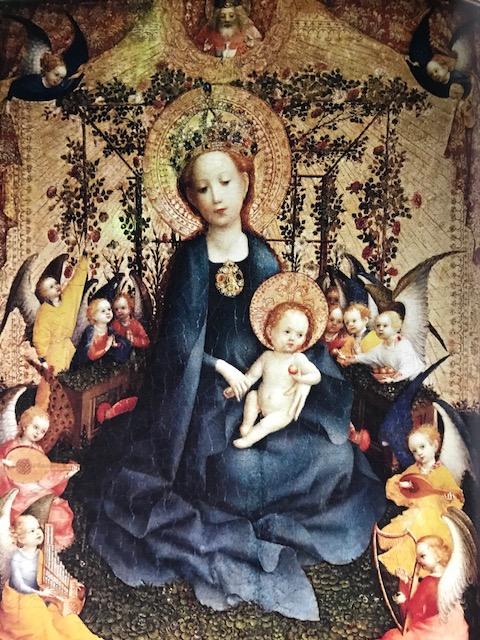
God placed Adam and Eve in a garden, Christian tradition says. (Genesis 2, 8-28) Rising from the dead, Jesus proclaimed eternal life in a garden. (John 20,11-18) For early and medieval Christians, Mary appeared as a garden enclosed, flowers, plants and trees surrounded her, “our life, our sweetness and our hope.” The Mary Garden, which became a favorite inspiration for medieval and renaissance artists, brought the promise of life to the “poor banished children of Eve.”

Does the Mary Garden have a role today in a world facing climate change and environmental degradation? Professor Florenda thinks it does. Besides the mysteries of faith, it teaches reverence for creation, for the soil, for plants that feed us and bring healing, for flowers that nourish our sense of beauty.

Certainly science and technology have a large part to play in the current environmental movement, but Professor Florenda notes the number of young people, from various religious tradition drawn to her Mary Garden at St. John’s, where the mysteries of seed and soil unfold, where pharmacy students study medicinal herbs and seasonal vegetables feed the poor.

The day of reflection on Mary Gardens ended at the grotto honoring Mary in the garden of Immaculate Conception Monastery in Jamaica. There, Professor Florenda spoke about the meaning of the grotto, its structure and the plants and trees surrounding it.

“There is a language in each flower,
that opens to the eye,
A voiceless but a magic power.
A prayer in earth’s blossoms lie.” Anonymous

Saint John Lateran

To listen to the audio of today’s homily please select file below:

Some years ago I went to Rome to visit churches. One was the Church of Saint John Lateran.

Churches have stories, which is especially true of  St. John Lateran. It’s the first of the great Christian churches built by the Emperor Constantine after coming to power early in the 4th century. He gave Christians freedom to practice their religion throughout the Roman empire. He also built them churches and St. John Lateran was the first of the many he built.  At its entrance is an inscription, “The mother of churches”; it’s been there for 1500 years.

The church, holding 10,000 people, was dedicated around  320 AD. Rome’s Christians must have been thrilled as they entered it.. Many were persecuted or has seen relatives, friends or other believers jailed or put to death during the reign of Diocletian, before Constantine.

Now, a new emperor honored them by building a church, a great Christian church, that everyone in Rome could see. He built it on property belonging to enemies of his, the Laterani family, which is why it’s called St. John Lateran. It’s situated on the southeastern edge of the city, away from the Roman Forum,  because Constantine didn’t want to antagonize followers of the  traditional religions. Still,  the Lateran church was a sign that Christianity had arrived.

Before this, throughout the Roman empire, Christians had no churches but met  in ordinary homes or small buildings. In Rome itself there were about 25 homes  where they met and worshipped.

That in itself made people wonder about them. Why didn’t Christians  participate in public rites and religious sacrifices conducted for the good of the empire, as good Romans did? What kind of religion was this anyway, people said? They’re godless, atheists. The 2nd century pagan writer Celsus saw them plotting rebellion, these “ people who cut themselves off and isolate themselves from others.” (Origen, Contra Celsum,8,2)

So, the building of the church of St. John Lateran was a signal of changing times. After centuries meeting apart in homes and small community settings, Christians now gathered as one great family.

That’s what churches do; they bring people together as one body, one family, one people. That’s how Paul described the church in his Letter to the Romans: “As in one body we have many members, and all the members do not have the same function, so we, though many, are one body in Christ, and individually members one of another.” (Romans12, 4-5)

An important part of the church of Saint John Lateran is its baptistery,  a large building connected to the church itself,  worn and patched, as you would expect from a building over 1500 years old. You can still see bricks from Constantine’s time. This is where for centuries Romans have been baptized. Conveniently, it’s built over a Roman bath, for a good supply of water for baptism. The church is called St. John Lateran because St. John the Baptist is one of its patrons, along with St. John the Evangelist. A beautiful Latin inscription is over the big baptismal basin and fount.

Those bound for heaven are born here,

born from holy seed by the Spirit moving on these waters.

Sinners enter this sacred stream and receive new life.

No differences among those born here,

they’re one, sharing one Spirit and one faith.

The Spirit gives children to our Mother, the Church, in these waters.

So be washed from your own sins and those of your ancestors.

Christ’s wounds are a life-giving fountain washing the whole world.

The kingdom of heaven is coming, eternal life is coming.

Don’t be afraid to come and be born a Christian.

One last thing about St. John Lateran, which many people don’t know. It’s the pope’s church. From the time of Constantine till the 15th century, the popes as leaders of the Church of Rome resided next to this church. Then, they moved to the Vatican, where they live today.

Celebrating the dedication of a church, as we are doing today, reminds us  how important church buildings are for teaching us our faith. God speaks to us in our churches, God comes to us in our churches.

“Do you not know that you are the temple of God,

and that the Spirit of God dwells in you?” St. Paul says.

“If anyone destroys God’s temple,

God will destroy that person;

for the temple of God, which you are, is holy.”

23rd Sunday a: Telling People They’re Wrong

For today’s homily, please play the video below:

Change and Automation


17. Theological and philosophical reflections on the situation of humanity and the world can sound tiresome and abstract, unless they are grounded in a fresh analysis of our present situation, which is in many ways unprecedented in the history of humanity. So, before considering how faith brings new incentives and requirements with regard to the world of which we are a part, I will briefly turn to what is happening to our common home.

18. The continued acceleration of changes affecting humanity and the planet is coupled today with a more intensified pace of life and work which might be called “rapidification”. Although change is part of the working of complex systems, the speed with which human activity has developed contrasts with the naturally slow pace of biological evolution. Moreover, the goals of this rapid and constant change are not necessarily geared to the common good or to integral and sustainable human development. Change is something desirable, yet it becomes a source of anxiety when it causes harm to the world and to the quality of life of much of humanity.

19. Following a period of irrational confidence in progress and human abilities, some sectors of society are now adopting a more critical approach. We see increasing sensitivity to the environment and the need to protect nature, along with a growing concern, both genuine and distressing, for what is happening to our planet.
Pope Francis, Laudato SI, 17-19

Avoiding an “irrational confidence in progress and human abilities”, we need to make “a fresh analysis of our present situation,” the pope says. He speaks of the “rapidification” of life– a fast changing world that cares little for nature or sustainable human development.

Like automation, smart cars, or whatever else puts people out of work and removes them from involvement in society or having a hand in the progress of our created world?

A Lot of Things We Don’t Know


Vacations take you away from home to somewhere else. My somewhere else for the last few days was Cape May, New Jersey, a small old town along the Jersey shore at the tip of the state.

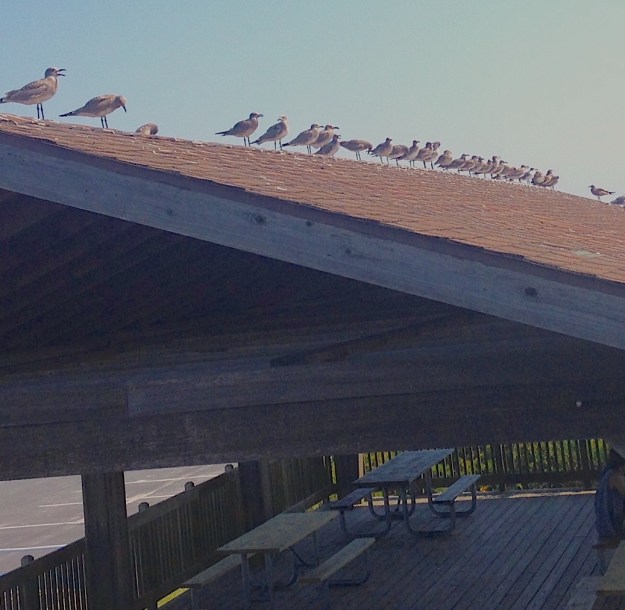
I went fishing but caught no fish. I went bird-watching at a good spot off the beach, but saw few local or migrating birds –except for the line of gulls perched on a shelter roof looking out to the sea. (Above)

Patient, they were. Why? I wondered. Were they expecting a feast from the nearby waters. Schools of baby blue fish had moved towards the shore, some fishermen said. Was that why no other fish were to be caught?

Were bigger fish on the way to feast on the baby blues? Who knows?

Something mysterious about the gulls perched patiently on the rooftop, though. Were they just taking a break, or did they know a feast was on the way and were gitting ready to swoop down on leftovers on the shore?

There are a lot of things we don’t know. You don’t have to go far from home to find that out.

The Visitor

This Wednesday’s Gospel (Lk 1: 39-56 ) tells the beautiful story of Mary’s visitation to her cousin’s house in the hills near Jerusalem.

“ Mary set out and traveled to the hill country in haste to a town of Judah, where she entered the house of Zechariah and greeted Elizabeth. When Elizabeth heard Mary’s greeting, the infant leaped in her womb, and Elizabeth, filled with the Holy Spirit, cried out in a loud voice and said,
‘ Most blessed are you among women, and blessed is the fruit of your womb. And how does this happen to me, that the mother of my Lord should come to me? For at the moment the sound of your greeting reached my ears, the infant in my womb leaped for joy. Blessed are you who believed that what was spoken to you by the Lord would be fulfilled.’ “
This is indeed a precious, sacred event. Mary goes on to “ prophesy “ with her song-like, much-beloved Magnificat, a prayer that always seems new every time I pray it.
Nearly six years ago I was blessed to visit the wooded valley of Ein Karem, one of the most beautiful places in Israel. It seems almost miraculous how, with only one turn in the road, one leaves behind the barren Judean desert and enters this lovely area full of greenery and life. Up on one of the surrounding hills we visited the place that is commemorated as the site of the Visitation. The view from up there is magnificent. A delicate, elegant church stands there, decorated with symbols of fertility, life, and womanhood. A high wall against the hillside is covered with large stone-carved versions of the Magnificat in many different languages. Joyful song seems to exude from these stones, and from the rich greenery all around. Upon reading the prayer in English and Spanish I was caught up in that joyful feeling, as if, like John, Elizabeth, and Mary, I was also “ filled with the Holy Spirit “ of the Child Jesus. That joy stayed with me for the rest of the day back in Jerusalem. I felt like if I had undergone a powerful supernatural experience, like the one described in the Gospel.
That happy memory is still so vivid in my mind. I have been a Catholic for only a few of my 67 years. Incredibly, most of the time I am still in a sort of “ honeymoon “ with my Lord Jesus, who personally came and opened my eyes to the infinite love of God. So it has taken me a while to come to appreciate and venerate the bountiful power and grace that He has given His Blessed Mother in Heaven.
Her mission seems to me to have mysterious angelic dimensions . She is not only His Messenger, whether in Tepeyac, or Lourdes, or Fatima, but every time we call her she brings her Son, in the most generous way, as she did on the Visitation. All I have to do is invoke her name and she and her Son “ visit me “.

The simple prayer of the Hail Mary tells the story. She has come to me in quiet haste in some of my most sorrowful moments. At her greeting I answer: “ Ave Maria “. The fulness of her grace pacifies my soul, and excites it too, because the Lord is indeed with her as she shares that blessing with me. The child-prophet in me can even leap for joy. The greatest blessing seems to be that of God-given faith, to actually believe that what has been spoken to my soul by my Lord will be fulfilled. She teaches me to pray and trust. She brings me hope, and most of all the boundless love of the “ fruit of her womb “, the living, present, Jesus.
And then she prays for all of us sinners. A perfect prayer is her Magnificat. There is unfettered praise, wonderment, and gratitude at God’s great love. Once again most of all there is trust : trust in the mercy, the strength , the justice, and generosity of our God for all of us, for in one way or another, we are the lowly, the poor, the hungry.
Thank you, Blessed Mother, shining example for all saints, bringer of solace, sister, friend.

Orlando Hernández

Immaculate Conception Church, Irvington on the Hudson

The Archdiocese of New York has a renewal program called Revive taking place in its parishes this year. The program comprises a reading from scripture, a sermon on the purpose of life, a witness talk, prayers and hymns.

This week, Monday, Tuesday and Wednesday evenings at 7:00 PM, I’m taking part in the Revive program at Immaculate Conception Parish, Irvington on the Hudson, NY. Besides Immaculate Conception, Sacred Heart, Our Lady of Pompeii, St. Matthew, and Our Lady of Perpetual Help Parishes are taking part in Revive.  I’m giving the sermon and will be offering some of the prayers.

Here’s the way I opened our mission this evening: