Category Archives: spirituality

Ordinary Time and Daily Prayer

The Christmas Season closes after the Baptism of Jesus, which we celebrate this Sunday. The Christmas celebrations are over. Ordinary time begins. Does that mean there’s nothing to do till Lent and the Easter season?

Sure there is. Ordinary Time is a time for daily prayer, and daily prayer is never over. The Second Vatican Council’s Constitution on the Liturgy says that daily prayer is at the heart of the Christian life and created a daily lectionary of scripture readings so “ the treasures of the bible be opened more lavishly for the faithful at the table of God’s word.” (SC 51)

The daily lectionary is a treasure for praying with the scriptures, but don’t take it for granted. Treasures, Jesus said, are usually hidden and you have to dig for them. That’s what we do in daily prayer. The liturgy is always a “work”, our daily work, an important work, a daily prayer. It’s the “summit” of the Christian life. We’re always at the beginning, not at the end.

We begin Monday to read the Letter to the Hebrews and the Gospel of Mark from our lectionary. There are feasts of the Lord and his saints to celebrate in the days ahead. It’s a lifelong learning we’re into, a school God provides,  and we learn day by day.

Noah’s ark, the Magi, the Slaughter of the Innocents

Noah’s ark, the Magi, the Slaughter of the Innocents. “They’re just myths,” you hear it said. I don’t like those stories dismissed that way, because it easily leads to a further dismissal: ”Is any of it true? Probably not.”

We think straight reporting is the only thing true. “Just the facts, Mam.” Everything else is fake news. But are these stories fake?

https://www.youtube.com/watch?v=Oj2bS2Rrj3g

“The Secrets of Noah’s Ark” a recent Nova program on PBS examining the biblical story makes good sense to me. In early times, floods were common in the “Fertile Crescent” the area in Mesopotamia {modern Iraq} where the Tigris and Euphrates Rivers and the ancient city of Babylon were located. So you had to keep boats handy– you never know.

You had to be ready for a great flood too, but people have short memories and people then, as now, tend to forget “the big ones.” “As it was in the days of Noah, so it will be at the coming of the Son of Man. In those days before the flood, they were eating and drinking, marrying and giving in marriage, up to the day that Noah entered the ark. They did not know until the flood came and carried them all away.” (Matthew 24, 37-38)

I suspect some Babylonian priests– meteorologists and story tellers of their time– came up with a flood story thousands of years before the Noah story to keep the people of their day on their toes – and maybe challenge some early climate change deniers too. It reinforced important advice: “ Keep your boats in good shape and make sure there’s also a big boat around for ‘the big one.’”

dsc00301

Exile of Jews  to Babylon

In 587 BC, thousands of Jews were driven from Jerusalem, destroyed by Babylonian armies, and were forced to make the thousand mile journey in Babylon. It was their Exile. When they heard the story of the great flood they saw it as a symbol of their own tragic circumstances. “By the rivers of Babylon, we sat and wept, remembering Zion.” (Psalm137)

Returning from exile, the Jews incorporated their version of the flood story into the Torah. It became a reminder to keep the covenant God made with them and beware of living unfaithfully as “in the days of Noah.”

Does real history underlie the story of the Magi and the Slaughter of the Innocents? Begin with Herod the Great, ruler of Palestine then, whom secular sources and many archeological monuments from the time describe quite well. Herod was a micro-manager who built fortified palaces in Jerusalem, the Herodium outside Bethlehem and other places to keep watch over his kingdom.

dsc00291-version-4

Citadel, Herod’s Palace Fortress, Jerusalem

fullsizerender

Herodium, Mountain Fortress of Herod the Great

He promoted trade with the outside world; he built the seaport of Caesarea Maritima on the Mediterranean Sea and cultivated the trade routes from Yemen and other eastern parts that led all the way to Rome. He would have kept tabs on those arriving with spices and luxury goods of all kinds. He knew who came and went.

Were the Magi wealthy eastern traders, quite knowledgeable about the religious world of the people with whom they traded? Did they hear of the Child in Bethlehem? Herod’s advisors and everyone else knew Bethlehem was associated with the legendary King David and there were prophecies about an heir to his throne coming from there. Did the foreigners visit the Child, bring their gifts, gold, frankincense and myrrh, the prizes of their trade, and then quickly leave, well aware of Herod’s paranoia, quick temper and brutality.

Given Herod’s jealous hold on power, the story of the slaughter of the Innocents in Matthew’s Gospel doesn’t seem unlikely, True, it’s not mentioned in any secular source, but neither are many other tragic stories of the time. Bethlehem, after all, was a small town, off the beaten track. The death of perhaps 20 or so infants might go unnoticed and be quickly forgotten.

Matthew’s story is hardly a myth. Rather, it sees things through God’s eyes. The star points to the real power guiding human history; the magi represent the rest of the world coming to adore the Child. Angelic powers are always at our side. The slaughtered infants are like so many tragic deaths that seem to question God’s promise of life, but God doesn’t forget, the story says, even if human history doesn’t remember. “The souls of the just are in the hands of God and no torment shall touch them.”

If you ever visit Bethlehem, go to see the Herodium, Herod’s massive fortified palace looking down on the nearby town. Joseph wouldn’t need much urging to take the Child and his mother from this place,would he? Go to the Citadel in Jerusalem built on the highest spot in the city. You can walk where Herod once walked and imagine him looking down on his kingdom. But it was not his kingdom, after all, it was God’s. Go to Caesaria Martima, the splendid port city created by Herod. Did the Magi’s caravans reach here?

Then ask yourself if the stories of Jesus’ birth and infancy are myths.

dsc00006

Caesaria Maritima

Guardian Angels

We usually associate Guardian Angels with children. In the gospel reading for the Feast of Guardian Angels, October 2, Jesus says we can’t get to heaven unless we become like little children whose “angels in heaven always look upon the face of my heavenly Father.”  (Matthew 18,1-5,10)

Artists, like the above, usually picture children with Guardian Angels, protecting and guiding them as they go on their way in a dangerous world.

Yet, the angels we read about  in the Bible are more than guardians of children; they’re signs of God’s guardianship of the whole world. They bring God’s message to Mary and Joseph and the prophets. They bring bread to Elijah in the desert and save Daniel in the lion’s den. Angels are part of God’s providential hand dealing with the world. They’re guardians and guides of nations, the human family and creation itself.  They’re everywhere instruments of God’s power and love and justice. 

This week’s news will be dominated, as usual,  by politics, wars, human tragedies and scandals, but here we are reading about guardian angels, who will never make the news of the day, yet are powerfully present in our world.  However smart or independent or grown-up we think are, God knows we’re still little children. We never outgrow God’s guidance and care: we have “loyal, prudent, powerful protectors and guides. They  keep us so our ways cannot be overpowered or led astray.” So that’s us in the picture above.

I think of the “principle of subsidiarity” on the feastday of the Guardian Angels. God spreads his  power around. I also remember that sometime ago I nearly hit a truck ahead of me but something suddenly stopped me. “Thanks.”

O God,
in your infinite providence you deign to send your holy angels to be our guardians. Grant to us who pray to you
that we may be defended by them in this life
and rejoice with them in the next.
Through our Lord Jesus Christ, your Son.

St. Thérèse of Lisieux: October 1

therese-close

We celebrate the feast of St. Thérèse, a Doctor of the Church, October 1. Saints are antidotes to the poisons of their times, G.K. Chesterton once wrote. They reveal what’s wrong in their world and counteract its poison by their own lives. Mother Theresa, for example, saw a world poisoned by its neglect of the poor.  She not only pointed out the evil but did something to remedy it.

What poison does St. Thérèse reveal? She lived in late 19th century France, when the poison of unbelief, which first infected French intellectuals like Voltaire, had spread to the country’s ordinary people. Many rejected faith in God and traditional religion. In their place they put their trust in reason and their own lights. As the psalmist said of his day, “There is no thought of God in them.”

Raised in a family of firm faith and traditional beliefs, Thérèse’s childhood was nourished by a sheltered life. Her faith grew in the Carmel of Lisieux, which she entered at 14. There she lived a life of prayer, with people of faith inspired by the spiritual wisdom of the Carmelite tradition. Yet limitations of sickness and unrealized dreams challenged her.

In her last days, she was plunged into a darkness that brought her an experience of  the poison of unbelief. God permitted her to be “invaded by the thickest darkness,” she said, and “the thought of heaven, up to then so sweet to me, was no longer anything but a cause of struggle and torment.”

In her experience she saw herself as a voice for those who do not believe.

“Your child, however, O Lord, has understood Your divine light, and she begs pardon for her brothers. She is resigned to eat the bread of sorrow as long as You desire it; she does not wish to rise up from this table filled with bitterness at which poor sinners are eating until the day set by You.

Can she not say in her name and in the name of her brothers, “Have pity on us, O Lord, for we are poor sinners!” Oh! Lord, send us away justified. May all those who were not enlightened by the bright flame of faith one day see it shine. O Jesus!

if it is needful that the table soiled by them be purified by a soul who loves You, then I desire to eat this bread of trial at this table until it pleases You to bring me into Your bright Kingdom. The only grace I ask of You is that I never offend You!” (Manuscript C, chapter 10)

Sharing the darkness that comes with unbelief, Thérèse  prayed in their name, “’Have pity on us, O Lord, for we are poor sinners!’ Oh! Lord, send us away justified. May all those who were not enlightened by the bright flame of faith one day see it shine. O Jesus!”  Her “struggle and torment” linked her to unbelievers “ not enlightened by the bright flame of faith.”

Mother Theresa seems to have had a similar experience of that darkness. Do other believers today share, in different degrees and different ways, that experience of darkness, that “dark night”, so that “those not enlightened by the bright light of faith may one day see it shine?” It seems so.

Here’s a description of how Thérèse  saw herself:

Since my longing for martyrdom was powerful and unsettling, I turned to the epistles of St Paul in the hope of finally finding an answer. By chance the 12th and 13th chapters of the 1st epistle to the Corinthians caught my attention, and in the first section I read that not everyone can be an apostle, prophet or teacher, that the Church is composed of a variety of members, and that the eye cannot be the hand. Even with such an answer revealed before me, I was not satisfied and did not find peace.

  I persevered in the reading and did not let my mind wander until I found this encouraging theme: Set your desires on the greater gifts. And I will show you the way which surpasses all others. For the Apostle insists that the greater gifts are nothing at all without love and that this same love is surely the best path leading directly to God. At length I had found peace of mind.

  When I had looked upon the mystical body of the Church, I recognised myself in none of the members which St Paul described, and what is more, I desired to distinguish myself more favourably within the whole body. Love appeared to me to be the hinge for my vocation. Indeed I knew that the Church had a body composed of various members, but in this body the necessary and more noble member was not lacking; I knew that the Church had a heart and that such a heart appeared to be aflame with love. I knew that one love drove the members of the Church to action, that if this love were extinguished, the apostles would have proclaimed the Gospel no longer, the martyrs would have shed their blood no more. I saw and realised that love sets off the bounds of all vocations, that love is everything, that this same love embraces every time and every place. In one word, that love is everlasting.

  Then, nearly ecstatic with the supreme joy in my soul, I proclaimed: O Jesus, my love, at last I have found my calling: my call is love. Certainly I have found my place in the Church, and you gave me that very place, my God. In the heart of the Church, my mother, I will be love, and thus I will be all things, as my desire finds its direction.

Feasts are for Reflection

Ryrson cross

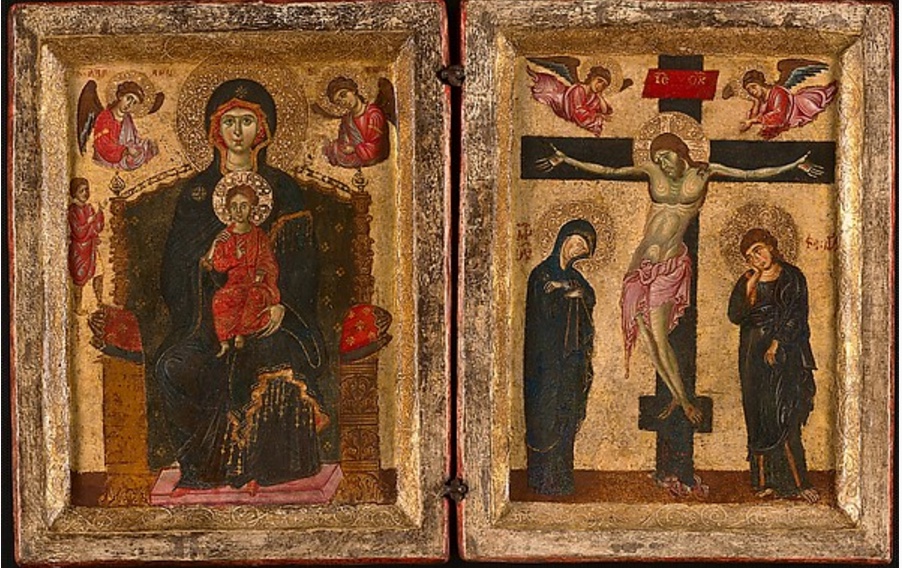
A 13th century European pilgrim to the Holy Land brought this icon home as a reminder of his pilgrimage. What places did that pilgrim visit? Surely, Bethlehem where Jesus was born, and Jerusalem where he was crucified and rose  from the dead. In both places , Mary was there with her Son.

In the picture on the left Mary is a joyful mother holding her Son, a divine Son whom the angels praise.  She is a daughter of Abraham, Isaac and Jacob, a daughter of the human family whom she represents. She never loses that joy, which she invites us to share.

In the picture on the right, Mary stands with John, an image of the church, beneath the cross of Jesus. Angels are astonished at the sight. Jesus seems to enfold his mother and the disciple whom he loves in his arms..

The gospel reading from St. John for the feast of Mary’s Sorrows says simply that Mary stood by the cross of Jesus. She’s a brave woman, not afraid to come close to the fearful place where Jesus was put to death. The Book of Judith, ordinarily the 1st reading for the feast, praises Judith, the brave and wise Jewish woman who’s not afraid to stand with her people at a dangerous moment in their history. Two women of courage face suffering and the challenge it brings.

The prayers, traditions and art of this feast take up the theme of Mary standing by the cross. She’s remembered  in poetry, music and art. “Stabat Mater” Here’s an example in Gregorian Chant and Pergolesi’s magnificent baroque setting.

At the cross her station keeping
Stood the mournful mother keeping
Close to Jesus to the last.

Women mystics, like St.Bridgid of Sweden, a mother herself and an important pilgrim to the Holy Land, saw the life of Jesus, particularly his passion, through a mother’s eyes. Wouldn’t Mary draw close to her Son’s cross and then hold him in her arms as they brought him down. The gospels do not mention it, but women like Bridgid were sure it was  so.

Women mystics like Bridgid gave us the Pieta.

A study of the Pieta in art in early medieval France shows the various ways this scene was pictured in art before Michaelangelo’s Pieta became an overpowering icon surpassing others. “Often she is viewed as caught up in the horror of the moment, but she is also shown praying or even gazing into the distance, as if contemplating comforting memories or the reunion to come. Her demeanor ranges from youthful innocence—the Purity that Time cannot age—to careworn maturity—Our Lady of Sorrows.”

Sorrow. like joy, has a range of faces. Mary shows us them all.

The Gospel of Luke and First Corinthians Go Together

We’re reading Paul’s 1st Letter to the Corinthians and the Gospel of Luke together these days at Mass. The two may be more closely connected than we suspect. Luke wrote some years later than Paul, but his audience would be much like those found in the church of Corinth.

Theophilus, to whom Luke dedicates his gospel, could easily be one of Corinth’s better-off Christians, who surely  would recognize  the lack of concern for the poor that Jesus condemns in Luke’s gospel as present in his own community as well. That unconcern appeared at table, in the celebration of the Eucharist in the Corinthian church, and Paul condemns it. (1 Corinthians 11, 17-22) Luke presents Jesus, over and over, at table, condemning the same unconcern for the poor as well.

Luke begins Jesus’ ministry in Galilee with his visit to Nazareth (Luke 4, 16-30) where he’s not recognized by his own who know him too well and are ready to throw him to his death over the hill.

The Corinthians–how many we are unsure– fail to recognize the humble Savior whom Paul preaches. “I did not come with sublimity of words or of wisdom. For I resolved to know nothing while I was with you except Jesus Christ, and him crucified.” (1 Corinthians 2, 1-5)

In Luke’s gospel, Jesus is the teacher and Lord bringing God’s word to the towns of Galilee. He brings God’s word to Corinth as well, but the Corinthians are attracted to the various disciples of Jesus, causing “jealousy and rivalry among you…Whenever someone says, ‘I belong to Paul,’ and another,’I belong to Apollos,’ are you not merely men? What is Apollos, after all, and what is Paul? Ministers through whom you became believers, just as the Lord assigned each one.”

God plants and waters the growth of his church; the disciples are disciples, only disciples, who must have “the mind of Christ.” (1 Corinthians, 3, 1-9)

Luke has a church like Corinth in mind when he writes his gospel. How about our church too, as we take  sides. “I belong to…” Good to read these two readings together now.

Readings.

Ezechiel, for those over Thirty

We‘re reading the Prophet Ezekiel at Mass these days. Early Jewish scholars considered him hard to read; only those over 30 should read him, some said. We have the same difficultly. The lectionary for today, Friday in the 19th week of the year, offers a gruesome story of infanticide. A infant girl is thrown out to die. Not a pretty story to look at.

It’s a story harsh to hear and hard to understand. Infanticide, a form of abortion. child abuse, gender discrimination, prostitution, ingratitude, forgetfulness of God. Ezechiel describes his own society in dark terms. Yet, all the while God is there. We’re offered a shorter version in our lectionary to spare us from the ugly details.

But don’t miss God’s intervention:

“You became mine, says the Lord GOD.Then I bathed you with water, washed away your blood, and anointed you with oil. I clothed you with an embroidered gown, put sandals of fine leather on your feet; I gave you a fine linen sash and silk robes to wear. I adorned you with jewelry… You were exceedingly beautiful, with the dignity of a queen.”

“But you were captivated by your own beauty,
you used your renown to make yourself a harlot,
and you lavished your harlotry on every passer-by,
whose own you became.”

“Yet I will remember the covenant I made with you when you were a girl,
and I will set up an everlasting covenant with you,
that you may remember and be covered with confusion,
and that you may be utterly silenced for shame
when I pardon you for all you have done, says the Lord GOD.”
{Ezechiel 16, 1-69)

Ezeckiel’ story of the abandoned girl is a story of sin and redemption. All the while God is there.

Look at the hard times, don’t ignore or hide from them, but see them with the eyes of God, the prophet says. “Thus says the Lord GOD,” I swear I am coming… I will claim my sheep…I will save my sheep…I myself will look after and tend my sheep.” (Ezekiel 34,1-11)

Good words for us today?

Life Comes from His Wounds

ICON

The Passionists celebrate the Feast of the Glorious Wounds of Jesus on Friday of the second week of Easter. The four gospels tell the great story of the passion of Jesus, each in its own way. More than the others, John’s gospel focuses on his wounds, unlikely signs revealing the mystery of the Word made flesh.

On Calvary  a small symbolic group stands beneath the cross of “the King of the Jews”– Mary, the mother of Jesus, the disciple whom he loved, and a few others. A gentile soldier joins them.

This group represents the “new Jerusalem,” “the inhabitants of Jerusalem who look on the one whom they have pierced…and mourn for him, as one mourns for an only child.” (Zechariah 11, 10 )

They receive a precious gift. “It is finished!” Jesus declares, and bowing his head, he pours out his spirit on them. A Roman soldier thrusts a spear into Jesus’ side. “Immediately blood and water flowed out.” (John 19, 34)

Blood, a sign of his life, flows on those standing beneath his cross. Water, signifying the Spirit within him, is poured out on the world they represent. Far from ending his life, his death is the moment Jesus shares his life.“This is the one who came by water and blood, Jesus Christ.” (I John 5,6)

Artists afterwards picture the wounds of Christ as cosmic signs. They place the grave of Adam beneath the cross — generations wait for the new life Jesus brings. Creation, symbolized by the sun and moon, looks on expectantly, for Calvary is where creation too is redeemed. Angels collect the blood and water from Jesus’ wounds in cups representing the mystery of the Eucharist. All days are found in this one day. On Calvary, the glory of the Lord is revealed in his wounds.

St. Paul of the Cross in his letters often wished the one to whom he’s writing to be placed in the “wounds of Christ” or the “holy Side of Jesus” or his “Sacred Heart.”  “I am in a hurry and leave you in the holy Side of Jesus, where I ask rich blessings for you.”

These expressions may seem pious phrases until we read the story of Thomas from John’s gospel. Jesus shows the doubting disciple the wounds in his hands and side, and Thomas believes.

Belief is not something we come to by ourselves. God gives this gift through Jesus Christ. We all stand beneath the life-giving Cross of Jesus. May his life give new hope to us and our world.

The Spring Rains Come

 April showers. Spring rains. A bowl of Easter Water stands near our altar during the Easter season.

Cyril of Jerusalem has a wonderful sermon on water that he preached to catechumens centuries ago. Here are a couple of lines:

“Water comes down from heaven as rain, and although it is always the same itself, it produces many different effects, one in the palm tree, another in the vine, and so on throughout the whole of creation. It does not come down, now as one thing, now as another, but while remaining essentially the same, it adapts itself to the needs of every creature that receives it.”

The saint goes on to say that just as water adapts itself to every creature, the Holy Spirit gives life to each one according to its needs and to benefit the common good. The Spirit’s coming is gentle, not felt as a burden, with tenderness, as a true friend, to save, heal, counsel, strengthen and console.

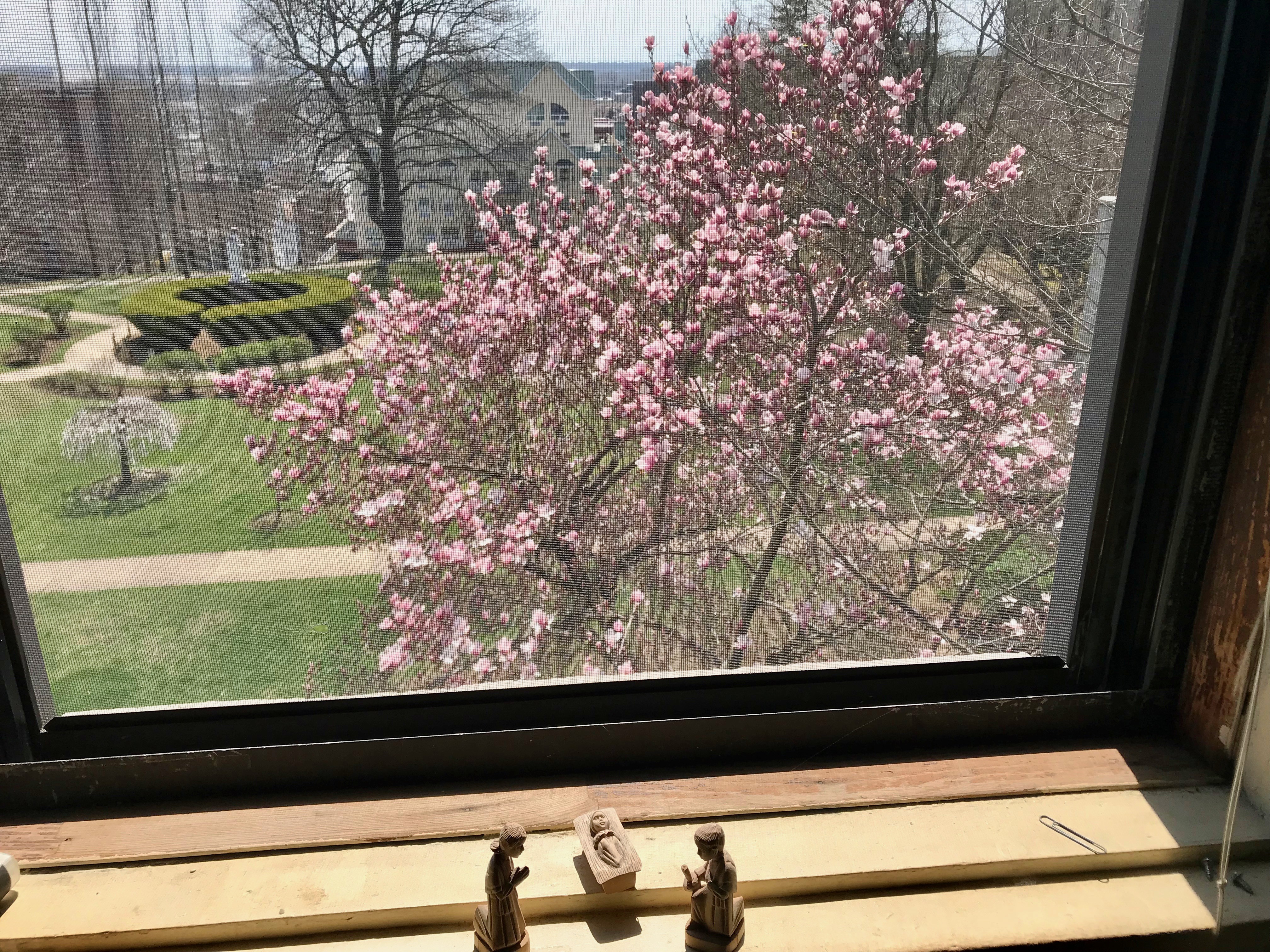
So back to spring rains. They have come this year.  The magnolia trees outside my room testify they’ve come, and the other trees and plants in our garden testify too. The rain falling on the earth does what it always does. Like the Spirit of God, water brings life.

Might we learn from the spring rains bringing life to all the varied plants, all shapes, all sizes, even some we might think useless or of no account?. Might we learn from the spring rains?

Send the spring rains, Lord, on our varied earth and human family.

Sustainable Development Goals:2023


In September 2015 world leaders at the United Nations agreed to work for 17 Sustainable Development Goals by 2030. The goals aim to “eliminate poverty, fight inequality and tackle climate change, while ensuring no one is left behind. They recognize that ending poverty must go hand-in-hand with strategies that build economic growth and address a range of social needs including education, health, social protection, and job opportunities, while also tackling climate change and environmental protection.” https://www.un.org/sustainabledevelopment/development-agenda/

The United Nations will convene a summit on the Sustainable Development GoalsDG 18-19 September 2023 at its Headquarters in New York, during the General Assembly high-level week. The goals at this point “are in deep peril. For the first time in decades, development progress is reversing under the combined impacts of climate disasters, conflict, economic downturn and lingering COVID-19 effects. The SDG Summit serves as a rallying cry to recharge momentum, for world leaders to come together, to reflect on where we stand and resolve to do more. It is a moment to recommit to a vision of the future that ensures no one is left behind. Fundamental shifts in commitment, solidarity, financing and action must put us back on track to end poverty, realize just societies and reset a balanced relationship with the natural world.” (UN report)

Cities are still an important focus for Sustainable Development, because today more than half the world’s population lives in cities and that number is expected to reach two-thirds by the year 2060. In cities “the battle for sustainability will be won or lost,” one UN expert remarked. https://www.un.org/sustainabledevelopment/blog/2018/07/un-forum-spotlights-cities-struggle-sustainability-will-won-lost/

The 11th goal of Sustainable Development is “making cities safe, inclusive, resilient and sustainable by 2030. Sustainability differs from city to city, but quality of life means among other things, adequate housing, work and employment, clean water and air, access to public transportation.

Today many countries are at war, building walls and wondering only about themselves. Why not think big? What can we do? The USA ranks 39th in fulfilling the goals. Our church, at least here in the US doesn’t seem active enough. Maybe better said: we’re not active enough. Yesterday’s blog was on the Israelites grumbling in the desert. Could be us.

Here’s the current report on the goals: https://sdgs.un.org/gsdr/gsdr2023