Category Archives: Passionists

The Saints March In

Last week was the feast of Saint Agatha, a early woman martyr from Catania in Sicily. We mentioned her at Mass that day among the women listed in the 1st Eucharistic Prayer, which many believe comes from the hand of St. Gregory the Great. (540-604 AD)

Some say Gregory’s mother or grandmother, I don’t remember who, got him to put Agatha’s name in the prayer because they had roots in Sicily and were devoted to the young martyr. Could be.

Rome was collapsing in Gregory’s day as barbarian invaders swept over the Italian peninsula, plundering, burning and destroying. It was the worst of times, and lots of people, among them the well-to-do residents of the Celian Hill where Gregory lived, were getting out of the troubled city as fast as they could.

But the saints weren’t marching out, they were “marchin in.” Those two lists of saints in the Roman canon were Gregory’s army, his enduring support. Their nearby  shrines were fortresses that sustained him. John and Paul, soldier saints who opposed a mighty army;  Cosmos and Damian, the doctors who cured and didn’t mind not getting paid,   Lawrence, who saw the poor as the treasures of the church. Besides Agatha, there was Cecilia, Agnes–strong Roman women of faith who wouldn’t give in, not matter what. All of them were still there in their churches. Gregory saw them, I think, as friends at his side, when so many others had left, and he wanted to remind others too that they were there.

And so we pray at the Eucharist “in union with the whole church.” The times may be rough, but we draw strength from the whole church, the saints living among us and those in glory who, in turn, get their strength from Jesus Christ.

At the Name of Jesus

A shelf of scripture commentaries and theology books wont bring me wisdom of themselves, St. Bonaventure says in his Breviloquium, otherwise only scholars would enter the kingdom of heaven.

“The stream of holy Scripture flows not from human research but from revelation by God. It springs from the Father of lights, from whom all fatherhood in heaven and on earth takes its name. From him, through his Son Jesus Christ, the Holy Spirit flows into us; and through the Holy Spirit, giving, at will, different gifts to different people, comes the gift of faith, and through faith Jesus Christ has his dwelling in our hearts. This is the knowledge of Jesus Christ which is the ultimate basis of the solidity and wisdom of the whole of holy Scripture…

If we are to follow the direct path of Scripture and come straight to the final destination, then right from the beginning – when simple faith starts to draw us towards the light of the Father – our hearts should kneel down and ask the Father to give us, through his Son and the Holy Spirit, true knowledge of Jesus and of his love. Once we know him and love him like this, we shall be made firm in faith and deeply rooted in love, and we can know the breadth, length, depth and height of holy Scripture.”

It’s the tradition of my community to begin prayer with a short reminder of our dependence on God’s revelation in Jesus Christ. “At the name of Jesus, every knee shall bend, in the heavens, on earth and under the earth, and every tongue proclaim to the glory of God the Father–Jesus Christ is Lord.”

Preaching in the World Marketplace

Today,  24 January 2010, Feast of Saint Francis de Sales and World Communications Day, Pope Benedict XIV urged priests, as he previously urged others in the church, to discover new possibilities in the “new media” for carrying out their ministry of preaching the Word of God. “Church communities have always used the modern media for fostering communication, engagement with society, and, increasingly, for encouraging dialogue at a wider level. Yet the recent, explosive growth and greater social impact of these media make them all the more important for a fruitful priestly ministry. “

For the pope, the new media is an important way of preaching the gospel, especially to the younger generation and to the world beyond the church and he calls on priests “to proclaim the Gospel by employing the latest generation of audiovisual resources (images, videos, animated features, blogs, websites) which, alongside traditional means, can open up broad new vistas for dialogue, evangelization and catechesis.”

There’s a new “agora,” a world marketplace, where Christ must be proclaimed. Get out there.

Bravo.

Sepphoris

Today’s gospel from Luke says that Mary and Joseph customarily took the Child up to Jerusalem for the yearly Passover feast. But was Jerusalem the only place they took him? Surely, they had friends and relatives in Cana and Capernaum, as well as in the Judean hill country, whom they visited from time to time? I don’t think they were a reclusive family hiding in the hills.

What about Sepphoris– Zippori the Israeli call it today– the capital of Galilee at the time, about five miles away from Nazareth, an easy walk for people then? According to one tradition, Mary’s family came from there. For the past decade, archeologists have been uncovering the ruins of this fascinating city.

Sepphoris was a flourishing place in Jesus’ day where, unlike Nazareth, gentiles and Jews lived together. Like other cities it was built on a hill surrounded by fertile valleys; looking east you could see the Mediteranean Sea. The city had a theater that sat 4,500 people, gleaming mansions with sparkling mosaics, streets lined with shops and public buildings. It was a center for tax-collecting and trade.

For sure, Galilee’s ruler, Herod Antipas, had his father’s taste for building. As in Jerusalem, building must have been going on there all the time. Did Joseph, a “builder” according to the gospel, work there? Did he bring his Son along with him? Did people from Nazareth bring their produce to the city to sell to the residents who smiled at the “simple” Nazarenes? Did Jesus see there how proud bureaucrats, like Pilate and Herod,”made their authority felt.” Did he watch the tough Roman legionnaires based there and recognize how futile a fight against them would be?

Sepphoris must have been one of the places, like Jerusalem, where Jesus learned about the world. The two wise teachers who mostly helped him understand what he saw were Mary and Joseph, “simple” people from Nazareth. But there must have been other family members and friends too who brought him up.

Angels didn’t.

The Feast of the Holy Family reminds us it’s not where you go to school, or where you live, or what things you have that’s important. It’s who brings you up?

On to Nazareth

This year we go quickly, too quickly I think, from Bethlehem to Nazareth for the Feast of the Holy Family on Sunday.

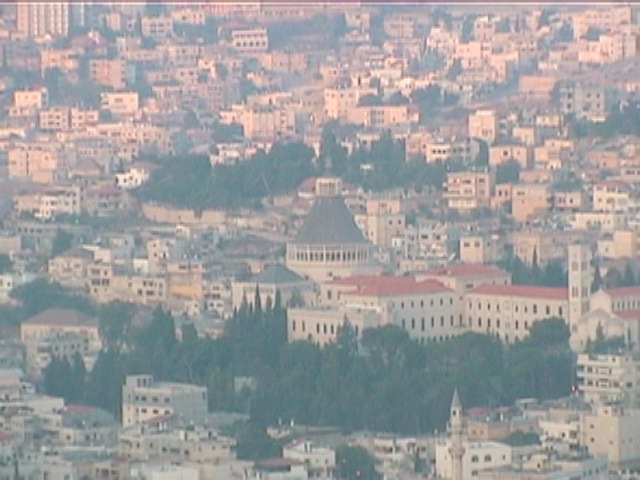
According to a story from CNN this week, Israeli archeologists announced that they had uncovered the remains of a house in Nazareth from the time of Jesus. It’s near the Church of the Annunciation, the large Franciscan church that’s built over the center of the ancient town.

The house has two small rooms, a courtyard with a cistern for gathering rainwater and a pit the archeologists speculate was dug as a hiding place at the time the Roman army invaded Israel in the mid 60s. It may not be the actual house where Jesus lived, but it would be like it.

They say that Nazareth probably had about 50 of these modest dwellings, clustered together, where families or groups of families lived. They tended small farms on the outskirts of the town.

This was where Jesus Christ was brought up and spent most of his life. Hardly a showcase for someone Christians call “the Light of the World,” But it was the place God’s Son chose to live among us. Another mystery to wonder about.

CNN also carried a story called Passions Over the Prosperity Gospel: Was Jesus Weathy? The “prosperity preachers,” evangelists who tell you to believe and you’ll get rich, should take a trip to the digs at Nazareth where  Jesus spent most of his days. Probably a little different than where they live.


I Wonder

I wonder as I wander out under the sky,

why Jesus, our Savior, was born for to die,

for poor, orn’ry people like you and like I

I wonder as I wander out under the sky.

Wonder is a word we use often at Christmas.It describes our reaction to something  beyond what we expect, beyond our experience and our understanding. It’s so big it leaves us lost for words.

We describe the mystery we celebrate today as the wonder of the Incarnation.The wonder that God, who made all things could become human like us, and in such startling circumstances.

A woman was telling me about her little girl, Isabel. She’s in the first grade in a little Catholic school down the street from us and they were into the Christmas story recently.

“She can’t wait to go to school, ” her mother said. “They’re putting together a creche for the Baby Jesus and they’re learning all about the angels, and the wise men who come to the stable on camels, and Mary and Joseph, and the shepherds and the wicked king who want to kill all the babies in Bethlehem. They’re offering little prayers that the whole world be blessed when he comes.”

Isabel is enthralled by it all. “Mommy, did you know Jesus had to sleep on straw. That  straw we put in the crib would  hurt him when he slept on it.”

Isabel was asking what she was going to get for Christmas, and her mother told her that before we open our hand to get anything we have to open it to give something. So Isabel wants enough money to buy presents for everyone in the world. She’s going to have to see the Secretary of the Treasury of the United States for a bailout like that, her mother says.

The Christmas story is a wonderful story. Children are delighted by it: it touches the oldest and wisest of us.

I was reading a Christmas sermon of St. Augustine recently. You can see him wondering  too about this great mystery. Listen to him.

The Word of God, maker of time, becoming flesh was born in time.

Born today, he made all days.

Ageless with the Father, born of a mother, he began counting his years.

Man’s maker became man; the ruler of the stars sucked at a mother’s breasts,

Bread hungered,

the Fountain thirsted,

the way was wearied by the journey,

the truth was accused by false witnesses,

the life slept in death,

the judge of the living and the dead was judged by a human judge,

justice was condemned by injustice,

the righteous was beaten by whips,

the cluster of grapes was crowned with thorns,

the upholder of all hung from a tree,

strength became weak,

health was stricken with wounds,

life died.

He humbled himself that we might be raised up.

He suffered evil that we might receive good,

Son of God before all days, son of man these last days,

from the mother he made, from the woman who would never be, unless he made

her.  (Augustine, Sermon 191, 1; PL 38, 1010)

Through the years, this mystery of God made so many wonder. May it bring us to  wonder today.

St. Ambrose

In a letter he writes to another bishop, St. Ambrose, bishop of Milan, whose feast we celebrate today, mentions the storms that inevitably beat against the church. Like a ship on a perilous voyage; the church must expect to face fierce winds and waves.

But it also should expect the gifts and protection that comes from God. Rivers of grace flow into the souls of those caught in the storm. When the waves reach their highest and winds blow the loudest, Christ sends his Spirit to give joy to the heart and wisdom to the minds of those who guide the shaken ship.

“He who reads much and understands much, receives his fill,” Ambrose tells his correspondent, who may be uncertain about his ability to weather the storm.  Then, like clear water “your exhortations may charm the ears of your people. Let your sermons be full of understanding. Solomon says: ‘The weapons of understanding are the lips of the wise.'”

You don’t need somebody else to tell you what to think and what to say. Look for the wisdom given to you and speak from it.

According to St. Augustine, who knew him, Ambrose was a reflective bishop who kept pondering God’s word and applying its wisdom to the questions raised by his own world.  We need reflective leaders. We need a reflective church.

2nd Sunday of Advent

In last week’s reading, Jeremiah looked out at the bleak landscape of Jerusalem, destroyed by the Babylonians, its people mostly in exile, and pointing to a shoot, a little sliver of life, told us to hope. This Sunday, his scribe Baruch describes a glorious restoration when God leads his people home.

The holy city clothed in glory will rise in splendor to welcome her returning children. “Led away on foot by their enemies they left you: but God will bring them back to you borne aloft in glory as on royal thrones.”

They have been “remembered by God, ” who levels mountains and valleys for their joyful journey, beneath fragrant trees, “with God’s mercy and justice for company.”

How unrealistic, many listening to the prophet’s vision must have thought!

How unrealistic the gospel reading also seems, as John the Baptist turns towards the desert to welcome “all flesh” to Jerusalem, still in the firm grip of the Romans, Herod’s dynasty and the priestly caste from Jerusalem.

Yet, the prophets speak the truth, even though we see only ruins and what is.  Remember us, O Lord.

The World of Blogs

I miss the give-and-take world of theological inquiry I often found in a number of periodicals that have become too expensive for my budget or can only be reached by a long trip to a library–or are going out-of-print. At the same time, it’s hard to find theological inquiry in the official Catholic press.  But you can’t stop people from thinking and I’m wondering if we are taking our thinking to the world of blogs.

I find I’m looking these days at the blogs from America Magazine and Commonweal as almost required reading. Today in America’s blog James Martin, SJ, writes about whether we should baptize children whose parents are not very interested in the church, and Austen Ivereigh has one on church marriage. Both hot pastoral topics. The blogs, written by people from different specialties and interests, cover a wide range of topics, from health care to Christian unity to religious toys for Christmas. They’re often followed by comments from readers pro and con. Welcome to the interactive world!

The church is healthy, not only when it prays and acts justly, but when it thinks. Is the church thinking making its way to blogworld?

The Call to All

We weren’t called on the shore of the Sea of Galilee as Peter and Andrew were, but St. Bernard says in today’s reading Jesus calls us as well. He speaks of the three comings of Christ.

“In his first coming the Lord was seen on earth and lived among men, who saw him and hated him. At his last coming All flesh shall see the salvation of our God, and They shall look on him whom they have pierced. In the middle, the hidden coming, only the chosen see him, and they see him within themselves; and so their souls are saved. The first coming was in flesh and weakness, the middle coming is in spirit and power, and the final coming will be in glory and majesty.”

Jesus said, “ If anyone loves me, he will keep my words, and the Father will love him, and we shall come to him,” and so as surely as he dwelt with his apostles who followed him from the boat will he dwell in the hearts of those who welcome him

Yet, Bernard speaks to a Christian community baptized into the Christian faith. What of those who do not welcome Christ, perhaps because they do not know him or misunderstand him? What of those nominal Christians who have all but forgotten their call? Bernard doesn’t say, but wouldn’t the Father still come to them and dwell with them until he chooses to reveal his Son?

There is a universal call to intimacy with God.