Category Archives: Passionists

Looking for a Guide?

Look to Jesus Christ, St. John of the Cross writes:

“Therefore if someone were now to ask questions of God or seek any vision or revelation, he would not only be acting foolishly but would be committing an offence against God – for he should set his eyes altogether upon Christ and seek nothing beyond Christ.

God might answer him after this manner, saying: This is My beloved Son, in whom I am well pleased; listen to him. I have spoken all things to you in my Word. Set your eyes on him alone, for in him I have spoken and revealed to you all things, and in him you shall find more than you ask for, even more than you want.

I descended upon him with my Spirit on Mount Tabor and said This is My beloved Son, in whom I am well pleased; listen to him. You have no reason to ask for new teaching or new answers from me because if I spoke to you in the past then it was to promise Christ. If people asked questions of me in the past then their questions were really a desire of Christ and a hope for his coming. For in him they were to find all good things, as has now been revealed in the teaching of the Evangelists and the Apostles. “ (Ascent to Mount Carmel)


Tuesday Night at the Mission

Praying from the Gospel of Matthew: Chapters 1-16

Matthew’s gospel gives important information about the origin and birth of Jesus Christ, so it’s an important gospel to read in Advent. We’re also going to read it most Sundays this coming year.

Matthew’s gospel is the Church’s first Catechism, the most popular gospel read in the early Church.

Where and when was it written?

It was written probably around 90 AD scholars suggest, and they offer three possible places: Antioch in Syria, Sepphoris near Nazareth and Tiberias on the Sea of Galilee. When the gospel was written, these cities had become centers for Jewish leaders who had fled from Jerusalem after the destruction of the city and its temple in 70 AD.  From these cities, they were trying to rebuild Judaism after the tragedy of 70 AD.

In their efforts to rebuild they came into conflict with the followers of Jesus Christ who saw him as the new hope for his people and for all the world. The Gospel of Matthew reflects the deep conflict between these two groups. The sharp critique of the scribes and pharisees in the 23rd chapter of Matthew is an example of the contentious spirit that must have existed on both sides.

Galilee and Judea

Matthew’s gospel focuses on two places of Jesus’ life and ministry: Galilee and Judea. He was raised in Nazareth of Galilee. Joseph tells the story of his origins there. After his baptism by John, Jesus spent some years in Capernaum, along the Sea of Galilee; he called others to follow him, and taught and performed great wonders in that region.  Matthew’s gospel recalls the origins and ministry of Jesus in Galilee in the first 16 chapters of his gospel. His sources are the tax-collectors and fishermen who followed Jesus during this period. Peter speaks for them all as he calls Jesus “the Messiah, Son of the Living God.” (Chapter 16)

In the remaining chapters, Matthew’s gospel recalls Jesus’ journey to Jerusalem, to Judea, where he will die and rise again. Afterwards, he sends his followers into the whole world to preach and baptize.

In Jesus’ time in Galilee, Herod Antipas (4 BC-39 AD), son of the infamous Herod the Great, who put the children of Bethlehem to death at the time of Jesus’ birth, ruled the region from his newly-built capital of Tiberias, only a few miles from Capernaum. His influence is important in the Gospel of Mattew even though he is mentioned only a few times in the New Testament. He ordered John the Baptist beheaded and later wondered if Jesus might be John come back from the dead. Jesus called him “that Fox.”

Later in Jerusalem, Herod came to celebrate the Passover and Pontius Pilate sent Jesus to him before passing the death sentence, but Jesus wouldn’t say a word to him. One interesting connection to Herod: Johanna, wife of Herod’s steward Cusa, was a follower of Jesus who stood with Mary and the other women at his cross.

Like his father, Herod the Great, Herod Antipas loved to build, and his splendid Greco-Roman city of Tiberias arose from 20 and 27 AD, while Jesus lived in Nazareth. It was a typical Roman city, with a Roman gate, stadium, spacious squares with marble statues, a grand palace with a golden roof and a large synagogue. To pay for it, and other big building projects in Galilee –Sepphoris, Caesaria Maritima– Herod sent his tax-collectors into the cities and towns of Galilee–places like Capernaum and Nazareth– to squeeze the fishermen and farmers for whatever they could get.

Herod was intent on exploiting the rich resources of Galilee and building up its economic potential, but for that  he needed money. Herod and his tax collectors weren’t popular among the people.

Highlights of the Gospel of Matthew

The highpoint of Matthew’s Gospel is found in chapter 16. At Caesaria Philippi  Jesus asks his disciples, “Who do people say that I am?” “Some say you are John the Baptist, some say you are Elijah,” they answer. “Who do you say that I am?” he asks them. Peter answers “You are the Christ, the Son of the living God.”

Peter’s strong confession would be fiercely disputed by the  Jewish authorities from Tiberias in the year 90, and others before them during the time of Jesus himself.

We recognized some of their objections. Jesus came from nearby, inconspicuous Nazareth where his own neighbors rejected him.   Did he really rise from the dead? Rumors were that his disciples stole his body from the tomb. Perhaps he resembled Elijah, or John the Baptist, or one of the prophets, but he could be a false prophet too.

The Jewish authorities would also question the credentials of the chief followers of Jesus– uneducated fishermen and unpopular tax-collectors. How could they be authentic teachers in Israel?

Modern scriptural studies, by pointing out the real life situations that influenced the creation of our gospels, help us  understand them better. Our gospels  didn’t drop down from heaven, they came from people struggling over the questions Jesus asked  Peter: “Who do people say that I am?” “Who do you say that I am?” The gospels were written to answer his critics then;  even now,  we can appreciate these old disputes.

For example, Matthew’s gospel speaks to questions about the origins of Jesus, born of a virgin and conceived through the power of the Holy Spirit.  Matthew’s gospel begins with a genealogy tracing Jesus back the David. He is a son of David. Joseph attests to his davidic origins, inspired by an angel. He testifies to Mary’s virginity. He guards the Child and Mary against the powers of darkness

Matthew’s Jesus speaks to the crowds from a mountain, like Moses, not just in a synagogue like the Pharisees. The gospel is filled with Old Testament references and miracles backing up his claims. Matthew’s gospel challenges the story that after his resurrection his body was stolen by his own disciples.

Matthew’s witnesses are ordinary people like Joseph, the just man, Peter, the fisherman, and Matthew, the tax-collector. “Flesh and blood” hasn’t revealed Jesus to them, but the Father in heaven. He has made them his star witnesses.

Did the Christians Lose in Galilee?

I think the followers of Jesus lost the battle with the new Jewish establishment in Galilee at the end of the 1st century, and many moved on to other places. Only some  remained in Galilee. The final words of Jesus to his eleven disciples in Matthew’s gospel seem to indicate a call to other places.

“The eleven disciples went to Galilee, to the mountain to which Jesus had ordered them.  When they saw him they worshipped, but they doubted. Then Jesus approached and said to them, “All power in heaven and on earth has been given to me. Go, therefore, and make disciples of all nations, baptizing them in the name of the Father, and of the Son, and of the Holy Spirit, teaching them to observe all that I have commanded you. And behold, I am with you always, until the end of the age.”  Mt 28, 16-20

Our church is ever on the move, but  we are empowered to go with it to wherever the Spirit leads.

Here are two biographies of leading characters in Matthew’s gospel: Joseph and Peter.

Joseph, the Foster Father of Jesus http://www.cptryon.org/holylives/nt/joseph/index.html

Peter: “You are the Christ, the Son of the Living God.” http://www.cptryon.org/holylives/nt/peter/index.html

Tuesday Morning Mass: Andrew, the Apostle

The Call of Peter and Andrew

The Italian artist, Duccio, paints an interesting picture of today’s gospel passage of the call of the disciples, Peter and Andrew.  Jesus stands on the shore calling the two brothers to come from their boat and follow him. The two brothers have their hands firmly on their fishing nets, looking a little warily at the one who’s calling them. After all, they’re got their livelihood to think about, families to support, and probably a thriving business that’s never been better.

According to John’s gospel, Andrew, not Peter, is the first to answer the call and leads his brother to Jesus.  At the Jordan River, Andrew is the first of two Galileans to whom John the Baptist points out Jesus. Afterwards Andrew finds his brother Peter and tells him “We have found the Messiah.” (John 1, 41) Peter, then other disciples from Galilee follow Jesus back to Galilee.

But there’s some doubt about Jesus, John’s gospel indicates.  “Can anything good come from Nazareth?” asks Nathaniel, who we learn later is from Cana in Galilee, a neighboring town.  It takes awhile before some suspicion is overcome.

As the one who introduces Peter to Jesus, Andrew is the first to see beyond popular objections and the first to overcome a natural reluctance to a changed life and vocation. So it took awhile for Peter to leave his nets and whole-heartedly follow Jesus. Andrew led him on the way.

Today we need people like Andrew when there is such questioning of Christianity, such cynicism about the gospel, the church and religion.  We need people who can see truth that’s been darkened by scandals or doubt.

We need people like the apostle Andrew.

Monday Night at the Mission

St. Elizabeth Seton: a Saint of Wall Street

Why talk about Elizabeth Seton on the first night of our mission at St. Margaret’s Church? She’s an American saint who lived in a crucial period in our country’s history; she actually lived on Wall Street for awhile. She faced some of the things we face today in American society.

In her 46 years of life, she experienced many changes. As we face changes today, many similar to hers, we can learn from her to keep searching for God through them all.

Here’s a biography of Mother Seton: http://emmitsburg.net/setonshrine/

1. She tells us to seek God faithfully day by day.

The United States Catholic Catechism for Adults (pages 1-8) offers her as an example of the human quest for God. “You have made us for yourself, and our hearts are restless till they rest in you.” (Augustine, Confessions)

In her 46 years of life she experienced  loneliness in her youth, prosperity as a happily married woman with a good husband and five children,  suffering brought by financial loss and her husband’s death,

In her religious search, first as an Anglican, then as a Catholic she tried to serve God as well as she could.  She thirsted for God and sought to do his will.

Life changes  us too. We may face an unknown future, not only personally, but as a world and as a church. Elizabeth Seton says: seek God through these experiences.

2. She’s an example of finding God in the world you live in.

Elizabeth Seton was born into a privileged world. Her father, Richard Bayley (1744-1801), was a distinguished physician who taught medicine at Kings College, later Columbia University, and was first Health Officer of the Port of New York.

Dedicated to medicine and medical research, he traveled back and forth to England to learn the latest in his field. He was a health-care crusader, who fought against diseases like yellow fever that regularly infested the city, especially its vulnerable immigrant population.

Her husband William Seton was part of a family that made its fortune in banking and shipping. He was a classic American entepreneur. Elizabeth and her husband belonged to a world that included Alexander Hamilton and other members of the America’s elite. She enjoyed the cultural and social benefits status brought her.

William’s shipping interests gained the family a fortune, but shipping was a risky business and just as easily could collapse and bring financial disaster. In 1802, it did.

From great wealth the Setons were plunged into bankruptcy. Elizabeth supported  her husband, now failing in health, by taking him on a sea voyage to Italy to visit some business friends, the Filicchis, in Livorno.

Her husband died in the quarantine station in Livorno, with Elizabeth and her little daughter at his side; she was left a widow with no financial resources.

3. What spiritual resources did she draw upon?

A childhood loneliness led her to look to God for support. She found God in the beauties of nature, in the scriptures and in devotional books that brought her comfort.

The church that first supported her was Trinity Church in downtown New York City. The Bayleys and Setons were Anglicans, and Trinity Church, with its annex St. Paul’s Church, was the parish church of the city’s elite.

In her time the Anglican Church in America was strongly influenced by the Enlightenment, a movement that put its hopes in human reason and science.

By the later colonial period, writes Anglican historian, David L. Holmes “Following the lead of the left wing of the Enlightenment (of which Benjamin Franklin represents a prime example), large numbers of Anglican gentry came to believe that reason and science provided all-sufficient guides for believing in God and living morally; any special revelation that occurred through Scripture, they decided, was superfluous or in need of radical pruning. They were intent on returning humanity to a primitive natural religion consisting in belief in the existence of God and a simple morality.” (A Brief History of the Episcopal Church , Valley Forge, PA 1993 p 40)

Alexander Pope expressed the opinion famously:

Know thyself,

Presume not God to scan,

The proper study of mankind is man.

Elizabeth’s father and her husband were men of the Enlightenment, absorbed in their careers and their business. Revealed religion, prayer,  were not important to them.

Elizabeth said that the only time she heard her father mention the name of God was on his deathbed.  She complains that her husband Will never shared in her own religious insights, until he came to die in Italy.

The two men most dear to her belonged to the church, regularly attended its services, but saw it mainly as an institution for upholding moral principles rather than as a place of God’s revelation.

However, as a married woman,  in Trinity Church, Elizabeth’s spiritual life grew. A new assistant minister, John Henry Hobart, came to Trinity in 1800 and was part of a reforming movement that gradually influenced the Anglican church.  In the mid 1800’s it’s most prominent expression was the Oxford Movement, one of whose leaders was John Henry Newman.

Reverend Hobart led Elizabeth to a life of daily prayer, the reading of scripture, a devotion to Jesus Christ, and a life of charity, helping widows and orphans from Trinity church.

Today we still experience the effects of the Enlightenment. Commentators say we are living in an age of secularization. (Charles Taylor, An Age of Secularization, Harvard University, 2002) One of our greatest challenges today is to engage those who, like Richard Bayley and William Seton, are deeply involved in the world, but have little interest in any revelation of God or in church.

Elizabeth and Catholicism

After the death of her husband in Livorno the Filicchi family took Elizabeth and her little daughter into their home there and treated her with exquisite kindness. They were devout Catholics who knew their faith well and invited their American guests to church with them. The liturgy of the church was a revelation to Elizabeth, especially the Mass. She wrote home to a friend:

“How happy we would be, if we believed what these dear souls believe–that they possess God in the Sacrament, and that He remains in their churches and is carried to them when they are sick…O God! How happy I would be…if I could find You in the church as they do…”

The Catholic Church, which was only a poor tiny congregation in her native New York, suddenly became for her a place that revealed Jesus Christ.

When she returned to New York City, she decided, against the strong objections of her friends and family, to become a Catholic.

In his history of the Catholic Church in the United States, “A Faithful People” (2008) James O’Toole describes the Catholic Church that Elizabeth Seton entered in 1805 as a “priestless, popeless” congregation, held together by believers who kept the Catholic faith alive in their homes and through occasional visits from the few priests who had come to the New World.

It was a “popeless church” because the popes of the late 18th and early 19th century struggled under the crushing control of Europe’s monarchs and could pay little attention to the faithful at the far ends of the earth.

It is extraordinary that Elizabeth Seton would enter the Catholic Church in America at this time, which had few members, little status and was thought of largely as a suspect religion.

Can we in a declining American church today, as priests become fewer and parishes close, find her faith in the church an example?

After a few hard years as a Catholic in New York City, largely abandoned by family and friends, Elizabeth was invited by Bishop John Carroll to go to Maryland, where there were more Catholics to establish a school and support her family.

Elizabeth’s years in Maryland marked the beginning of a new period in American Catholic history. Not only did she establish a small school, but she began a community of religious women, the Sisters of Charity. Eventually her community, joined by others, would establish networks of schools, hospitals and social endeavors that became the backbone of the church in America.

As millions of Catholic immigrants arrived in America in the mid 1800’s  growing numbers of women religious welcomed them to the Catholic Church and formed the great immigrant church that became the face of Catholicism in America. American women religious were at the heart of a growing church. We owe them an enormous debt.

Elizabeth Seton invites us to look at our own role in the world we live in and in our church. She was a woman of prayer and she invites us to be people of prayer. So many of her decisions came through prayer. Ours must come through prayer too.

She reminds us that our quest for God takes place in the life and the world where God places us. We live in a secularized world; how do we engage it? We live in a changing church; how do we help it fulfill its divine destiny? As children of the church we must draw close to her .

This is our time to seek God.

A Mission at St. Margaret’s: Monday

Monday Mass: November 29

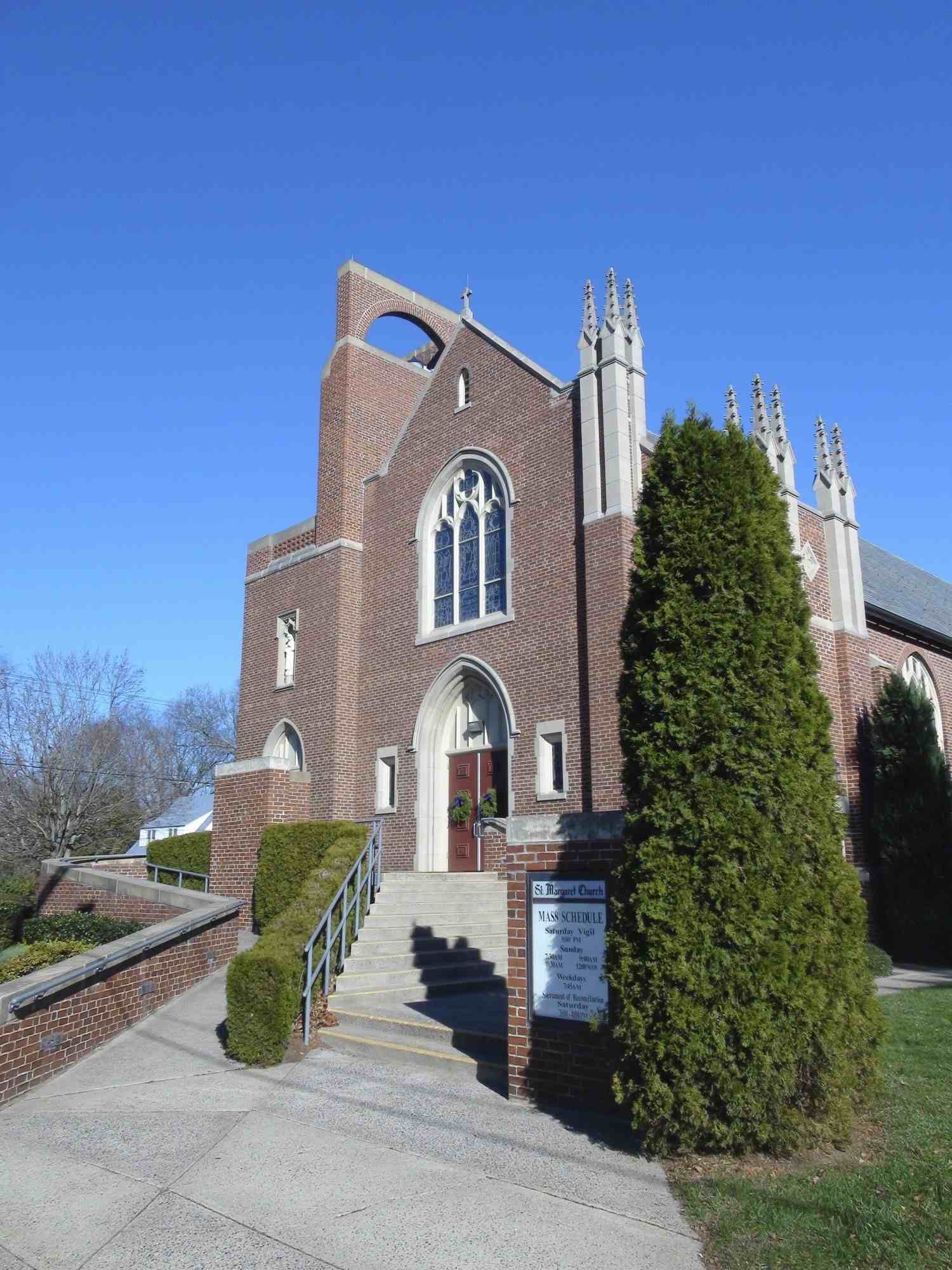
This morning in St. Margaret Church in Madison, Ct,  I celebrated Mass and afterwards gave a short morning catechesis on the Holy Eucharist, our great common prayer.  Here are some simple suggestions I made about praying at Mass.

https://vhoagland.wordpress.com/2009/10/01/praying-at-mass/

http://vimeo.com/6084341

Tonight at 7 PM our mission continues. Here’s the lineup.

Monday: Searching for God: St. Elizabeth Ann

Opening hymn

Announcements and opening prayer

Catechesis  (10 minutes): Growing in faith:  The US Catholic Catechism for Adults

Praying today: Prayers and prayerbooks

Reflective hymn

Sermon:   (35 minutes)     The Saint of Wall Street: St. Elizabeth Ann Seton

Benediction hymns, short prayer, closing hymn) (15 minutes)

The way we’re learning about our faith is changing. One example is the new US Catholic Catechism for Adults. It’s a catechism for adults, instead of a catechism for children. It’s for adult Catholics, and not just for priests or special catechetical teachers. All of us are invited to learn and keeping learning about our faith, and then live what we know and believe.

The new Catholic Catechism for Adults, besides definitions and explanations, uses the lives of saints and holy people, many of them American, as examples and guides of faith. Faith doesn’t exist in a book, it’s lived by people.

St. Elizabeth Seton is the first saint the catechism offers. She a wonderful example of what’s meant when we say we are searching for God. All of us are searching for God. Her life took an extraordinary number of twists and turns, from childhood, to married life, to prosperity and then to adversity,  to her conversion to Catholicism and her life as a dedicated religious involved in the ministry of the church.Through it all she kept searching for God who made her and mysteriously called her.

Another way we use to learn about our faith today is the scriptures. Tuesday night and Wednesday night we’re going to look at Jesus as he is presented in the Gospel of Matthew, which is often called the first Christian catechism.

I’ll give a summary of these presentations afterwards in blogs at Victor’s Place

The Days of Noah

I preached today at St.Margaret’s, Madison, Ct. and told the people they could follow me at Victor’s Place. From the stats it looks like a lot did. Here’s a summary of my sermon today.

I just got back from a pilgrimage to the Holy Land earlier this week.  I led 42 people from  St. Mary’s Parish in Colts Neck, NJ, to visit the holy places. After they returned, I spent over a week at Bethany, where my community, the Passionists, have a house and church, appropriately called St. Martha, built over 1st century Bethany, where Jesus stopped to visit Martha, Mary and her brother Lazarus.

The Holy Land was crowded with pilgrims when we were there. Strange as it may seem,  in spite of the political troubles, they’re having a record breaking year for visitors. The majority were from eastern Europe– Russia, Poland, Lithuania, the Ukraine– as far as I could tell.

That part of the world is often called by historians “ The Bloodlands, ” because over 14 million people were killed there in the 2nd World War, either by Stalin or by Hitler. More people died there than anywhere else in that terrible war. Certainly, most of these people I saw lost family members then. So they came here, I believe, not just as tourists, but as believers who had come to the holy places that gave them a faith for hard times.

Many of the Americans who were there were Protestants, and a good number were Fundamentalist Protestants who strongly support the State of Israel.

I think you see things a little differently when you go to the Holy Land. You read the scriptures a little differently. I’m looking at the scriptures today and two things strike me.

On this 1st Sunday of Advent, listen to those beautiful words of Isaiah: “Come, let us climb the LORD’s mountain,

to the house of the God of Jacob,

that he may instruct us in his ways,

and we may walk in his paths.”

When you go to the Holy Land  you’re doing that all the time: climbing mountains. It’s a land of hills and mountains, and even if you get around by bus, you still have to get out and climb. The Mount of Olives, the temple mount, Mount Tabor, the Mount of the Beatitudes, Mount Carmel. Even when you want to go up to Mount of Calvary in the Church of the Holy Sepulcher, you have to climb a steep staircase.

The people of Jesus’ day climbed these mountains to see where they were going, first of all. In those days people didn’t have Google Maps, so they went up  high places to see where they were going. On the mountains they got a sense of direction and perspective.

The people of Jesus’ day also climbed mountains so that they could experience God.  God was in the high places, they believed. God refreshed you when you went up to the high places.

Could I suggest that our Advent mission we begin today might be a good way to climb the mountain of the Lord and get the direction and perspective we need. We easily lose our way.

In  the  gospel, Jesus uses an interesting phrase, “the Days of Noah.” He uses it to  describe an experience to beware of. You remember how he describes the days of Noah. In those days,  he says, “people are eating and drinking, marrying and giving in marriage.” Nothing wrong with that, you say.

But even good things can become routine, causing life to become dead.  The days of Noah are “same old, same old” days, nothing’s happening, nothing’s going on, as far as we can see. Might as well “Turn on the Television,” “Have a beer,” The days of Noah are days of blinding routine. We end up sleep-walking, missing out on what life brings.

So what’s my life and your life like? Are we living  in the days of Noah?  In the days of Noah we need to be lifted up:   “When you’re down and out, lift up your head and shout, there’s gonna be a great day!”

Today the season of Advent begins. It’s a time that brings hope. It saves us from being trapped by routine. Stay awake.  Advent is a time that proclaims a Great Day?

Our church today needs an awakening. Archbishop Dolan from New York was interviewed the other day in The New York Times about the church and he offered a sobering appraisal of what it’s experiencing today. Almost half of our young Catholics getting married are not getting married in the church. Participation at Mass is down to 35%. There’s a big slippage going on in our church. We need an awakening.

What should we do? Certainly church leaders have to do something? But what about ordinary Catholics? The church has always depended on them. Like the small Advent candle we light today, the church shines one by one.

I don’t think I’ll ever forget one memorable event from my pilgrimage to the Holy Land. That was my visit to Lazarus’ tomb. As I finally got there, after traveling around the Israeli Security Wall, a large group of Russian pilgrims were entering the tomb. These were people from the “Bloodlands.” They crowded into that tight space of death and began to sing their powerful Russian songs of faith. The tomb was transformed by their singing.

Faith does that. It defies death. It transforms life. It gives hope.

Advent’s Coming

We begin the season of Advent this Sunday. Jesus is Coming! He came over two thousand years ago in Bethlehem, of course, but he said he would come again, at the end of time.

“He will come again in glory to judge the living and the dead, and his kingdom will be without end.” In the Our Father, we pray: “Your kingdom come.” “We wait in joyful hope for the coming of our Savior Jesus Christ,” we say at Mass.

Joyful hope. Waiting in “joyful” hope means having a larger, long-term vision to sustain and strengthen us through our days. A joyful hope keeps dreams for something better for our world and ourselves alive.

A joyful hope saves us from small-mindedness, from being dragged down by failure, from being pulled a deadening present.

Deliver us from the days of Noah, this Sunday’s gospel says. “…In the days of Noah, so it will be at the coming of the Son of Man. In those days before the flood, they were eating and drinking, marrying and giving in marriage.” The days of Noah are “same old, same old” days, nothing’s happening, nothing’s going on. “Turn on the Television,” “Have a beer,” The days of Noah are days of blinding routine.

In the days of Noah we need to be lifted up:   “When you’re down and out, lift up your head and shout, there’s gonna be a great day!” That’s what Advent does, it proclaims a Great Day.

While I was staying at Bethany last week, I met some fundamentalist Protestants who support the establishment of the State of Israel so that Jesus will return and God’s kingdom will finally come. They believe God has given the Jews all the land of ancient Palestine by a solemn biblical decree and when they take possession of it, human history comes to a victorious end. They believe Christians have to do all they can to hasten this coming by prayer and political action.

I disagreed with them. I don’t think God’s kingdom will come because a people take over a piece of land. Jesus seems to say that  in Sunday’s gospel.

“Therefore, stay awake!

For you do not know on which day your Lord will come.”

Staying awake is what we have to do, and it’s harder to stay awake than to take over land.


A Church of the Hebrews?

Fr. Pol took me to the airport this morning early for the flight home. He celebrated Mass the evening before at Tel Aviv for about 700 Filipinos and other Catholics who work in that area as care-givers and domestics. There are over 80,000 Filipinos alone in Israel.

In the Gulf area there are about 2 million Catholics, many from the Philippines, India, Sri Lanka and Africa.

Pol was enthusiastic about the lively, ingenious faith of these immigrants, who send much of their earnings home, yet contribute so much to the efforts of their church here in Israel. They meet regularly at St. Peter’s Church in Joppa  and are planning another Christian center between Tel Aviv and Haifa. Some vital new movements are inspiring them.

The Israeli who hire them appreciate these workers for their ability to care for the sick and the elderly, and their honest values. Often they will arrange for them to get to Church on Sunday. Fr. Pol wonders if they will bring some of them to the faith.

Relations of immigrants to the government can be difficult, however. As in America, some are here illegally. Their children often are schooled in Hebrew and they want a more permanent relationship to the country but the political situation is not favorable now. Some are thinking that these immigrants may be the beginning of a new Christian presence, not just a pilgrim presence, in the Holy Land. One priest who is a Jewish convert is speaking of a Church of the Hebrews.

Fr. Pol and Fr. Marito and the Camboni Sisters next to them minister to this immigrant community regularly, driving all over Israel to wherever they can meet them.

Today is the Feast of Christ the King. Usually great things are done, according to Christian thinking, not by political or military or economic power, but by the power of the weak and the small. Weren’t lowly immigrants largely responsible for the original growth of the church?

Yesterday I missed an  opportunity for going with Fr. Pol to Tel Aviv because I wanted to get to Lazarus’ tomb and the Comboni Sisters offered to take me because they were going shopping. 17 Kilometers later we landed at the tomb and the sister said, “Look across the wall, that’s where we live, just a few yards away.”

The ugly security wall.

It didn’t stop a group of Russians from descending into the tomb. For about 15 minutes they sang glorious Russian chants and then came up into the sunlight. The tomb became radiant with their faith.

Living by the Wall

The tomb of Lazarus is only down the road from here, but unfortunately I’m blocked from getting there by the Israeli security wall at the end of our street. Instead of a few minutes walk, I can get there only by traveling a good distance around the Mount of Olives.

The security wall winds through our property and the property of the Camboni sisters, an Italian order who have a school and a hostel next to us. As they look out their back  window, it looms over them, about twenty feet away, and it goes on as far as the eye can see.

I have been celebrating morning Mass these days for the sisters–in Italian– and they told me the wall has stopped many children, all Muslim, from coming to their school.  Relations between Christians and Muslims in this neighborhood have always been good, thanks to the good works of these religious women.

If the Israelis want peace, it would be better to tear down the wall and sponsor some schools and clinics like those run by the sisters. A high barbed wire wall, patrolled by armed soldiers, blocking streets people have been using for centuries, running through the backyards of ordinary peoples’ homes, stopping the flow of business, doesn’t win you friends.

It makes enemies.

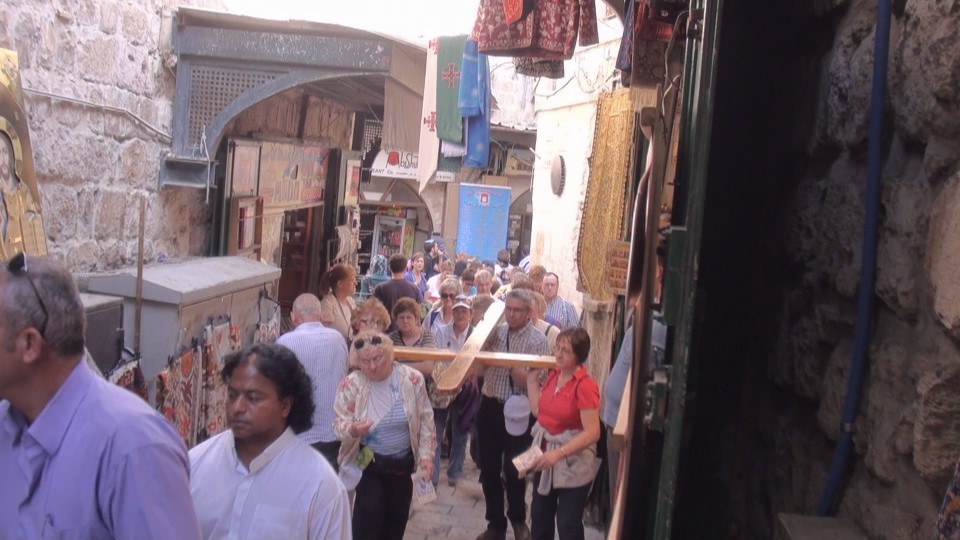
This afternoon Fr. Roberto drove me to the city where I made my way to the Via Dolorosa again, which was more crowded than ever with groups praying and groups shopping and gawking.

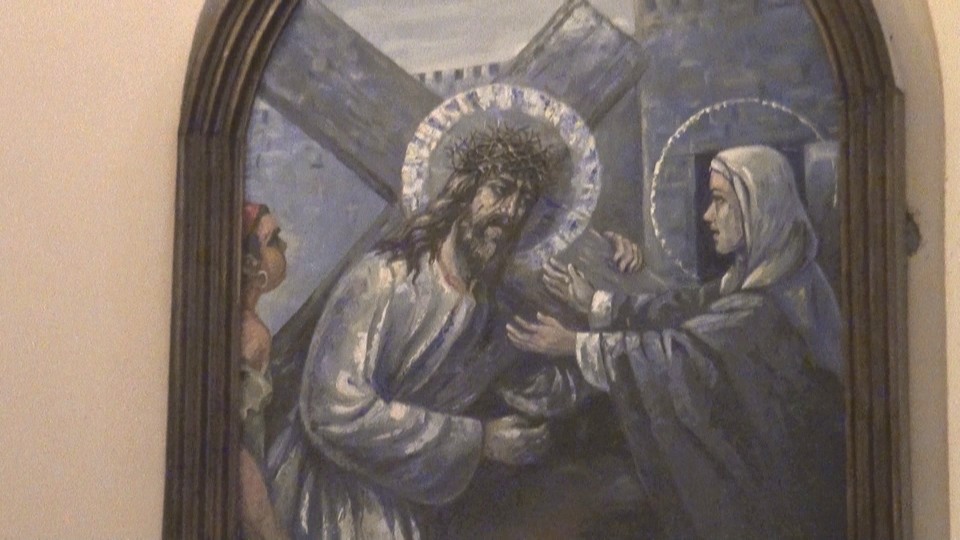
I did discover an Armenian church at the 4th Station that was an oasis in Babel. The church has some paintings of the 3rd and 4th stations. Jesus meets his mother at the 4th station. In the quiet courtyard before the church a mother was nursing her infant. In the church was a picture over the altar of Mary nursing her child.

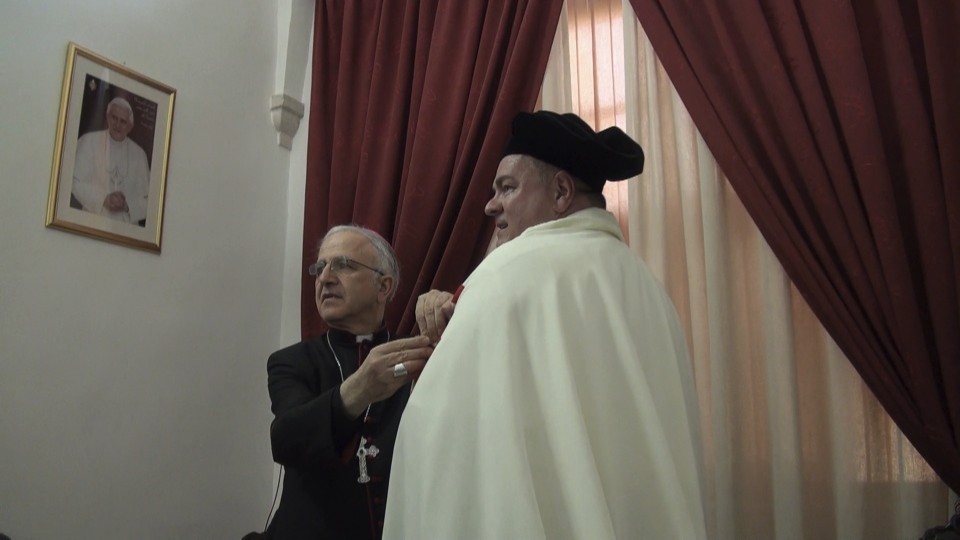
The day ended at the Latin Patriarchate where Sir Patrick Allen, Knight of the Holy Sepulcher from  Union City, NJ, met Bishop Shomali, who was born in Bethlehem, to receive an award for bringing over 100 people to the Holy Land on pilgrimage. I was a photographer and guest, and the bishop even said some nice things about the Passionists.

The Second Tomb

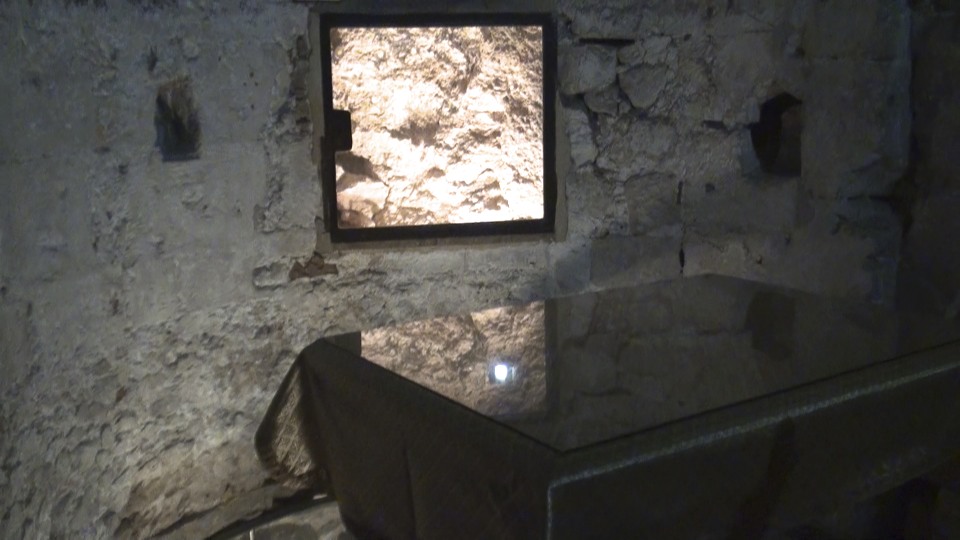
Right down the street from where I’m staying these days–in Bethany–is the traditional tomb of Lazarus. Jesus raised Lazarus from the dead, you remember, and stories of that famous incident and other events from Bethany figure large in the New Testament.

I went over to the Franciscan bookstore near the Joppa Gate this morning and got a small book on Bethany which goes into the history of this tomb and what archeologists have found as they dig and dig. Actually, they have stopped digging–for the present.

Surely, like the tomb of Jesus, the tomb of Lazarus would be remembered. Egeria, the 4th century nun, who was to all these places, says that there were so many people at Lazarus’ tomb  when she was there that they packed the whole church and all the fields around. For Christian pilgrims Lazarus played a vital part in the story of Jesus.

Right now, the Franciscans, the Greek Orthodox and the Muslims (who venerate Lazarus, by the way) are all around his tomb together. It looks like the same war over turf that goes on at the Church of the Holy Sepulcher.

Raising Lazarus from the dead was the final sign God gave before raising Jesus from the dead, John’s gospel says. It’s a miracle telling us we shall share in his resurrection.

Political reasons weren’t the only thing that brought Jesus to his death, it was his claim to be the way, the truth and life. The miracle brought people from Jerusalem to see a man who came from the dead and the one who raised him. The authorities reckoned that Lazarus would have to be taken care of too.

The believers were here in Bethany; not many in the temple, according to John’s gospel. Like Martha, carrying her pots and pans, they believed he was the Messiah, the Son of the Living God, who  brings life to the whole world. That’s why Bethany, and Lazarus, are important.

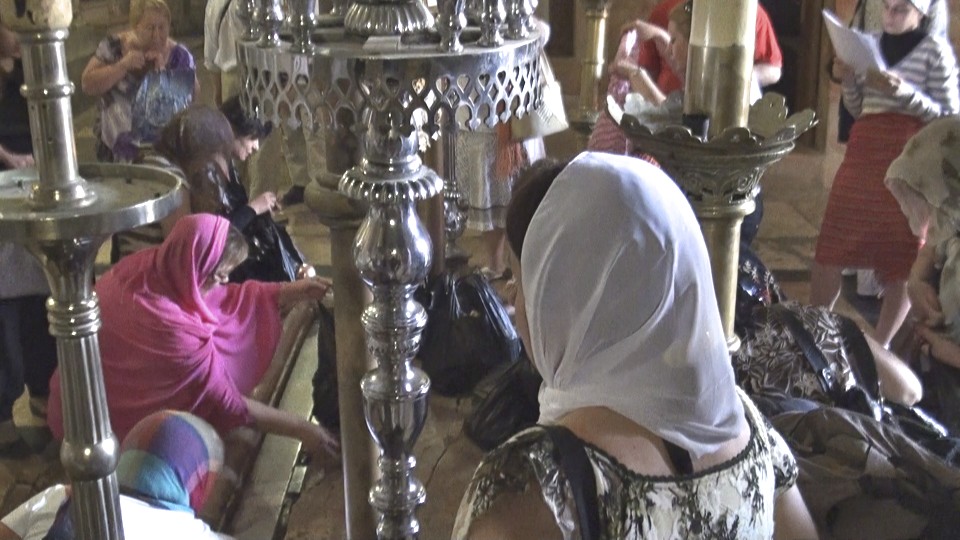
I spent today at the Church of the Holy Sepulcher, watching the crowds pile into the dark church and sat for some time in “Adam’s Cave” next to Calvary on a bench looking at the exposed rock where the crucifixion took place.  A stuffy guide came in with two Englishmen and said, “Look at that fellow over there, he’s sitting on the tomb of Baldwin 1, one of the first Crusader rulers of Jerusalem and doesn’t even know it.” I went back and looked up Jerome Murphy O’Connor who says the Greeks removed that tomb in 1809.

So much for experts.