Category Archives: Passionists

Ignatius and Polycarp

Years ago I visited Izmir, Turkey, with a classmate of mine. We were searching the city, formerly Smyrna, for traces of St. Polycarp, one of its first Christian bishops, who was martyred there in AD 153. With difficulty, we found a small Catholic church named for him surrounded now by a large Muslim neighborhood, and also the ancient agora where he was condemned and put to death.

I think of him today because today’s Office of Readings offers St. Ignatius of Antioch’s  “Letter to the Magnesians,” which was written in Smyrna early in the 2nd century and mentions Polycarp, its bishop.  Under arrest on his way to Rome where he will be executed in the Colisseum , Ignatius writes to the Magnesians urging them to be faithful disciples of Christ and imitate him. Polycarp gave him support on his way to death.

One sentence of his letter caught my eye. “Be moved by his goodness,” he writes, “for if Jesus were ever to imitate the way we behave ourselves, we would be truly lost.”

For Ignatius, then, when the scriptures say Jesus “ was like us in all things except sin” they do not mean that he embraced our mediocrity, our compliance with evil, our pursuit of success and fame–all temptations he faced in the desert. He was uniquely human. A unique messenger from God.

Human goodness as we know it is weighed down by weaknesses in the best of us. Human behavior as we experience it suffers from their presence.

Christ came that we might imitate him, the “way, the truth and the life.” He offers an example of what we as human beings should be.

Ignatius’ letter indicates a certain forgetfulness of Jesus Christ taking place in his day. The apostles and other eyewitnesses have passed on, and other teachers are taking their place. They have rivals: some are traditional Jews, who are enticing Christians  back to the ancient wisdom and practices of Judaism. Others are from popular religious and philosophic groups, like the gnostics,  a rising power who taught then.

What Ignatius’ time needed were Christian leaders with links to the first followers of Jesus and could vouch for him and pass on their witness, especially through the gospel writings that reported what he said and did. “What was he like?” “What did he say?” “What did he do?” The gospels had recently been written.

“Be convinced of the birth and passion and resurrection which took place at the time of the procuratorship of Pontius Pilate; for these things were truly and certainly done by Jesus Christ, our hope, from which God grant that none of you be turned aside.”

Polycarp of Smyrna and Ignatius of Antioch are key figures in our Church. Both not only taught about Jesus Christ but imitated him in their deaths. Later Christian writers recognized their importance. In the late 2nd century, Irenaeus wrote:

“Polycarp was not only instructed by apostles, and conversed with many who had seen Christ, but was also appointed bishop of the Church in Smyrna by apostles in Asia…He always taught what he had learned from the apostles, and the Church has handed down that teaching which alone is true. His successors testify to this. ( Adversus Haereses. Book III, Chapter 4, Verse 3 and Chapter 3, Verse 4)

Tertullian wrote about AD 208:

“Heresies are novelties with no connection to the teaching of Christ. Some may claim they come from apostles. We say: where did your church come from? Give me a list of your bishops from now till the apostles or to some bishop appointed by him. The Smyrnaeans go back to Polycarp and John, and the Romans to Clement and Peter; let heretics come up with something to match this.” (De praescripione heret.)

It was a dangerous century, a transitional time, when big changes were taking place. Maybe we’re facing something like it today?
Rembrandt

Among the books we have in our library are some art books from the years when The Sign Magazine was published here and books were accumulated for their illustrations. One of them is “Rembrandt’s Drawings and Etchings for the Bible.”

Though he’s known best for his portrayal of the Dutch world of his time, Rembrandt was very interested in stories from the Bible, both from the Old and New Testament. Possibly one third of his work is devoted to biblical subjects, about 700  drawings among them.

What led him to paint and draw biblical events? It wasn’t mainly a patron’s commission, as was the case of  his contemporaries– Rubens, for instance.  Rembrandt seems genuinely attracted to the bible and felt compelled to draw something from the biblical narrative, not because he could make money on it, but because it said something to him and his situation in life.

“Rembrandt’s relation to the biblical narrative was so intense that he repeatedly felt impelled to depict what he read there. These sketches of Rembrandt have the quality of a diary. It is as though he made marginal notes to himself…The drawings are testimonies, self-revelations of Rembrandt the Christian”  ( p. 6)

It seems he got this interest in the bible from his mother, a devout woman, who had a Catholic prayerbook that featured  the Sunday gospels with illustrations on facing pages. As she prayed from this book, did she show them to her little boy growing up?

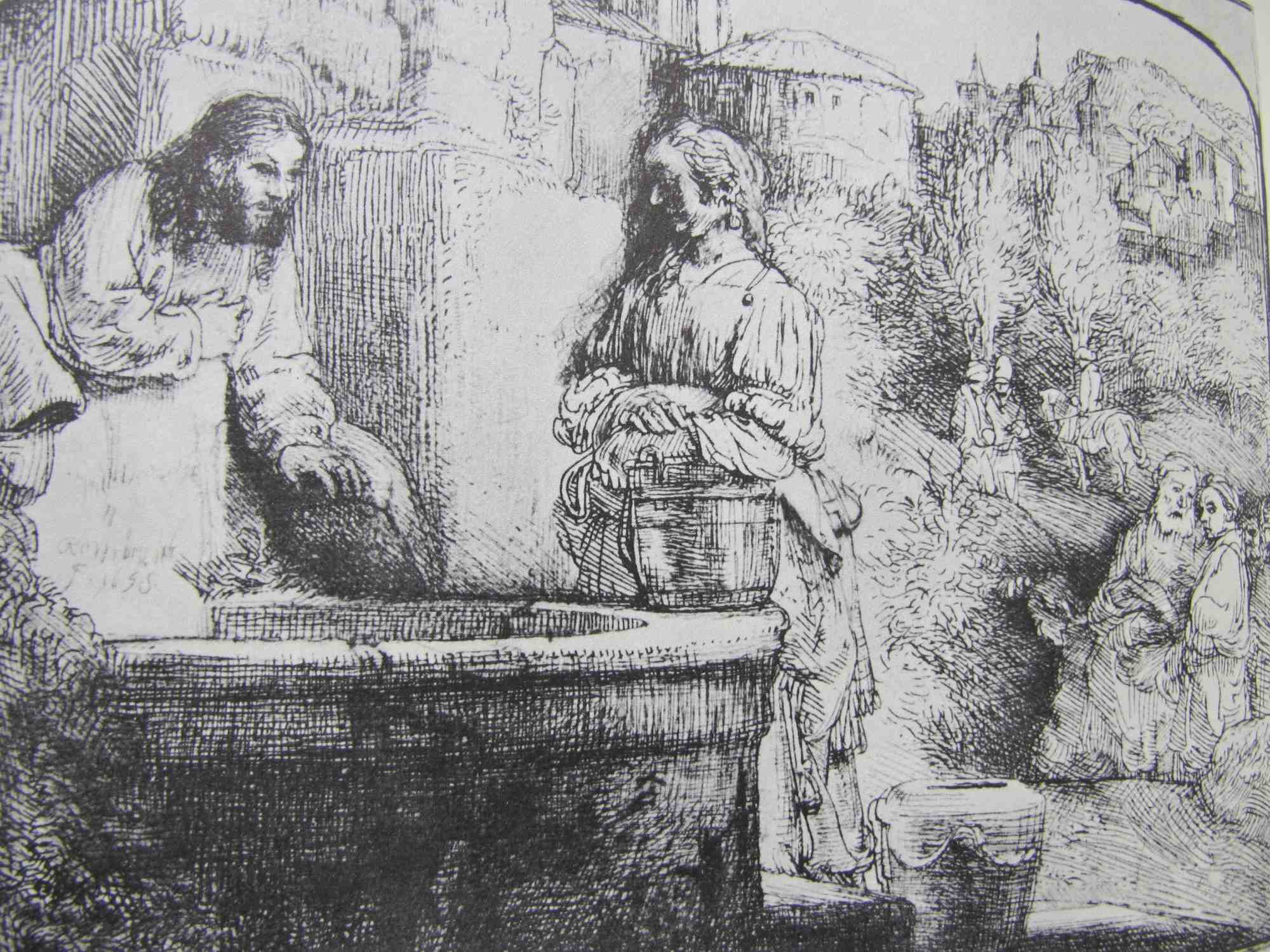
His portrayal of the scriptural stories are so insightful. Just look at his portrayal of Jesus at the well with the Samaritan woman, which is found in John’s gospel. Jesus deferentially asks for a drink of water, bowing to the woman as he points to the well. And she stands in charge, her hands firmly atop her bucket. She’s a Samaritan and a woman, after all. He wont get the water until she says so. Jesus looks tired, bent over by the weariness of a day’s long journey.

Certainly, this is no quick study of a gospel story. Obviously, Rembrandt has thought about the Word who made our universe and the Savior who came to redeem us. Perhaps he’s also thinking of the way Catholics and Protestants were clashing among themselves, their picture of Jesus a strong, vigorous warrior. There he stands humbly outside a little Dutch village that the artist’s contemporaries might recognize. Some of them may be pictured looking on at the two.

Artists have a powerful role in relating truth and beauty.

And what about Rembrandt’s mother? A 19th century French Sulpician priest, Felix Dupanloup, who had a lot to do with early American Catholic catechetical theory said,

“Till you have brought your children to pray as they should, you have done nothing.”

Looks like she did her job.

Sacred Heart

Today, the Friday after the Feast of Corpus Christi, is the Feast of the Sacred Heart. The feast was deliberately placed on this date because of its associations with the death of Jesus and the mystery of the Eucharist. Statues and symbols of this feast can still be found in so many of our churches and shrines and even our homes. Devotion to the Sacred Heart was a favorite devotion of the generation of Catholics before ours. It was promoted especially by the Jesuits, but the whole church took it up.

I think today of Sacred Heart Church in Springfield, Mass where Theodore Foley grew up. The devotion expressed in that church must of had a profound influence on him.

The devotion was strong in the pre-Vatican II church, but not so strong now. How do I know? I was listening to a little segment on church music from Vatican Radio, which featured popular hymns to the Sacred Heart. Most of them you don’t hear today.

By the way, the Vatican Radio site is a lively place to get little gems of information, like “Was St. Paul a Mysoginist?” Some wonderful stuff on the art and architecture of Rome too.

The devotion, however, points to a mystery that transcends its present expression. Here’s St. Bonaventure, from today’s Office of Readings:

“Take thought now, you who are redeemed, and consider how great and worthy is he who hangs on the cross for you. His death brings the dead to life, but at his passing heaven and earth are plunged into mourning and hard rocks are split asunder.

“By divine decree, one of the soldiers opened his sacred side with a lance. This was done so that the Church might be formed from the side of Christ as he slept the sleep of death on the cross, and so that the Scripture might be fulfilled: ‘They shall look on him whom they pierced’. The blood and water which poured out at that moment were the price of our salvation. Flowing from the secret abyss of our Lord’s heart as from a fountain, this stream gave the sacraments of the Church the power to confer the life of grace, while for those already living in Christ it became a spring of living water welling up to life everlasting. “

June 30th

June 30th, following the Feast of Saints Peter and Paul, we celebrate the early Christian martyrs put to death by Nero after the disastrous fire that burned down much of the city July 19, 64 AD. If I were in Rome today I would go to the church of Saint Peter in Chains or to the gardens of Saints John and Paul on the Celian Hiill to remember them.

The two apostles were put to death around this time and many (we don’t know how many) followed them.

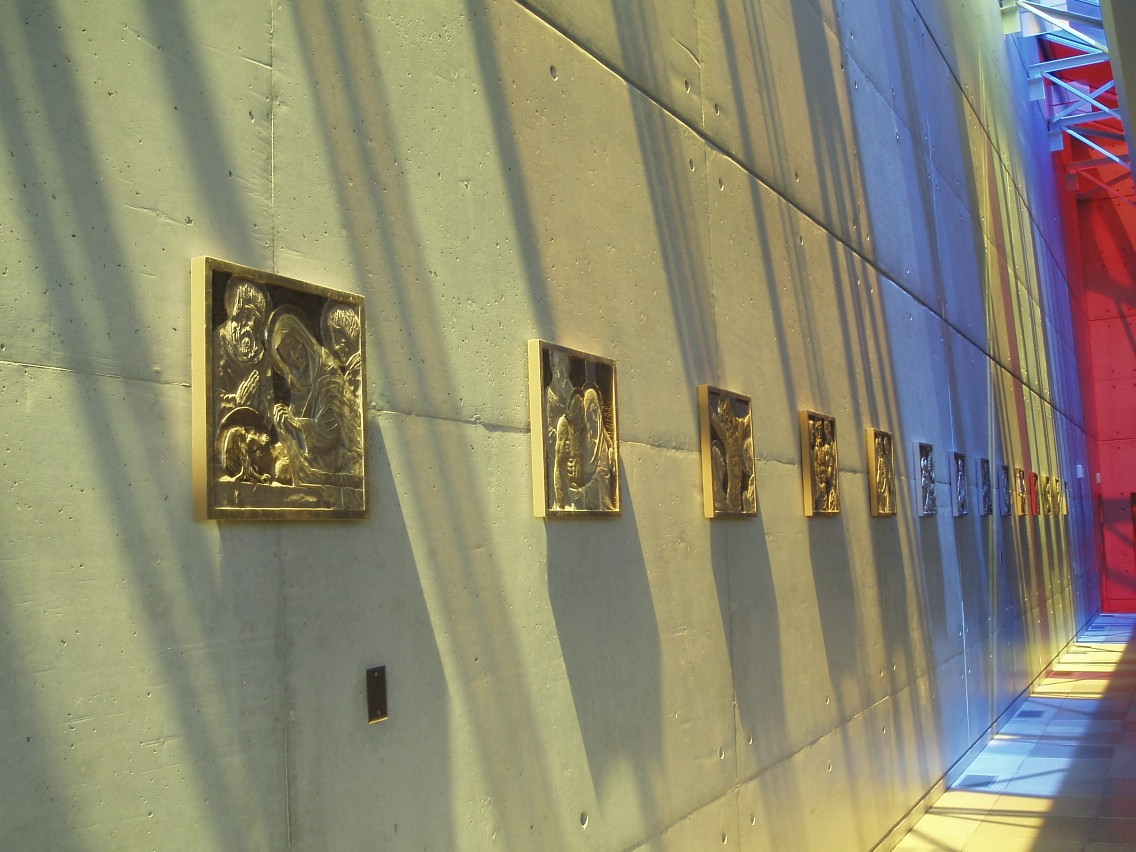
There’s a blog and a video on the church of St. Peter in Chains here and here.And a video on the Stations of the Cross in the gardens of Saints John and Paul here. There’s also a video on the Quo Vadis story here.

The persecution and martyrdom  in 64 throws light on the creation of the Gospel of Mark, which many think was written in Rome afterwards.

One thing I think this feast and the Gospel of Mark suggests: the Church of Rome did not flee from the uncertainty and persecution it faced then. I think the Quo Vadis story indicates that. It didn’t give up.

We pray today:

Father,

you sanctified the Church of Rome

with the blood of its first martyrs.

May we find strength from their courage

and rejoice in their triumph.

We ask this through our Lord, Jesus Christ, your Son.

Peter and Paul

Today, the Feast of Saints Peter and Paul, the Vatican began a new website on the internet that combines a number of their websites under one portal: www.news.va

Good idea, nice and simple. Begun on the Feast of the two apostles who are considered the founders of the church of Rome it’s a website addressed to the world. And on its opening page there’s the pope playing with what’s surely an iPad. May others do likewise. I’m not quite sure about Peter, but I’m sure Paul would have loved one of those things.

One story on the new site is about a new discovery archeologists made of a 6th century portrait of St. Paul, the Apostle, from a catacomb near Naples. Paul, is described in the story as looking like a Roman philosopher. He peers out from the side of an arcosolium, a burial place, at the mourners who come to honor their dead. He who saw the Risen Christ carries news of new life.

His portrait looks like other early portraits of him, just a Peter’s portrait is pretty much established early on. Peter looks like a rough and ready fisherman–which I’m sure he was. I think he would be uncomfortable to hear himself described as “the prince of the apostles.”

Not that he was a shrinking violet. In today’s readings, St. Augustine claims that the three affirmations of love Jesus called him to make, according to the Gospel of John, were to conquer Peter’s “self-assurance.”

“Quite rightly, too, did the Lord after his resurrection entrust his sheep to Peter to be fed. It is not, you see, that he alone among the disciples was fit to feed the Lord’s sheep; but when Christ speaks to one, unity is being commended to us. And he first speaks to Peter, because Peter is the first among the apostles.

“Do not be sad, Apostle. Answer once, answer again, answer a third time. Let confession conquer three times with love, because self-assurance was conquered three times by fear. What you had bound three times must be loosed three times. Loose through love what you had bound through fear. And for all that, the Lord once, and again, and a third time, entrusted his sheep to Peter.”

“There is one day for the passion of two apostles. But these two also were as one; although they suffered on different days, they were as one. Peter went first, Paul followed. We are celebrating a feast day, consecrated for us by the blood of the apostles. Let us love their faith, their lives, their labours, their sufferings, their confession of faith, their preaching.”

The Glory of God

I was surprised to see Harold Camping at his usual place on television the other night. The rapture didn’t happen May 21st, he explained, because God wanted to alert the world that the end was going to come this October. A caller wondered if we could do anything about helping this world of ours, but Harold was quite firm that God was going to destroy it completely. It’s an open sewer, according to him. Nothing’s worth saving.

How different from the Christian vision of St. Irenaeus, the 3rd century  bishop of Lyons, whose feast we celebrate June 28th. He condemned the gnostics– favorites of new age thinkers today– for their dismissal of creation as evil. The One God is the source of our created world and we know him through it, Irenaeus taught. We cannot know God if we depreciate or ignore the world God has made; it mirrors his glory.

“The glory of God gives life; those who see God receive life. For this reason God, who cannot be grasped, comprehended or seen, allows himself to be seen, comprehended and grasped by us, that he may give life to those who see and receive him…  God is the source of all activity throughout creation. He cannot be seen or described in his own nature and in all his greatness by any of his creatures. Yet he is certainly not unknown.”

The Word of God has a twofold role, according to Irenaeus, revealing God in creation and finally coming in the flesh to complete this revelation in Jesus Christ.  No  one has ever seen God, except the only-begotten Son, who is in the bosom of the Father; he has revealed him.

He revealed God to us and presented us to God. He safeguarded the invisibility of the Father to prevent us from treating God with contempt and to set before us a constant goal toward which to make progress. On the other hand, he revealed God to us and made him visible in many ways to prevent us from being totally separated from God and so cease to be.

“Life in us is the glory of God; in human life one can see the vision of God. If the revelation of God through creation gives life to all who live upon the earth, much more does the manifestation of the Father through the Word give life to those who see God.”

Harold should read that wonderful story from the Book of Genesis we read yesterday at Mass about Abraham bargaining with God for the salvation of Sodom and Gomorrah. The world’s worth saving.

We are His Flock


Last Saturday I celebrated Mass in a parish whose pastor was retiring and a new one was coming in to take over. It was the Feast of Corpus Christi, a vivid reminder of the presence of Jesus Christ among us. He is our shepherd and we are his flock.

We’re very conscious today of human leaders, whether they are politicians, business leaders, bishops or pastors. We want them to keep things going, to solve problems and to lead us into the future. When things go wrong, they’re the first we blame. Often they are all we see.

But there is another who leads us. “We are his people, the flock of the Lord.” St. Augustine comments on this verse from the psalms:

”  In this song we have declared that we are his flock, the people of his pasture, and the sheep of his hands… You are my sheep, he says. Even in the midst of this life of tears and tribulations, what happiness, what great joy it is to realise that we are God’s flock! To him were spoken the words: You are the shepherd of Israel. Of him it was said: The guardian of Israel will not slumber, nor will he sleep. He keeps watch over us when we are awake; he keeps watch over us when we sleep.

A flock belonging to a man feels secure in the care of its human shepherd; how much safer should we feel when our shepherd is God. Not only does he lead us to pasture, but he even created us.”The words we have sung contain our declaration that we are God’s flock: For he is the Lord our God who made us. He is our God, and we are the people of his pasture and the sheep of his hands.

Human shepherds did not make the sheep they own; they did not create the sheep they pasture. Our Lord God, however, because he is God and Creator, made for himself the sheep which he has and pastures. No one else created the sheep he pastures, nor does anyone else pasture the sheep he created.

“The Lord is my shepherd,” we say. And he shepherds the world as well.

We Go to God Through Questions

I’ve been talking to a number of people lately who have questions about their faith. I emailed this to one of them today:

Here are some sources you might find interesting as you look again at the faith you learned long ago.

Just a few months ago a new Catholic bible was published called the New American Bible Recent Edition. NABRE. The last printing was 20 years ago, but since so much new archeological material and textual discoveries have become available since then, they thought a new edition was due. Part of what we are experiencing today is an explosion of new knowledge in these fields and in other fields of human knowledge. I’m going to pick up that new bible soon myself. It has wonderful notes and introductions to the books and it’s also the translation we read in church.

I was in a Barnes and Noble store yesterday and looked at the section of bibles, but I could hardly locate the New American Bible among the other editions. With the decline of Catholic book stores it’s hard to get the books we might be looking for. The media don’t help either with some of their sensational productions on religion.

The pope’s two new books, “Jesus of Nazareth”. are also good to read. I’ve been reading his last one about the Passion and Resurrection of Jesus, and I find it stimulating. He’s using much of the latest scholarly materials and offering some wonderful insights. and he’s not afraid to take on tough questions.  We are all doing the same thing: learning and learning again.

I like a recent catechism published by the American bishops: The United States Catholic Catechism for Adults. You can get it at Amazon.com. It approaches the different aspects of faith simply and offers a person, whether a canonized saint or not, who exemplifies that aspect and tells their story. Faith is better seen when it’s lived by people.

Since you were impressed by your recent visit to the Holy Land you may be interested in some entries I did for our pilgrimage from St. Mary’s from October 16 to November 20, 2010. You can find them on Victor’s Place, my blog, at https://vhoagland.wordpress.com/

I think I told you what one of my theology teachers told me long ago. “We go to God through questions. You find one answer and ten more questions are there waiting to be answered.”

Questions are part of our search for God.

Good St. Anthony, come around

“Good St. Anthony come around, something’s lost and can’t be found.”

The famous 13th Franciscan saint  was born in Portugal and died in Padua, Italy.  He was canonized almost immediately after he died in 1231. A brilliant preacher and teacher of scripture he was declared a doctor of the church in 1946.

Anthony’s skill at finding things seems to come from a personal experience–he lost his psalter, the book of scripture that contains the psalms. In his day the psalter was the prayer-book of religious, who carried it around with them always. Gradually printing made it possible to put all the scriptures and prayers  in one book, but in Anthony’s day the psalter was it, most likely the only book a poor friar could call his own.

What makes the story more interesting is that some say a disgruntled student of Anthony’s stole the book. I wouldn’t be surprised if all of Anthony’s class notes–he was a teacher–and all of his sermon notes–he was a preacher in demand– were in that psalter too. So. imagine losing your computer with all your files and personal information on it?

Horrors!

You can see why Anthony prayed to get that book back, and why he has sympathy for those who  experience losing important things.

The story also reminds us that Anthony not only taught, he prayed as he taught. The way he lived matched the words he spoke. That was the secret of his effective preaching.

Here’s some words of Anthony from one of his sermons:

“The one who is filled with the Holy Spirit speaks in different languages. These different languages are different ways of witnessing to Christ– humility, poverty, patience and obedience. We speak these languages when we reveal these virtues to others. Actions speak louder than words; let your words teach and your actions speak… Gregory says: ‘A law is laid upon the preacher to practice what he preaches.’”

St. Gabriels, Toronto

I’m spending a few days in Toronto with our Canadian Passionists, who minister at St. Gabriel Church, a new church built in 2006 which reflects the eco-theology of Fr. Thomas Berry, a Passionist who died a few years ago. He believed we need to foster a life enhancing relationship with the earth and the whole cosmos.

The church is located in a booming area along Sheppard Avenue in North York where high-rise condos and a new subway line are recent additions to this growing prosperous Canadian city. It’s a showplace for human technology and building skills. What better place for a  reminder of things beyond the human?

The church and its surroundings are almost swallowed up by the great buildings around it; a modest sign along busy Sheppard Avenus beckons you into St. Gabriels.

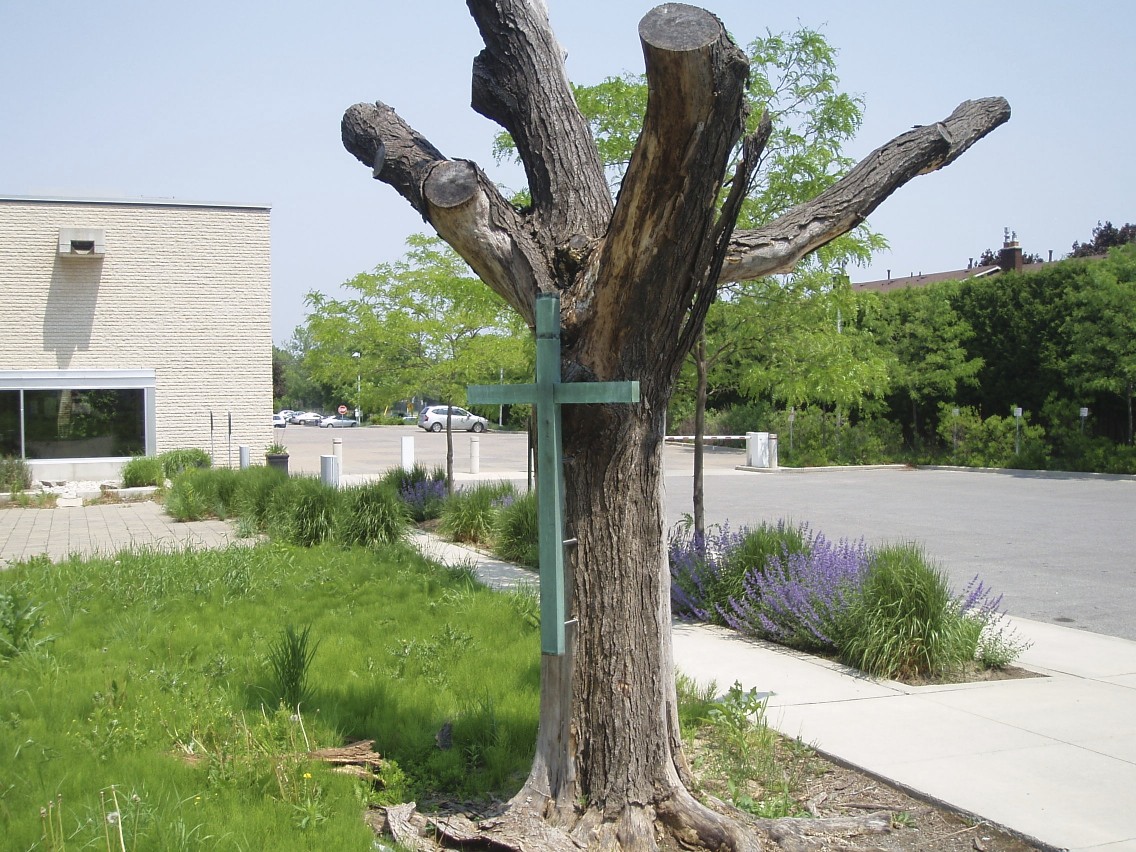
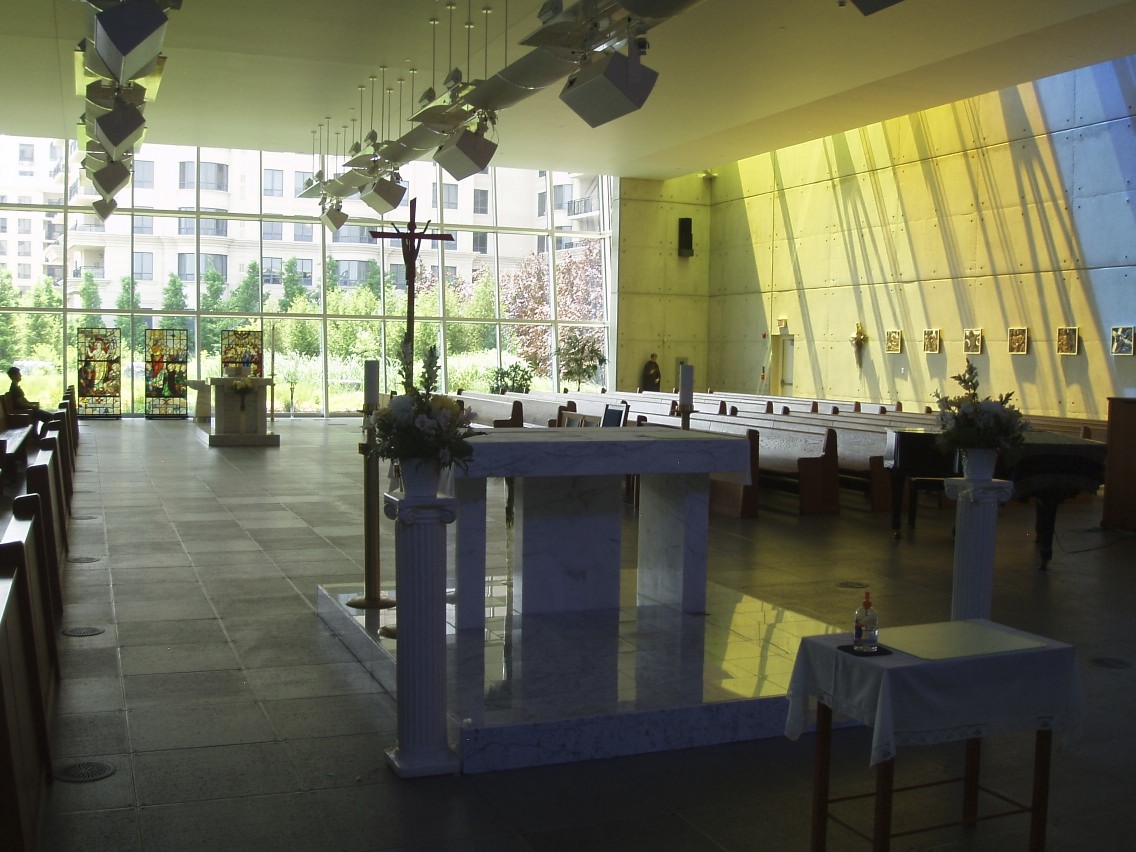
It’s not a church you would expect. No steeple skyward, no shrines of saints outside. A solitary statue of Christ stands on the roadway toward it. The entire south facade of the church is clear glass welcoming sunlight into the worship space within and a garden where the story of creation is retold from its beginning. Rocks, flowers, trees and grasses face the glass wall that dominates the new building,  A large tree trunk cut from a land development nearby stands at the edge of the outdoor garden, signed with a green cross. It signifies the Passion of the Earth, which the human community, recklessly exploiting the earth’s resources, has inflicted on the natural world.

Looming beyond the garden are the tall buildings of our modern human world.

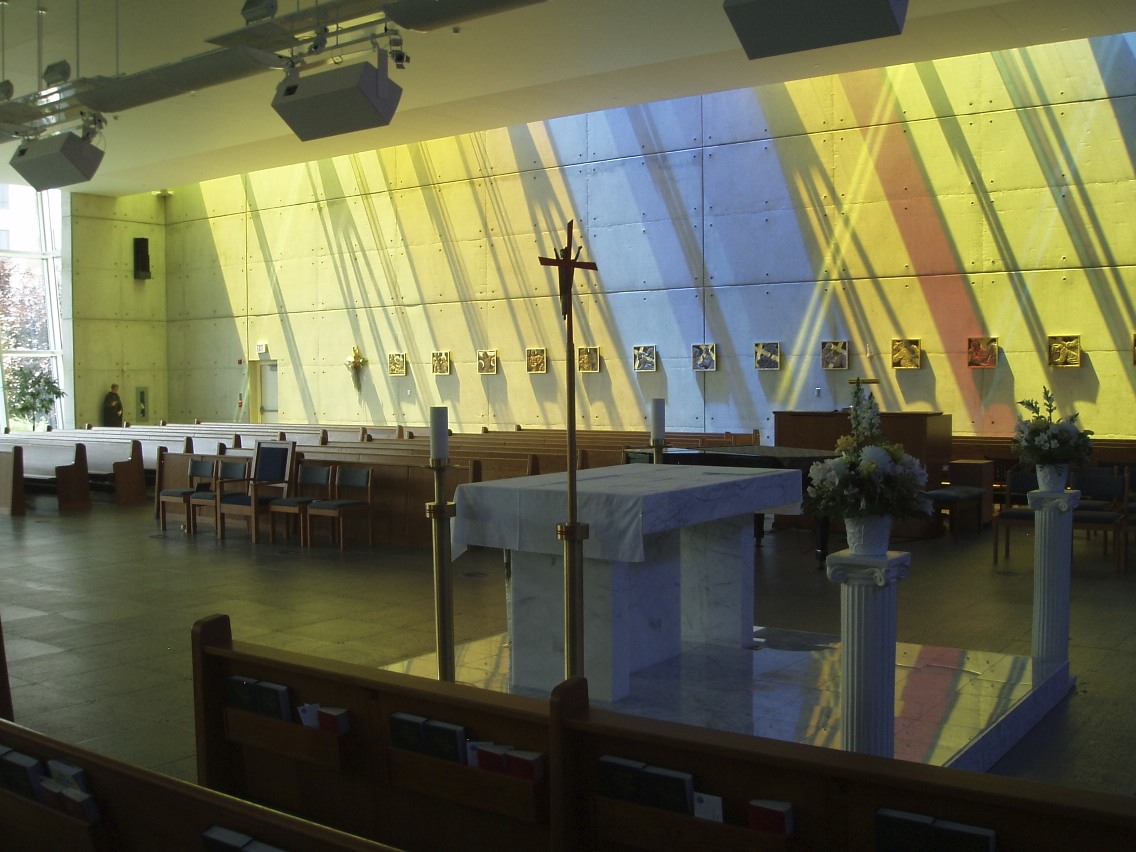
Sunlight through its expansive southern window and upper windows plays through the interior space of the church by day and over the seasons. This is not a church cut off from the world outside but in harmony with it.

The church pews, salvaged from an earlier church, are arranged antiphonally facing the baptismal fount near the southern glass wall, the ambo where the gospel is proclaimed, and the altar where the Eucharist is celebrated. A chapel where the Blessed Sacrament is reserved is situated in the northern part of the worship space. The Word who made the universe; the Savior sent to redeem us is present here in this church.

The baptismal fount, also from the earlier church, has water flowing from it; a rainspout on the outside southern wall delivers rainwater to a simple river bed below. The two remind us of our dependence on water as well as light.

The church seats 750 people; the present parish membership comes from all the continents and many nations. A parallel narthex provides a meeting place for these “living stones” who form the church today.

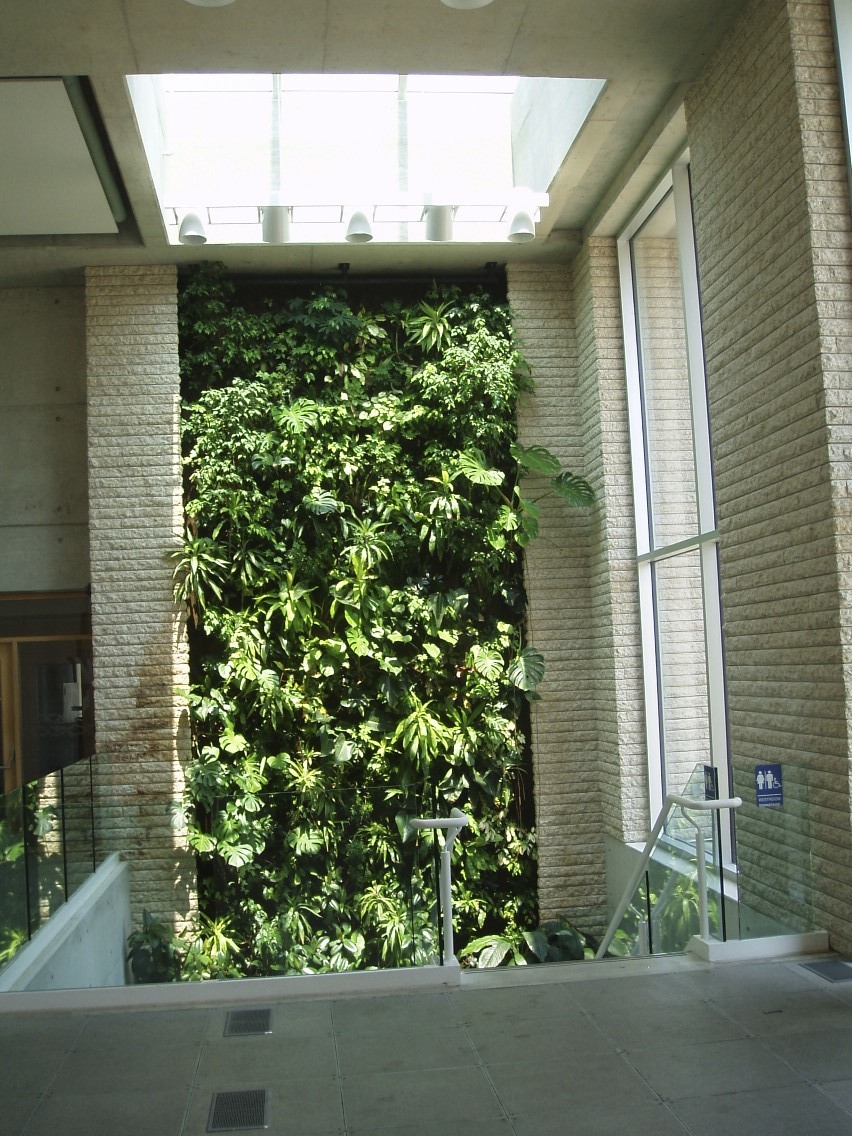
The church was built to be energy efficient. Most of its parking area is located beneath the church. Parishioners ascending from the underground parking face a large bank of plants, which serve to purify the air as well as remind them of the importance of the rain forests for the earth.

”Imaginative and creative,” Aloysius Cardinal Ambrozic, Archbishop of Toronto, Canada, called the new Passionist church of St. Gabriel, when he dedicated it on Sunday, November 19, 2006. The Jesuit magazine AMERICA featured the church in a recent issue on church architecture.

The parish website is http://stgabrielsparish.ca/

A Youtube video is here: http://www.youtube.com/watch?v=GasOYiK1l68