Category Archives: Passionists

Shelter Island Thoughts


I spent this past week on vacation with two other members of my community on Shelter Island at a retreat house for youth that we’ve recently closed and now are in the process of selling. It’s a place of memories for us, a summer paradise for swimming and sports and a vibrant place where thousands of young people over the years found spiritual nourishment in programs for the young.

Now, like so many other good places devoted to spiritual purposes throughout the county, it’s closing. You have to feel a sense of failure and disappointment. What’s happening, we ask?

Finances and personnel are the reasons we point to, but these don’t answer the question adequately. Our society has lost its interest in God. Not everybody, to be sure, but for many the search for God has fallen down the list of their priorities. As I write, I’m watching an instructor teaching children how to play tennis in this place where young people were once taught to pray.

Religious people like ourselves, supposedly the guardians and promoters of religion, wonder if we are to blame. On EWTN the other night, Fr. Benedict Groeschel seemed to think so; he criticized religious communities for their “worldliness” and there’s some truth in his criticism, but it’s not the complete answer by any means.

I’m reading Pope Benedict’s book “ Jesus of Nazarth” these days and there are two sections in it I find particularly helpful. The first, is his section on the Kingdom of God, and as I read it this place came to mind.

The Kingdom of God is a complex concept; the first disciples of Jesus were not sure what it was. They had  kingdoms of their own in mind that they thought might fit the bill. But Jesus said his kingdom was not like theirs. If it were, his followers would have risen up to stop his enemies putting him to death, but his kingdom was not of this world.

Our kingdoms tend to be like those of Jesus’ first disciples. They may be treasured, holy,  wonderful places in themselves, but they’re kingdoms of the world. Our temptation, like the last temptation of Jesus in the desert, is to hold on to them as if they were the Kingdom of God. But God lets them pass away so that we may search again. Is that what God is doing now?

“Thy Kingdom come,” we say in our prayer, not “My Kingdom come.”

The second section of the pope’s book I found helpful was his thoughts on “Resurrection Thinking,” (my phrase, not his). After the resurrection the disciples of Jesus did a lot of thinking about what had happened before. “When he was raised from the dead, his disciples remembered that he had said this; and they believed the scripture and the word Jesus had spoken.” (John 2,22) Over and over the gospels tell us his disciples remembered something he said or did, sometimes they were terrible things like the events of his passion and death, but now they saw them in a new light.

They didn’t even delete their own sinfulness and lack of faith from the remembered story.

“The Resurrection,” the pope says, “teaches us a new way of seeing.” (p.232) We can look into ruins and see another life rise in them. “Behold, I make all things new.”

What will be the new life we see rising from here? The pope says “all” the disciples were involved in this “Resurrection Thinking.” It takes place through prayerfulness.  A guide, the Spirit of Truth, is there to point our way to the future.

What’s involved today here at Shelter Island, and in so many other places like it, is more than waiting for a buyer.


Who Do You Say Jesus Is?

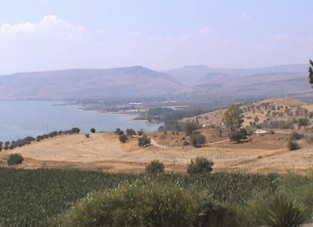
“Who do you say I am?” is the question Jesus asks his disciples at Caesaria Philippi. It’s a question  at the center of Matthew’s Gospel, which we read today in our liturgy.  Before this, Jesus has taught and done marvelous things in Galilee, mostly around the Sea of Galilee.  Now he’s going up to Jerusalem. “Who do your say I am?”

He asks the question at Caesaria Philippi, a place we don’t know much about, because the city fell into ruins after Jesus’ death and resurrection,  but it’s a place that has an important role in our gospel story.

Caesaria Philippi was located about 40 miles from the lake area where most of Jesus’ ministry took place. It was a gentile city, devout Jews tended not to go there, so we might ask why Jesus took his disciples there to ask this important question.

Caesaria Philippi was located right at the base of Mount Hermon, the great mountain that was the origin of most of the water that flowed into the Sea of Galilee and the Jordan River. It was a large Greco-Roman city built  in Jesus’ time as part of a big economic boom going on in Galilee. Under the Herods, especially Herod Antipas, a number of large cities like Tiberias, Sepphoris and Caesaria Philippi were built in Galilee to handle the developing trade in agriculture and fish from the Sea of Galilee. The Herod’s wanted this area to be a supplier of food for the Roman Empire.

Some scholars think that Joseph moved his family to Galilee from Judea to get work in this new economy. Sepphoris, one of its booming cities, was only four miles from Nazareth.

“Who do people say I am?”  Jesus’ disciples answer his question in typical Jewish terms. “Some say you are Elijah, John the Baptist, or Jeremiah, or one of prophets.”

In sight of Caesaria Philippi, Jesus’ question might also be posed: “Who do these people say I am?”  The unspoken answer might be “Nobody.”

Would that be the answer we would give if we were asked what any of our great cities think of Jesus Christ today? “They think he’s nobody.”

“And you, who do you say I am?”

“You are the Christ, the Son of the Living God.”

Vatican Radio

Vatican Radio  is one of my favorite Bookmarks. Not only do you find basic texts from Rome, like the pope’s talks at World Youth Day, but some great off-beat material too, like interviews with the delightful Carmelite Latinist for the Vatican, Fr. Reginald Foster. The turns and history of latin words can be fascinating and Fr. Reginald is never afraid to give you his own opinions. He’s a brilliant character.

Periodically, there are interesting short programs on music and the art of Rome too on Vatican Radio. One recent program about English hymns to the Sacred Heart made me aware of what that devotion is all about and how it has changed over the years. I’d also like to hear more from the Australian bishop who spoke recently about St. Paul the Apostle’s attitude towards women. You can download these short audio clips and listen to them again.

For this Sunday’s gospel, on the famous promise that Jesus makes to Peter at Caesaria Philippi you can’t do better than listen to Jill Bevilaqua’s 18 minute commentary. Wonderful blend of good history, music, good exegesis and fresh approach. Besides Bevilaqua, there are some other talented women you hear on Vatican Radio, like Philippa Hitchens and Elizabeth Lev.

Great site!

Pope Benedict’s “Jesus of Nazareth”

Are old voices speaking out anew? What about the voice of Holy Scripture, the books of the Old and New Testament? What about an old pope?

I’ve just finished reading Pope Benedict’s  Jesus of Nazareth, volume 2. I think this book may be his greatest contribution to the church. He’s regularly described as a traditionalist, but in this book he approaches Jesus listening, not to voices from earlier church commentaries, but to new voices speaking through modern biblical studies.

Recent popes  have acknowledged and approved of modern biblical scholarship, but none use it so thoroughly as Benedict does in this work. He opens the scriptures and let’s them speak of Jesus and his mission to the world.

His insights are profound and make you want to look at the scriptures more closely yourself  for the wisdom they contain. One recent European study said that Catholics there don’t read scripture much; I think the same could be said about this side of the Atlantic too. People prefer sermons.

My challenge is not to get people to listen to my sermons, but to help them prayerfully read and reflect on the scriptures themselves in a regular way. That’s what the pope himself recommended recently. Take up the scriptures; they speak of Christ.

He never says read my book, but I’m going to read it again too. It’s very good.

Ever Old, Ever New

Our faith is “ever old and ever new.” It has a beauty ever old and ever new, a beauty found in the ancient scriptures we’ve received and in the creeds and traditions handed down to us; a beauty that shines out as it meets new times and circumstances and knowledge. The beauty of Jesus Christ.

Sometimes we hear about “an age of faith,” meaning an age gone by when faith was strong and real. That age is gone, it’s said; our times are unbelieving times when faith is weak and dying.

But is that true? Is faith just for another time, or is it also for our time? Can it be that  it only waits for fresh understanding and expression.

“For last year’s words belong to last year’s language

And next year’s words await another voice.” (T. S. Eliot)

“Jesus Christ is the same, yesterday, today and forever.” (Hebrews 13,8) Where are the voices that speak of him now? Are they ours?

God of Storms and Tiny Sounds

Sometime in the summer I go down to the Jersey Shore and just sit by the water. The other day some young boys were looking out at the ocean and one said to the other: “What do you think is out there where we can’t see?” The other said, “ I don’t know, but something’s out there.”

Little children were playing along the shore that day, and as mothers and fathers have always done, they stood close to the children telling them to watch themselves, the waves can be dangerous.

The sea is fascinatingly beautiful and dangerous at the same time. For St. Paul of the Cross, the founder of the Passionists, the sea was a favorite symbol of the infinite love of God and our spiritual passage to a new, uncharted future. He lived for many years on a mountain on Italy’s Tuscan coast and I think he spent a lot of time looking at the sea and learning from it too.

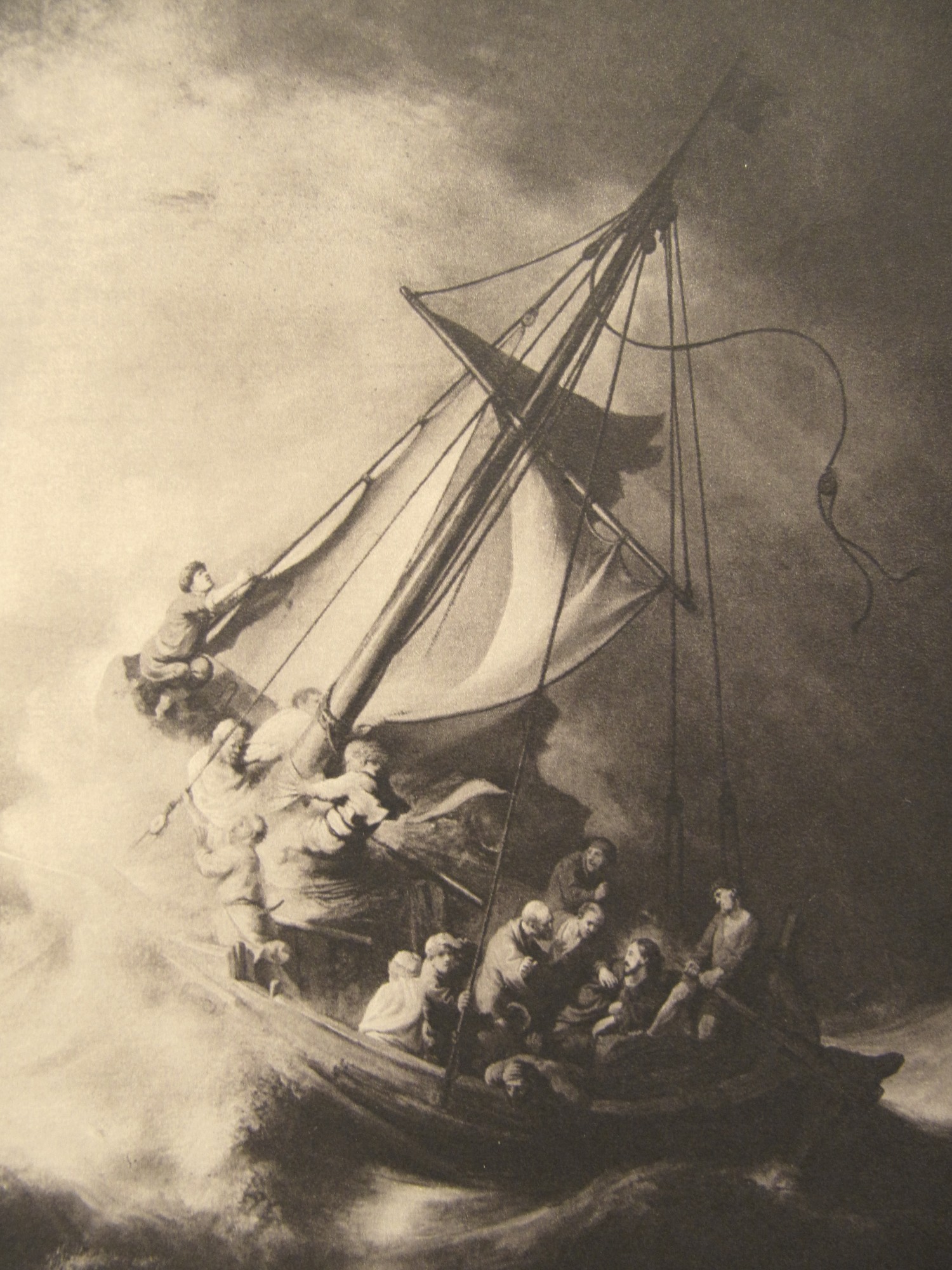
It’s a book that teaches us about life. We may believe in God’s love all right, but sometimes storms come that seem more powerful and we’re sure we’re going to sink.

That’s what happened to Peter in Sunday’s gospel. When told by Jesus to come to him over the water, he set out bravely, but “ when he saw how strong the wind was he became frightened; and, beginning to sink, he cried out, “Lord, save me!”
Immediately Jesus stretched out his hand and caught Peter.”

The sure hand of God is stronger than the raging storms of the sea, our gospel reminds us. Hold on to that hand.  At the same time, our first reading from the Book of Kings reminds us that God is just as strong in quiet times when nothing much seems to be happening.

As the Prophet Elijah watches from his mountain cave, strong winds, earthquakes, fire strike the mountain, but he finds God, not in these, but in the “tiny whispering sound” where one might not expect God at all. God works in quiet times too.


Lessons from Miracles

The miracle of the loaves and the fish is one of the most important miracles of Jesus mentioned in the New Testament. It’s in all four gospels: Mark reports it twice. Most people who know anything at all about Jesus know this story in some form or another. We read Matthew’s version at Mass last Sunday.

Miracles teach us many things. Defying reasonable explanations, they’re signs that God is present in our world and not distant or uninvolved in human affairs. They’re striking acts of divine love and mercy breaking the usual quiet and unseen presence of God among us. In the life of Jesus, miracles are one of the ways God confirms his divine mission.

Miracles teach us other things too. For instance, the story of the loaves and fish reminds us of  the Holy Eucharist, the sacrament in which Jesus through signs of bread and wine nourishes and supports us on our journey through life.  Just as God sent heavenly food,  manna, to the Jews as they made their way through the desert to the Promised Land, so Jesus gives this Bread as food on our way to eternal life.

Miracles invariably involve ordinary human beings as they unfold. Unfortunately, we sometimes overlook their human dimension.

A little boy had five loaves and two fish, John’s account of the miracle relates. (John 6, 9) He evidently gave them to Jesus. No one seems to remember his name. A small detail in the story, we may say. In this same miracle, it’s the disciples of Jesus who alert him to the hunger of the crowds and after the miracle distribute the bread and the fish to them. Minor details of the story, we may think.

Yet, it’s good to keep in mind that in every miracle Jesus seems to involve people,  who cry out their need, like the blind men along the road, or bring him a request for someone else, like the Roman soldier asking for his servant, or bring him the sick and the needy,  like the care-givers who followed him wherever he went.

The cure of the paralyzed man is one of the most colorful stories in the gospel. Those who brought him to Jesus  (how many were there anyway?) carry the helpless man  to the house where Jesus was and when they can’t get through the door because of the crowds, they climb onto the roof, cut a hole in it, and lower him down before Jesus.

The man was cured and walked out of the house carrying his mat with him. It was a miracle, truly,  but what about those who brought him? Some human cooperation like theirs is found in almost all of the miracle stories of the gospel.  A rare exception may be the story from John’s gospel of the paralyzed man who sat for 37 years near the Pool of Bethsaida and had no one to help him enter its healing waters. No one brought him to the attention of Jesus, it seems. so Jesus spontaneously heals him, because he’s so helplessly on his own.

God seldom acts alone, the miracle stories tell us; he invites human cooperation. Our challenge, then, is to respond and do our part in God’s work in this world.  That response may be as small as the little boy’s response who gave over his five loaves and two fish. But it’s important just the same.

How do we prepare ourselves for this role? I think  by daily prayer.

Martha

Martha and Mary were not just related  by blood, St. Augustine says, they were related by the same holy desire.  “ They stayed close to our Lord and both served him harmoniously when he was among them.”

Martha served him as the “Word made flesh,” who was hungry and thirsty, tired and in need of human care and support. She longs to share what Mary enjoys, his presence, his wisdom and his gifts. And she will find her desires fulfilled.

“You, Martha, if I may say so, will find your service blessed and your work rewarded with peace. Now you are much occupied in nourishing the body, admittedly a holy one. But when you come to the heavenly homeland you will find no traveller to welcome, no one hungry to feed or thirsty to give drink, no one to visit or quarrelling to reconcile. no one dead to bury.”

“No, there will be none of these tasks there. What you will find there is what Mary chose. There we shall not feed others, we ourselves shall be fed. What Mary chose in this life will be realized there in full.  She was gathering only fragments from that rich banquet, the Word of God. Do you wish to know what we will have there? The Lord himself tells us when he says of his servants, Amen, I say to you, he will make them recline and passing he will serve them.

Jesus in the Temple, 2

It’s important to remember that Jesus, as well as being a humble native of Nazareth, was also was a regular worshipper in the temple at Jerusalem and was nourished by the great ideas and vision that radiated from this holy place.

Indeed, the Second Temple was admired throughout the world of his time. Whatever the Jews thought of Herod the Great, the unpredictable ruler of Judea, most would be proud of the magnificent temple he built. It was one of the world’s wonders.

Yet, when some spoke to Jesus about its beauty, how adorned it was with gifts, he replied “As for these things you see,  the days will come when not one stone will be left upon another; all will be thrown down.” (Luke 21,6)

The temple was not just a cause for national pride for the Jews; it nourished their spirituality. God, who was honored here, was no household god with limited power, or a national god concerned with one people. The Divine Presence honored here was the Lord of heaven and earth, the God of the nations.

That belief was expressed in the psalms that Jesus and his disciples would have prayed. Two psalms we pray in the Liturgy of Hours Wednesday and Thursday of this week (week 1) are prayers from the temple and its worship:

Psalm 47

All you peoples, clap your hands; shout to God with joyful cries.

For the LORD, the Most High, inspires awe, the great king overall the earth,

Who made people subject to us, brought nations under our feet,

Who chose a land for our heritage, the glory of Jacob, the beloved.

God mounts the throne amid shouts of joy; the LORD, amid trumpet blasts.

Sing praise to God, sing praise; sing praise to our king, sing praise.

God is king over all the earth; sing hymns of praise.

God rules over the nations; God sits upon his holy throne.

The princes of the peoples assemble with the people of the God of Abraham. For the rulers of the earth belong to God, who is enthroned on high.

Psalm 48

Great is the LORD and highly praised in the city of our God:

The holy mountain, fairest of heights,

the joy of all the earth,

Mount Zion, the heights of Zaphon,

the city of the great king.

God is its citadel, renowned as a stronghold.

See! The kings assembled, together they invaded.

When they looked they were astounded; terrified, they were put to flight!

Trembling seized them there, anguish, like a woman’s labor,

As when the east wind wrecks the ships of Tarshish!

What we had heard we now see in the city of the LORD of hosts,

In the city of our God, founded to last forever.

O God, within your temple we ponder your steadfast love.

Like your name, O God, your praise reaches the ends of the earth.

Your right hand is fully victorious.

Mount Zion is glad!

The cities of Judah rejoice because of your saving deeds!

Go about Zion, walk all around it,

note the number of its towers.

Consider the ramparts, examine its citadels,

that you may tell future generations:

“Yes, so mighty is God, our God who leads us always!”

The temple proclaimed God who rules over creation and the nations, but as Jesus reminded his disciples a place can pass away but the God proclaimed there does not pass away. In fact, Jesus spoke of himself as the new temple, who replaces this building and who cannot be destroyed,

Isaiah offered a similar message, which we also read today (Thursday morning, week 1)

“Thus says the LORD: The heavens are my throne, the earth is my footstool. What kind of house can you build for me; what is to be my resting place?

My hand made all these things when all of them came to be, says the LORD. This is the one whom I approve: the lowly and afflicted man who trembles at my word.” (Isaiah 66,1-2)

After the destruction of Jerusalem, Jews who had been banished from the city by the Romans were allowed at set times to stand on the Mount of Olives and mourn for the temple and their great city. Christians also would go there to remember that cherished institutions and human  endeavors can pass away, but Jesus Christ does not pass away.

I was with the people in the picture above, who looked out  from the Mount of Olives to the temple mount and Jerusalem across the Kidron Valley. Good place to put things in perspective these days.

Jesus in the Temple

Where did Jesus teach and pray and live when he was in Jerusalem? That’s hard to figure out today because the city was thoroughly destroyed by the Romans in 70 AD, and since then earthquakes, wars, political and religious forces have hammered away at the old city.

Jerusalem destroyed: 70 AD

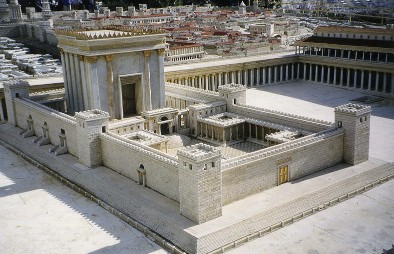
Archeologists try their best to reconstruct ancient Jerusalem and they’ve produced a wonderful model of the city from about the time of Jesus, which can be seen today at the city’s Israel Museum.  As the model indicates, the Second Temple built by Herod the Great dominated the city then. Jesus must have taught and prayed in this splendid place–still being built during his lifetime– as he came to celebrate the Jewish feasts.

His activity here triggered his condemnation to death.

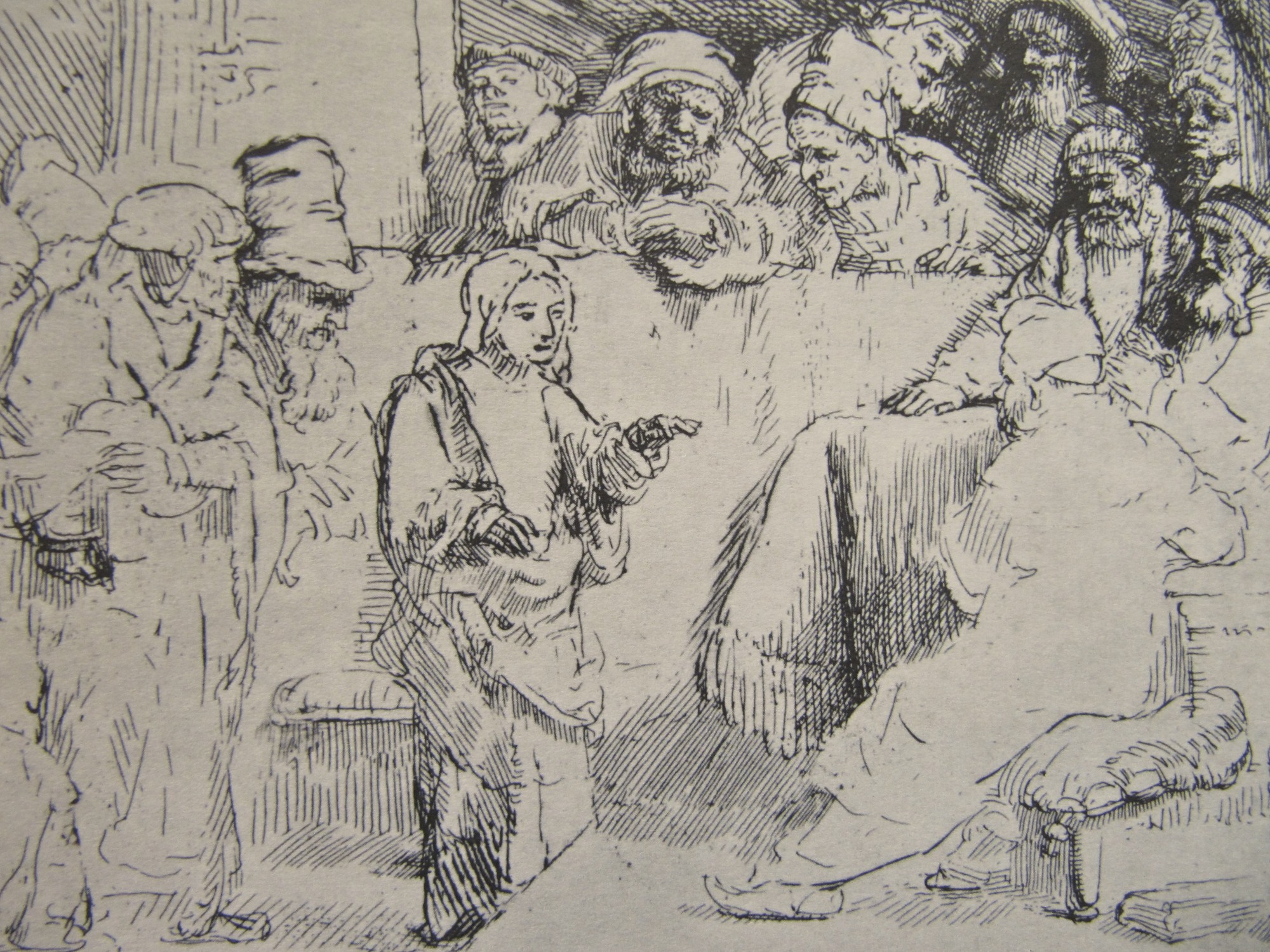
Can we say more precisely where he taught and when he began teaching there? Luke’s gospel offers the interesting story that his parents, after missing him on one of their usual visits to the Holy City,  “found him in the temple, sitting among the teachers, listening to them and asking them questions.” (Luke 2,46) This probably took place in the Court of the Gentiles, the extensive space that surrounded the temple itself, which we can see in the model. We can surmise that, as observant Jews, his family brought him to Jerusalem for the major feasts.

The name, Court of the Gentiles, indicates an area open to all, even though the temple building itself was open only to the Jews. In the Court of the Gentiles,  young Jewish children like Jesus and adults looking for a greater understanding of their faith were able to listen and ask questions of the Jewish teachers. At the same time, even those who did not share the Jewish faith were welcome here,  namely,  non-Jews, gentiles, who could speak to Jewish teachers, inquire about the Jewish faith and even pray to the unknown God.

The Court of the Gentiles was an important part of the temple area; it proclaimed Jewish openness to the world.  The psalms and the prophets spoke of the God of all nations and looked to the day when all peoples would be counted among the children of Abraham:

“In days to come the mountain of the Lord’s house

will be established as the highest mountain

and raised above the hills.

All nations shall stream toward it;

many peoples will come and say:

‘Come, let us climb the Lord’s mountain to the house of the God of Jacob,

that he may instruct us in his ways

and we may walk in his paths.” Isaiah 2,1-5

The Court of the Gentiles was the place where Jesus proclaimed a new age that would fulfill these promises.  As he grew “in wisdom and age and grace” Jesus continued to go to the temple with his family from Galilee to celebrate the Jewish feasts, still “listening to the teachers and asking them questions.”

But after his baptism by John, Jesus’ visits to the temple changed. During the feasts he made extraordinary claims about himself and his mission, as John’s Gospel records.  His claims, along with healings he worked in Jerusalem– his cures of  the man born blind and of the paralyzed man, above all his raising of Lazarus from the dead– alarmed the temple authorities.

The gospels all record the disturbing incident that took place in the temple during the final stages of his ministry. According to Mark’s gospel: “He entered the temple and began to drive out those who sold  and those who bought, and he overturned the tables of the money-changers and the seats of those who sold pigeons; and he would not allow anyone to carry anything through the temple. And he taught and said to them, “Is it not written, “my house shall be called a house of prayer for all the nations?’ But you have made it a den of thieves.” (Mark 11,15-17, Matthew 21,1017; Luke 19, 45-46; John 2,13-17)

Not only was the Court of the Gentiles a place for teaching and prayer, it was also a place for exchanging money, getting advice from priests about where and how to pray and make your offerings,  buying food and animals for sacrifice. In a prophetic gesture, Jesus upset this traditional apparatus and called for renewing the temple so that it could fulfill its destiny as “a house of prayer for all the nations.”

The Gentiles would no longer be excluded from experiencing the Divine Presence;  Jesus signified he came to break down the dividing wall between Jew and Gentile and reconcile both to God through his death. He himself would be the new temple and the sacrifice of reconciliation for all peoples.

No wonder that a major accusation made against him later at his trial before the Jewish leaders was based on what witnesses claimed were his threats to destroy the temple. “We heard him say ‘I will destroy this temple made from human hands and I will build another not made by human hands.” (Mark 14,58)

Some picture Jesus as a hapless Galilean peasant caught in a government net to catch and destroy potential revolutionaries, like Barabbas. Jesus went to his death for more reasons than that. His activity in the temple is an important part of his life and mission, and it led to his death.