Category Archives: Passionists

Mary Magdalene

Today’s the feast of Mary Magdalene. Some recent writers in an attempt to “de-mythologize” Jesus would like to romanticize his relationship with Mary, basing themselves on flimsy late evidence from the gnostic writings of the 3rd and 4th century. They claim he was even married to her. However,tohe gospels see Mary primarily as a disciple who loved him and followed him along with other women. According to the earliest authentic sources we have Jesus was unmarried and his ministry and life was transparent to his early followers.
The media loves sensationalism; it sells and draws an audience. Unfortunately, it takes on a life of its own.

Mary Magdalene

Along with Peter, Mary Magdalene is a key witness to the resurrection of Jesus. Her story is told in John’s gospel which describes their meeting in the garden. For the rest of her years Mary would remember those moments by the tomb.
In the morning darkness she had come weeping for the one she had thought lost forever. She had heard him call her name, “Mary”. She had turned to see him alive and the garden became paradise.
Like a new Eve she had been sent by Jesus to bring news of life to all the living. She was his apostle to the apostles. The belief of Christians in the resurrection of Jesus would be founded on this woman’s word.
On Easter Sunday the church questions her:
“Tell us, Mary, what did you see on the way?
‘I saw the tomb of the now living Christ.
I saw the glory of Christ, now risen.
I saw angels who gave witness;
the cloths, too, which once covered head and limbs.
Christ my hope had indeed arisen.
He will go before his own into Galilee.'”
–Easter sequence

Fascinated by her story, medieval spiritual writers added simple human details to the Gospel accounts. According to the author of the Meditations on the Life of Christ, Mary held the feet of Jesus when he was taken down from the cross, because she had kissed them and washed them with her tears once before.

“(At the tomb) she could not think, or speak, or hear anything except about him. When she cried and paid no attention to the angels, her Lord could not hold back any longer for love… ‘Woman, whom do you seek? Why do you weep?’ And she, as if drugged, not recognizing him said, ‘Lord, if you carried him away, tell me where, and I will take him.’ “Look at her. With tear-stained face she begs him to lead her to the one seeks. She always hopes to hear something new of her Beloved. Then the Lord says to her, ‘Mary’.

“It was as though she came back to life, and recognizing his voice, she said with indescribable joy, ‘Rabbi, you are the Lord I was seeking. Why did you hide from me so long? …I tell you so much grief from your passion filled my heart that I forgot everything else. I could remember nothing except your dead body and the place where I buried it, and so I brought ointment this morning. But you have come back to us.’

“And they stayed there lovingly with great joy and gladness. She looked at him closely and asked him about each thing, and he answered willingly. Now, truly, the Passover feast had come. Although it seemed that the Lord held back from her, I can hardly believe that she did not touch him before he departed, kissing his feet and his hands.”
For more on Mary Magdalene, see http://www.cptryon.org/holylives/nt/magd/

Palm Sunday Procession

The gospels of Mark, Matthew and Luke report that Jesus began his entry to Jerusalem on Palm Sunday at Bethphage and Bethany on the Mount of Olives. From here he went into the city of Jerusalem seated on a donkey and those who followed him threw olive branches before him, crying, “Hosanna to the Son of David, blessed is he who comes in the name of the Lord, hosanna in the highest.”

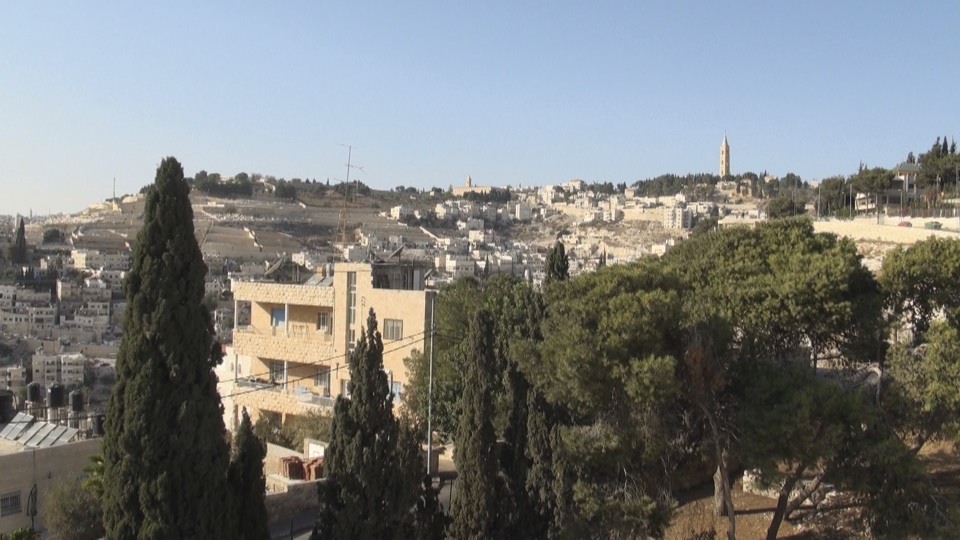
From the roof of the Passionist house in Bethany you can see the eastern slopes of the Mount of Olives looming ahead; the road winds over the crest of the mount down the other side past the Garden of Gethsemani and into Jerusalem. We walked part of the road last week.

The area around  Bethany was probably sparsely populated at the time of Jesus and into the Christian era. During great feasts, the poorer pilgrims would stay in the area, probably pitching tents up in the olive groves, and walk to the city. Here are two pictures from the 1940‘s when the area was less populated, today it is Muslim.

After Constantine established the church in Jerusalem and built churches like the Church of the Holy Sepulcher in the 4th century, vast crowds came here on Palm Sunday to reenact the gospel. They probably began near here to go their way into the city to the empty tomb .

Fr. Roberto tells me the procession today for the Latin church goes through St. Stephen’s Gate and ends in the Church of St. Ann.

Our Palm Sunday celebration today in the Roman rite imitates the ancient practice of the Church of Jerusalem, as well as many other of its Holy Week rites as well. We follow our ancestors in faith in sign. Before our Palm Sunday procession we hear these words:

“Let us remember with devotion this entry which began his saving work and follow him with  lively faith. United with him in his suffering on the cross, may we share his resurrection and new life.”

Don’t forget, however, that the little procession we have in our churches today once stretched over some tough hills and went for a distance.

In the garden behind the Passionist house are some first century ruins of a few Jewish houses from the time of  Jesus. Outside one is  a mikvah for purifications. Not far away is the Franciscan church next to the traditional site of the tomb of Lazarus. Who knows? Could they have lived here? It looks like its part of the ancient village of Bethany.

In back of the site is the famous security wall which runs through the Passionist property. More about that later.

Palm Sunday Procession

The gospels of Mark, Matthew and Luke report that Jesus began his entry to Jerusalem on Palm Sunday at Bethphage and Bethany on the Mount of Olives. From here he went into the city of Jerusalem seated on a donkey and those who followed him threw olive branches before him, crying, “Hosanna to the Son of David, blessed is he who comes in the name of the Lord, hosanna in the highest.”

From the roof of the Passionist house in Bethany you can see the eastern slopes of the Mount of Olives looming ahead; the road winds over the crest of the mount down the other side past the Garden of Gethsemani and into Jerusalem. We walked part of the road last week.

The area around  Bethany was probably sparsely populated at the time of Jesus and into the Christian era. During great feasts, the poorer pilgrims would stay in the area, probably pitching tents up in the olive groves, and walk to the city. Here are two pictures from the 1940‘s when the area was less populated, today it is Muslim.

After Constantine established the church in Jerusalem and built churches like the Church of the Holy Sepulcher in the 4th century, vast crowds came here on Palm Sunday to reenact the gospel. They probably began near here to go their way into the city to the empty tomb .

Fr. Roberto tells me the procession today for the Latin church goes through St. Stephen’s Gate and ends in the Church of St. Ann.

Our Palm Sunday celebration today in the Roman rite imitates the ancient practice of the Church of Jerusalem, as well as many other of its Holy Week rites as well. We follow our ancestors in faith in sign. Before our Palm Sunday procession we hear these words:

“Let us remember with devotion this entry which began his saving work and follow him with  lively faith. United with him in his suffering on the cross, may we share his resurrection and new life.”

Don’t forget, however, that the little procession we have in our churches today once stretched over some tough hills and went for a distance.

In the garden behind the Passionist house are some first century ruins of a few Jewish houses from the time of  Jesus. Outside one is  a mikvah for purifications. Not far away is the Franciscan church next to the traditional site of the tomb of Lazarus. Who knows? Could they have lived here? It looks like its part of the ancient village of Bethany.

In back of the site is the famous security wall which runs through the Passionist property. More about that later.

The Tomb of Lazarus

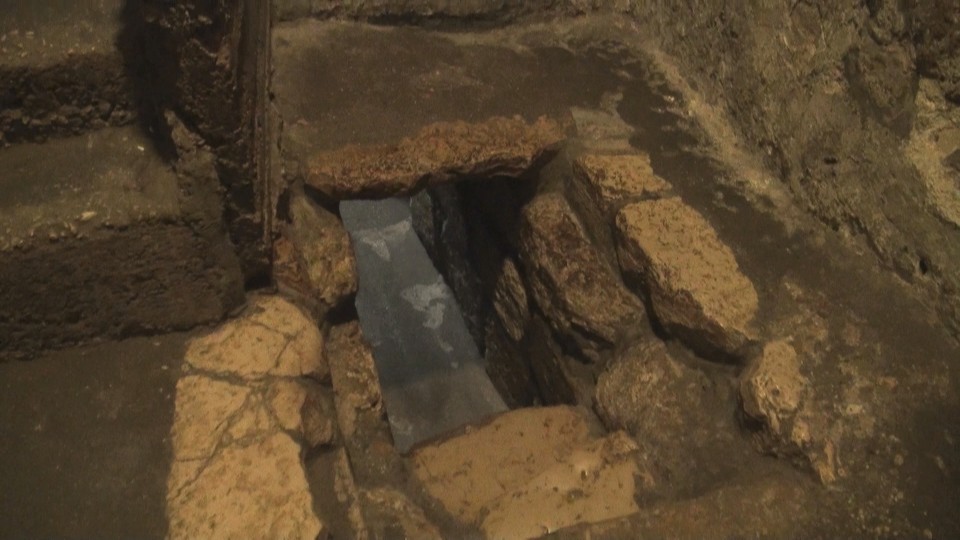
I visited the tomb of Lazarus in November 2010 while in the Holy Land. It’s only a few hundred yards from the Passionist house, St Martha, in Bethany, where I was staying, but because of the Israeli security wall you now have to drive about 13 miles around the wall to get there.

Some sisters from the nearby Comboni convent drove me there on their way to go food shopping one day. As I approached the tomb a group of about 30 pilgrims from one of the slavic countries were entering the tomb, so I stayed outside till they left. During the 2nd World War over 40 million people were killed by Hitler and Stalin in what’s been called “The Bloodlands,” parts of Eastern Europe that were fought over so viciously. Were these people going down to the tomb from that part of the world, bringing memories of “The Bloodlands,” I wondered?

They started to sing in harmony their beautiful eastern chants and the haunting, glorious music came up from the dark rock cavern below. Lazarus was being celebrated again and his tomb rang with their joyful song.

“Lazarus, come out!”

And not only were they celebrating the raising of Lazarus but our hope of resurrection too.

The dark tomb was still ringing with their singing when I went in. Joyful song from a tomb. Lazarus represents us all. That’s the powerful message from our gospel today which prepares us for the life-giving death of Jesus.


The Dawn from on High

Today we buried Brother Jim Fitzgerald, who served our community in Union CIty for many years. I took this picture from our residence in Union City one December morning last year when we were reading from Luke’s gospel and Zechariah’s canticle which says “the dawn from on high shall break upon us.”

Jim loved this place. I preached this homily at his funeral Mass today:

Brother James Fitzgerald, CP            +December 15, 2012

A year or so ago, Bro. Jim Fitzgerald and I were taken by Father Jerome Vereb on a “mystery ride” in Pittsburgh. We went to Knoxville, not far from our monastery in the Southside, where Jerome pointed out streets and homes that some of our priests and brothers came from. At one street he announced dramatically the purpose of our mystery ride. Pointing to an old decrepit building, he said “That’s where young Jim Fitzgerald got his start in the world of media at the King’s School of Oratory.

I remember Jim qualifying that claim. He didn’t graduate from the King’s School for Oratory where many of early radio’s future stars trained, but– yes it was true– his mother brought him there, as a young boy of 6 or 7, to get some elocution lessons for a career in radio. It was the 1930s and radio was going nationwide; Pittsburgh was the center for the new media.

Jim did commercials and acted on the radio as a child. Then as a young boy at Central Catholic High School he was an announcer. For almost 46 years he had a distinguished career on radio in Pittsburgh and later in Ocean City, Maryland. He was a familiar voice on WWSW, one of Pittsburgh’s premier stations.

His radio career became secondary after Jim made a retreat in high school at the Passionist Monastery of St. Paul of the Cross in Pittsburgh. He heard Jesus inviting him: “If you will be perfect, sell what you have and give to the poor, and come follow me.” In the Passionists he saw the way to follow Jesus and for the rest his life he found his friends and spiritual guidance in our community.

He took vows as a Passionist in 1947 but had to leave formal studies in 1949 for reasons of health. He resumed his career in radio, but the Passionists kept drawing him like a magnet. He helped out regularly at St. Paul’s Monastery and later St. Michael’s residence in Union City, NJ, and in 1984 became a member of that community, and eventually took vows again in December 2008.

Jim was a deeply spiritual man. In his room the other day I noticed near his chair books he was reading: a book on prayer, on the theology of history, on the spiritual life and some crossword puzzles. He was a lifelong learner who never lost his desire to know God more. His room is empty today; it’s as if he got his wish.

He was deeply committed to the Passionist life. Jim was the only one I know who read everything that came from our superiors in Rome or here in the States or from Passionists anywhere and kept records of what they said in his files. All you had to say was, “Jim, do you know where I can find something on those Spanish Passionists killed during the Spanish Civil War?” In 20 minutes something would be there. He was devoted to the Passionist life and to its ministries. For years, he dedicated himself to our publications and put his considerable talents into our various publishing efforts.

At the same time, as anyone who lived with him in Union City knows, Jim would do anything for you. If you needed anything from the store, he’d get it. He kept the kitchen stocked; he cleaned the guest rooms, so many ordinary things. He was a humble man, a friend, who served us all.

So we remember him.

Our gospel today recalls the Passion and Resurrection of Jesus, in which we remember another life and another death. “Those who knew Jesus,” Luke says, “stood at a distance, including the women who had followed him from Galilee and saw these events.” (Luke 23,49) Like us here, they looked on at a death and remembered things of his life.

But our reading does not stop at death and neither should we. It goes on to describe something more: the mystery of Jesus’ resurrection: “He’s has been raised,” the angels say to the women who come to anoint the body of Jesus and don’t find it. He is “the Living One.”

Jim is living. He’s sharing in the risen life of Jesus, so he’s not just a memory. His life is changed, not ended.

Often after funerals, Jim would quote from the marvelous hymn “For All the Saints.”  “We feebly struggle, they in glory shine.” “Let’s get back to the struggle,” he’d say.

Now, he goes towards the promise of glory. Is that life detached from this one; are those gone before us oblivious to our world? If the Risen Jesus is the model, those sharing his risen life carry this world with them into the next, and they bring from that world wisdom and  support for ours and for us. They bring what they loved into eternity, and with the clearer vision they have now, with a surer knowledge of God’s plan, with the power of the Risen Christ, they walk with us, as the Risen Jesus walked with his own. Unrecognized, they’re still here.

It’s the communion of saints that we celebrate here in this Eucharist where earth is joined to heaven. Now, a good man joins that communion.  We don’t lose him. You, his family, do not lose him. We, the Passionists, do not lose him. He’s with us in another grace-filled way, a strengthening way, a real way, as the ancient hymn says:

“And when the fight is fierce, the warfare long,
 Steals on the ear the distant triumph song,
 And hearts are brave again, and arms are strong.
Alleluia! Alleluia!

O blest communion, fellowship divine,
We feebly struggle, they in glory shine;
Yet all are one in Thee, for all are Thine.
 Alleluia! Alleluia!

Victor Hoagland, CP


3rd Sunday of Advent

Readings are here.

Knowing who you are is one of the most important tasks we have in this life.

Here’s a homily on John the Baptist  by St. Augustine. He had to distinguish himself from Jesus, the Messiah.

John is the voice, but the Lord is the Word who was in the beginning. John is the voice that lasts for a time; from the beginning Christ is the Word who lives for ever…

Because it is hard to distinguish word from voice, even John himself was thought to be the Christ. The voice was thought to be the word. But the voice acknowledged what it was, anxious not to give offence to the word.

I am not the Christ, he said, nor Elijah, nor the prophet. And the question came: Who are you, then? He replied: I am the voice of one crying in the wilderness: Prepare the way for the Lord.

The voice of one crying in the wilderness is the voice of one breaking the silence. Prepare the way for the Lord, he says, as though he were saying: “I speak out in order to lead him into your hearts, but he does not choose to come where I lead him unless you prepare the way for him.”

What does prepare the way mean, if not “pray well”? What does prepare the way mean, if not “be humble in your thoughts”? We should take our lesson from John the Baptist. He is thought to be the Christ; he declares he is not what they think. He does not take advantage of their mistake to further his own glory.

If he had said, “I am the Christ,” you can imagine how readily he would have been believed, since they believed he was the Christ even before he spoke. But he did not say it; he acknowledged what he was. He pointed out clearly who he was; he humbled himself.

He saw where his salvation lay. He understood that he was a lamp, and his fear was that it might be blown out by the wind of pride.

Friday, First Week of Advent

  Readings:

Isaiah 29:17-24:  The deaf shall hear and the blind shall see.

Matthew 9:27-31:  Jesus gives two blind men sight.

Two blind men are among the many healed by Jesus in Matthew’s gospel. They’re healed together and they represent the blind who will see when the Messiah comes, Isaiah says.

Notice there are two of them, not one. Do the two blind men represent a collective blindness, a group blindness, perhaps a group prejudice against certain people, or a way of thinking that distorts how others are seen? Is it more than    physical blindness they share?  The cures Jesus worked touched more than the ills of body.

When John Newton, the former 18th century captain of an African slave ship, wrote the famous hymn “Amazing grace,” he said he “was blind, but now I see.” It wasn’t physical blindness he described. The tough seaman was converted on a voyage after reading Thomas a Kempis’ “The Imitation of Christ,” and gradually came to see the horrific evil of slavery as well as other vices he had fallen into.

In 1788 after years of debate over the issue in England, Prime Minister William Pitt formed a committee to investigate the slave trade which, until then, was largely seen by the nation as good for their country’s economic welfare. One of its star witnesses was John Newton who described in detail the slave trade and the horrendous practice it was.

This advent may Jesus bring light to our world, our nation, and our church. There are many things we don’t see.

What do you think they are?

Successful and Unsuccessful Saints

In yesterday’s post I offered a summary of Bishop N.T. Wright’s talk to the Italian Catholic Bishops in which he stated that our understanding of the resurrection of Jesus is influenced today by the thinking of the Enlightenment, which placed God (if God exists) beyond our world. We are the lords of creation, according to that thinking. This life and all in it is in our hands to shape and control as we think best.

Yet, the Risen Christ is Lord of creation, still present in our world, fashioning it to become God’s new creation. He has not just come and now is gone, with us only at our death to take his own into heaven. Nor is he just lord of the perfect. Every knee bows before him.

I wonder if the thinking of the Enlightenment has also influenced our thinking about the saints. We like “successful saints” who seem to leave their mark in society by what they accomplish: building schools, hospitals, blazing new trails on the world scene. We like saints who do something big.

What about saints like Saint Gemma, Saint Pio–who seem to be sidelined most their lives without obvious human accomplishments­– aren’t they witnesses to the power of the Risen Christ to reach into humble life and be present there?

I heard recently that Saint Pio is probably the most popular saint in the church right now. Interesting. Books about St. Gemma are the most popular books we distribute at Passionist Press. Interesting.

Is holiness only for the perfect, the bright, the accomplished? Or does the Risen Christ reveal himself to the humble, sometimes giving them the treasures of his wounds? Maybe the voice of the faithful is telling us something.

The Approach of the Leper

These Sundays at Mass we’re looking at the beginnings of Jesus’ ministry vividly described in Mark’s gospel. Jesus came from the Jordan River where he was baptized with Peter and his brother Andrew, and James and his brother John, fishermen from Capernaum.

He was invited to stay in Peter’s house in that town, which today you can see if you’re fortunate to visit the Holy Land.  Archeologists have uncovered the town of Capernaum in recent years and you can see the remnants of its old houses made of black basalt, the foundations of the synagogue where Jesus prayed; and beyond the town are the low mountains where he taught. It’s a fascinating place.

Peter’s house was the center of his ministry there, it seems. Mark describes what happened after Jesus cured Peter’s mother in law: “When it was evening after sunset they brought to him all who were ill and possessed by demons, and he cured them. The whole town was gathered at the door.”

In recent times, Franciscan archeologists have identified Peter’s house among the closely packed houses of the town, and a shrine church is built over it now.

So many people crowded around that house that Jesus had to escape to the surrounding hills to pray. Afterwards he told his disciples that he had to visit other towns and places in Galilee.

Probably the leper approached him as he was going to one of those other towns. Our first reading from the Book of Leviticus gives a succinct account of how lepers were treated in those days. They were separated from family and hometowns and sent to live apart in abominable conditions. People were afraid to go near them.

Rembrandt has a wonderful sketch of the lepers approaching Jesus.(above) It looks like Peter, who is behind him, is hiding in back of the Lord afraid to catch anything from the poor creatures who approach begging for help and healing.

Are we too afraid of people like the lepers, people suffering so much, people suffering from unexplained suffering, that we think we’re going to be overwhelmed by their suffering? We hide from the sufferings of the world. “None of that near me,” we say. But Jesus leads us to the leper. Let’s see suffering with him.

The Resurrection Story

On Wednesday night of our mission at St.Charles Borromeo, in Port Charlotte, Florida, I preached on the Resurrection of Jesus. It’s a mystery that predicts our future.

Recent scriptural studies have made us aware that the gospels of Matthew, Mark, Luke and John were originally meant for particular churches and situations, and so when we read them it’s good to keep in mind the world and circumstances behind each one. Each gospel offers its own unique insight into mysteries of Jesus, and to gain that insight we have to resist our tendency to harmonize one gospel with  the others.

Luke’s account of the resurrection of Jesus centers around the story of the two disciples on the road to Emmaus. Like the other gospels, Luke begins with the women at the tomb that Easter morning, but the Risen Jesus does not stay at the tomb. The Lord engages the world at large and shares his risen life with his disciples and all creation.

In his gospel and the Acts of the Apostles, Luke shows God’s plan of salvation being realized in the person and life of Jesus and then extended to all humanity in his church as its spreads from Jerusalem to Rome, which was then considered the center of the world.

He offers the journey of the two disciples on their way to Emmaus as a way to understand the church’s journey through time.  Just as he did with the two disciples, the Risen Lord walks with his church on its mission through the ages.

It’s not an easy journey. Like that of the two disciples, it’s not a triumphant march. It’s marked by disillusionment, by questions and gradual enlightenment, as their journey was. If the Risen Lord were not with them as they left Jerusalem at the end of the Passover feast, they would have ended up hopeless. The church would fall into hopelessness too, if he were not with her.

Like the two disciples we find the Risen Christ slowly in the scriptures and in the breaking of the bread. Like them, he makes our hearts burn within.

Luke’s resurrection account offers us a way to look at the church today. It’s a good corrective to a triumphalistic view that expects the church to be perfect. It isn’t. It’s also a good corrective to a perfectionistic view of ourselves.

Like the two disciples, we have our questions and suffer our disappointments, but the Risen Christ walks with us. He engages our questions and helps us to understand. He is present in the breaking of the bread, the Holy Eucharist. We don’t see him; he has vanished from our sight, but he is with us. We can rejoice in the Risen Lord with us and guiding us to his kingdom.