Category Archives: Passionists

5th Sunday of Easter: Bless them All

Audio homily here:

When we read the Acts of the Apostles in the easter season, we see another form of church. The church of Paul and Barnabas is certainly different in structure from the church we know today.

There were no parishes or dioceses then. In Rome, if you asked where the Vatican was, they’d point you to a race course on a hill on the fringe of the city where the emperor had his private games. There were no monasteries or religious communities or other Christian institutions.

When Paul and Barnabas went to different places, they went to the Jewish synagogues where they spoke about Jesus as the Messiah. The reaction to their message was mixed, at best. At times they were violently rejected, but some Jews and some “God-fearing gentiles” – non-Jews who appreciated Judaism and its spirituality– accepted their message about Jesus and his promise of salvation.

The synagogue was the normal “catechumenate” where early Christian missionaries like Paul and Barnabas found converts to the faith. No synagogues, as far as we know, became Christian churches.

Where, then, did new believers go? They gathered in the houses of other believers, in “house churches”, usually bigger houses belonging to merchants. The owners and their families lived in these houses, but they also conducted their business in part of the house. Their servants and slaves would live and work there too.

In his Letter to the Romans Paul sends his greeting to Prisca and Aquila and the “church in their house.” They were husband and wife, a couple of merchants who ran a leather business in Corinth. Paul lived with them for almost two years; he worked and taught in their house. After that, he lived in their house in Ephesus and founded the church in that city. He calls them “ my co-workers in Christ Jesus, who risked their necks for my life. I am grateful to them but also all the churches of the gentiles.”

In Rome there were no churches as we know them till the 4th century, but historians count 25 house churches where  Christians met in the early centuries in that city.

Our church structure developed since then, we can see  a development in our first reading today. Paul is appointing leaders in every church. But there’s something important this early time can teach us. At the end of his Letter to the Romans, after expounding on some of his most profound teachings, Paul remembers a number of people in Rome he wants to greet. Prisca and Aquila and all the church in their house are the first; they must have moved back to Rome.  Then there are  a number of other names that seem to come spontaneously to his mind. They’re the names of ordinary Christians, not just the owners of the houses where Christians meet and their families, but the servants, the slaves, the ordinary people whom Paul lived with and worked with and prayed with side by side.

Unfortunately, this section of his letter is never read in church. It should be; it breathes with affection and appreciation and love for all the people who are the body of Christ. Listen to it.

Greet Prisca and Aquila, my co-workers in Christ Jesus,
who risked their necks for my life, to whom not only I am grateful but also all the churches of the Gentiles; greet also the church at their house. Greet my beloved Epaenetus, who was the firstfruits in Asia for Christ.
Greet Mary, who has worked hard for you.
Greet Andronicus and Junia, my kinsmen and my fellow prisoners; they are prominent among the apostles and they were in Christ before me.
Greet Ampliatus, my beloved in the Lord.
Greet Urbanus, our co-worker in Christ, and my beloved Stachys.
Greet Apelles, who is approved in Christ. Greet those who belong to the family of Aristobulus.
Greet my kinsman Herodion. Greet those in the Lord who belong to the family of Narcissus.
Greet those workers in the Lord, Tryphaena and Tryphosa. Greet the beloved Persis, who has worked hard in the Lord.
Greet Rufus, chosen in the Lord, and his mother and mine.
Greet Asyncritus, Phlegon, Hermes, Patrobas, Hermas, and the brothers who are with them.
Greet Philologus, Julia, Nereus and his sister, and Olympas, and all the holy ones who are with them.
Greet one another with a holy kiss. All the churches of Christ greet you. ( Romans 3,3-16)

Paul doesn’t want to leave anybody out. You can hear his love for them all. That’s the love Jesus had for his disciples. “Love one another, as I have loved you.” That’s the love that should be in our church, no matter what its structure is.

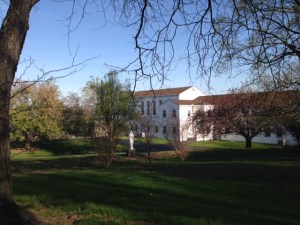
Little Sisters of the Poor

IMG_1809
For the last 7 days I have been with some of the Little Sisters of the Poor on retreat at their place in Flemington, NJ. We’ve been reflecting, for the most part, on the scripture readings from the lectionary for these days in the easter season, and I put some of my reflections down in previous blogs.
IMG_1835

The Little Sisters of the Poor are currently engaged in a dispute on health care with the United States government and the case is before the Supreme Court. Here’s a website explaining their stand. They’re not an advocacy group; they take care of the elderly poor in residences in this country and throughout the world. Holy women, they’re doers, not talkers.

I didn’t mention the case in my talks these days; they were days of prayer and reflection. But the easter readings from the Acts of the Apostles do seem to offer them a template for this experience. As the teacher of the law Gamaliel said about the Jewish-Christians arranged before the Sanhedrin,, “If it comes from God, you will not be able to destroy them; you may even find yourselves fighting against God.” Acts 5, 39

Another lesson we learn from the Acts of the Apostles is that the mystery of the passion and resurrection is always present in our lives and the journey we make together as a community. No matter how dark it seems, God brings us to life and light. That’s the way the Kingdom of God comes.

The Little Sisters know a lot about caring for the elderly, especially the elderly poor, something our government may not know much about, if truth be told. Instead of prosecuting them for breaking a law, wouldn’t it be better to get their advice how to treat the frail elderly? Care for an aging population is a growing challenge for our society.

The Little Sisters know something about it.

Fourth Sunday of Easter: the Good Shepherd

audio homily here: 
I met the Italian film director Mimmo Mancini some years ago who was getting ready to film “Ameluk” a film about a Holy Week procession in an Italian town. It was released in Italy last year. As I remember the story the handsome Jesus selected to take part in the procession had an accident and was replaced by a Muslim from Palestine who, for reasons you might guess, didn’t fit the bill with the locals and a lot others. Part of it was he wasn’t handsome enough. We’re so sure that looks, appearances, image are everything.

“I am the good shepherd,” Jesus says in today’s gospel. Now I don’t know too much about shepherds, what they look like, but from what I know I don’t believe they’re a particularly handsome group. They spend most of their time outside in the cold or heat; weather-beaten, scruffy looking, with few opportunities for grooming themselves, not much to look at. Tough job being a shepherd. Yet, it’s hard for us to imagine that Jesus didn’t look like a Hollywood movie star.

But the good shepherd cares for his sheep. That’s what Jesus does; he cares for his sheep. He cares for his sheep no matter what the weather, cold or hot. He makes the journey with them, no matter how hard it is. He doesn’t abandon his sheep, no matter what. He searches for those who are lost and he looks for others to enter his flock.

That’s the way Jesus, the Risen Jesus, describes himself in John’s gospel today:

“I am the good shepherd.
A good shepherd lays down his life for the sheep.”

He’s not doing it for pay, he’s not someone hired, putting in his time, caring little for his sheep, ready to run away when the wolf comes and the sheep are scattered.

“I am the good shepherd,
and I know mine and mine know me,”

He knows his sheep, Jesus says, not in an impersonal way. He speaks and they hear his voice. ‘Just as the Father knows me and I know the Father,” he says, and “I will lay down my life from them.”

Third Sunday of Easter: Forgiveness

audio homily here:

I think I know where this gospel took place– Tabgha, a quiet, wooded area on the Lake of Galilee just south of the ancient town of Capernaum. Easy walking distance from the town that was the center of Jesus’ ministry.

The name Tabgha comes from the seven springs of water flowing into the lake there. When I visited some years ago, flocks of birds were singing in the trees and drinking from the streams of water.

For centuries fishermen must have pulled in for fresh water from the springs, and perhaps fry some fish over a fire on the beach. It’s a likely place where Jesus would come to pray. Two centuries-old churches are on the site; tradition says he met his disciples here after his resurrection.
DSC00042

John’s gospel says that Peter and other disciples of Jesus came to Galilee after the Lord’s death and resurrection and went fishing. Through the night they caught nothing, but at dawn they heard a call from the shore to cast their nets out again.
“… Jesus was standing on the shore; but the disciples did not realize that it was Jesus.”

They caught a large catch of 153 fish. Jesus then called from the shore to come eat some fish at a fire he had started and he gave them bread and some fish to eat and revealed himself to them.

Peter has a leading role in this story. He jumped into the water to get to the shore. Then after they have eaten, Jesus takes him aside and three times asks the disciple who denied him three times, “Do you love me?” A beautiful statue marks that moment.
sinful man
Three times the apostle who cursed and swore in the courtyard of the High Priest that he did not even know Jesus answers “Yes, I do. I love you.” And Jesus tells him “Feed my lambs. Feed my sheep.”

A great example of forgiveness . No scolding words or recriminations. No “I told you so.” No warning, “You do that again and …” No demotion, no putting on parole. Rather, Jesus gives Peter new responsibility. “Feed my lambs” as I do. A beautiful picture of God’s mercy.

Instead of punishing him, God calls Peter to new things. The mercy of God always calls us to something new, some new life.

Tabgha, along the Lake of Galilee where Jesus met his disciples, is a wonderful place to visit. I wonder if Jesus prayed here during his days in Capernaum and called his disciples to rest awhile. Here he communed with God his Father; here he prayed and forgave. His memory lingers at this lovely place besides the Sea of Galilee.

Prayer and forgiveness go together Jesus taught. “Forgive us our trespasses as we forgive those who trespass against us.” Today’s gospel tells us to pray and forgive. Maybe someone has hurt us, maybe there’s some situation we’re facing now. A job we don’t like, a home situation we’re angry about, something in society that upsets us.

Pray and forgive.

2nd Sunday of Easter (C): The Promise Unfolds

To listen to today’s homily, please select the audio file below:

Acts 5,12-16 The Jerusalem Church
Revelations 1, 9-11a, 12-13.17-19 The Promise of the Risen Lord
John 20,19-31 Doubting Thomas

The resurrection of Jesus happened centuries ago, but today’s three readings remind us it’s a mystery still unfolding even now. Jesus is the “first fruits,” others must still follow him to share in his life. His resurrection gave birth to a church, which must still reach out to a doubting humanity symbolized in the apostle Thomas for its growth. All creation is still “groaning” till it reach its completion when  God’s kingdom comes.

When Jesus entered Jerusalem to face death, he used the familiar figure of the seed to describe the mystery before him. “The hour has come for the Son of Man to be glorified. Amen, amen, I say to you, unless a grain of wheat falls to the ground and dies, it remains just a grain of wheat; but if it dies, it produces much fruit.”

Like the seed the mystery of the resurrection grows to bear much fruit.

Our gospel reading, Jesus appearance to Thomas, reminds us that the Lord still reaches out to a humanity whose faith is imperfect, like Thomas, like Nicodemus, like the crowds whom he feeds with the loaves and the fish in Galilee, like his own disciples at the Last Supper. He still draws into this great mystery people with imperfect faith, slow to believe, like us.


The church he brought into being was a small seed at first in Jerusalem,  but it’s spreading its branches throughout the world, despite the thorns and hard ground that resists its growth. And creation itself despite fears about its future is makings its way to a completion beyond what we know now.

The Risen Jesus remains with us . “There is nothing to fear,” he says to his disciple on the Lord’s day, “ I am the First and the Last and the One who lives. Once I was dead, now I live–forever and ever. I hold the keys of death and the nether world. Write down, therefore, whatever you see in visions-what you see now and what you will see in time to come.” (Revelations 1.17-19)

We see him now by faith, in time to come face to face.

A Church that Heals?

peter healing

Readings

Peter and the other disciples confidently walk among the needy, bringing them life and healing in the name of the Risen Jesus. “Thus they even carried the sick out into the streets and laid them on cots and mats so that when Peter came by, at least his shadow might fall on one or another of them.” (Acts 5, 15) Healing is a sign of the resurrection.

Our readings from The Acts of the Apostles for the next few days are about the cure of a crippled man in the temple. (Acts 3, 1-4, 37)  Peter and John meet the man begging at the temple gate. “In the name of Jesus Christ the Nazorean, get up and walk,” Peter says, and the man got up and “went into the temple with them, walking and jumping and praising God.”

Jesus began his ministry in Galilee with dramatic healings like that. Peter’s mother in law was among the first he healed on the momentous day he came to Capernaum. (Mark 1, 29-32) Wonder and excitement quickly spread, people flocked to him, but soon opponents began to question and finally try to stop the Nazorean.

His followers continue his healing mission after his resurrection.  “In the name of Jesus Christ the Nazorean” Peter and the rest move others to believe and join them by signs of healing; they also face the reaction Jesus faced when he healed. They face opposition.

An important witness of God’s presence in the early church, is healing still important in our age which trusts so much in modern medicine and the latest drugs and treatments?  Pope Francis recently called the church a “field hospital.”A reminder that the church must never abandon it’s mission to be a healing church, witnessing to the resurrection of  Jesus, praying for and caring for and sustaining those in need.

The Acts of the Apostles is a template for looking at our church today as well as the church of the past.


Easter Sunday

To listen to today’s homily, please select the audio file below:

Many followers of Jesus saw him risen after he came from the tomb, the New Testament writers say, but Mary Magdalene’s witness is especially significant. She was a key witness to his death as well as his resurrection. We remember her testimony on Easter Sunday.

First, she was a witness to the death of Jesus. She was among those who saw him die, the gospels say. She witnessed his last excruciating hours on the cross. She saw the soldier pierce his side with a lance. She was with Mary his mother, standing there looking on. She helped them in the grim ritual of taking his body down from the cross. She was one of the women who brought some ointments and  cloths for his burial. That was a woman’s role then, to bury the dead. She watched them lay him in a tomb, about a stone’s throw from where he was crucified. There would be no doubt in her mind that Jesus was dead.

She waited till the Jewish feast was over to come to the tomb. She came early in the morning, not hoping to see him alive, but just to complete his burial. What was done when he died was done hurriedly, the gospels tell us. Like Martha, the sister of Lazarus, Mary Magdalene believed in the resurrection on the last day. It was important for her that the body of Jesus be properly anointed with perfumed oil, because he had been someone most pleasing to God. He would certainly be among those God would raise up on the Last Day.

Mary would not be at the tomb alone. Other women would be with her. The question they had coming to the tomb was: Can we get some help moving the stone away from the entrance to the tomb? It was large. Maybe the guards who were stationed there, maybe some workers, some people passing by. The tomb was not far from the road going into the city.

But Mary saw that the stone had been rolled away and the tomb was empty, the burial cloths were there, the cloth that covered his head, but his body was not there. (John 20,1-9) She ran to tell Peter, who came with John and found it as she had said.

In our first reading today we hear Peter’s description of what happened next. “This man God raised on the third day and granted that he be visible, not to all the people, but to us, the witnesses chosen by God in advance, who ate and drank with him after he rose from the dead.” (Acts 10, 37)

John’s gospel goes on to tell Mary’s story of her meeting with Jesus in the garden where he was buried. She thought he was the gardener until she heard him speak her name, “Mary.” He was alive. He told her he was going to his Father and her Father, his God and her God. On that dark morning she came to finish burying him. Now he was alive, risen, and the world was changed.

“Tell us, Mary, what did you see on the way?” the church asks her in our liturgy today. “
’I saw the tomb of the now living Christ.
I saw the glory of Christ, now risen.
I saw angels who gave witness;
the cloths, too, which once covered head and limbs.
Christ my hope had indeed arisen.
He will go before his own into Galilee.'”

He is risen from the dead, the witnesses say. He died and he rose again. Believe in him, follow him, they tell us. He lives and promises life to those who follow him. He is God’s Son, believe in him.


Immigration, Now and Then

Immigration is a hot political topic today. It’s not just an issue here in America; it’s a world issue. Millions of people all over the world are on the move today because of wars, violence and because they can’t make a living on lands affected by climate change.

Our first reading today at Mass is about Abraham, the “wandering Aramean” whom God blessed as he went from place to place. May God bless those wandering from place to place today.

Today also is St. Patrick’s day. This was a big day in the place where I was born and raised, Bayonne, NJ, a city of immigrants, many from Ireland. The Irish went to church today to thank God for the faith brought to them by St. Patrick and for being able to live in a country where they could make a living and bring up their families, hoping for a better life.

Years ago, I visited the place where some of my relatives came from in Donegal, in northern Ireland. I saw the little abandoned farm house, with no roof, where some of them lived. An old man in the neighborhood remembered the day they left for America, three young people carrying away their simple belongings. It was all they had. There was no work for them there anymore.

When they came to America they took whatever jobs they could get. It had to be hard for them making their way in a new land and another way of living. But they helped one another, and that’s one of the things I remember about that immigrant generation. They helped one another.

I took a picture of that abandoned house in Donegal and gave it to my relatives. I see it’s still hung proudly in their house when I visit. We have to remember where we come from. We’re children of Abraham, on our way to a place that’s still before us. We have to stick together.

4th Sunday of Lent C: The Prodigal Son

To listen to today’s homily, please select the audio bar below.

The story of the prodigal son is one of the longest in the gospel and it’s also one of the most important. It’s not just about a boy who goes astray, of course, it’s about the human race gone wrong.

“Give me what’s mine,” the son says boldly to his father. We all tend to say that. And he takes off for a faraway country, a permissive paradise that promises power and pleasure, in fact, it promises him everything, where he can do anything he wants.

But they’re empty promises, and soon the boy who had so much has nothing and ends up in a pigsty feeding pigs, who eat better than he does.

Then, he takes his first step back. He “comes to himself,” our story says; he realizes what he has done. “I have sinned.”

How straightforward his reaction! Not blaming anybody else for the mess he is in: not his father, or the prostitutes he spent so much of his money on, or society that fooled him. No, he takes responsibility. That “coming to himself” was the first gift of God’s mercy.

He doesn’t wallow in his sin and what it’s brought him, either. He doesn’t let it trap him. He looks beyond it to the place where he belongs, to his father’s house. It wont be an easy road, but he keeps his eyes on it and starts back home.

There he’s surprised by the welcome he receives. More than he ever expected. The father takes into his arms and calls for feast.

His story is our story too.

In these days of Lent, many of us approach the sacrament of reconciliation.  That sacrament is very much like the journey the son takes back to his father. First of all, we look for the mercy of God to come to ourselves, to know our sins and to look for our place in our Father’s house.

Bless me, Father, for I have sinned. we say beginning our confession. The prayer of the son has become our prayer. We acknowledge our sins.

Then the priest who represents Jesus, who speaks for his Father in heaven, says.

God, the Father of mercies, through the death and resurrection of Jesus Christ, has reconciled the world to himself and sent the Holy Spirit among us for the forgiveness of our sins.

Through the ministry of the church, may God grant you pardon and peace, and I absolve you in the name of the Father and of the Son and of the Holy Spirit. Amen.

We receive pardon and peace, the gift of God’s mercy.

How easily we leave your side,

Lord God,

for a place far away.

Send light into our darkness,

and open our eyes to our sins.

Unless you give us new hearts and strong spirits,

we cannot make the journey home,

to your welcoming arms and the music and the dancing.

Father of mercies and giver of all gifts,

guide us home

and lead us back to you.

The Passion of Jesus

sacred heart mission

This evening at our mission at the Cathedral of the Sacred Heart, Raleigh, North  Carolina, I recommended reading the gospels for the rich spirituality each of them offers.

Tonight we read St Luke’s passion narrative, the focal point of his gospel. All the narratives  before it, from the infancy narrative, to the accounts of Jesus’ baptism, his initial mission in Galilee, and his journey to Jerusalem lead to his passion, death and resurrection.

Jesus does not journey alone, nor does he suffer and die and rise again alone. He does not enter paradise alone.  From Galilee to Jerusalem followers join him, interesting followers, like Zacchaeus the publican and the blind man on the Jericho road whom some might find questionable followers. Jesus embraces them.

In Luke’s gospel the mercy of Jesus seems to increase as he journeys to Calvary and his death on the Cross. He does not turn his face away from Peter who denies him. He reaches out to those who crucify him: “Father, forgive them for they know not what they do.” Calvary, a place of death, becomes a shining place of mercy. A thief who simply asks for remembrance is promised paradise. “Today, you will be with me in paradise.

The thief finds a companion in death. He does not die alone or without hope. Reading Luke’s gospel we hear this same promise made to us. The thief is sinful humanity.