Category Archives: Passionists

Reading the Scriptures

bible

I began a mission at Sacred Heart Cathedral in Raleigh, NC tonight with some suggestions. First, get a good bible, like the New American Bible, Revised Edition–  a good translation, good notes and it’s the bible we read in church in our liturgies.

More and more, the bible is becoming our ordinary catechism, prayer book and spiritual reading. At the Second Vatican Council our church embraced the scriptures and the tools of modern scriptural scholarship for understanding the bible. We are becoming a more biblically based church. Some of Pope Francis’ most important reflections, for example, come from the scriptures he’s reading at daily Mass.

My second suggestion it to read the bible with the church. Follow the scripture readings read on Sundays and throughout the year. Each Sunday through the year we read one gospel consecutively. This year we’re reading from the Gospel of Luke.

The church’s lectionary is an opportunity for all of us to hear and reflect on the scriptures together. Reading the scriptures is not only for our personal enrichment, it can build up a parish community and families that hear the word of God together.

I recommend some online resources. The US Bishops’ site http://www.usccb.org/nab/y offers the New American Bible, the lectionary of readings for the year, as well as commentaries on the scriptures. The Passionists have daily reflections on the scripture readings at www.thepassionists.org. I comment mostly on the lectionary readings in this blog. vhoagland.wordpress.com

Today it’s important to learn about the bible from good sources. Not all the programs on the biblr on television from The History Channel and National Geographic and others are reliable.  Sometimes the programs are fundamentalist and simplistic, or sometimes use sensationalism to attract viewers.

Finally, don’t be afraid to meditate on the gospels. Some of the most beautiful insights into the gospels come from ordinary people praying from the scriptures. I think of Brigid of Sweden, whose reflections on the Passion of Jesus gave us the Pieta, the image of the dead body of Jesus cradled in his mother’s arms beneath the cross. The gospels say nothing of that scene, but Brigid said it had to be.

Meditation on the scriptures can also take place in a traditional prayer like the rosary. Pope John Paul II recommended this form of meditation in which we join Mary, who “treasured all these things and kept them in her heart.

If we meditate on the scriptures, we will meet Jesus, not only Jesus of the gospels or the the Risen Jesus who promise to be with us all days. It will lead us to meet the Lord in the least, the Lord in disguise, the Lord of the poor who calls us to the corporal and spiritual works of mercy
First Sunday of Lent: The Temptations of Jesus


The temptation of Jesus in the desert, after his baptism in the Jordan River, shows his human side as much as any other gospel story. Yes, He is the Son of God, a voice from heaven proclaimed him God’s Son in the waters of the Jordan. He died and rose from the dead, he is “God from God, true God from true God,” but Jesus was also human.

We may tend to see him only as divine,  unlike us: a miracle worker, an assured teacher, a master of circumstances, someone above it all, but we’re told in scripture that Jesus was “like us in all things except sin.” An earthly life was challenging for him as it is for us. Life was always challenging for him as it is for us.

Luke’s gospel, following Matthew’s gospel, shows us the humanity of Jesus in the temptations he faced in the desert, and these same temptations were there throughout his life. The Spirit led Jesus into the desert, a challenging place for human beings, where you can get tired and hunger, where you struggle for footing and wonder where you are. The desert is the place where human weakness shows.

Jesus faced three temptations in the desert, our gospel says. One temptation was to think you’re the master of creation. “Turn these stones into bread,” Satan says to him, the Son of God can do that. But if you are truly human–and we say the Jesus was truly human–you can’t turn stones into bread. You can’t control nature. That means that Jesus, like anyone human, got tired and hungry, could get sick and get old. He needed human support and friendship. Yes, for a short period Jesus worked some miracles, but much of his life, the long years he lived in Nazareth, he accepted the limitations of humanity. He did not escape from being human. He was like us.

The second temptation in the desert was a temptation to control people, to dominate them, to be in charge of them, to make them serve you. “The devil took him up and showed him all the kingdoms of the world in a single instant and said to him, “I shall give to you all this power and glory; for it has been handed over to me, and I may give it to whomever I wish. All this will be yours, if you worship me.”

I’ll make people your servants, the devil said. Jesus said, “You shall worship the Lord your God, and him alone shall you serve.” Instead of people serving him, Jesus lived for others and gave his life for others. “I did not come to be served, but to serve.”

The third temptation is a temptation to control God. That’s what the devil suggests when he takes Jesus up to the temple and tells him to throw himself down and God’s angels will save him. You can tell God what to do, said the devil. Use God’s power to become powerful yourself. Jesus told him: “You shall not put the Lord your God to the test.”

In the temptations of Jesus, symbolically recalled in our gospel today, we recognize the humanity of Jesus. He is like us. In his temptations, we can see our own temptations. Just look at how Jesus was tempted and the temptations we face. “Turn these stones into bread.” We would love to snap our fingers and change our lives when they’re not working out to our liking. We would love to be miracle-workers, untouched by sickness or death, having perfect lives, having it all.

“I’ll give you power over people so that they’ll do whatever you want,” the devil tells Jesus. They’ll please you, they’ll agree with you, they’ll like you. How tempting that suggestion is us too.

“I’ll see that God does what you want,” How sweeping that temptation is, but it’s a real danger we face too, that instead of we serving God, doing God’s will and working for God’s kingdom to come, we see God working for us and the kingdom we would like to come.

This gospel is a very symbolic gospel. It not only shows the humanity of Jesus, it shows the temptations all of us, human beings,  meet in life. But the gospel wants us to see something more. Jesus did not come just to show us what it means to be human, he came to help us to be human. He did not give into temptation, the human temptations he faced. He delivers us from temptation. He lives in us and works with us and sustains us and helps us regain our strength again and again.

Just as the people of Israel were sustained on their way through the desert, Jesus sustains us.


4th Sunday C Help Us Lord to Believe


To listen to today’s homily, select the audio file below:

For two Sunday’s we have been reading the long account from St. Luke’s gospel of Jesus’ return to Nazareth, his hometown, as he begins his ministry in Galilee. I mentioned last week Luke’s interest in Jesus’ early life. More than any other evangelist, he writes about Jesus early years.

The four gospels take a dim view of Nazareth, the hometown of Jesus Christ. Early in his gospel, John says that Philip, one of Jesus’ first disciples,  invited Nathaniel to meet “Jesus, son of Joseph, from Nazareth.” “Can anything good come from Nazareth?” Nathaniel replies. (John 1,46).

 The gospels of Mathew and Mark  recall the sad rejection of Jesus by his hometown after his baptism by John the Baptist.  Matthew places it after Jesus has spoken to a large crowd in parables. Then, he goes to Nazareth and speaks in the synagogue to his own townspeople, who are at first astonished at his wisdom, but they wonder where did “the carpenter’s son” get all this. They know his mother and his family, and they reject him. (Matthew 13,54-58)

Mark’s gospel puts the event after Jesus has raised a little girl from the dead. Going to Nazareth with his disciples, he’s greeted in the synagogue with astonishment because of his wisdom; they’ve heard of his mighty deeds, but then they ask where did this “carpenter” get all of this? He’s “Mary’s son” and they know his family. Jesus “was amazed at their lack of faith.”    (Mark 6,1-5)

In Luke’s gospel Jesus goes into the synagogue at Nazareth almost immediately after his baptism and reads from the Prophet Isaiah the passage: “The Spirit of the Lord is upon me; He has anointed me…” Jesus says he’s fulfilling the words of the prophet. He’s the Messiah.

In the reading today the people of Nazareth not only reject him but try to put him to death. They are people who have known him all his life, we presume even members of his family are among them.

Here is a concrete example of what’s said in another gospel: “He came to his own and his own received him not.” Of course, their reaction surprises us. How could they be so blind? How could they not see?

Our first reading today may offer some insight into their reaction. It’s about the Prophet Jeremiah who also met opposition from his own people and was put to death for his claims. Maybe he can help us understand what happened at Nazareth?

The prophet speaks for God. “Stand up and tell them what I command you,” God says to Jeremiah, “I have appointed you a prophet to the nations.” But when God first calls him, Jeremiah shrinks from the task. ” Don’t send me, I’m just a child.” They know me too well; I
I don’t have the status, the aura of a prophet.

That seems to be what happened at Nazareth. They knew Jesus too well. “Isn’t this the carpenter’s son?” They doubt, they want more proof. “The prophet is honored, except in his native place,” Jesus says,amazed at their unbelief.

The prophet speaks for God, but what God says through the prophet may not be to our liking. Sometimes it seems too good to be true. We’re cynical people. We think like human beings, not like God. Would God promise us a life beyond death, beyond suffering, beyond disappointment, beyond failure. Could God be the carpenter’s son? Could it be true,as the Letter to the Hebrews says, “In times past, God spoke to our ancestors through the prophets,but in these last days he has spoken to us through his Son.” (Hebrews 1, 1-2) Could God so love the world that he would send his Son to bring us life?

Let’s not be too harsh with the people of Nazareth. When we are looking at them, we are looking at ourselves.

Let’s ask for faith, faith like Mary his mother had. Let’s ask that we listen to his words and believe in his promises. Let’s ask that we follow Jesus Christ in the mysteries of his life, death and resurrection, till he reveal himself to us and we share in his glory. Help us, Lord, to believe in you.

3rd and 4th Sunday C; His Own Turn Against Him

Audio homily here:

Luke begins his account of Jesus’ public life by recalling his return to Nazareth after his baptism by John in the Jordan. This Sunday and next Sunday we read from Luke’s long account of that event.

Mark and Matthew tell this story later in their gospels, but Luke, who concentrates more on Jesus’ early life than the other evangelists, puts the beginning of Jesus’  public life in Nazareth, in the synagogue where he worshipped, among those who knew him best. (Luke 4, 14-21)

Luke paints the coming of Jesus into this world in broad, sweeping terms in his gospel. Caesar Augustus was the world’s ruler, Herod ruled in Palestine, others ruled under them. At the same time, he focuses on Jesus’ own personal history. Born in Bethlehem, Jesus’ first home is an obscure village in northern Galilee– Nazareth, where he grows “in wisdom and age and grace, before God and man.” There he was brought up.

The synagogue at Nazareth was probably like other synagogues in the towns of Galilee. Some, like that at Magdala on the Sea of Galilee, have been excavated in recent times. It was a small one story rectangular building, with two tiers of seating all around its walls, made for a town of no more than 500 people. In the middle of the synagogue was a stand holding copies of the various books of the scriptures. The synagogue was the center of life in those towns.

Jesus has returned to Nazareth after beginning his ministry “all through Galilee, teaching in their synagogues and praised by all. (Luke 4, 14-15) Now, back home, he goes into the synagogue on the Sabbath, “as he was accustomed to do.”

He gets up from his place to read the scriptures. (From the same place where he sat for years? Was Mary his mother there with him?) He’s “ handed a scroll of the prophet Isaiah.

He unrolled the scroll and found the passage where it was written:

The Spirit of the Lord is upon me,

because he has anointed me

to bring glad tidings to the poor.

He has sent me to proclaim liberty to captives

and recovery of sight to the blind,

to let the oppressed go free,

and to proclaim a year acceptable to the Lord.

Rolling up the scroll, he handed it back to the attendant and sat down,

and the eyes of all in the synagogue looked intently at him.

He said to them,

“Today this Scripture passage is fulfilled in your hearing.”

A short sermon, and a powerful statement. “This scripture passage is fulfilled in your hearing.” The Spirit of the Lord is upon me, Jesus says. I’m anointed to bring glad tiding to the poor. Jesus claims a messianic calling.

His neighbors, who have known him for years, are first impressed, then question him, then deny his claims, then threaten to put him to death.

In their gospels, Mark and Matthew describe opposition to Jesus coming first from the scribes and Pharisees, the leaders from Jerusalem, but Luke sees opposition to Jesus coming first from his own hometown, from family, neighbors and friends. He knows how important this rejection is.

It’s true, isn’t it? When we enter this world, we enter the small unit of human life, a family, and beyond the family, the people and places that shape us early in life. We’re subject to this important smallness, our “Nazareths” where we grow “in wisdom and grace.” We’re first nourished there; we look for lasting love and support there. It means so much to us.

Throughout his ministry, Jesus will know opposition. Leaders of the people, public officials will oppose him.  In his final days, his own disciples will abandon him. Only a few will stand by his cross. The physical sufferings he endured were great. He was scourged, his head was crowned with thorns, his hands were nailed to a cross, he died hanging there long hours alone.

But rejection from his own at Nazareth will weigh heavily on him. It was a big part of the mystery of his cross. “He was amazed at their unbelief.” Yet, Jesus who embraced humanity with love, embraced Nazareth too. He loved it with God’s great love.

We have to pay a lot of attention to where we’re born, where we’re brought up, our families, the people we live and work with. Nazareth is important to us.


Opening the Door

Holy Door
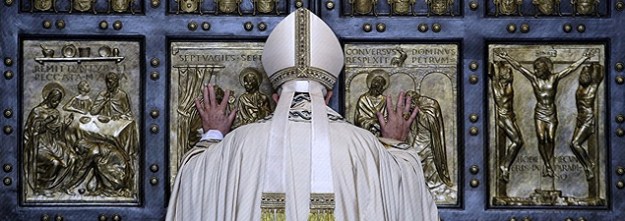
Yesterday Pope Francis in a symbolic gesture pushed open the door to St. Peter’s Basilica in Rome to begin the Holy Year of Mercy. Opening a door is an invitation to go in, to see what’s inside, even if we have been in there before. The pope is inviting us to go into the mysteries of our faith, to look again and appreciate them.

We forgot so easily and need to remember. This is a time to open the doors to our own parish churches, as the pope did the door to St. Peter’s, asking for the grace to see them again. They’re not just buildings, remember, they’re places where we meet God– the merciful face of God, Jesus Christ. He is the great sacrament, God’s Son, born of Mary, who suffered under Pontius Pilate, was crucified, died and was buried. On the third day he rose again. He’s present in all the sacraments we celebrate in this place. This is his church.

He tells us to “be merciful as our heavenly Father is merciful.”

Our parish church is where we celebrate “the mysteries of faith.” Faith alone unlocks the mysteries of this place. So at the door we make the sign of the cross, the sign of faith. This is a place where we are blessed by God, the creator of all things, by his Son, Jesus Christ, and by the Holy Spirit. “In the name of the Father and of the Son and of the Holy Spirit.”

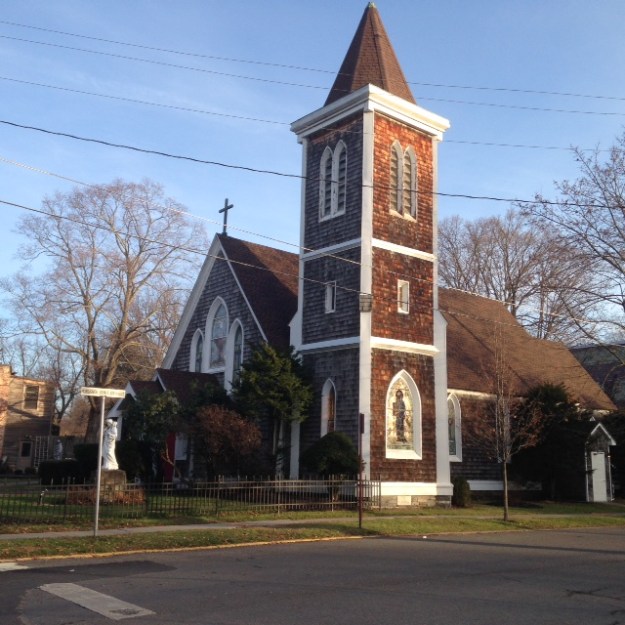
The opening of the Year of Mercy is a good time to push open the door of our parish churches and see them again. This evening I hope to do that on the last day of our parish mission, here at Good Shepherd Parish, Rheinbeck, New York.

Good Shepherd Parish, Rheinbeck, NY

IMG_1516
I’m preaching a parish mission at Good Shepherd Parish, Rheinbeck, New York, December 5-9. The theme of the mission is “Be merciful, as your Father is merciful,” the theme of the Holy Year of Mercy that Pope Francis called for last March.

The holy year begins December 8th and ends November 20, 2016, “the Sunday dedicated to Our Lord Jesus Christ, King of the Universe–and the living face of the Father’s mercy.”

Each evening, from Monday to Wednesday, I’ll be preaching on God’s mercy.

Monday: Jesus the Living Face of the Father’s Mercy. In Luke’s gospel Jesus is truly “the living face of the Father’s mercy” from his birth till his death and resurrection. His miracles and encounters with many during his lifetime, like the blind man and Zacchaeus, the tax collector, reveal his gift for changing people and bringing them joy. We experience the mercy of God in the Eucharist and the Sacrament of Penance through Jesus Christ, our Lord.

Tuesday: Mary, Mother of Mercy. “Hail holy Queen, Mother of Mercy, our life, our sweetness and our hope.” God’s gift of grace enabled Mary to be what Jesus asked: “Be merciful, just as your Father is merciful.” It enabled her to embrace so many mysteries of God’s hidden plan, especially the mystery of suffering and death. We, “banished children of Eve,” cry out to her; she is “our life, our sweetness and our hope.”

Wednesday: Jesus, the Bread of Life. In his encyclical, Laudato Si, Pope Francis invites us to see in the Eucharist a call to care for the earth, our common home. “The Eucharist joins heaven and earth; it embraces and penetrates all creation. The world which came forth from God’s hands returns to him in blessed and undivided adoration: in the bread of the Eucharist, ‘creation is projected towards divinization, towards the holy wedding feast, towards unification with the Creator himself’. Thus, the Eucharist is also a source of light and motivation for our concerns for the environment, directing us to be stewards of all creation.” (LS 230)

Advent Weekday Readings: 2nd Week

An Overview

The Old Testament readings this week, mostly from Isaiah, describe our journey through the desert as a hard journey, but the desert will bloom and a highway will be there, a holy way. (Monday) We’ll hear tender, comforting words as we go. (Tuesday)  Those who hope in God will renew their strength, soaring on eagle’s wings. (Wednesday) We’re as insignificant as a worm, the prophet says, but God takes us in hand and says: “Fear not; I am with you.” (Thursday) God teaches us the way to go. (Friday) We meet prophets like Elijah and John on our way. (Saturday)

Above all, Jesus is our way, the gospel readings say. The paralyzed man lowered through the roof in Caphernaum got up and was ready to make the journey. He symbolizes paralyzed humanity enabled to walk again. (Monday) Jesus the good Shepherd searches for and finds the stray sheep. (Tuesday)  “Come to me all who are weary…” he says. (Wednesday) We’ll find prophets and guides like John the Baptist and Elijah. (Thursday) Though rejected like John the Baptist, Jesus still teaches. He will always teach. (Friday) He saves us, even though he goes unrecognized like John and Elijah. (Saturday)

You can follow the daily readings  here

2nd Sunday of Advent: The Merciful Way of the Lord


To listen to today’s homily, please select the audio file below:

Last year, CNN ran a series on television called Finding Jesus: Faith, Fact, Forgery. One of the segments was about John the Baptist. I’m afraid I didn’t like John as he was portrayed. He shouted a lot about the coming judgment. There was something scary and unstable about him and I thought to myself: “I don’t know if I would follow this man.”

In the CNN presentation scholars periodically commented on John and his relationship with Jesus. They seemed to say that Jesus was a copy of John, that he got everything from John; he learned everything from John. That made me wonder if I would follow Jesus, if that was the way he was.

I find the scriptures offer a more reliable picture of John and Jesus. Luke’s gospel sets the stage for John’s appearance. “In the fifteenth year of the reign of Tiberius Caesar,
when Pontius Pilate was governor of Judea,
and Herod was tetrarch of Galilee,
and his brother Philip tetrarch of the region
of Ituraea and Trachonitis,
and Lysanias was tetrarch of Abilene,
during the high priesthood of Annas and Caiaphas,
the word of God came to John the son of Zechariah in the desert.”

“In the desert.” John preached “in the desert,” in the Jordan valley where pilgrims from northern Israel traveled on their way up to Jerusalem. They’ve taken the time off to go up to the temple and then go back home to their work and life as before. They’ve been walking on rough roads in hot days. They’re stopping to get some water before walking the last 15 miles up to the holy city.

John approaches them. “Something is happening, something big is going on. Something that the prophets have promised. We have to get ready for it. God is ready to do something. Someone is coming. ‘Prepare the way of the Lord.’ God is coming to judge us.”

Yes, there’s an urgency about John, but he’s not insane. He sees there’s something great ready to happen. God, the judge of all is coming. Someone is coming to bring God’s judgment.

When Jesus comes, John is certainly not his teacher. He recognizes Jesus and baptizes him in the Jordan. But Jesus is not a copy of John. Later, from he’s in prison, John sends disciples to Jesus who ask “Are you he who is to come, or shall we look for another.” Jesus said to them in reply, “Go and tell John what you hear and see: the blind regain their sight, the lame walk, lepers are cleansed, the deaf hear, the dead are raised, and the poor have the good news proclaimed to them. And blessed is the one who takes no offense at me.” (Matthew 11, 5-6)

Jesus calls himself the face of God’s mercy, the hand of God’s mercy, the gift of God’s mercy. John was waiting for God who is judge, but Jesus reveals God who is kind and merciful.

On March 13, 2015, Pope Francis called for a Holy Year of Mercy, a year to live “in the light of the Lord’s words: ‘Be merciful, just as your Father is merciful.’ (Luke 6, 36) The year begins this week, December 8th, the Feast of the Immaculate Conception and ends on November 20, 2016, “the Sunday dedicated to Our Lord Jesus Christ, King of the Universe–and the living face of the Father’s mercy.”

31st Sunday B: Our Planet’s Keeper

To listen to today’s homily please select the audio file below:

Our first reading today from the Book of Kings describes a drought that afflicted Palestine thousands of years ago. It’s a dismal picture. There’s been no rain. The crops have failed. Water’s scarce and the land’s desolate. A poor widow is scrounging for some sticks to start a fire. The people most affected by this drought are the poor.

It’s a natural disaster. The reading reminds us that God is present, even in desperate situations like droughts and other natural disasters. But scientists today are telling us that many of the disturbances in our world now- storms, droughts, the unusual weather changes that threaten us–are not from nature alone; they’re man-made. We’re facing an environmental crisis that can bring irreparable harm to our world. We certainly need God’s help. But we need to do something about it ourselves.

I was at a symposium on the environment at Fordham University on November 3, 2015. It was entitled: Our Planet’s Keeper? The Environment, the Poor and the Struggle for Justice.” The speakers were Cardinal Oscar Rodriquez Maradiaga from Honduras and Professor Jeffrey Sachs, director of the Earth Institute at Columbia University and advisor to the United Nations on millennium environmental goals.

The symposium dealt with two important areas. One was Pope Francis’ recent encyclical Laudato Si issued on May 24, 2015. The encyclical addresses our global environmental crisis and is probably the most widely received papal document in modern times. As a South American Francis has experienced firsthand the crisis of the environment on that continent and its affect on the poor. His letter is addressed, not only to Catholics, but to the peoples of the world.

The pope timed his letter to influence another important event, namely the critical meeting on the environment to be held in late November and early December in Paris of representatives of the nations of the world. The name of the meeting is COP21, that’s bureaucrat-speak for meetings sponsored by the United Nations that have been going on for the last 21 years trying to deal with climate change. Since 1992 at the Earth Summit in Rio di Janeiro countries of the world have been seeking “stabilization of greenhouse gas concentrations in the atmosphere at a level that would prevent dangerous anthropogenic interference with the climate system”. The goal is to keep the rise in global mean temperature to 2 degrees Celsius above pre-industrial levels—beyond which disaster seems inevitable.

Unfortunately, nothing has been achieved in the 21 years of those meetings. In his encyclical Pope Francis charged that by putting “national interests above the global common good”, the world is guilty of “failure of conscience and responsibility” regarding the environment.

At the meeting at Fordham Professor Sachs welcomed the pope’s encyclical as a “moral voice” we need to hear. He saw the pope’s subsequent visit to world leaders at the United Nations as a positive influence on the upcoming meeting in Paris. He also sees a change in public opinion throughout the world and in our country concerning the environment.

Public opinion–that’s us. I don’t think we think much about issues of the environment. The media certainly doesn’t. I haven’t heard the environment brought up in our political debates so far. That’s probably because politicians, following their pollsters, think people are more interested in the economy, jobs, federal spending and health care.

That may be changing. A recent poll in October of the “National Surveys on Energy and the Environment” from the University of Michigan and Muhlenberg College reports a big spike over the summer in Americans–70%– who believe in global warming. That’s 10% increase from this time last year. One author of the poll said the reason from the increase is not that people are listening to the scientists or reports from the UN or– I would say– even the pope. They’re “responding to their perception of weather,” he said; “… what last summer or winter was like.”

So people are looking out the window or seeing the reports on television. We have had the hottest summer on record, the strongest hurricane on record, a water shortage and rationing in California, drought throughout the world displacing millions of people who are looking for another place to live.

The danger is that our world may begin to look a lot like the world described in our first reading today. Do we want to leave that kind of world to our children and the next generations? We need to know much more about this crisis than we do; we need to do more about it than we’re doing.

The cardinal at our symposium the other day urged people to read the pope’s encyclical. It’s not just about climate change, the pope is calling for a change in the way we live and the way we think. and the way we care for our world.

The title of the symposium the other day was Our Planet’s Keeper? Who’s our planet’s keeper? We are.

Care for Our Beautiful Earth

senic2
Today, cardinals, patriarchs and bishops of the Catholic church across the globe, called on the leaders of governments, business and finance, the United Nations, NGOs and other members of civil society who will negotiate issues of climate change (COP21) at a meeting in Parish, December 7-8 to produce a just and legally binding and “truly transformational” climate agreement. The Catholic leaders cited Pope Francis’ encyclical letter, “Laudato si.”

“We join the Holy Father in pleading for a major break-through in Paris, for a comprehensive and transformational agreement supported by all based on principles of solidarity, justice and participation. This agreement must put the common good ahead of national interests. It is essential too that the negotiations result in an enforceable agreement that protects our common home and all its inhabitants.”

The Catholic leaders ended with a prayer for this important meeting:

Prayer for the Earth

God of love, teach us to care for this world our common home.
Inspire government leaders as they gather in Paris:
to listen to and heed the cry of the earth and the cry of the poor;
to be united in heart and mind in responding courageously;
to seek the common good and protect the beautiful earthly garden you have created for us,
for all our brothers and sisters,
for all generations to come.
Amen.