Category Archives: Passionists

What Do You Do With Gold Coins?

Often when I find myself thanking God for all he has given me in this life: reasonably good health, such wonderful people to love and be loved by, such graces, such joys, his very presence, the gifts of his Holy Spirit, I find myself asking like so many, “What can I do to repay you for your love? How can I serve you? What do you want me to do with these gifts?”.

Today’s Gospel reading at Mass from Luke prompts me to ask these questions once again.

“A nobleman went off to a distant country

to obtain the kingship for himself and then to return.

He called ten of his servants and gave them ten gold coins

and told them, ‘Engage in trade with these until I return.’

The golden coins given to me by the Master, priceless gifts, consecrated hosts from a paten that come into my hands, golden seeds of wheat to be planted in a field– how can I share them? How do I begin?

I guess I must begin in humility, in gratitude, swept by praise to his Glory.

Psalm 150 ends the Book of Psalms appropriately with a trumpet blast, accompanied by the joyful noise of lyre, harp, strings, pipe, cymbals, wild dance and loud, loud praises to the Lord. Perhaps that is the best way to invest those golden coins of his, telling the world of his boundless Love and the joy that it brings, joining with the hosts, the elders, winged creatures, and countless saints.

Day and night, with our eyes on the One who sits on the throne, let us not stop exclaiming:

“Holy, Holy, Holy is the Lord God almighty,

Who was and Who is and Who is to come.” (RV 4:8)


Orlando M Hernández

33rd Sunday C: Visiting Churches

Audio homily here: 

Whenever I can, I invite visitors to our monastery in Jamaica, Long Island, to take the subway to downtown Manhattan for a ride on the Staten Island Ferry and then visit Battery Park, the Museum of the American Indian, and some of the old churches and shrines among the city’s famous skyline. I try to tell the story of our country and the Catholic church in America by walking through those places. It’s a good opportunity to talk about the care we need to give creation as we look at the waters of the harbor, the question of immigration as we visit Castle Clinton in the Battery, and the church as we visit the area’s churches. Looking at the past helps you to understand the present.

Our walk usually ends at St. Peter’s church, the oldest Catholic church in New York City, on the corner of Church and Barclay Streets, a block away from the World Trade Center. The church was dedicated November 4, 1786, three years after British troops evacuated the city at the end of the Revolutionary War and it’s been there as an active parish every since.

Previously, New York City was under Dutch and British rule for almost 150 years. During that time the city was strongly anti-Catholic, with laws calling for any Catholic priest who came there to be jailed. Catholic worship was forbidden; there were no Catholic churches.

Even after the Revolutionary War, despite their support for the American cause, Catholics were looked down upon in New York City. There were only a few hundred in a population of almost 20,000. Being a Catholic didn’t get you far in New York in those days.

So how did that church get built? Well, there were some foreign diplomats from France and Spain and Portugal in the city then. New York was the nation’s capital at that time. (1785-1790)

There were a couple of well-to-do Catholic businessmen, but most of the Catholics that formed St. Peter’s were poor Irish and German immigrants and French refugees and slaves from the recent revolution in Haiti.

Not a good mix of people to form a parish, you might think. This new congregation, besides facing the anti-Catholic attitude of New Yorkers, was poor and getting poorer as new Catholic immigrants poured into New York from Europe. Its priests weren’t the best either. They seemed to be always squabbling among themselves. There were some scandals among them. The laypeople were also divided among themselves. There were factions that wanted to run the parish their way or no way. There wasn’t a bishop in the country at the time to straighten things out.

So what kept it going? The other day we celebrated the Feast for the Dedication of the Church of St. John Lateran in Rome. The liturgy for that feast offers some wonderful insights into what a church and a parish should be. “My house is a house of prayer,” Jesus says. This church is not a social hall; it’s a place where we meet God and God meets us. It’s a place where we are welcomed on our way through life by a living water that restores us and helps us grow. ( Ezekiel 47.1-12) It’s is a place where we remember our mission in this world: we’re builders of the City of God, living stones that together form the temple of God. ( 1 Corinthians 3, 9-17) It’s is a place of communion, where we commune with God and God with us.

The readings for the feast say a church is a place of welcome. It’s where the lost sheep find their way home. It’s where people like Zacchaeus, the tax collector mentioned in St. Luke’s gospel, find new hope for their lives. It’s is a place of sacraments, where infants are blessed, where marriages begin, where we put our dead in the hands of God who promises eternal life.

What keeps a church and a parish going is its spiritual life, its life of prayer, its life of ministry.

Whenever I go to St. Peter’s Church on Barley Street I point out two markers at its entrance. One says that St. Elizabeth Seton, the first native born American saint, was received into the Catholic Church here in 1806. She had been a member of a prominent Anglican church just down the street, Trinity Church, but came to St. Peter’s drawn by her faith in the Mass and the Blessed Sacrament. Socially, it was step down for her. Spiritually, she found a home here in this struggling, messy parish of poor immigrants.

The other marker recalls Pierre Toussaint, a Haitian slave who was also a member of this church in colonial times. He became a famous New York hair-dresser and was welcomed into the homes of elite members of New York society for over 50 years. For 50 years he came to Mass every morning at St. Peter’s. He’s buried in the crypt at St. Patrick’s Cathedral and in being proposed for canonization today.

The church is not a place of brick and stone. It’s a place for people, holy people, to meet God and one another.  They make the church.

32nd Sunday C: Thinking About Death

Audio Homily here:

How do we want to die? I think we’ll be hearing that question more frequently after our current elections are over. “End of life” decisions are going to be part of the political agenda in the future. In our society we’ll be facing a range of questions about death and dying.. 

Let’s think about the term “end of life” first. If we listen to our first reading from the Book of Maccabees, the seven brothers who are put to death for defying their Greek conquerors and keeping their Jewish faith don’t see death as an end of life. “You are depriving us of this present life,” one of the brothers says, “but the King of the world will raise us up to live again forever.”

The seven brothers see this life as given to them by God, who is master of life and death. Life doesn’t end. We are in God’s hands from the beginning. It’s for God to decide when we die, but God promises life beyond death. It’s for us to remain faithful as long as we live.

We hear in today’s gospel people denying that there’s life after death and trying to bait Jesus with what they think are absurd circumstances. Jesus tells the Sadducees  that life beyond this life is not the same as here on earth. A heavenly life is beyond what we can imagine.

So denying life beyond death isn’t new. Today we can hear the same denial of eternal life, the life that Jesus promises and shows us in his resurrection. One of the signs of that denial may be, I think, the increasing number of suicides, even among young people. We can see this life as our only life, and when circumstances become seemingly intolerable and seemingly hopeless, some unfortunately end their earthly lives. But we leave them to God’s mercy.

Today death often goes unmentioned. We don’t want to talk about it. We just want to think about life. But death is an important part of life.

There was a passage in a popular book some years ago by Carlos Castenada about an old Indian, Don Juan, and a young sophisticated scientist from the northeast, walking together in the desert in the southwest. The two are world’s apart in the way they think. 

As I recall it, the old Indian says to the young man, “Did you see the White Eagle circling over your shoulder?”

“ Yes, I see it,” the young man replies.

“That’s your death, keep an eye on it.”

“That’s a morbid thought,” the young man says, “We don’t think about that any more.”

“You should,” Don Juan says, “Keep an eye on your death. It will keep you from being small-minded.”

The young man’s describing the way a lot of people look at life today. We don’t want to think about death. We’re thinking more about extending life here on earth, through better diet, better heath care, better exercise;  we don’t like to think of a life ending in death.

But we should keep death in mind. Death is the door to another life. By ignoring it we can limit ourselves to a life too small, too self-centered, too brief. We need to see life as God sees it.   Life is not ended in death, it’s changed.

So death  is not something to be ignored; it is one of the two most important moments in life. That’s why we say in the Hail Mary. “Pray for us sinners, now and at the hour of our death. Amen.”

Remembering World Youth Day

img_3385

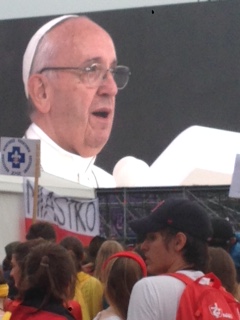
During the summer of 2016, I had the opportunity to travel to Krakow, Poland, to attend World Youth Day. I began my journey with five other people from my parish, Holy Family Church in Fresh Meadows. along with the 500 people from the Diocese of Brooklyn. I had no expectations for what was to come my way.

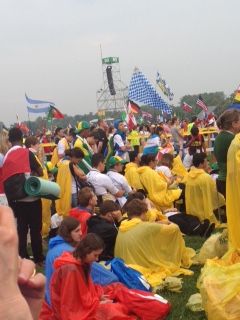
I had so many incredible experiences when I realized that there were approximately 3 million Catholics who came from across the world to be united in Poland because of their love and passion for Jesus. There were an overwhelming amount of opportunities to experience the year of mercy throughout the different activities in Poland. I attended the catechesis sessions in Krakow, walked through the concentration camp in Auschwitz, visited the chapel in the shrine of the Black Madonna in Czestochowa, and attended the festival in Blonia Park where Pope Francis visited the anxiously awaiting pilgrims.

img_3363

The incredible overnight experience in Krakow was so joyful as I walked along a five mile route with the rest of the young people from Brooklyn and Queens. We camped out in an open field and joined millions of youth in a peaceful environment. The year’s World Youth Day was focused upon the lives of Saint Pope John Paul II, Saint Faustina and Saint img_3367Maximilian Kolbe, especially during the catechesis sessions.

World Youth Day in Krakow changed my view of Catholicism because I was used to attending church on Sundays and occasionally a meeting with my youth group. I never would believe that there were so many young Catholics that are truly seeking Jesus and eager to spread his mission. I truly believe that my Catholic faith has been transformed spiritually and I am very grateful for that experience.

I hope to attend World Youth Day in Panama in 2019!


Raquel Goncalves

31st Sunday C: Mercy Goes Everywhere

Audio homily here:

Luke’s gospel talks about God’s mercy, not in definitions but in stories. Today at Mass it’s the story of Zacchaeus, the chief tax collector in Jericho. He was a wealthy man who climbed a tree to see Jesus as he was passing by through his town, and Jesus called him and stayed with him in his house on his way to Jerusalem. In many ways, his story is an interesting lesson that shows how God’s mercy works. It works everywhere. (Luke 19, 1-10)

Zacchaeus was the chief tax collector in Jericho, which means he was an agent for Herod Antipas, who ruled Galilee and Perea in Jesus’ day. Archeologists have uncovered the ruins of many of Herod’s building projects in Galilee and elsewhere, and it’s evident he built on a grand scale and built lavishly, to impress his allies the Romans.

You needed money for this kind of building, of course, and that’s where tax-collectors came in. There was no dialogue or voting on government spending then. Herod told his army of tax-collectors, “Here’s how much I need; you go out and get it. Go to the fishermen along the Sea of Galilee and the farmers around Nazareth and the shepherds in the Jordan Valley and the merchants in Jericho and get what I need; I don’t care how you get it out of them.”

And so the tax collectors went out and got the money, keeping some for themselves too. That was the way the system worked. You needed to be tough and relentless for that job, and it had to leave you hard headed and hard hearted. An unsavory profession. People thoroughly resented them. They wanted nothing to do with them.

Zacchaeus, the chief tax collector in Jericho, was the one whom Jesus called and the one he stayed with on his way to Jerusalem. God wanted to do something for him.

The only thing Jesus says in the tax collector’s house, a place into which others wouldn’t go, is: “Today salvation has come to this house because this man too is a descendant of Abraham. For the Son of Man has come to seek and to save what was lost.” No thunderous warnings, no stern corrections. Salvation has come and they sit down for a feast. You can hear in the story echoes of the Parable of the Prodigal Son, also from Luke’s gospel.

It’s interesting to note, too, that Jesus doesn’t call Zacchaeus to follow him, as he told another tax-collector, Matthew. He doesn’t tell him to give up his job and get out of that dirty, complicated situation. No, as far as we can tell Zacchaeus was still chief tax-collector in Jericho after Jesus left, still taking orders from Herod Antipas, still part of a sinful world. But that’s where Zacchaeus will experience salvation, even there.

That might be one of the interesting lessons about God’s mercy. It works in the real world and in real life. God’s mercy works in the difficult, complicated situations that people experience in life. It’s not always easy to get away from life as it is. Yes, surely Zacchaeus was a changed man from his meeting with Jesus. God reached out to him, God came to his house, God called him to change, and he did. “Behold, I give half of my possessions to the poor, and if I have defrauded anyone, I’ll return it fourfold.” He was changed by his experience of the mercy of God.

We hope we are too.

Monday Night at the Mission

img_2227

Last night at St. Theresa’s Church in Woodside, Queens, New York City, I spoke about the gift of prayer and the simple prayers we know, like the Sign of the Cross and the Our Father, which can be our teachers of prayer. God gives us, saint and sinner alike, the gift of prayer.

Tonight, I spoke about the saints as our teachers. What can we learn from St. Theresa of Lisieux, the patroness of this parish? A doctor of the church who was 24 years old when she died, one of three women who have that honor. St. Theresa of Avila and St. Catherine of Siena are the others.

Theresa added two titles to her name after she entered the Carmel. She was Theresa of the Child Jesus and the Holy Face. I spoke about her spirituality of childhood this evening. She received a grace on Christmas night when she was 13 years old:

“Jesus, the gentle little child of one hour, changed the night of my soul into rays of light…On that night of light began the third period of my life, the most beautiful and filled with graces from heaven. What I had been unable to do in ten years, Jesus did in one instant, contenting himself with my good will, which was always there. I could say to him as his apostles did, ‘Master, I fished all night and have caught nothing. More merciful to me than he was to them, Jesus took the net himself, cast it, and drew it in filled with fish. He made me a fisher of souls. I greatly desired to work for the conversion of sinners, a desire I hadn’t experienced before. I felt love enter my heart, and the need to forget myself and pleasing others. Since then I’ve been happy.” Chapter 5, Story of a Soul.

In the gospels, Jesus told us to become like little children to enter the kingdom of heaven. I reflected on a definition of spiritual childhood given by St. Leo the Great. To be a child means to be free from crippling anxieties, to be forgetful of injuries, to be sociable and to live wondering before all things.


Sunday at the Mission

At our mission tonight at St. Theresa in Woodside, New York, I’ll continue reflecting on the gift of prayer.

We all have the gift of prayer. We can pray. God gives that gift to saints and sinners alike, though we may tend to think only saints and “good” people can pray. But that gift is given to all, because God is Father of saints and sinner alike. Prayer is a gift of God’s mercy.

Prayer is a gift given to all; it’s meant to be used continually. Like the gift of faith growing  like a mustard seed, the gift of prayer is meant to grow.

We’re reading all this year at Mass from Luke’s Gospel, which is called a gospel of prayer. It’s called that because the evangelist offers many examples and teachings of Jesus on prayer. Now, at this point in the  liturgical year especially, our readings at Mass seem to be devoted to prayer.

Last week, for example, we heard the desperate prayer of the ten lepers: “Jesus, Master, have pity on us.” Today we heard the parable about the widow and the unjust judge. Next week, we’ll hear the humble, almost hesitant prayer of the publican: “O God, be merciful to me, a sinner.” Later on in Luke’s gospel, when Jesus dies and enters his glory, we’ll hear the cry of the thief: “Lord, remember me when you come into your kingdom.” All these readings tell us God gives the gift of prayer to everyone, the sinner, the desperate, everyone.

Yet, prayer tries our patience. Like the poor widow facing the powerful unjust judge, whom we read about this Sunday, we may not see our prayers answered quickly. We can then grow weary praying. In his parable Jesus says our prayers are answered “speedily,” yet we have trouble understanding that word “speedily.” It doesn’t match our timetable or our expectations. We don’t like waiting.

We also can make prayer too small and limit it to things entirely personal. Today, some would reduce prayer and meditation to ways to gain inner balance or to bring your blood pressure down. Prayer is bigger than that. It’s asking for “God’s kingdom to come, God’s will be done.” Prayer is meant to  open us to new horizons, new undertakings, to see the world with the eyes of Christ.

Far from leading us away from the world, we are led in prayer to face a world crippled by violence and strife. Only God can help us. Please Lord, come and assist us.

I’m going to pose some questions to those here at the mission:

What prayers are you attracted to?

Are there any places that lead you to prayer?

Any trying times in your life that you found yourself praying?

Then I’m going to reflect on some of our common prayers, like the Sign of the Cross and the Our Father. After that, we will have Benediction.


29th Sunday C: Pray, Pray, Pray

To listen to today’s homily, please select the audio file below:

If I ask you what gifts you have, you might say, “Well, I can cook a good plate of pasta, or I’m a pretty good carpenter. I can fix a lot of things around the house. I think I’m a good mother or good father, good grandmother, good grandfather.” We actually have a lot of gifts; many we may not be aware of.

Now, I can tell you one gift we all have.  Unfortunately this gift is one we may not be aware of. That’s the gift of prayer. We all have the gift of prayer. We can pray. Let’s begin our reflection on today’s gospel about the widow who gets what she wants from an unjust judge with that. We all have the gift of prayer.

If you notice in the gospels, Jesus teaches his disciple how to pray, but he never says they can’t pray. He never says that to anyone: he presumes that prayer is a gift everyone has.  Prayer is a gift God gives to everyone, whether we use that gift or not. The greatest sinner as well as the greatest saint,  has the gift of prayer.

Think of the thief on the cross next to Jesus, who turned to Jesus and said  “Lord, remember me when you come into your kingdom.” We might guess that the thief hadn’t prayed in a long time, maybe his prayer is a cry of desperation. But he prays, and is prayer is answered. More than he ever expected. The gospels are  filled with that kind of prayer.

Now, what Jesus is concerned with in our parable today is that we get tired of praying. For one reason or another, we give it up. Maybe we don’t think praying is going to do any good. God isn’t listening, or we’re not good enough to speak to God.  Maybe we think we can take care of  ourselves. We don’t need the help of God. For all of these reasons we can lose our appreciation of the power of prayer; we think it’s really not necessary,  so prayer becomes an unused gift, a neglected gift.

Now, let’s look at the example in the gospel that Jesus gives. He offers the picture of “a judge in a certain town who neither feared God nor respected any human being.”  He’s a dishonest judge, one of “Untouchables” He doesn’t care about God or anybody else. He seems to have absolute power, or at least he thinks he has.

On the other hand, there’s a widow, who seems to have no power at all. She seems powerless, maybe someone has cheated her; someone has wronged her. She’s looking for justice, but can she get it? We could speculate further. Who caused this injustice ? Maybe it’s a friend of the judge, or the judge himself who seems to control everybody and everything.  but whoever and whatever it is, she wants what’s right, and humanly speaking,  it doesn’t seem she has any chance of getting justice.

But she keeps going, she doesn’t let up, she doesn’t lose hope. She’s persistent. The judge says, “She keeps bothering me, she wearing me down, and he finally gives in and justice is done.
What about God, Jesus asks? Compare him to the unjust judge. He’s the very opposite, He cares for the poor widow; he wants justice done.

“Pay attention to what the dishonest judge says,”Jesus says,
Will not God then secure the rights of his chosen ones
who call out to him day and night?
Will he be slow to answer them?
I tell you, he will see to it that justice is done for them speedily.

We hear those words of Jesus and questions arise.  Justice will be done, the rights of God’s chosen ones will be secure. God will see justice done speedily. Speedily?

Speedily for us means right away, doesn’t it? And when things are not done right away, we lose faith, we wonder if God cares or can God do anything about it at all.

That’s why we have to keep the poor widow in mind. What keeps her going is faith and hope. It’s obvious she believes she has Someone more powerful that the unjust judge on her side. And so do we. But God’s way of securing our rights, God’s way of having his kingdom come, God’s time is not ours. We have to keep praying, keep knocking at the door, keep asking, keep seeking, night and day.

The biggest problems in the world, the greatest challenges we face can be met, if we like the poor widow believe in the gift of pray and pray with faith, night and days, that God’s will be done.

Poor Haiti

Father Enzo, one of our Passionists in Haiti, went recently to Dame Marie, La Serengue and Jeremie, places devasted by hurricane Matthew, where the St. Luke Foundation for Haiti has schools and clinic.

“The duration of the flight to Dame Marie is one hour by helicopter.  Half way to Jeremie today rain was hitting the windshield of the helicopter, and we started to worry that we had to abort again, but fortunately we were able to go through.  The raindrops on the windshield seemed to me like to many teardrops and while we were flying, I was thinking of how many tears Hurricane Matthew had provoked.

“Just before arriving to Jeremie, the helicopter turned slightly inland to reach Dame Marie, where the eye of the hurricane passed.  I remember visiting previously the past two years, and remember that compared to the rest of the country the province of Grand Anse had very lush vegetation.  What struck me immediately as soon as we turned inland was to see how Hurricane Matthew chopped acres and acres of trees.

“The province of Grand Anse is particularly isolated, and paradoxically one of the most vegetated places that remained in the country, which has otherwise been so heavily deforested.  The hurricane is always a natural disaster, no doubt.  But with our human hands we can increase the disaster by not treating the earth as the common home given to us by God, through deforestation, pollution, poor building construction, lack of urban planning, so often the result of poverty.

“When we arrived to Dame Marie, we saw houses spread throughout the vegetation without their roofs, and rivers grown three times their size. It was heartbreaking.  When we were approaching Dame Marie, it was hard to understand even what we were looking at arriving by helicopter.  From the air we could see the roof of the parish church blown away and so of the houses, but we saw many colors.  Getting closer, we saw that it was clothes hanging everywhere to dry after all those days of rain.

“We landed on the football field.  The pilot was afraid to land, thinking that the people would assault us in search for food, and just wanted to go from one place to another by air.  We are well known in the area, and Nebez is originally from there, so we landed.  The pilot gave us 15 minutes on the ground because of the weather conditions.  As we landed we were surrounded by hundreds of people who began to clap hands, sing and praise God for our arrival.  It was almost like they were visited by God.  More than bringing food, blankets, clothes or water, I think today it was very important to them to know that they were not abandoned, they are not alone and that they belong to a bigger family.

” We visited the community hospital and that’s when I cried as I saw people laying on the floor crying and abandoned. I was impressed while we were walking with the Bishop how people stopped him saying, “praise God that the Lord has visited his people” and asking him with concern how things were in Jeremie. On our way back to the helicopter it was amazing to see women washing clothes, cooking, drying the corn or the rice in the sun, to see the notebooks and books of the children drying in the sun hoping to go back to school as soon as possible.

“Once at the helicopter, it was beautiful to see the children playing on the field doing cartwheels around us. Before we left, the Bishop prayed with the people he said that our houses have been destroyed, our lives have been disrupted, our tress and crops have been chopped off, but we are all alive, and this is already a grace.  All the people began to shout “Amen, hallelujah!” The next few weeks are going to be critical, and we are thinking not only to bring supplies, but also to set up a hospital tent. It is worth mentioning that we were first people to reach Dame Marie after the hurricane.

“While we were flying over Jeremie before landing we saw the cathedral completely open on the top.  The roof had been blown off, and was heartbreaking to see.  But mostly it was heartbreaking to see the people with houses destroyed, built so poorly and with such poor materials to begin with.  When we landed in the football field, the people recognized the Bishop and started to run towards him.  It was beautiful to see.  What came to mind was when Jesus said “I am the good shepherd; I know my own sheep, and they know me” (Jn 10:14). But again, I saw more a lamb than a shepherd, who was ready to carry on his shoulders the burden of his people.  We had to leave him quickly, but promised him that we would return to help him and his people.

“I would like here to talk about the resilience of our Haitian brothers and sisters.  They are like a boxer in a boxing ring.  Knocked down, and the count to ten is on, but they are always able to stand up before the final countdown.  Not even the hurricane can knock them out.  It makes me think too of what is now a prophetic image of Our Lady of Sorrows, the patroness of our congregation, that we had painted on the side of our new residence which bears her name that will face the entrance of the new St Luke hospital.

“Our Founder, Paul of the Cross used to compare Our Lady of Sorrows to a rock on which the waves slam but cannot move her.  As I contemplated this, I saw Our Lady holding Christ’s shroud firmly but gently as a mother holds her child.  The wind and the waves batter her as she appeals to God on behalf of the Haitian people.  There is sorrow in her face but confidence too.  Why else would she be on that sharp rock but for her faith!

“On our way to Jeremie the sky was full of rain drops that reminded me of tears. On the way home the sky was clear but my eyes were full of tears. It is an obligation to have been the eyes and ears on behalf of our friends and supporters who are so concerned for those affected by this disaster, and now to be their voice to you on their behalf.  These are people who are already so vulnerable of being invisible to the outside world, and I am humbled today to have had the chance to help share their story.”


Fr Enzo Del Brocco

St Luke Foundation and

Passionisti Haiti Mission of Our Lady of Sorrows

28th Sunday C: The Gift of Life


To listen to this week’s homily, please select the audio file below:

Some years ago, I visited the Vietnam Memorial in Washington, DC with a cousin of mine who fought in that war. We were passing along the wall where names of those who were killed in that war were inscribed, when he stopped and pointed to a name.

One day, he said, his artillery unit was ordered to a forward position; he was the officer in charge. Just as he was ready to get into the helicopter, word came that he was wanted for a meeting at headquarters, so he got out of the helicopter and told a junior officer to take over; he would join them as soon as he could.

That day the unit took heavy fire; the name he pointed to on the wall was the officer who took his place.

“Why am I living and he’s not?” That’s a question he keeps asking, he told me. “Why am I alive?”

That’s really the ultimate question in today’s readings. The lepers who were cured by Jesus were facing death. There was no cure for their disease. Leprosy was so frightening then that those affected by it were driven from their homes and families to live in isolated places and forbidden to go near anyone. Jesus gave them the miracle of life.

It didn’t matter if you were rich or poor. Namaan, the Syrian general, whom we read about in our first reading, was one of the most powerful people in the world, but he had leprosy; it was a death sentence. In desperation he went down to Israel looking for a cure, a miracle. Washing in the Jordan River, he received the miracle of life.

The ten lepers were cured, our gospel reading says, but only one was truly thankful. The other nine seem to take the life they were given for granted. Do those nine represent most of us? The one who was thankful was a Samaritan.

Namaan, the Syrian, was also thankful. He went to the prophet Elisha after being cured and offered him gifts. No, the prophet said, life is God’s gift, not mine, and he wouldn’t take anything from the Syrian.

“Then at least let me take some dirt from this place, ‘two mule loads of earth,’” Namaan says, “so that I can take it back with me and  stand on it and remember and give thanks to God for what I have received here. “ He won’t forget the gift of life and how to use it.

That’s the great challenge we all face–not to forget that life is a gift and it’s been given to us by God to live well every moment, each day, as long as God gives it to us.

Our church is a place of thanksgiving. Above all, our church is a place where we give thanks. Our Mass is also called Eucharist, an act of thanksgiving. “Let us give thanks to the Lord our God.” “It’s truly right and just” that we do this. In this place we remember the God of Life who gives us life. Here too we receive a promise of life beyond this, greater than this, through Jesus Christ.

We have been given the gift of life, a precious gift. Don’t take it for granted. We thank God for it and try with all our strength to live it as we should.