Category Archives: Passionists

The Holy Family


Luke 2,41-52

For most people, Christmas is over– the music’s stopped; Santa Claus is gone from the malls. The decorations are down and put away. It’s over.

But in church Christmas isn’t over. We’re still singing  carols and continue to celebrate as we think  about what it means when we say “our God was made visible.”

Today’s the feast of the Holy Family. The Word was made flesh, and as the child of Mary and Joseph Jesus was part of a family in the small town of Nazareth in  hills of  Galilee.

For one thing, families then were extended families or clans, living close together and working side by side. Archeological excavations in Nazareth and Capernaum (pictures below) make that clear. Families worked together in the fields or in  business, they ate together and moved together, as they still do in parts of the Middle East and elsewhere today.
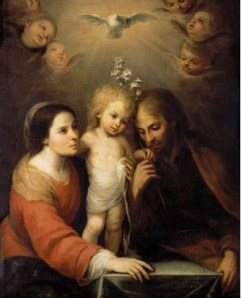
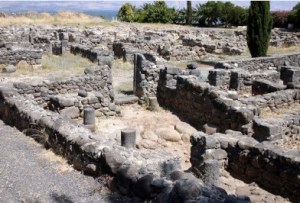
holy familyCapernaumruinsDSC00062

It’s safe to say that nuclear families didn’t exist then. A nuclear family– mother, father and children– is a modern form of family life. Mary, Joseph and the Child Jesus were not all by themselves in a small house in Nazareth. Rather, Jesus was raised in an extended family where  grandfathers and grandmothers, uncles, aunts and cousins lived together and were involved in bringing him up.

That doesn’t take away the part Mary and Joseph played in his upbringing, of course. They weren’t props, standing by while angels brought him up. Some of the apocryphal gospels – early stories about Jesus which the church rejected  – seem to say that.  One  story describes the Child Jesus forming  the figure of a bird from clay, then breathing on it, and instantly it becomes a living bird and flies away. Stories like that presented him exercising  miraculous powers as a child.

The church rejected those stories because they gave a  false picture of Jesus growing up. He “was subject” to Mary and Joseph, the gospel of Luke says. He grew up in their care as an ordinary child would.

Like mothers and fathers everywhere, they saw to his needs, they held him in their arms,  fed him, clothed him,  stayed up at night when he was sick. They taught him his first words,  guided his first steps,  nudged him along this way and that.

They  brought him to church–the synagogue, the temple–as we see in today’s gospel from Luke. They instructed him in his tradition. They taught him to pray,  interpreted events for him,  listened to his questions,  encouraged him over and over. They had their misunderstandings, as today’s gospel  indicates. In fact, they  influenced his life.

Yes, angels were there, but at a distance.  Mary and Joseph and that larger family and village around him raised the Child.

Today’s  feast of the Holy Family takes in the years of Jesus’ childhood and early adult life called his “Hidden Life.” His  years in that nondescript town among those ordinary people were truly hidden, yet were they less important than his Public Life, the few years he taught and did great miracles,  suffered and died and rose from the dead? In those hidden years “he humbled himself.”  A hidden life is important; it’s what mostly characterizes life in a family.

We need to think about family life today, because it’s in trouble.  For one thing, the nuclear family– father, mother, children– is  in trouble. I read some disturbing statistics recently. In every state in our country, families where children have two parents have declined significantly in the last 10 years. One of three children live in a home without a father. Almost 5 million children live in a home without a mother. A single mother may have an income of $24,000. Two parents are likely to have an income significantly greater.

What can we do? How can we help? Feasts  like the Holy Family focus our attention on important things.  They remind us what’s important in God’s eyes. The feast of the Holy Family focuses on the family. It’s important, it says.  At the same time, it tells us God’s grace will be ours when we work to make families go and when we support them all we can.  God points to family life today. It’s vitally important in our world.

3rd Sunday of Advent A: I Am Not The Christ

Audio homily here:

There’s something about John the Baptist that makes us uneasy. It’s not just the way he dresses or what he eats that disturbs us. He’s in the desert, after all, where you can’t keep up appearances or eat what you want. No, I think what makes us uneasy about John is his unflinching commitment to God. He’s loyal to the mission God gives him, no matter what, even if he has to die for it.

Our reading today from Matthew’s gospel begins in a prison where John’s waiting for death. He was put there by Herod Antipas, the ruler in Galilee, because John had criticized him and Herodias his new wife. It’s a ridiculous story, if you remember it. Criticizing powerful people can cost you your life. But John wasn’t afraid to do that; he spoke the truth no matter who was offended.

Even as he faces death, John doesn’t think of himself. He urges his disciples to look to Jesus and transfer their loyalties to him. “When John the Baptist heard in prison of the works of the Christ, he sent his disciples to Jesus with this question, ‘Are you the one who is to come, or should we look for another?’”

The film director, Martin Scorcese produced a movie recently based on a novel by the Japanese writer Shusaku Endo called “Silence.” The film and the novel explore the true story of the Jesuit martyrs in 17th century Japan who were put to death by crucifixion along with thousands of Japanese Christians. The story is filled with the doubts and questions they experience in their terrible ordeal. The Jesuit has to deal, above all, with his own pride and self-assurance. The silence is the silence of God, whom the novelist says sits with his arms folded before the suffering of others.

In an interview Scorcese was asked if he thought American Catholics would be able to stand the test of martyrdom. Would we die for what we believe? He said he thought we are too conflicted. We live in a different world, a world fascinated with technology and its promise to solve everything.

I suppose that’s why John the Baptist and stories of martyrs make us uneasy. For some years John preached and baptized in the desert region near the River Jordan. The Messiah is coming, he said. The Kingdom of God is at hand. Prepare the way of the Lord. God is coming to judge us all.

Many responded and believed what he said. Some thought that he himself was the Messiah, but John said no he was not. He wasn’t worthy to tie the sandals of the One who was to come. He was just a voice in the wilderness, he said.

Just a voice, John says. In a commentary, St. Augustine says that  “John is the voice, but the Lord is the Word who was in the beginning. John is the voice that lasts for a time; from the beginning Christ is the Word who lives for ever.”

John’s “voice” passes away. He no longer baptizes at the Jordan River. He cedes to the Word who will always speak. He cedes to the Word, and so should we.

Our voice passes away; something of ourselves has to go– some of the things we hold dear, the friends who surround us, institutions that upheld us.  Our way must give way to God’s way. Whether we know it or not we’re all facing martyrdom in different forms. We think so little of this.

Listen again to Augustine:  “What does prepare the way mean, if not be humble in your thoughts? We should take our lesson from John the Baptist. He is thought to be the Christ; he declares he is not what they think. He does not take advantage of their mistake to further his own glory.

“If he had said, ‘I am the Christ,’ you can imagine how readily he would have been believed, since they believed he was the Christ even before he spoke. But he did not say it; he acknowledged what he was. He pointed out clearly who he was; he humbled himself.

“He saw where his salvation lay. He understood that he was a lamp, and his fear was that it might be blown out by the wind of pride.”

Is that how we should look on ourselves too? We were given a lighted candle at our Baptism, symbol of the life God gives us in this world. We were given a voice, some talents to use. It’s up to us let our light shine, to speak as we can, to use our talents as best we can in the time we have here.

Jesus Christ, the Light, Sun of Justice, has come into the world. “I am not the Christ,” we say with John, “He is greater than I.”

Comfort for those who labor

traffic    

Wednesday’s Advent Gospel (Mt 11: 28-30) is so beautiful and comforting. No wonder it is specially beloved and quoted by so many of His people. “Come to me, all you who labor and are burdened, and I will give you rest. Take my yoke upon you and learn from me, for I am meek and humble of heart; and you will find rest for yourselves. For my yoke is easy, and my burden light.”

     I am trying so hard to talk less and to listen more, for God’s voice, during my prayer. It is not easy. But reading these Gospel sentences from Jesus always makes me feel as if He is personally talking to me with all His tenderness and love.

     One of the blessings of retired life is that my wife and I can go for an early dinner at 5:00 p.m. on a weekday. Last Thursday, while looking out the picture window of the diner, I could see row upon row of slow-moving headlights on Northern Blvd. and the Clearview Expressway in Queens, NY: so many people sitting through the heavy traffic in their cars in the falling darkness after a long day at work. I spent so much of my life like that, like so many others “who labor and are burdened”, longing for a few hours of rest at home. Back then I did not realize that the place of rest was right there within my heart, where the Love of Jesus was always waiting patiently for my conversion.

     Now, years later, when I rest and rejoice in His Love, I have also learned from Him a thing or two. His Love makes His yoke easy and His burden light, but it is still a yoke and a burden. He calls us to share, and relieve, the burdens of so many of our brethren, His brothers and sisters.   

     In the November 26th issue of The Brooklyn Tablet, Fr. Robert Lauder writes:

      ” While many of us may be able to wax eloquently about how beautiful love is, we may need to remind ourselves that in our lives the call to love God and neighbor can be demanding. Dorothy Day, who spent her life loving and serving the poor often referred to an insight from Fyodor Dostoevsky’s novel,

‘The Brothers Karamasov’. The insight is that in reality, love can be a harsh and dreadful thing. Love can call us to make great sacrifices. Though we benefit from loving, that does not necessarily make loving easy.”

     I pray that the people in those cars realize what an important part love has in the sacrifices and struggles that they undergo in their work-lives. I pray that within their personal loves they discover, some time, somehow, the One who loves them beyond comprehension, the Source of everything that is worthwhile and good in their lives, the One who at the end of the road waits for them with open arms to give them true rest.

Orlando Hernandez

Wednesday, 2nd Week of Advent

The words from Isaiah  today, scholars say, are not the words of Isaiah but the words of an unknown prophet writing centuries later to Jewish exiles in Babylon. He urges them to return to Jerusalem, but many have settled in the new land and have no taste for returning.

The journey’s long and hard, some say. Nothing to go back to.  Forget Jerusalem and the One who called, others say. Our God has let us down, so we’ll sing the songs of this land.

Confronting them, the writer uses Isaiah’s name, a prophet long dead,  lest the Babylonians charge him with treason for suggesting the Jews return. Still, the unknown prophet confronts them with God’s words:

“To whom can you liken me as an equal? says the Holy One.”

God knows every one of you and calls you all by name. Come back where you belong; you can make the journey.

“He gives strength to the fainting;

for the weak he makes vigor abound.

Though young men faint and grow weary,

and youths stagger and fall,

They that hope in the LORD will renew their strength,

they will soar as with eagles’ wings;

They will run and not grow weary,

walk and not grow faint.” (Isaiah 40)

Is it still the same, a people estranged from God, unaware of God’s call, unwilling to consider a return? Why believe in the promise? Why return to a city or a world or a church in ruins? But Advent call. In Advent we pray for “us, poor banished children of Eve.”.

Fidel

fidel

Dear Lord,

     The death of Fidel Castro, Cuban dictator, brought joy to many and sadness to others. In Miami there were celebrations in the streets of Little Havana. In Cuba there were nine days of mourning. Many of my friends ask how I feel about the death of Fidel. I’m neither happy nor sad. As a Christian I don’t rejoice in someone’s death. What I do is put them in Your capable hands, my Lord. I’m no one to judge!

     I’ve been praying for Fidel’s soul. Unfortunately I can’t forget that because of his political views and cruel policies generations lost their country and way of life. Torture, executions, imprisonment, all took place if you dared to disagree with any of his policies. Freedom no longer existed. Indoctrination began! Your churches, Lord, were closed. Prayer and religion were no longer necessary, we now had Fidel.

     My mother decided that she needed to leave Cuba for my sake and her own. In 1962 we became refugees. Thanks to the U.S., which opened its arms to us, we began a new life. It wasn’t easy, my God. Here we were penniless in a new land facing a new language and new obstacles. But with the help of family, the U.S. government, and the Catholic Church hope began to spring up and we survived.

     We left Cuba, my God, afraid and without much hope. We left Cuba because one man lost his way and the need for power overwhelmed his ideals. Fidel did have wonderful ideals, but the dark side won, in his case.

     I’ve been in the U.S. now for over fifty years. I’m in love with You, my Lord Jesus and I have to admit that happened here in the U.S.. Good things happened to most Cuban refugees. Most of us survived. We progressed. We lived full lives. But we never will know what could have been. The Cuba of today is nothing like the Cuba of yesterday. For some it’s very sad, for others it’s life. For me it is Your will, my God! May You, our Lord and Savior have the mercy on Fidel that he neglected to have for many of his people.

Berta Alvarez-Hernández

Tuesday: 2nd week of Advent


“Comfort, give comfort to my people, says your God. Speak tenderly to Jerusalem, and proclaim to her that her service is at an end.” The tender  words of Isaiah in today’s reading end with this promise: ” Like a shepherd he feeds his flock; in his arms he gathers the lambs, carrying them in his bosom, and leading the ewes with care.” (Isaiah 40,1-11)

“I am the Good Shepherd,”Jesus says

A few years ago Carol Rothstein took the picture above of shepherds in the Jordan Valley along  the road to Jericho . Jesus and his followers likely traveled this same road on their way to Jerusalem and surely passed  a scene like this. Would he have told them the story of the Good Shepherd then?

The mountains in the distance make the picture so interesting.  Can you imagine a shepherd taking off in search of one of his flock lost in those distant hills? What an effort it would be! An impossible task! The wondrous merciful love of God for each of us is like that, our gospel today says.

“If a man has a hundred sheep and one of them goes astray,

will he not leave the ninety-nine in the hills

and go in search of the stray?

And if he finds it, amen, I say to you, he rejoices more over it

than over the ninety-nine that did not stray.

In just the same way, it is not the will of your heavenly Father

that one of these little ones be lost.” (Matthew)

That’s a story of God’s mercy. Ending his earthly journey, Jesus will reach out to a thief who’s lost as he turns to the thief on the Cross and brings him to Paradise.

Handel put to music this powerful theme:

2nd Sunday of Advent: Listen to John the Baptist

audio homily here:


DSC00164

John the Baptist may look and sound  forbidding, but don’t let appearances put you off. He spoke in the wilderness, where looks are not important and you can’t keep up appearances. The wilderness symbolizes the hard places we all must pass through.

So we shouldn’t deny they exist. Or think a simple sentence will take them away. I suppose that’s why I prefer John the Baptist to Joel Osteen.

John’s father was Zachariah, a priest in the temple, a much more secure place to be. He told John: “You, my child shall be called the prophet of the most high, for you will go before the Lord to prepare his way.” (Luke 1) God called John to the wilderness to show people the way to God from there.

The Judean wilderness where John the Baptist baptized lay about 15 miles east of Jerusalem in the Jordan Valley north of the Dead Sea. Pilgrims from the north took an ancient road along the River Jordan and followed it as it veered right near the town of Jericho to ascend steeply about 3,500 feet up to the Holy City, about an 9 hour walk. A tough road in itself to travel.

Near where the road begins to ascend, John baptized great crowds in the river’s refreshing waters. He baptized Jesus and his disciples in these waters and then pointed Jesus out as “the Lamb of God” and told his followers to follow him as their Shepherd and Way.

John was a voice pointing Jesus out in the wilderness. He still points him out in the wilderness today and tells us to follow him. “You’ll make it through the wilderness,” he says.

music on John the Baptist.

God Calls

In yesterday’s Gospel  Jesus meets Peter, Andrew, James, and John by the Sea of Galilee and says:  “Come after me and I will make you fishers of men(Mt 4:19).” I have to regard it as miraculous that “at once”, “immediately “, these men leave all they have and all they do, and choose to follow Jesus.

The Bible has various examples of regular people who respond to the call of God, not with any “ifs, buts,and ors,” but in a state of immediate surrender and obedience: Abraham, the Blessed Mother, her husband Joseph. What is it about true, intimate contact with God that compels people to act like this? What did those Apostles see in the eyes of Jesus?

I humbly believe that they looked into the Sun that is Divine Love, and they realized  they could do nothing else but to follow that Love. Like all of us, they had been longing for this moment all their lives.

Henry J. M. Nouwen writes: “We are the Beloved. We are intimately loved long before our parents, teachers, spouses, children, and friends loved or wounded us. That’s the truth of our lives….. Yes, there is that voice, the voice that speaks from above and from within and that whispers softly or declares loudly: ‘You are my Beloved, on you my favor rests.'”  Yes, the Apostles on that shore had looked upon the Truth, and they felt within their hearts the calling to proclaim it, so that:

                  “Their voice has gone forth to all the earth,

                  and their words to the ends of the world.”(Rom 10:18)

All the way to me!  After 43 years of vacillation between indifference and longing, prompted by the example of loving people, and by the reading of the Scriptures, I beheld the risen Host one Sunday in a church in Queens, NY, and Jesus opened my eyes to His Truth and my ears to his message:  “You are my beloved.  In you my favor rests.” And then: “Come follow me.”

Wow!  It was that quick, how my life totally changed.  And here I am now.

The road was not easy for those Apostles who followed Jesus on that day in Galilee. It certainly has not been easy for me. But I know (even if sometimes I forget) that I am a beloved son of God, the same as every person on Earth, and I proclaim this in gratitude and joy.

              Orlando Hernandez

Thanksgiving’s Coming

Thanksgiving Day’s coming Thursday in the USA and many will be with family and friends. We have just come through a brutally fought election and I wonder if some Thanksgiving gatherings this year will be as peaceful as in other years. Will fights continue over the table?

Our Mass readings these days are from the Book of Revelations and Luke’s gospel where Jesus speaks of the last times. They’re frightening, upsetting times.  “Nation will rise against nation, and kingdom against kingdom.  There will be powerful earthquakes, famines, and plagues from place to place; and awesome sights and mighty signs will come from the sky.” (Luke 21,11)

Notice, though, the promise of peace found continually through these readings announcing chaos and destruction. “Not a hair of your head will be destroyed,” Jesus says in the gospel today. (Luke 21,19) God’s with us in the chaos.

In our Reading from Revelations today people are singing songs of victory. No matter how chaotic the times, God’s there in them, working his purpose in the chaos. The battle’s won, not lost, through the abiding power of God.

“Great and wonderful are your works,
Lord God almighty.
Just and true are your ways,
O king of the nations.”  (Revelations 15, 4)

We can sit down at Thanksgiving singing a victory song and remembering that not a hair of our head will be destroyed.

I see this year on Thanksgiving Day the church celebrates the feast of the Vietnamese martyrs killed in the 18th century. Saint Andrew Dung– Lac and 117 others were put to death in a cruel persecution of Christians. One of the characteristics of Christian martyrdom is the joy of the martyr in the midst of a frightful situation. Here’s a letter of Saint Paul Le-Bao-Tinh, one of the martyrs:

“I, Paul, in chains for the name of Christ, wish to relate to you the trials besetting me daily, in order that you may be inflamed with love for God and join with me in his praises. The prison here is a true image of everlasting hell: to cruel tortures of every kind – shackles, iron chains, manacles – are added hatred, vengeance, calumnies, obscene speech, quarrels, evil acts, swearing, curses, as well as anguish and grief. But the God who once freed the three children from the fiery furnace is with me always; he has delivered me from these tribulations and made them sweet, for his mercy is for ever.

“In the midst of  torments, that usually terrify others, I am, by the grace of God, full of joy and gladness, because I am not alone – Christ is with me.”

“I am not alone–Christ is with me.”

I suppose we can say that no matter bad we see the times, we can sit down at Thanksgiving with joy.


Christ the King: The Power of Mercy

For an audio version see here:

Luke’s gospel for the Feast of Christ the King presents Jesus, not in a royal palace, but on a dark desolate hill. He’s not surrounded by cheering crowds, but by people cursing his name. He has no crown of gold, but a crown of thorns. His robe lies torn from him, heaped on the ground soaked in his blood. His throne is a cross, and over the cross is the inscription: THIS IS THE KING OF THE JEWS.

The temptation is to see this scene as a failure. But listen to the gospel. One of the criminals calls out to the wretched figure hanging next to him: “Jesus, remember me when you enter your kingdom.” And power goes out from him. “This day you will be with me in paradise.

The thief is an interesting figure in the gospel. He has no name, nothing is known of his life or his crime. There he is, desperate, thinking all is gone. Powerless, no one would take a chance on him. Who would bother with him or think him worthwhile? Who would come close to him? Only a God who in the person of Jesus Christ would come so low as to share a cross with him.

The thief has no name, but we believer that he bears everyone’s name. In the thief we see ourselves, our desperate, poor, powerless selves. Yes, that is how much Christ loves us. He is close to the sinners of this world, to us..