Category Archives: Religion

Philippians: Have the Mind of Christ

Our first reading at Mass this week is taken mostly from Paul’s Letter to the Philippians. St. Luke describes Paul’s mission to Philippi, ” a leading city in the district of Macedonia and a Roman colony”, in the 16th chapter of the Acts of the Apostles. “We spent some time in that city” , Luke says, indicating he’s describing something he knows firsthand. It was a dramatic and fruitful stay.

Paul encounters Lydia, “a dealer in purple” at the place along the river where women prayed. She listened to his message and asked for baptism for herself and her household. She also convinced Paul and his companion to stay at her house, which became a house church. Women play a major role in the spread of the gospel.

Paul also encountered persecution in Philippi when he was accused of causing businesses to fail because of a cure he worked. ” The magistrates had them stripped and ordered them to be beaten with rods. After inflicting many blows on them, they threw them into prison and instructed the jailer to guard them securely. When he received these instructions, he put them in the innermost cell and secured their feet to a stake. ( Acts 16:22-24)

An earthquake broke the walls of the prison and the jailor, fearing the prisoners had escaped, was ready to kill himself. The earthquake led to his conversion along with his household – another house church in Philippi. It also led to Paul’s exoneration by the fearful magistrates of Philippi.

Commentators describe Paul’s warm relationship with the Philippians. It looks like a lot of important people there were on his side, or at least very respectful of his mission. They say he wrote this letter– to Lydia’s house and the jailor’s household– from prison, either in Rome, Ephesus or Caesaria.

Paul had his share of prisons during his ministry. That experience and others like it convinced him to see his life in the light of the suffering Christ. He told the Philippians they were granted “for the sake of Christ, not only to believe in him but also to suffer for him. Yours is the same struggle as you saw in me and now hear about me.”  (Philippians 1, 29-39)

Have the mind of Christ, Paul tells them– and us– in this important passage, probably from an early Christian hymn:

Have among yourselves the same attitude 
that is also yours in Christ Jesus,
Who, though he was in the form of God,
did not regard equality with God
something to be grasped.
Rather, he emptied himself,
taking the form of a slave,
coming in human likeness;
and, found human in appearance,
he humbled himself,
becoming obedient to death,
even death on a cross.
Because of this, God greatly exalted him
and bestowed on him the name
that is above every name,
that at the name of Jesus
every knee should bend,
of those in heaven and on earth and under the earth,
and every tongue confess that
Jesus Christ is Lord,
to the glory of God the Father.” (Philippians 2, 6-10)

This passage occurs often in the church’s  prayer tradition. On Palm Sunday, it’s read as Jesus enters Jerusalem to suffer and die on the cross. In the Liturgy of the Hours, the Church’s daily prayer, it’s read each Saturday evening. The passage even appears before Christmas, a reminder that from the beginning Jesus accepted the weakness of “human likeness.” Unlike Adam who grasped for equality with God, Jesus humbled himself. 

We follow Jesus from birth to death and then to resurrection. It’s not a grim unhappy journey. Commentators on the Letter to the Philippians call it a “Letter of Joy.” Having the mind of Christ make life a journey to glory. 

31st Sunday b: Love God; Love your Neighbor

For this week’s homily please watch the video below.

Stars and Saints

Hubble Ultra Deep Field
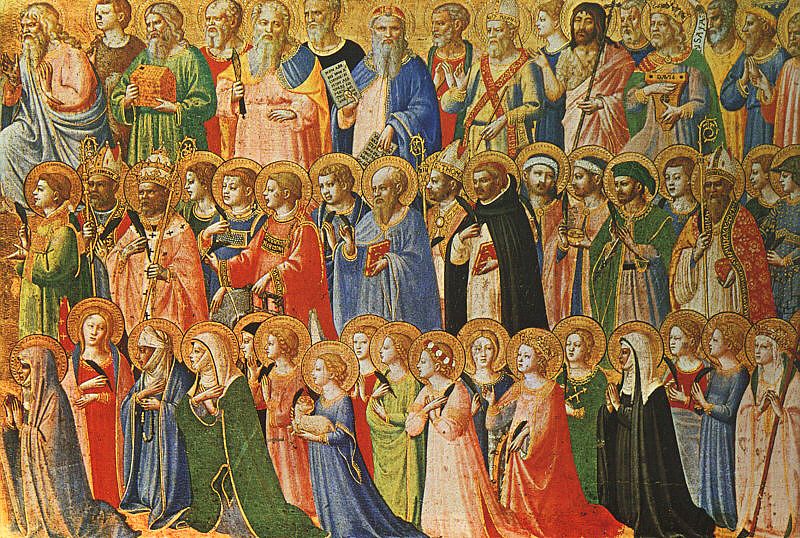
Fra Angelico, The Forerunners of Christ with Saints and Martyrs

By Gloria M. Chang

From eternity the Lord God designed humanity and the cosmos in his image, envisioning the constellation of saints bursting with Christic Light in the heavens. Formed from the dust of the earth, Adam evolves through the eons to completion in Jesus Christ, his descendant and Lord—the Potter’s masterpiece (Isaiah 64:8). 

Kindling the treasure of Christ’s flame in “jars of clay,” we grow day by day into the image of the Blessed Trinity as one Mystical Body (1 Corinthians 15:41). The dazzling kaleidoscope of saints, reflecting the unity and diversity of the Father, Son, and Holy Spirit radiates the infinite rays of divinity. Each saint refined in God’s furnace of Love emerges as an original from the hands of the Divine Artist, for “star differs from star in glory” (1 Corinthians 15:41).

Form me with your hands, Lord, day by day.
You are the Potter; I am the clay.
From soil you shaped sparkling saints like stars, 
Blazing your glory from earthen jars.

Just as we have borne the image of the man of dust, we shall also bear the image of the man of heaven.

1 Corinthians 15:49


This content by Gloria M. Chang was originally published online at Shalom Snail: Journey to Wholeness

An Ambassador in Chains: Ephesians 6: 10-20

We’re reading today from Paul’s Letter to the Ephesians 6:10-20 (Thursday Wk. 30) He’s writing as an ambassador of the gospel, but an “ambassador in chains” asking for prayers that “speech may be given me to open my mouth, to make known with boldness the mystery of the Gospel.”

“Draw your strength from the Lord and from his mighty power,” Paul writes to the Ephesians and possible to the church at large. But he’s also asking for himself,  for the strength of a warrior, for the “armor of God”. “faith as a shield”, “the helmet of salvation”, “the sword of the Spirit.” Battle language, for sure.

No ordinary battle either. HIs enemies are not flesh and blood, but principalities and powers, world rulers of this present darkness, evil spirits in the heavens. 

I’m not a scripture scholar, but this sounds like the persecution of Nero that startled the Christians in Rome after the fire that burned much of the city down in 64 AD and sent an unknown number of them, including Peter and Paul, to a cruel death. It was an absurd persecution that went beyond what flesh and blood could conjure up. 

I’m adding a video on that persecution, told by way of an old Roman church, the traditional storyteller of Christian history. It’s the church of St. Peter in Chains. 

Church of St. Peter in Chains, Rome

St. Christopher, Pray for Us

Christopher

“The Vatican said recently he doesn’t exist,” our guide informed us as we looked up at the imposing statue in Cologne Cathedral in Germany a few years ago, Then, we passed quickly on.

Afterwards, I told him the Vatican didn’t say Christopher never existed, but as of now there is no historical evidence for the popular saint who carries the little child on his shoulders. For one reason or another, no historical evidence exists for a good number of our early saints.

It’s more than finding a Christopher in history, however. If you look at what he’s doing, there have been–and still are– many Christophers. (Bearers of the Christ Child) His holiness can be unrecognized, but very real. He’s there in the women and men who day after day carry children on their shoulders, getting them where they must go and keeping them from the dangers little children face.

Caregivers of all kinds do the same thing. I watch them here at our place, where we have a number of priests and brothers who can’t get around, getting them into wheelchairs and getting them to where they have to go. Not much glamor in that job, but a lot of people need carrying, especially today.

The media seems to thrive on violence today. Gangs taking on gangs, macho heroes blowing up cities, killing thousands.  Non-stop violence. 

Christopher was a sign to generations past that strength is more than swinging a sword.  You’re strong when you serve the weak.

We need you today, St. Christopher. Pray for us. Inspire us.

We follow the Apostles

we are “being built on the foundation of the Apostles and prophets, with Christ Jesus himself as the capstone. Through him the whole structure is held together and grows into a temple sacred in the Lord…” (Ephesians 2: 19-22)

That picture of the church is brought before us every month with a feast of an apostle, We celebrated two apostles yesterday, Simon and Jude. On a feast of the apostles we look back and look forward. We belong to a growing church meant to embrace people from every nation, time and place. It’s a church bound for glory. That’s the church we belong to.

We belong to a church described as a building, not a complete building, but one “being built.” The foundation is the apostles and prophets. Jesus Christ is the cornerstone, holding everything together and ensuring it grows to the “sacred temple of the Lord.”

Yet, in our part of the world, is our church growing? It looks like it’s falling apart. Perhaps we don’t see how big our church is. It’s bigger than we think. Some weeks ago Pope Francis was in Southeast Asia and commented on the growing church he saw there. A youthful, enthusiastic church, he said. We see only a part of the church.

The apostles brought their message to all the earth. They do not just report their memories of Jesus; they brought their message to others, to the ends of the earth. Accounts of their missionary journeys may not all be historically true, but their conviction of a universal mission was certainly true. They call us to this same mission;  a great church is being built and we are part of it.

“We have inherited heaven along with the apostles,” our morning prayer says. “On the foundations stones of the heavenly Jerusalem, the names of the twelve apostles of the Lamb are written,” we read in morning prayer. That’s where we are headed. We see only so much..

30th Sunday b: Take heart, follow Him

For this week’s homily please watch the video below.

For the last five Sundays or so, Mark’s gospel describes the journey of Jesus and his disciples from Galilee to Jerusalem where he’ll die and rise from the dead. It’s not a day by day account of the journey or a list of each place they pass;  the gospel is more interested in the people Jesus encounters and invites to follow him  along the way.

Good ordinary people, as far as we can judge. Peter and his brother Andrew,  the other fishermen from Galilee,  James and John, were among the first who follow him. Good, solid reasonable people. The rich young man who meets Jesus on the way– our gospel reading a few weeks ago– a good, solid individual. Jesus calls him to follow him.

But Mark indicates his followers often fail to understand him, especially his message about suffering and death. Yet he calls them anyway, even though over and over Mark says, “They did not understand him.” 

 “You think like human beings think,” Jesus says to Peter,  who wanted him to put thoughts of suffering and death from his mind. James and John are looking for positions in Jesus’ earthly kingdom, a sure thing. The rich young man’s afraid of losing what he has. They think like human beings think. They don’t understand him.

Of course, Mark’s gospel says that’s the way we think too. We’re  limited, we’re self-serving, we’re  afraid to trust in the wisdom and promises of God. We think like human beings. 

At one point in Mark’s gospel,  the disciples throw up their hands in desperation after Jesus admonishes them,  “Then who can be saved?” Are you looking for a perfect remnant?

Today’s gospel seems to answer that question. “As Jesus was leaving Jericho near the end of his journey, Bartimaeus, a blind man, the son of Timaeus, is sitting by the roadside begging.” The blind beggar sits there by the road. He can’t see.  And he has nothing to recommend him. Nobody wants to look at him, but Jesus calls him and gives him his sight. 

Not only does Jesus give him sight, but Bartimaeus, the son of Timaeus, gets up and follows Jesus on the way, up to Jerusalem. 

In a simple, beautiful way, Mark’s Gospels presents a powerful story of God’s mercy. The blind man is a symbol of humanity, blind to so much. But God’s mercy is stronger than human understanding, human weakness, even human sin. God’s mercy helps us to see, to get up and to go with Jesus to Jerusalem.

A powerful story of hope. It’s not a small remnant that will be saved. It’s an immense throng. Listen to Jeremiah, our first reading.  

“The LORD has delivered his people,
        the remnant of Israel.
    Behold, I will bring them back
        from the land of the north;
    I will gather them from the ends of the world,
        with the blind and the lame in their midst,
    the mothers and those with child;
        they shall return as an immense throng.
    They departed in tears,
        but I will console them and guide them;
    I will lead them to brooks of water,
        on a level road, so that none shall stumble.
    For I am a father to Israel,
        Ephraim is my first-born.”

Letter to the Ephesians: 4:1-6

Our readings these days from Paul’s Letter to the Ephesians and Luke’s gospel speak of a people on a journey, longing to see God’s face. But first, there’s a mountain to climb before standing in God’s holy place. Not an easy climb. (Responsorial psalm, Friday)

I, a prisoner for the Lord,
urge you to live in a manner worthy of the call you have received,
with all humility and gentleness, with patience,
bearing with one another through love,
striving to preserve the unity of the spirit
through the bond of peace;  
one Body and one Spirit,
as you were also called to the one hope of your call;
one Lord, one faith, one baptism;
one God and Father of all,
who is over all and through all and in all. (Ephesians 4:1-6)

Paul calls for patience, unity and peace from his flock in Ephesus, whose leader is now a prisoner. Most likely, they feel adrift. When the shepherd is struck the sheep scatter.

And so Paul promises the care of the Good Shepherd who cares for his flock from on high, whose care never ceases.

The one who descended is also the one who ascended
far above all the heavens,
that he might fill all things. And he gave some as Apostles, others as prophets,
others as evangelists, others as pastors and teachers,
to equip the holy ones for the work of ministry,
for building up the Body of Christ,
until we all attain to the unity of faith
and knowledge of the Son of God, to mature manhood
to the extent of the full stature of Christ,
so that we may no longer be infants,
tossed by waves and swept along by every wind of teaching
arising from human trickery,
from their cunning in the interests of deceitful scheming.
Rather, living the truth in love,
we should grow in every way into him who is the head, Christ,
from whom the whole Body,
joined and held together by every supporting ligament,
with the proper functioning of each part,
brings about the Body’s growth and builds itself up in love. (Ephesians 4:7-16) 

A good teaching for the church today.

House of Prayer

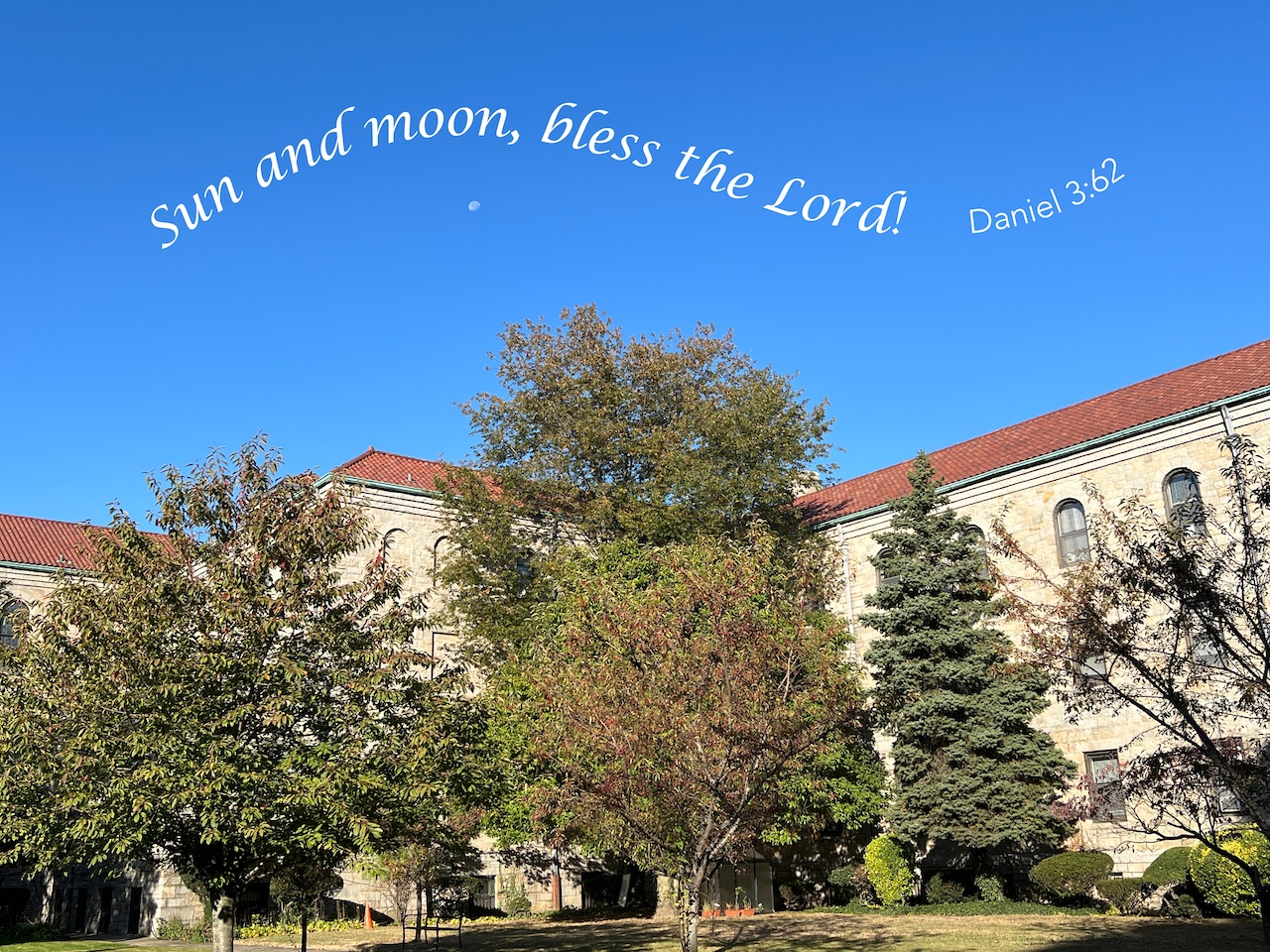
Photo of Passionist Monastery in Jamaica, NY with the text of Daniel 3:62, "Sun and moon, bless the Lord!"
Passionist Monastery in Jamaica, NY

By Gloria M. Chang

A monastery is a house of prayer to pursue the “happy” or blessed life. Our Passionist priests and brothers in Jamaica, NY faithfully pray the Liturgy of the Hours every morning and evening, which prepares them to give the bread of the Word and the Eucharist at Mass and to serve in various ministries. Prayer and the Eucharist, the daily bread of apostles, fuel works of mercy.

In a letter to a Roman noblewoman named Proba, St. Augustine offers valuable insights on prayer. The bishop of Hippo, whose rule of life continues to guide monastic communities today, understood the value of “prayer at appointed hours.” Although he was an extremely busy bishop, St. Augustine kindled his desire for God throughout the day by lifting his heart in prayer from sunrise to sunset. Forgetfulness of God in the midst of constant work makes the heart “lukewarm” and “chill” over time.

Thankfully, we can redeem the time. As the earth revolves around the sun, children of God revolve in the orbit of the Blessed Trinity. Space and time, the materials of our journey from birth to eternity, belong to the Father, Creator of all things through his Word and Spirit. Jesus, who frequently spent the night in prayer, models our way home to the Father.

Can one pray during a busy schedule? St. Augustine teaches that “even in these actions” (work responsibilities), we pray by continually longing for God. Many words are unnecessary. The desert monks discovered that short but frequent prayers, “hurled like swift javelins,” keep the heart and mind fixed on the Lord.

“Ask and it will be given to you; seek and you will find; knock and the door will be opened to you” (Matthew 7:7). Persistence in prayer with sighs and tears unite us with the ineffable God, “for he has established all things through his Word and does not seek human words.” As a monastery is a house of prayer, so are all of us “temples” of prayer in the Holy Spirit (Romans 8:26-27).

The Passionists Pray website offers resources for daily prayer, which can be accessed here.

From a letter to Proba by Saint Augustine, bishop

Let us turn our mind to the task of prayer at appointed hours

Let us always desire the happy life from the Lord God and always pray for it. But for this very reason we turn our mind to the task of prayer at appointed hours, since that desire grows lukewarm, so to speak, from our involvement in other concerns and occupations. We remind ourselves through the words of prayer to focus our attention on the object of our desire; otherwise, the desire that began to grow lukewarm may grow chill altogether and may be totally extinguished unless it is repeatedly stirred into flame.

Therefore, when the Apostle says: Let your petitions become known before God, this should not be taken in the sense that they are in fact becoming known to God who certainly knew them even before they were made, but that they are becoming known before men through boasting.

Since this is the case, it is not wrong or useless to pray even for a long time when there is the opportunity. I mean when it does not keep us from performing the other good and necessary actions we are obliged to do. But even in these actions, as I have said, we must always pray with that desire. To pray for a longer time is not the same as to pray by multiplying words, as some people suppose. Lengthy talk is one thing, a prayerful disposition which lasts a long time is another. For it is even written in reference to the Lord himself that he spent the night in prayer and that he prayed at great length. Was he not giving us an example by this? In time, he prays when it is appropriate; and in eternity, he hears our prayers with the Father.

The monks in Egypt are said to offer frequent prayers, but these are very short and hurled like swift javelins. Otherwise their watchful attention, a very necessary quality for anyone at prayer, could be dulled and could disappear through protracted delays. They also clearly demonstrate through this practice that a person must not quickly divert such attention if it lasts, just as one must not allow it to be blunted if it cannot last.

Excessive talking should be kept out of prayer but that does not mean that one should not spend much time in prayer so long as a fervent attitude continues to accompany his prayer. To talk at length in prayer is to perform a necessary action with an excess of words. To spend much time in prayer is to knock with a persistent and holy fervor at the door of the one whom we beseech. This task is generally accomplished more through sighs than words, more through weeping than speech. He places our tears in his sight, and our sighs are not hidden from him, for he has established all things through his Word and does not seek human words.

Reference

The passage from St. Augustine can be found in the Office of Readings for Monday of the 29th Week in Ordinary Time.

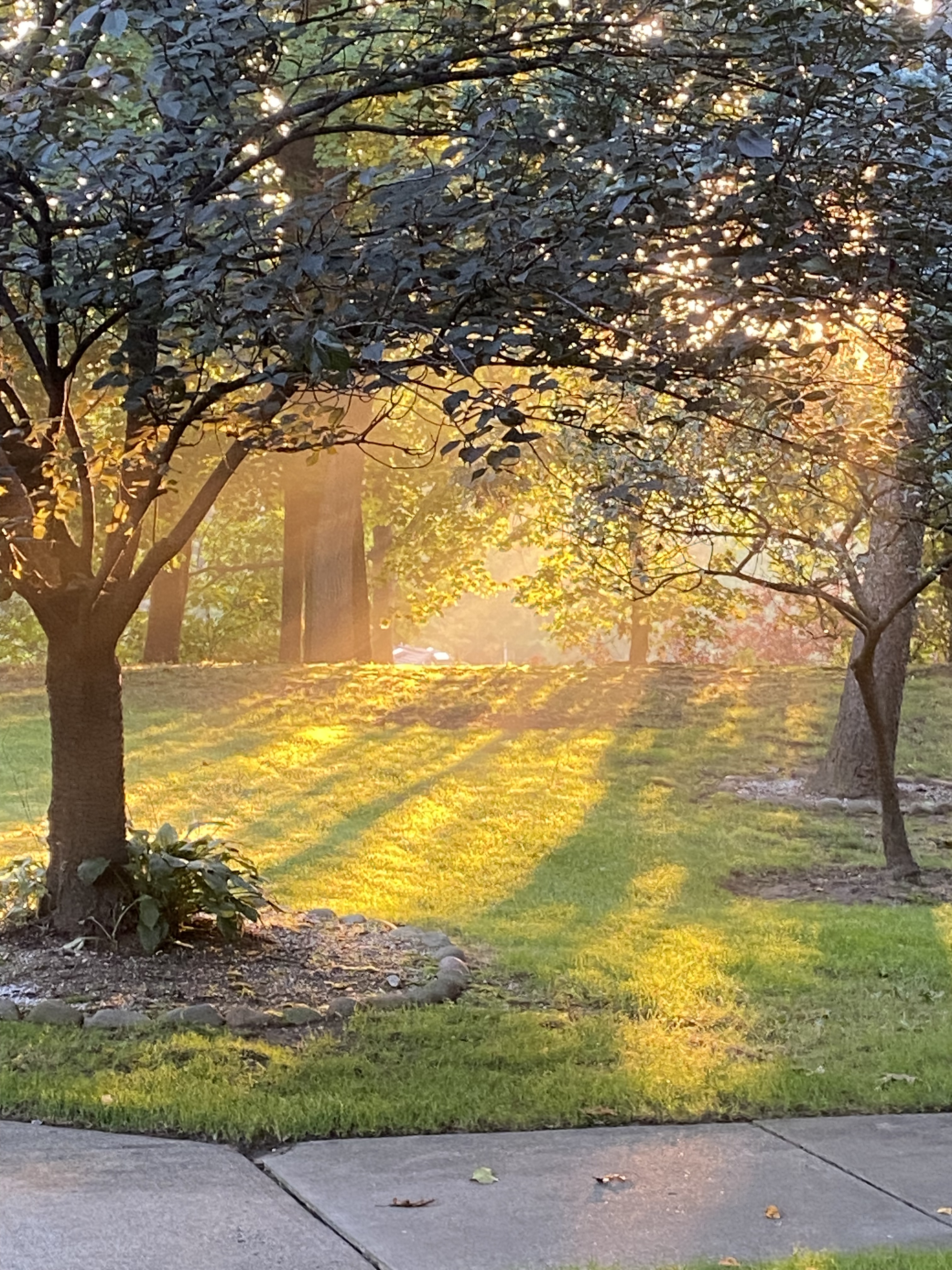
Sunrise

The autumn sun has a special brilliance as it rises in the morning bathing our oak trees, our spruce, our plum and cherry trees with light. Toward the end of the 1st century, St. Clement of Rome wrote a letter to the Christians of Corinth, the church St. Paul wrote two letters to earlier.

In lyrical language Clement pictures God’s great plan for creation. “Fix your gaze on the Father and Creator of the whole world.” You can see the Creator in the world he made.

“By God’s direction the heavens are in motion, and they are subject to him in peace. Day and night they fulfill the course God has established. The sun, the moon and the choirs of stars revolve in harmony at his command in their appointed paths without deviation….The earth blossoms in the proper seasons and produces abundant food…”

The destiny of creation is not destruction but resurrection. The world has its fierce, stormy seas, but God commands the seas.

“ Consider, beloved, how the Lord keeps reminding us of the resurrection that is to come, of which he has made the Lord Jesus Christ the first fruits by raising him from the dead. Let us look, beloved, at the resurrection that occurs at its appointed time. Day and night show us a resurrection; the night lies in sleep, day rises again; the day departs, night takes its place. Let us think about the harvest; how does the sowing take place, and in what manner? The sower goes out and casts each seed onto the ground. Dry and bare, they fall into the earth and decay. Then the greatness of the Lord’s providence raises them up again from decay, and out of one many are produced and yield fruit.”

It’s not nature mysticism Clement recommends. It’s a world seen through the eyes of faith. God’s “great providence” is at work.

Sunrise through the trees in our garden the other day whispered that to me.