Category Archives: Religion

Jerusalem 2033

In Advent we celebrate the Lord’s coming, to Bethlehem in the past, to us now in the present, and again on a day we do not know. God comes in mysterious ways. Advent is a time for seeing God’s plan.     

At the celebration of the 1700 years of the Council of Nicea and the Nicene Creed in Turkey November 29th,  Pope Leo invited the leaders of the Christian churches at the celebration to join him in Jerusalem in 2033 to celebrate the Death and Resurrection of Jesus 2,000 years ago.

That’s 8 years from now.

Asked about Pope Leo’s journey to the celebration at Nicea and what it may accomplish, Cardinal Parolin, Vatican Secretary of State  said “It can be likened to sowing seeds; the Lord knows the fruits and the time to reap them.”

Will seeds sown at the reunion of Christians at Nicea in 2025 grown in Jerusalem in 2033? 

Jesus prayed that we be one. 

Advent, Monday of the 1st Week

“Come, let us climb the LORD’s mountain,
    to the house of the God of Jacob,
That he may instruct us in his ways,
    and we may walk in his paths.”
For from Zion shall go forth instruction,
    and the word of the LORD from Jerusalem.” (Isaiah 2)

Isaiah spoke about all nations seeking instruction and disarming as Assyrian armies were rumbling toward Jerusalem to destroy it. People listening to him must have said “What’s he talking about? Can’t he see what’s at our door now?”

But Isaiah insists God will instruct the world in his ways. Yes, even now, God is instructing us. His message is not to hide because the Assyrian armies are coming; save yourselves!  Rather God says get ready for the days that are coming when “ they will beat their swords into plowshares, their spears into pruning hooks and there will be no wars any more.” God’s peaceable kingdom is coming.

Isaiah’s promises appear in wonderful imagery throughout Advent. There will be a cloud by day and a fire by night over God’s holy mountain. The mountain is a place of delight, not fear. Children play around a cobra’s den, the lamb and the lion lie down together, the poor become rich, a great banquet feeds them all. The fears of life give way to delight.

Wonderful imagery for a world today paralyzed by fear and confusion. Wonderful imagery for us who, like the shepherds at Bethlehem, wait fearfully in the dark. 

The Assyrian army surely had the equivalent of the Roman centurion in today’s gospel, who were the backbone of their armies. Powerful men, loyal soldiers, they could tell their troops ” Kill them all” or “Lay down your swords,” and their soldiers would do it.

The Roman centurion in today’s gospel represents power, yet power humbled before Jesus:  “Lord, I am not worthy that you should  come under my roof, but say the word and my servant will be healed.” He comes with a faith not found in Israel.

The Messiah has power over the proud and the strong, our gospel reminds us. No one, even a tough centurion, is beyond the reach of his mercy.

Advent is a time of hope, a daring hope that’s not just about surviving. It’s about much more. Jesus Christ instructs us and shows us the path to take. He’s knocking at the door, an Advent prayer reminds us. He invites us to work for the coming of God’s kingdom. He comes to lead us there.

Keep us alert, we pray, O Lord our God,

as we await the advent of Christ your Son,

so that, when he comes and knocks,

he may find us watchful in prayer

and exultant in his praise.

Who lives and reigns with you in the unity of the Holy Spirit,

God, for ever and ever.

Amen.

Follow the advent readings here.

Nicea 325-2025

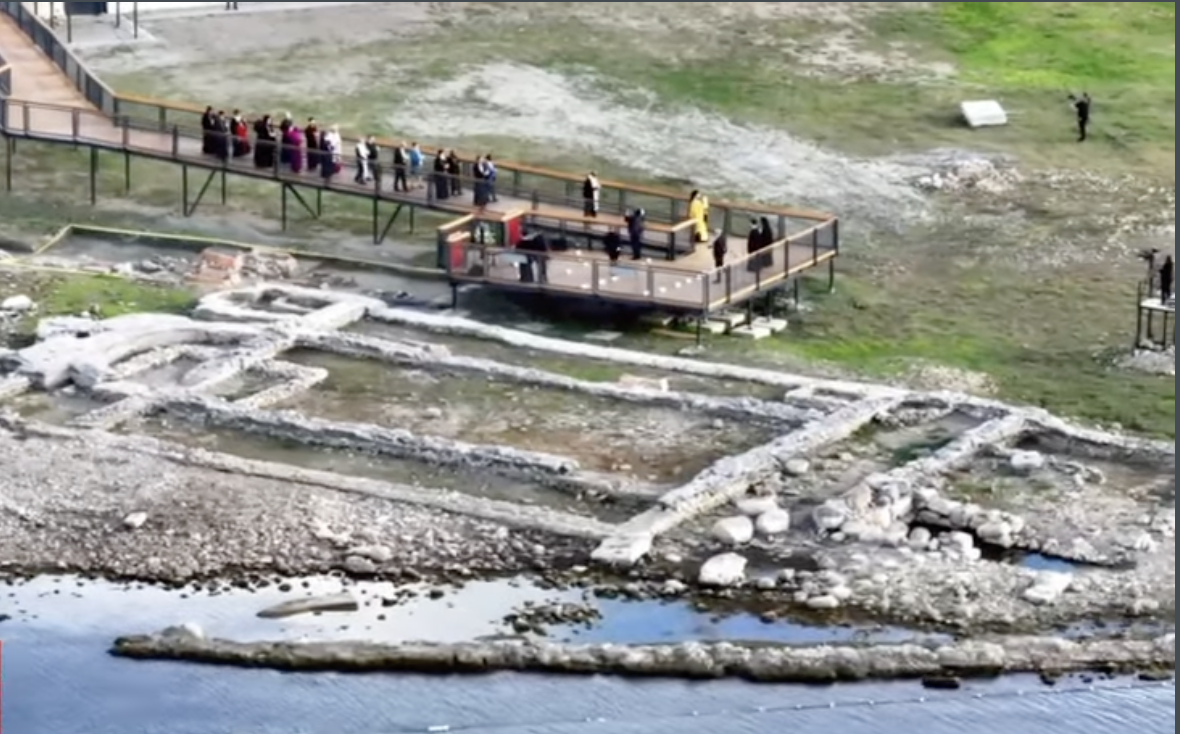
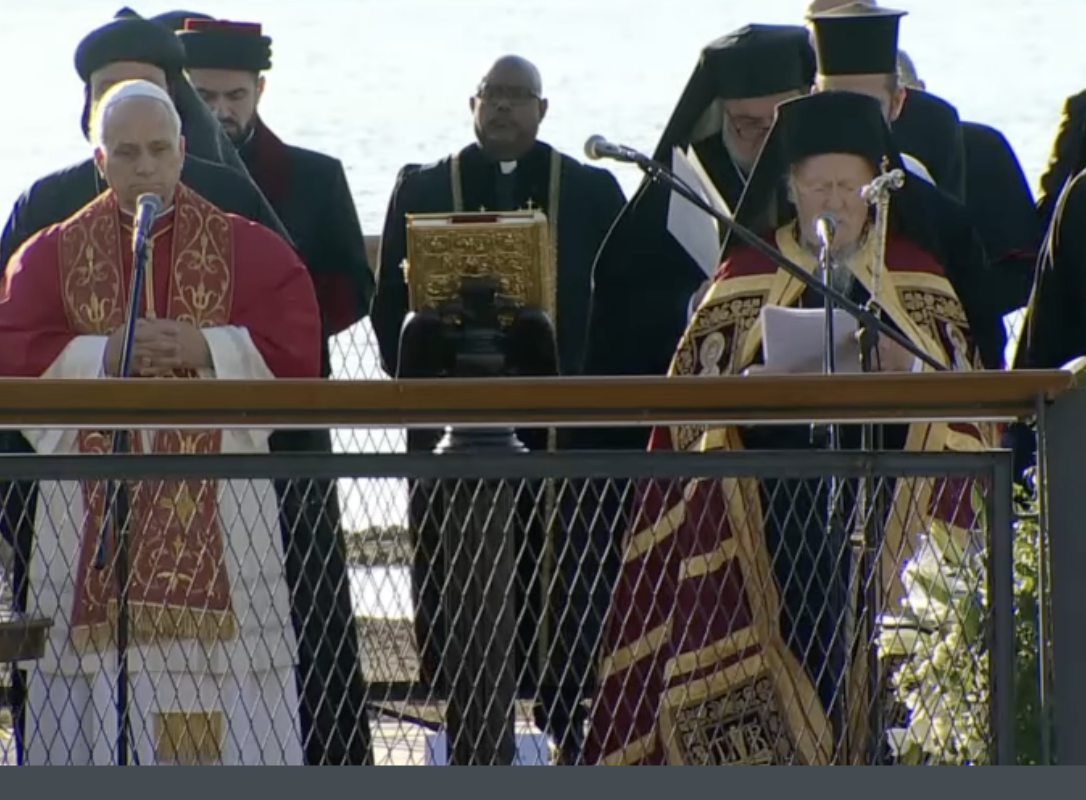
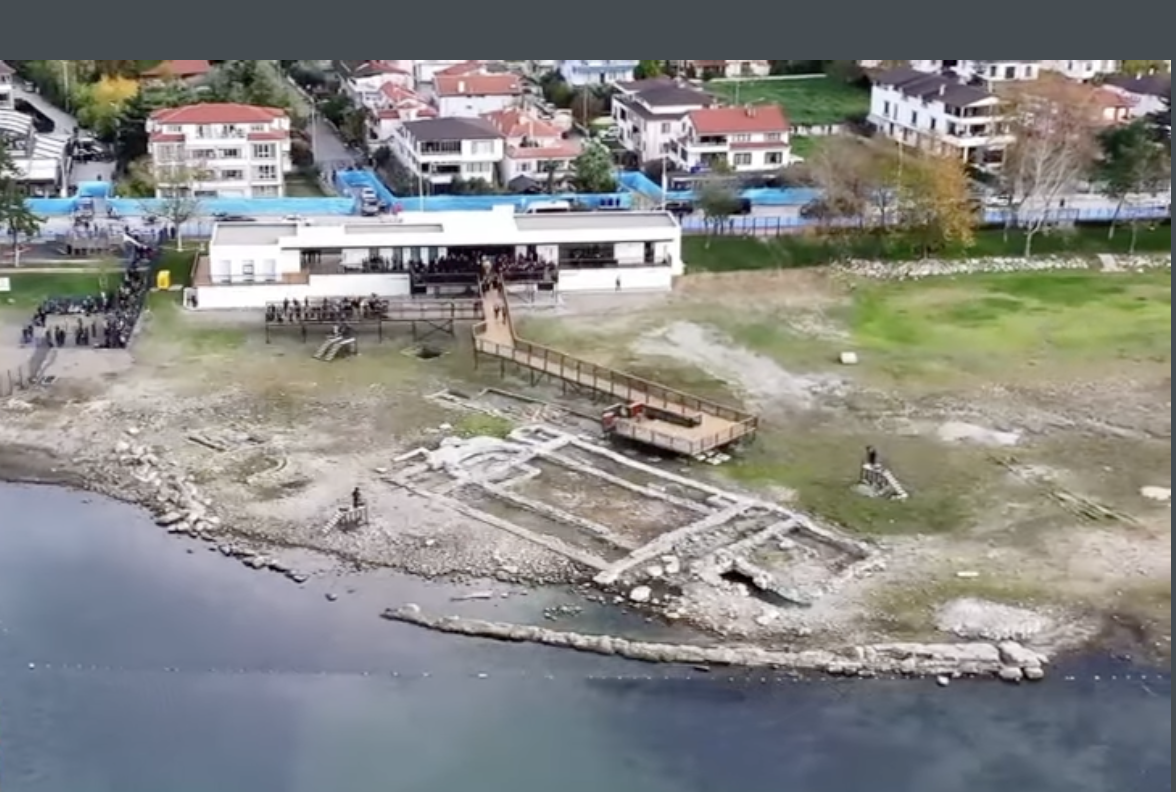
Pope Leo and 20 or more Christian leaders celebrated on November 28th, in Iznik, Turkey, the creation of the Nicene Creed 1700 years ago at the Council of Nicea. The Patriarch Bartholomew of the Greek Orthodox Church organized the meeting. Representing millions of Christians, they came as pilgrims to a place overlooking the ruins of an ancient church from that time.  

In his  apostolic letter De Unitate Fidei, November 23, 2025, Pope Leo urged the Catholic church to renew her enthusiasm for this fundamental profession of faith agreed upon in Nicea in 325. The creed is not simply a document from the past, the pope writes, but  a “compass” into the future that can  be “ understood in ever new and relevant ways.”

The Emperor Constantine called the bishops of the church to Nicea to deal with the disturbance caused by Arius, who denied the divinity of Christ.  In a letter to them he wrote:”Since at first it had been agreed that a synod of bishops should take place at Ancyra of Galatia, it has now appeared to us, for many [reasons], that it is better that it should gather in the city of Nicaea, in Bithynia: both on account of those bishops coming from Italy and the other regions of Europe, and on account of the good climate, and because I shall be in a proximate way an observer of and a participant in the things that are going to take place.”

The emperor presided over the council, known as the “Synod of the 318 Fathers.” The number of attending  bishops was unprecedented. Some still bore the marks of the torture they had suffered during the recent persecution of Christians by Diocletian. The vast majority came from the eastern Roman Empire. Only five came from the western part of the empire, despite the emperor’s plan. Pope Sylvester was represented by  Bishop Hosius of Cordoba and two Roman presbyters.                                                                                                                                                                                                                                                                                                                                                                                       To reflect on the council today,  Pope Leo recommends in his letter the study of a significant document,Jesus Christ, Son of God, Saviour. 1700th Anniversary of the Ecumenical Council of Nicaea,  published December 15, 2024 by the International Theological Commission.  

The International Theological Commission was founded by Pope Paul VI on April 11, 1969  to foster deeper theological dialogue and support for the pope and the Congregation of the Faith. Popes such as John Paul II, Benedict XVI, Francis and now Leo XIV have used the commission to deal with issues and challenges facing the church. The work of the commission often signals the direction the church will take as it charts its course in the world. 

The document offers an enlightening history of the Creed and has important suggestions for uniting the Christian churches today. It describes the Creed.as more than a summary of doctrinal propositions. The Creed is “an icon of words”, revealing the mystery of God and the church.

How is Nicea a “compass” into the future that can be “understood in ever new and relevant ways”, an “icon of words”? The Council of Nicea brought together bishops and their advisors from all over the Christian world. Ecumenical, it united all the churches. It was a council received and accepted by the whole church. Its decisions shaped the whole church and secular society as well. Will another council like it come?

As leadership passed from apostles to bishops, Nicea was also a “ new institutional expression of authority in the Church.”  From a Jewish world, the faith found a home in another culture and language at the Council of Nicea. Is Nicea an example of a global church?

The creed of the council had a profound influence  on the church’s liturgy and prayer. Our liturgy today bears its imprint. Do we recognize the deep mysteries expressed in our prayer?

Pope Leo in “De Unitate Fidei reflected on the powerful words of its creed:

“It is worth emphasizing the verb descendit, in the Nicene Creed: ‘he came down.’ Saint Paul describes this movement in strong terms: ‘[Christ] emptied himself, taking the form of a slave, being born in human likeness’ (Phil 2:7). The prologue to the Gospel of Saint John likewise states that ‘the Word became flesh and dwelt among us’(Jn 1:14). The Letter to the Hebrews also teaches that ‘we do not have a high priest who is unable to sympathize with our weaknesses, but we have one who in every respect has been tested as we are, yet without sin’ (Heb 4:15). On the eve of his death, Jesus humbled himself like a slave to wash the feet of his disciples (cf. Jn 13:1-17). Only when he was able to put his fingers into the wound of the risen Lord’s side did the Apostle Thomas confess: ‘My Lord and my God!’(Jn 20:28).

It is precisely by virtue of his Incarnation that we now encounter the Lord in our brothers and sisters in need: ‘As you did it to one of the least of these brothers and sisters of mine, you did it to me’ (Mt 25:40). The Nicene Creed does not depict a distant, inaccessible and immovable God who rests in himself, but a God who is close to us and accompanies us on our journey in the world, even in the darkest places on earth. His immensity is revealed when he makes himself small, laying aside his infinite majesty to become our neighbor in the little ones and in the poor. This revolutionizes pagan and philosophical conceptions of God.

Another phrase from the Nicene Creed is also particularly revealing for us today. The biblical statement ‘became flesh’ is clarified by adding the word “man” after “incarnate.” Nicaea thus distances itself from the false doctrine that the Logos took on only a body as an outer covering and not the human soul, which is endowed with intellect and free will. Instead, it seeks to affirm what the Council of Chalcedon (451) would later explicitly declare: in Christ, God assumed and redeemed the whole human being, body and soul. Saint Athanasius explains that the Son of God became man so that man might be deified. [5] This enlightening understanding of divine revelation was prepared by Saint Irenaeus of Lyon and Origen, and then further developed with great richness in Eastern spirituality.”

I have been reflecting these days on the simple, pervasive ways the ancient council and its creed affects the way we pray today: 

The Sign of the Cross, ever present in our prayers. “In the Name of the Father, and of the Son and of the Holy Spirit. Amen.” The creed we pray each Sunday and on major church feasts . The Eucharistic Prayer to the Father, through the Son, in union with the Spirit. The doxology, we pray at the end of a psalm: “Glory be Father, and to the Son, and to the Holy Spirit. As it was in the beginning, is now and will be forever, world without end. Amen.”

Yes,  Jesus taught in simple parables easily understood, but he also revealed the greatest mysteries: “The Father and I are one.” “The faith preached by Jesus to simple people is not a simplistic faith…Basically, any Christian, by tracing the sign of the cross on himself or herself, expresses the heart of the Trinitarian and Paschal faith in a fitting and full way,” the document from the International Theological Commission states. (118) 

And in a footnote from the document we hear the great theologian Yves Congar, OP., ’All my faith is in the most banal of my signs of the cross, and, when I pronounce ‘Our Father’, I have already included all that knowledge which will be delivered to me only in the Revelation of glory.”

We often hear the complaint today that our liturgy is not “spiritual” or “reverent” enough. Some seek a return to the Latin Mass as a remedy. 

Maybe our celebration of the 1700 years of the Council of Nicea will awaken us to the treasure we have in our present liturgy, filled with mysteries so simply stated in the language of the bible and the creed.

Saint Andrew, brother of Peter

Duccio_di_Buoninsegna_036

November 30th is the Feast of St. Andrew. On the lakeshore in Galilee Jesus called him and his brother Simon Peter to follow him. We only know a few details about Andrew. What are they?

He’s a fisherman, of course. Andrew is a Greek name. Why would a Jew have a Greek name? The area around the Sea of Galilee was then multi-cultural, and Andrew’s family were originally from Bethsaida, a trading town in the upper part of the Sea of Galilee with a substantial Greek population. Would that explain why they may have spoken some Greek?  Afterwards they located in Capernaum, another trading town close by.

Could that explain why later in John’s gospel, Andrew and Philip bring some Greek pilgrims to Jesus before his death in Jerusalem. Jesus rejoices, seeing them as signs that his passion and glorification will draw all nations to him. One sees why the Greek church has Andrew as its chief patron: he introduced them to Jesus.

Bethsaida, on the northern shore of the Seas of Galilee, has been recently excavated.

Bethsaida 393
Bethsaida: Winegrowers house
IMG_0632
Bethsaida: Ruins
IMG_0624
Bethsaida: Ruins

 Andrew seems to have an interest  in religious questions. He’s described as a disciple of John the Baptist, who points Jesus out to him. Jesus then invites Andrew and another disciple to stay for a day with him. “Come and see.” Afterwards, Andrew “found his brother Simon and said to him ‘We have found the Messiah.’” (John 1,35-41)

I notice too that Andrew bring the little boy with the bread and fish to the attention of Jesus.

The Greek Church sees  Andrew as the first of the apostles because he’s the first to follow Jesus; then he calls his brother. Western and eastern Christian churches together celebrate his feast on November 30th.

The letter to the Romans, the first reading for his feast in the Roman Catholic liturgy, stresses there is no distinction between Jew and Greek, and praises messengers who bring God’s word to others. Tradition says Andrews brought the gospel to the Greeks, and also claims that Andrew was crucified on the beach at Patras in Greece. Besides Greece, Andrew’s also the patron of Russia and Scotland.

We ask you, O Lord,
that, just as the blessed Apostle Andrew
was for your Church a preacher and pastor,
so he may be for us a constant intercessor before you.

Troparion (Tone 4) (Greek Orthodox)

Andrew, first-called of the Apostles
and brother of the foremost disciple,
entreat the Master of all
to grant peace to the world
and to our souls great mercy.
Kontakion (Tone 2)

Let us praise Andrew, the herald of God,
the namesake of courage,
the first-called of the Savior’s disciples
and the brother of Peter.
As he once called to his brother, he now cries out to us:

“Come, for we have found the One whom the world desires!”

Finally, from John Chrysostom in our Office of Reaadings today, we learn how to read the scriptures:

After Andrew had stayed with Jesus and had learned much from him, he did not keep this treasure to himself, but hastened to share it with his brother. Notice what Andrew said to him: We have found the Messiah, that is to say, the Christ. Notice how his words reveal what he has learned in so short a time. They show the power of the master who has convinced them of this truth. They reveal the zeal and concern of men preoccupied with this question from the very beginning. Andrew’s words reveal a soul waiting with the utmost longing for the coming of the Messiah, looking forward to his appearing from heaven, rejoicing when he does appear, and hastening to announce so great an event to others. To support one another in the things of the spirit is the true sign of good will between brothers, of loving kinship and sincere affection. 

  Notice, too, how, even from the beginning, Peter is docile and receptive in spirit. He hastens to Jesus without delay. He brought him to Jesus, says the evangelist. But Peter must not be condemned for his readiness to accept Andrew’s word without much weighing of it. It is probable that his brother had given him, and many others, a careful account of the event; the evangelists, in the interest of brevity, regularly summarise a lengthy narrative. Saint John does not say that Peter believed immediately, but that he brought him to Jesus. Andrew was to hand him over to Jesus, to learn everything for himself. There was also another disciple present, and he hastened with them for the same purpose. 

  When John the Baptist said: This is the Lamb, and he baptizes in the Spirit, he left the deeper understanding of these things to be received from Christ. All the more so would Andrew act in the same way, since he did not think himself able to give a complete explanation. He brought his brother to the very source of light, and Peter was so joyful and eager that he would not delay even for a moment.

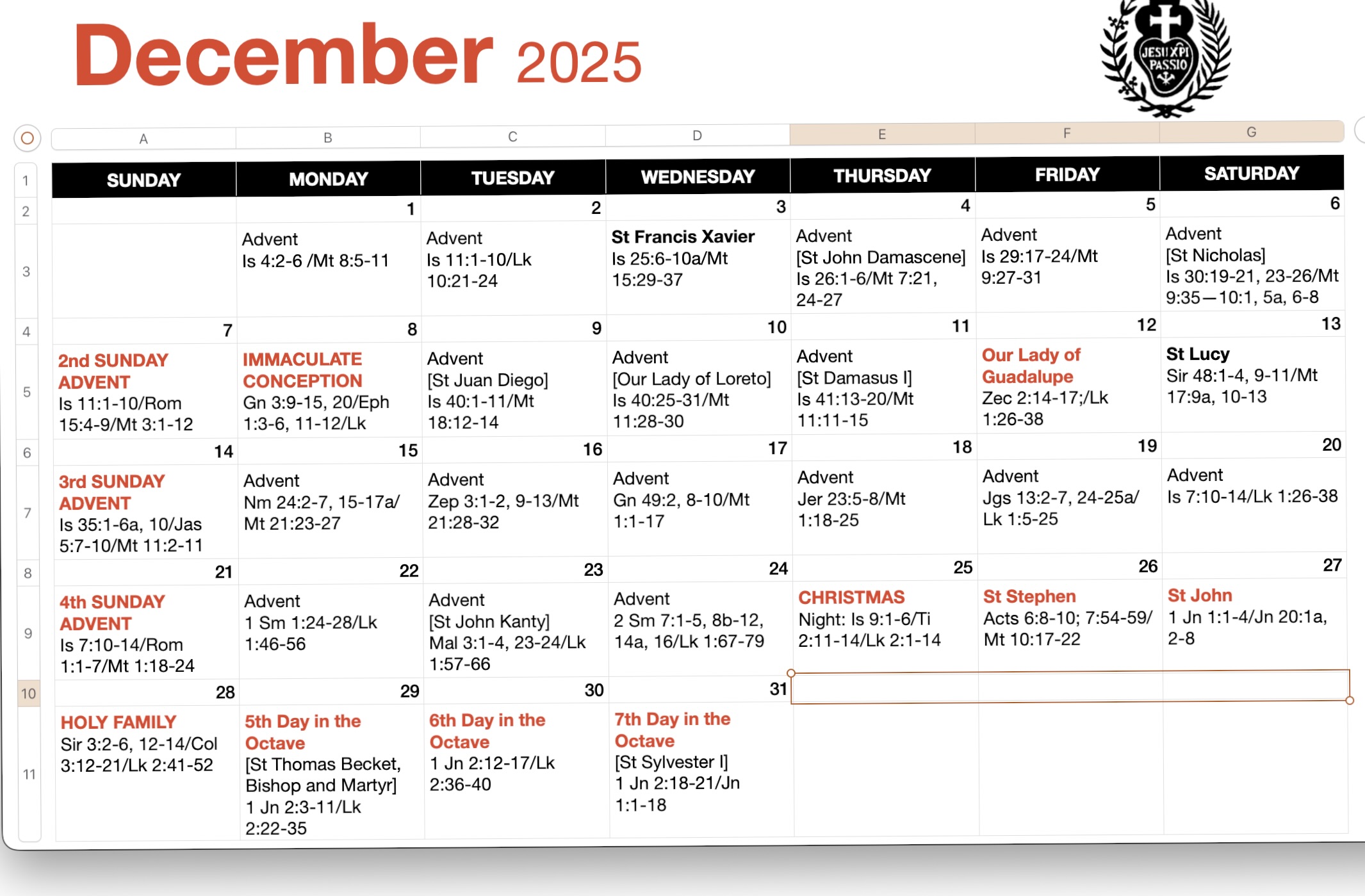
!st Sunday of Advent a. A Blessed Hope

For this week’s homily, please watch the video beow.

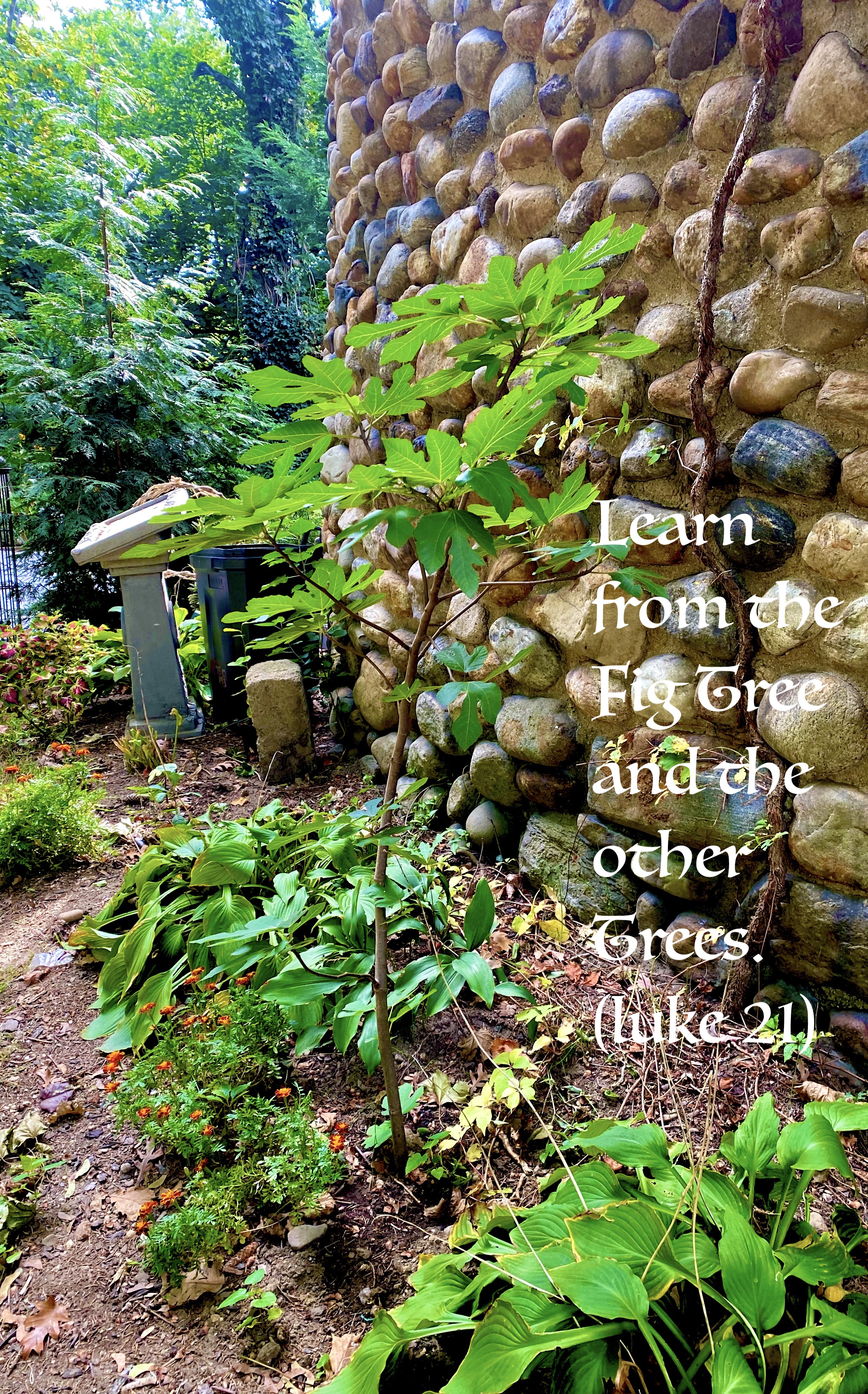
Learn from the Fig Tree” Luke 21:29-33

Jesus told his disciples a parable.
“Consider the fig tree and all the other trees.
When their buds burst open,
you see for yourselves and know that summer is now near;
in the same way, when you see these things happening,
know that the Kingdom of God is near.
Amen, I say to you, this generation will not pass away
until all these things have taken place.
Heaven and earth will pass away, 
but my words will not pass away.”

Luke 21:29-33

The same day we read of terrifying night visions from the Book of Daniel in the first reading from our lectionary (Daniel 7) Jesus offers a parable about the fig tree and other trees. Learn from them– summer is near. We usually miss this reading because it occurs on the Thursday Thanksgiving is celebrated and other readings take its place.

It proposes another way to see the coming of God’s kingdom. It will be like the coming of summer. After the winter storms, the earth will flower in abundance, Jesus promises. 

The coming of God’s kingdom doesn’t destroy creation but brings it a surprising summer. I find it interesting the way our knowledge of creation supports our knowledge of the plan of God.

Saving Advent and Christmas

Wikipedia’s article on Advent offers a description about how Christian denominations– Catholic, Anglican, Lutheran, Presbyterian, Methodist– approach the feast of Christmas, through devotional prayers and practices like the Advent wreath, the Christmas tree, musical performances like the Nine Lessons of Carols and Handel’s Messiah. Purple is the color of the season in most of these churches, blue in the Scandinavian countries.

The Wikipedia article features the devotions of Advent. Little is said ofGreek church’s Nativity Fast or the Roman Catholic liturgy of Advent. The Catholic liturgy of Advent “remained unchanged until the Second Vatican Council introduced minor changes,” it says.

That’s not accurate. The Roman Catholic Advent liturgy underwent a major change after the Second Vatican Council. A better schedule of readings and new Eucharistic prefaces were introduced to the liturgy; morning and evening prayers and other parts of its liturgy were enhanced. The Catholic Advent liturgy is a ringing affirmation of hope.

Advent hope is nourished by the first coming of Jesus Christ, but also by the promise of his second coming. It’s hope defying human calculation or human logic – an impossible hope. A hope spelled out in the devotions like the Advent wreath and the Christmas tree, but above all proclaimed in the Advent scriptures and liturgy.

Isaiah’s oracles from 8th century Judea are heard in the first few week of Advent, They proclaim that kind of hope.  Even as Assyrian armies capture and destroy his land, Isaiah sees a sign, the root of Jesse, set up before the nations. 

“His dwelling shall be glorious. The wolf shall be a guest of the lamb, and the leopard shall lie down with the kid; The calf and the young lion shall browse together, with a little child to guide them. The cow and the bear shall be neighbors, together their young shall rest; the lion shall eat hay like the ox. The baby shall play by the cobra’s den, and the child lay his hand on the adder’s lair. There shall be no harm or ruin on all my holy mountain; for the earth shall be filled with knowledge of the LORD, as water covers the sea.”

Wolves and lambs, leopards and kid goats, calves and lions lie down together on God’s holy mountain. The impossible becomes possible. That’s the  kind of hope we need today. 

Our Christian holidays and seasons are suffering more and more from secularization and commercialization. Like Santa Claus they need to be saved. They celebrate a greater hope than human imagination dares – hope in God and the promises God offers in Jesus Christ.

Let’s celebrate that hope in our liturgy.

Saving Santa Claus

Santa came to town for Macy’s annual Thanksgiving Parade. From the parade he went into the store for Black Friday and he will be there for the rest of the days till Christmas.

More than a salesman, Santa’s a saint– Saint Nicholas– and he reminds us Christmas is for giving rather than getting. His quiet giving mirrors God’s love shown in Jesus Christ.

Telling his story is one of the ways we can save Santa Claus from being captured by Macys and Walmart and all the rest. First, take a look at our version for little children, which has over 200,000 views on YouTube. How about telling that story to a real little kid you know? Wouldn’t you rather they know someone like him than the guy in the store in a red suit?

Then, you might want to go on to our  modest contribution for bigger children– like us:

A Thanksgiving Prayer

Noah

Thanksgiving is a good time to remember our blessings, starting with Creation itself .  I’m sure that was Noah’s prayer when God delivered him.

All-powerful God,
you are present in the whole universe
and in the smallest of your creatures.
You embrace with your tenderness all that is.
Pour out upon us the power of your love,
that we may protect life and beauty.
Fill us with peace, that we may live
as brothers and sisters, harming no one.
O God of the poor,
rescue the abandoned
and forgotten of this earth,
so precious in your eyes.
Bring healing to our lives,
that we may protect the world and not prey on it,
that we may sow beauty,
not pollution and destruction.
Touch the hearts
of those who look only for gain
at the expense of the poor and the earth.
Teach us to discover the worth of each thing,
We thank you for being with us each day.
Encourage us, we pray, as we struggle
for justice, love and peace.

Happy Thanksgiving.