Category Archives: Religion

They Guide Us Still


The calendar of the Roman Catholic church was reformed in 1969 after the Second Vatican Council. One aim of the reform was to ensure that the mysteries of Christ celebrated during the year were not overshadowed by celebrations of the saints, especially during the seasons of Advent Christmas, Lent and Easter. To achieve that goal, the number of saints in the general calendar was reduced, some historically unreliable saints eliminated and celebration of other saints made optional.

Particular calendars for various countries, dioceses and religious communities took on the celebration of saints and feasts that were peculiar to them. In the calendar at present there are solemnities, like Christmas and Easter, feasts, memorials and optional memorials.

The new arrangement doesn’t mean that saints aren’t important any more. They are. The saints are examples of faith in their time and promote a vision of faith in our time. They show that “holiness is not bound by time and place.” It’s not limited to the bible or biblical times. It’s found “always and everywhere.”

Saints are not bound by their own time either, they also reach into our time. What’s said of the apostles in the preface for their Masses can be said of other saints too. “From their place in heaven they guide us still.”

Some of the saints we write about in this blog are found in the general calendar of the Catholic Church, others in the calendar of the church in the United States, others in the Passionist calendar.

Saints like Mary, the Mother of Jesus, the apostles, saintly women and men like Theresa of Avila and Francis of Assisi are patrons and guides of the universal church. Other saints, like Elizabeth Ann Seton, John Neumann and Charles Houben– all celebrated this week–are in the United States calendar or the Passionist calendar.

This week the American bishops are on retreat in Chicago. As we celebrate Elizabeth Ann Seton and John Neumann, important saints for the history of the church in North America, may they guide us still.

Charles Houben, the Passionist saint who cured so many at Mount Argus in Dublin, Ireland, still heals and still helps the Passionists understand their charism today.

A Mere Coincidence?

Vincent J. Rizzuto, M.D., FACP

When you’re an 80-year-old doctor, you think you’ve seen it all.
For two years I served as a specialist in internal medicine in the U.S. Army in Okinawa during the height of the Vietnam War.
I’ve done industrial medicine for a large New York bank.
I taught interns and residents at Mary Immaculate Hospital in Queens, New York.
I supervised the work of other doctors prior to my retirement.
But nothing in all my professional experience prepared me for what happened next.
I developed a severe episode of depression following the sudden death of my younger sister. I was afraid I might take my own life if I were left unattended, so I voluntarily consented to several successive admissions to a major psychiatric/medical center in New York City. The diagnosis was endogenous depression and Parkinson’s disease. In short, I suddenly found myself in Hell and proceeded to abandon all hope!

From a technical viewpoint, I received the finest, most comprehensive, up-to-date psychiatric and medical therapy available today. However, my depression was so deep that eventually I exhausted most of the customary therapeutic modalities, including medications. Consequently, I was forced to resort to some of the older agents. The only remaining procedure was shock therapy, but this was discontinued because of serious adverse effects. I remember telling my doctors that I would rather die than undergo shock therapy. For all practical purposes, as far as I was concerned, modern medicine had come to a standstill.

Finally, after a deeply distressing two-year period, I was discharged in “stable” condition for outpatient follow-up. I contacted a doctor friend who “just happened” to know a home health aide who was “ eminently capable and trustworthy”, who in turn, “just happened” to be available since, unfortunately, her patient expired the week before. As Albert Einstein once said, “Coincidence is God’s way of remaining anonymous!”

The next phase of my life was punctuated by a series of plunges–deeper and deeper into depression. The only clear recollection I have of this period was that I experienced an overwhelming, almost constant nausea which was refractory of all treatment. I awakened each morning “immersed” in nausea which progressively worsened throughout the day.

At this point, another doctor friend introduced me to a 92¬–year–old, but positively brilliant Catholic priest, Father Joseph Guzinski, C.P. Father Joe’s ministry was spiritual direction. I told him my story and he became my personal spiritual advisor. This was the only avenue left to explore, but quite frankly, I did not ascribe much hope to it. How could this 92–year–old man in a wheelchair possibly stop the unrelenting onslaught of the depression/nausea–fueled crises which engulfed me?

Father Joe was quick to grasp how sick I was–he immediately got down to business. He instructed me in the use of the holy oil of Saint Charles, and he provided directions for its administration. He suggested that Vanessa (my home health aide) apply Saint Charles’ oil on my forehead in the form of a cross each morning while we recited a prayer to Saint Charles.

Similar to Jesus’ time, olive oil is still used by the Catholic Church to anoint the sick. It’s a sign of God’s mercy, soothing and healing our wounds. Of course, the Church offers other spiritual measures to help those who are ill, but that subject is beyond the scope of this article.

St. Charles spent most of his life as a priest at the Passionist monastery at Mount Argus in Dublin, Ireland. He was responsible for many miraculous cures. In fact, the doctors surrounding the Passionist monastery wanted St. Charles transferred because his miracles had a negative impact on their income!

One day, my severe depression simply vanished as quickly and dramatically as it began. There was no “fuss or fanfare”. I suddenly felt vigorous and healthy–very peaceful, extremely happy– a great weight had been lifted from my shoulders. This euphoric feeling only lasted about 1-2 minutes. Concomitantly, I knew my depression was cured! I can’t tell you how I knew–I just knew and felt it instinctively. This event took place about 7-10 days after we initiated the prayers to Saint Charles with the application of the holy oil. I can pinpoint the day/time precisely. It was 11:00 a.m. Easter Sunday morning.

Subsequently, I was examined by a professor of neurology at New York Columbia-Presbyterian Weill Cornell Hospital. He concluded that I did not have Parkinson’s disease and he advised me to stop taking the very powerful anti-Parkinsonism drugs.

You might ask, to what do I, as a doctor and a man of science, attribute my cure from depression. As a matter of fact, there is very little doubt in my mind because I have never had any difficulty reconciling science and religion.

Perhaps Shakespeare said it best when Hamlet told Horatio, “There are more things in heaven and earth, Horatio, that are dreamt of in your philosophy.”

Let’s review a few facts and then you can decide for yourselves.

First, depression is a serious, even deadly, disorder in which suicides are not uncommon. My depression had a veritable stranglehold on me. I was so nauseous that I couldn’t think or see properly or even walk a straight line. And it was getting worse! And there was no relief in sight!

Following my cure from depression, I developed a problem holding my head up. This is a rare phenomenon known as the “head drop syndrome.” In my case, it was the direct result of the “stranglehold” related to my depression, a reminder, as it were, of the time when I was more dead than alive.

When we are sick, God expects all of us to avail ourselves of the best possible medical care which He has already provided. He will not help us unless we help ourselves. I did that. But there came a point when it was obvious that modern medicine was no match for my disease. Psychiatry was powerless over the degree of depression. This was when I requested divine intervention thorough the intercession of St. Charles. And you know the result.

I would like to conclude with a word of advice. We must be very cautious when we ask for God’s assistance. Don’t be like the businessman who was looking for a parking spot in New York City. He was already late for an important meeting. At last, he looked up in the direction of heaven and said, “Dear God, let me find a parking spot, and I will do anything you want.” Just then, a small truck pulled out, leaving him more than ample room to park. He looked up and said, “Never mind. I found one.”

Miracles are rare, but when they do occur, they often happen very quickly. If you are not observant you are liable to miss them.

As C.S. Lewis once said, “Miracles are a retelling in small letters of the very same story which is written across the whole world in letters too large for some of us to see.”

Who are you?

Baptism jpg

In today’s reading at Mass from John’s gospel,  Jewish officials and Pharisees from Jerusalem send representatives to John the Baptist as he’s baptizing in the Jordan River near Jericho asking “Who are you?” “Are you the Messiah, Elijah, the Prophet?” “Why are you baptizing?”

“I’m not the Messiah, or Elijah, or the Prophet,” John answers. “I am the voice crying out in the desert, ‘Prepare the way of the Lord. ’” John knew who he was and who he was not, and he wasn’t afraid to be the one God wanted him to be.

John could have followed his father,  Zechariah, as a priest in the temple at Jerusalem,  a role passed on from father to son. But John chose a different course. God led him another way.

We don’t know when, but John went down to the Jordan Valley where the road ascended to Jerusalem, and preached to and baptized the crowds going up to Jerusalem to the temple of the Lord. The clothes he wore, his style of life set him apart from everyone else.

John didn’t care how he looked or what people thought of him. He certainly didn’t choose an easy place to be, a desert place. Later, Jesus praised his strength and determination.

To know who you are, you need to listen to God’s call,  and evidently John did that. To speak the truth courageously, you need to depend on God’s strength, and evidently John did that too.  He became a voice for God, even if he sounds at times like a drill sergeant readying people for the battle of the last days. He said unpopular things to powerful people and faced the consequences. Herod Antipas, who ruled Galilee and Perea, arrested him and put him to death.

We’re like John whenever we ask God, “Who am I?” and listen for an answer. We’re like him whenever we use bravely the voice God gives us.

We’re God’s Children Now

The First Letter of John, read this week at the end of the Christmas season, counters the claim of some early Christians that the Word did not become flesh, that Jesus did not become human like us. They thought it unworthy of God to assume our lowly humanity.

The dissidents were either Docetists, people who rejected the belief that God could become human, and so Jesus would seem to be human but was not, or they were Gnostics who believed that Jesus pointed to a greater power still to be revealed.

They turned away from a belief that “the Word was made flesh.” God was not born, nor live hidden for years, nor teach and do mighty deeds in Jesus Christ. God did not experience death and rise again in Jesus, his Son. The all-powerful God would reveal himself in a better way than this, they believed.

Invoking the authority of the Apostle John, who saw Jesus and believed, the letter condemns that opinion and those who express it. Keep away from them, it says. The Word became flesh and we see his glory reflected in his humanity. The gospels this week, from the Gospel of John, show John the Baptist pointing Jesus out to his disciples as the One who is to come.

Rejecting the Incarnation affects the way we think about ourselves, the letter continues. If humanity can’t be united to the divinity, then we can’t be called “children of God.” But we are God’s children, John says, even now in the flesh.

“Beloved, we are God’s children now;

what we shall be has not yet been revealed.

We do know that when it is revealed we shall be like him,

for we shall see him as he is.”

Jesus Christ was finally revealed in his resurrection. We wait for that moment ourselves, when we hope to share that mystery “through him, with him, and in him.” Not only shall we see him as he is, but we shall see our flesh, our lowly humanity, graced by his resurrection.

Let’s not forget: “we are God’s children now.


Still Wondering


We don’t stop wondering at the Christmas crib. Christmas is over for most people today. The tree’s taken down, decorations put away. But the Christmas mystery is too big for a one day celebration; that’s why the church prepares for this celebration through the four weeks of Advent and continues through the days of the Christmas season till the Feast of the Epiphany. Christmas Day may be over, but our celebration and reflection on the Christmas mystery is not over.

This mystery raises questions and has consequences, which the feasts that follow Christmas Day explore. Since ancient times churches of the east and west have celebrated the feast of Stephen, one of the first disciples of Jesus and the first to die giving witness to him. (Acts 6,8 ff) on December 26.

When Jesus was born “all who heard it were amazed by what had been told them by the shepherds.” (Luke 2,18) But Stephen would be stoned to death when he told about the One who was sent. The message will not always be heard, yet still must be told. 

“The love that brought Christ from heaven to earth raised Stephen from earth to heaven,” St. Fulgentius says of the martyr Stephen.

December 28th is the feast of the Holy Innocents;  little children from Bethlehem put to death by Herod the Great so no rivals would challenge his power and throne. (Matthew 2, 13-18) When Jesus was born “all who heard it were amazed by what had been told them by the shepherds.” (Luke 2,18) Yet Herod the Great heard the message and tried to end it. The birth of Jesus does not bring an end to evil in the world. The Child is born “for to die for poor orn’ry creatures like you and like I.”  

December 27th is the feast of St. John, the apostle. This is another feast celebrated along with the Christmas feast by all the churches of the east and west from earliest times. It explores the great question: Who is this Child born of Mary? Writings identified with John the Apostle– the 4th Gospel and letters–  are read at Mass on Christmas Day and days that follow the feast. 

Jesus Christ, born of the Virgin Mary, is true God and true man, “the Word made flesh, the Word of God who made all things, dwells among us.”

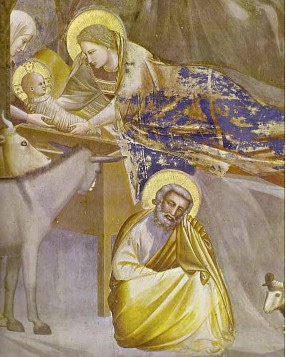
Like the shepherds who watched in the darkness we need to keep our eyes on this sign of light:  “the infant wrapped in swaddling clothes and lying in a manger.” Like Mary, we need to keep reflecting on this mystery in our heart to appreciate what it means for the world and for us. Like Joseph we don’t stop wondering.


mary 10


The Playground, a Slice of Pizza, and a Plate of Cookies

Hain's avatarHowie Hain

by Howard Hain


Yesterday my address may as well have been Sesame Street.

Returning to our one-bedroom apartment in Union City, New Jersey, after three nights at my mother’s house for the Thanksgiving weekend, my daughter had one thing in mind: “Park.”

A two-year old can get quite repetitive. Off we went.

We chose the playground on the other end of town in order to lengthen the walk. Francesca rode in the carriage, looking back over her shoulder at us and saying “park” at the sight of every tree, child, or basketball.

She sat in every swing, slid down every slide, and climbed every rung. She played so hard she hardly even fought us when we said it was time to go.

The pizza guy cut her slice into tiny pieces. Francesca ate all but the crust, bobbing her head up and down with every bite.

Next stop, the bakery.

View original post 180 more words

December 24: The Dawn from On High

IMG_1623

The birth of John the Baptist. Luke’s gospel says, is closed connected to the birth of Jesus. today. We celebrate the two births as we draw near to Christmas.  Struck dumb by doubt,  John’s father Zechariah speaks again as he agrees to the child’s name. “John is his name.”

John Baptist birth

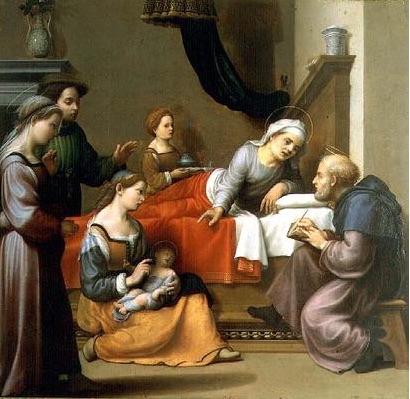
Artists often portray the birth of John in a room with midwives attending Elizabeth at his birth, but Luke’s gospel portrays Zechariah his father singing a song at his birth.. “In the tender compassion of our God, the dawn from on high shall break upon us. For you, my child,  shall go before the Lord to prepare his way, by the forgiveness of sins”  He sees the birth of John in a larger perspective.

“The dawn from on high shall break upon us.” A new day can dawn in a spectacular way at times. I saw daybreak over New York City a few years ago from our house in Union City. Shortly before, the city was dark, then the day broke to bathe it in gold.  What promise daybreak holds!

These days, darkened by political unrest worldwide, poverty,  terrorism, racial problems and homelessness, we need grace from on high. Christmas comes at a good time.

Readings here.

O King of all nations and keystone of the church,  come and save us whom you formed from the dust.

Friday Thoughts: Pure Extra Virgin

by Howard Hain
william-dyce-the-garden-of-gethsemane-1860

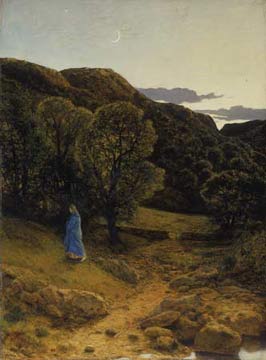
William Dyce, “The Garden of Gethsemane”, 1860*


To your eyes a thousand years are like yesterday, come and gone, no more than a watch in the night.

—Psalm 90:4


.One good olive.

There are so many factors.

The altitude. The light. The soil. The temperature. The rainfall. The wind. The dew point and humidity. The age of the tree.

Then there are those factors that we can control: pruning, watering, fertilizing, fanning, netting, and wrapping chilly trees with burlap or fleece.

And of course there are those other factors, those that fall somewhere in-between, between our control and our complete lack thereof: most of these relate to the sneaky work of numerous little thieves—animals, birds, insects, and perhaps even fellow farmers or other hungry travelers who just happen to pass by.

But when all is said and done—when all the factors are poured into the olive equation, mixed-up well, and left to unify or settle out—the fruit that’s produced by the world’s most nostalgic, symbolic, and romantic of trees means very little (at least in digestive terms) if it’s simply left to shrivel up and fall to the ground.

———

Picking an olive is perhaps the highest part of the art.

———

When to do so? And toward what end?

If too early, great potential is squandered.

If too late, great taste is lost.

If indecisive, we might as well let nature enjoy it for the time being—for one way or another—God’s process will eventually return it to the earth.

———

And yet, we’re still not done, for even if the olive is picked at just the right time, from just the right tree—the one that has grown in all the right circumstances—when it comes to the culmination of olive production, all is moot if the precious fruit of the womb is never squeezed.

For no matter how good the olive, without applied pressure, there’s nothing left to be labeled “pure extra virgin”.


.But when the fullness of time had come, God sent his Son, born of a women…

—Galatians 4:4


* Gethsemane is the name of a garden on the Mount of Olives in Jerusalem. It appears in the Greek of the Gospel of Matthew and the Gospel of Mark as Γεθσημανή (Gethsēmanē). The name is derived from the Aramaic ܓܕܣܡܢ (Gaḏ-Šmānê), meaning “oil press”.


(Dec/23/2016)


4th Sunday of Advent: Faith brings Joy

For this week’s homily please play the video below.

Readings: 3rd Week of Advent


DECEMBER 16 SUNDAY THIRD SUNDAY OF ADVENT
Zep 3:14-18a/Phil 4:4-7/Lk 3:10-18 (9)

17 Monday Advent
Gn 49:2, 8-10/Mt 1:1-17 (193)

18 Tuesday Advent
Jer 23:5-8/Mt 1:18-25 (194)

19 Wednesday Advent
Jgs 13:2-7, 24-25a/Lk 1:5-25 (195)

20 Thursday Advent
Is 7:10-14/Lk 1:26-38 (196)

21 Friday Advent
[Saint Peter Canisius, Priest and Doctor of the Church]
Sg 2:8-14 or Zep 3:14-18a/Lk 1:39-45 (197)

22 Saturday Advent
1 Sm 1:24-28/Lk 1:46-56 (198)