Category Archives: ecumenism

Why Read the Old Testament?

Some people complain about the selections from the Old Testament we’re reading at weekday Mass these past few weeks. Too long, they say, they don’t tell us anything. They’d rather hear what Jesus is saying and doing.

Why do we read from the Old Testament? Reading from the Old Testament is a lot like reading from the New York Times or the Daily News, or following David Muir on ABC each evening. You’re not going to hear much about Jesus there either. The media gives us the news of the day as it happens and, especially these days, it’s not encouraging.

Not much encouraging news in our Old Testament reading today from the Book of Numbers either. (Numbers 13-14) Giants are out there blocking the way to the promised land. Israel’s scouts face giants as they reconnoiter the world ahead. There’s no way ahead.

Our media tells us the same: giants are blocking our way– North Korea, the Middle East, storms from climate change, political giants who seem to get in the way of a world of justice and peace. And we don’t have answers what to do.

But the Old Testament tells us more than the media. It’s salvation history. More than the story of the Jews, the Old Testament is the story of the human race and all creation on a journey, from the beginning of time to its end. Human sinfulness, tragedies and delays are there, but the story begins and ends in hope. God is there.

That makes the Old Testament stories so different from the stories the media serves up everyday. God is there from the beginning. That’s the way our selection today from the Book of Numbers begins: “The LORD said to Moses [in the desert of Paran,]‘Send men to reconnoiter the land of Canaan,
which I am giving the children of Israel.’” And God is there as his people experience the consequences of their foolishness and lack of faith.

The columnist David Brooks in the Times yesterday said he has to think less about Donald Trump or he’s going to go crazy. He needs to think more about the deeper shifts taking place in society, he says.

I wonder if thinking about the deeper shifts is enough to stop you from going crazy these days. We need hope from another source. That’s where the Old Testament and the rest of the scriptures comes in. Some prefer calling it the “First Testament.” It testifies that the first thing to keep in mind about time is that God is there, from beginning to the end. God is our Savior.

August is Here

At the start of each month I email members of the Confraternity of the Passion and anyone else who asks a calendar indicating the scripture readings for the Mass and the feast days of the saints we remember that month.

The reason I do is that following the church calendar is an important way to grow in faith.It puts us in touch with the scriptures in our daily lectionary and the wonderful world of the saints.

Reading the daily scriptures together with fellow believers throughout the world develops a common mind, as it were. Fortunately, not just Catholics use the daily lectionary, some Protestant churches use it now too; so more Christians read the same scriptures together through the year.

Praying together can bring us together, we hope. Praying the scriptures together, which the Catholic church encouraged at the Second Vatican Council, is a step towards Christian unity. Blessed Dominic Barberi, Passionist whose feast is August 26th was especially dedicated to the work of Christian unity.

This month at Mass we continue reading from Matthew’s gospel. With chapter 14, Jesus begins to establish his church, built on Peter, a rock, but a frail man who with the other disciples must follow Jesus to the cross.

The following chapters from Matthew offer an instruction about the nature of the church. Its members must care for each other and forgive those who have offended them. At the same time they’re obliged to correct their fellow Christians, even to the point of separation from the community. (Matthew 18)

During the first few weeks of August we’ll continue reading from the books of Exodus, Leviticus, Deuteronomy and Numbers about the Jewish exodus from Egypt led by Moses. Then we’ll read about their occupation of Canaan under Joshua and the Judges.

It’s a brutal occupation. Our lectionary softens our exposure to it by limiting what we read about it, but even so, why the violence? Why so many exterminated in the name of God? The scriptures raise questions and cause objections as well as give answers and raise our hopes.

Here’s where good commentaries and wise answers help; otherwise, we lapse into biblical fundamentalism. I’m reading the commentaries from the New American Bible, which recognize we can’t read these books as literal history. There’s a human hand at work in them.

God reveals himself progressively to the human family, which is intent on its own welfare and quick to destroy rather than build. God works in mud. Here’s a quote I like:

“Progressive revelation throughout Israel’s history produced far more lofty ideals, as when the prophets see all the nations embracing faith in Yahweh, being joined to Israel, and living in peace with one another (Is 2:2419:232545:2225Zec 8:2223), and the New Testament teaches us to love even our enemies (Mt 5:4345).” (New American Bible, Commentary)

There’s another way to look at the violence and exterminations found in the Book of Joshua:

“The theological message of the book is unmistakable. God has been faithful to the promise of the land. If Israel relies totally on the Lord for victory; if Israel is united as a people; if the law of herem is kept and no one grows rich from victory in war—then and only then will Israel possess the land.”

We’re a long way from possessing the land. “Your kingdom come.”


Receiving a Prophet

In today’s Gospel we read about Jesus’ return to “His native place,” and the reception He got from His peers when He began to teach them. They found it hard to take Him seriously, asking,

    “Is he not the carpenter, the son of Mary, and the brother of James and Joseph and Judas  and Simon?  And are not his sisters here with us?” And they took offense at him.  Jesus said  to them, “A prophet is not without honor except in his native place and among his own kin and in his own house.”

    Why such a reaction?  Why were they not proud of their hometown boy?  We’re they jealous of Him? Did they believe that a humble carpenter’s son had no right to teach about the divine?  Were they startled because He no longer acted like a “regular guy”, one of them?

    When I started testifying about my newfound faith at men’s retreats and at prayer groups, some people would come up to me and thank me for helping them in their search for healing, and for God, while others treated me like I was just some upstart who didn’t know anything! Well, I guess one of the lessons of this Gospel is that you just can’t please everybody, especially if they’re your friends and relatives .

    After my conversion, many of them could not believe that I was for real. One of my drinking buddies winked at me and said, ” You gotta be kidding! Common, have fun. You only live once.” Another said, “Hey, don’t turn into a religious fanatic! That’s not the guy I know! What about that temper?”

    A nice cousin of mine said, “You’re dedicating your life to God now that you’re retired? That’s a nice hobby. I guess you gotta do something with your free time.”

     A very intelligent, cynical, clever friend would use her language skills to prove me wrong, and justify her way of thinking and acting towards others.  I was no match for her smart talk. But another fiercely atheist friend synthesized the feelings of all the others:” Don’t come preaching to me! I don’t want to hear anything about God! If you’re my friend,  let’s talk about anything but that!”

    Like Jesus, I was ” amazed at their lack of faith!” I certainly wasn’t able to perform any “mighty deeds” there, except perhaps keep my composure, shake my head, and smile. I really love these persons. I guess the best I can do is show them this, knowing how much greater than mine is the love that our Lord Jesus has for them.

    If they ask me I will tell them about the peace I feel in my heart. Maybe I’ll be able to show them how I have changed, even if a little, perhaps reflect the words of the scholar of mythology, Joseph Campbell: ” Preachers err by trying to talk people into belief, better they reveal the radiance of their own discoveries.”

    My spiritual director, Fr John Powers C.P., once wrote, ” I begin the telling of my tale with the assumption that my story is, in some measure, everyone’s story.”

Orlando Hernandez

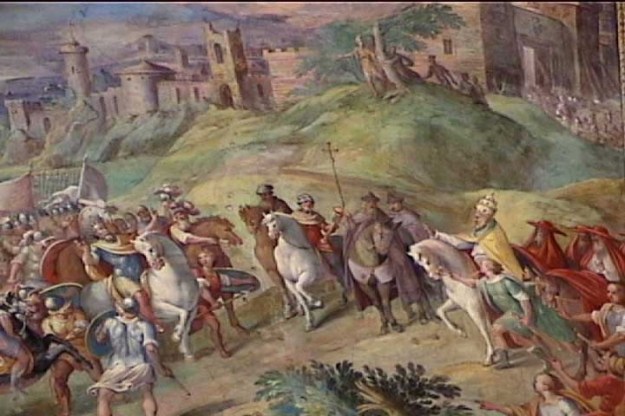
Pope Leo the Great: Part 2

LEOATTILAa

Pope Leo had to step in when Attila and his army were threatening to destroy Rome. The elite of Roman society had fled the city, the government was gone, the rest were busy securing their own homes in the city. I don’t think Leo, a churchman who was by nature a thinker deeply engaged in the study of spiritual things wanted to meet the dangerous invaders at the city gates, but he did. He rose to accept the responsibility.

When society is in danger because it refuses to face the issues that endanger it, the church can’t flee or look to its own security. It has to step in. That means not only church leaders but every believer has to meet the challenges at our gates today which government and society won’t acknowledge– Climate change and care for the earth, immigration and care of refugees, nuclear disarmament, universal healthcare, global peacekeeping, respect for the family and human rights.

“Remember your leaders who spoke the word of God for you. Consider how their lives ended and imitate their faith. “ (Hebrews 13, 7) (Common of Pastors} Remember Leo.

Tomorrow we have another leader, who fought for the poor when most were concerned for the rich: Martin of Tours. Remember Martin of Tours.

22nd Sunday C: Friend, Come Up Higher

Listen to audio:

Meals of every kind are described in the New Testament. Jesus begins his ministry at a wedding banquet in Cana in Galilee, John’s gospel says. Before his death, he has a meal with his disciples and after his resurrection he has some meals with them again. Martha and Mary and his friends in Bethany celebrate the return of Lazarus from the dead at a meal. His enemies say he ate too many meals with tax-collectors and sinners. Some of Jesus’ most profound teachings and actions take place at a meal.

Today in our reading from Luke’s gospel Jesus is invited to a Sabbath meal at the home of one of the leading Pharisees, but this meal is different from those just mentioned. They were carefully watching him, the gospel says. At a Sabbath meal God is thanked for his gifts, which he gives to all, but at this meal Jesus is being watched. He’s not an ordinary guest as he enters this home. He’s there to be measured and grilled by his hosts and put in his place.

At the time of Jesus it wasn’t unusual for a symposium to take place at a meal, especially in the home of someone like the leading Pharisee in today’s gospel. A symposium was an occasion when there would be a discussion of issues: questions would be raised, controversial matters would be debated. It was a time for people with quick wits and sharp tongues to show off how smart they were.

At this meal Jesus was going to be discussed; questions and controversies about him would be brought up and he would be disposed of. So we might imagine the guests at the Pharisee’s home on that occasion were like spectators at a prize fight, looking for the best seats to watch and maybe even take part in the contest themselves.

If this meal was a symposium, and I think it was, listen carefully to Jesus’ words to those who were there. He doesn’t just tell his hearers about common etiquette; he reminds them what this meal should be all about. This is a Sabbath meal. It’s a time for thanking God for the gift of life. It’s a time for rejoicing, not for showing off how smart you are. This is time when God calls us up higher. “Friend, come up higher.” From our small places here on earth, from the smallness we might consider our lives to be, God calls us up higher. It’s not a time pulling people down with your smart words.

For that same reason, this is a meal where everyone should have a place at the table, not just the wealthy and the privileged, the smart and the powerful, but “the poor, the crippled, the lame and the blind.”

Now, that’s what our Mass is about, isn’t it? Our Mass is our Sabbath meal where we give thanks for the gift of life. We give thanks to God. It’s right and just, our prayers say. We do this at all times, “always and everywhere,” but now we do it as disciples with Jesus our Lord. We listen to his word, we come to him in the bread and the wine, and through them he comes to us.

“Lift up your hearts.” “Friend, come up higher.” We lift up our hearts to the Lord. God calls us to come up higher, to see our gifts and the destiny we’re promised, to recognize our relationship with one another, to let go of the fears and doubts that cloud our minds, to feel the peace and hope God wishes us to have. The Mass prepares us for the life beyond this time. . “The Mass is ended. God in peace.” “Thanks be to God.”

Our Mass is a wonderful teacher, and we’re meant to take what it teaches and make it part of the rest of our lives. Let me give you a simple example, since we’re speaking about meals. Suppose we could make our meals, our eating together, Sabbath meals, where we enjoy the gifts of God we find in food and in one another.

That may sound like a strange suggestion. It sounds strange because eating together is becoming a endangered practice today. For one thing, a lot of people eat alone today, or if they come to a meal they might as well be eating alone.

Wouldn’t it be wonderful if all our meals became times when we experienced those words of the gospel: “Friend, come up higher,” when we build each other up instead of tearing each other down, when we all feel welcome by others, even the stranger and the outsider, when we enjoyed the gifts of God in food and human companionship.

21st Sunday C: “Will Only A Few Be Saved?”

To listen to today’s homily please select the audio file below:

“Lord, will only a few people be saved?” someone asks Jesus on his journey from Galilee to Jerusalem, described in Luke’s gospel, our Mass reading today. He doesn’t answer the question, but instead tells his listeners to respond immediately to God’s call when they hear it.

Why was the question asked anyway, you wonder? Was it because the response wasn’t great when Jesus made his way to Jerusalem? In our first reading Isaiah predicts people from all nations will flock to Jerusalem when the Messiah comes. Were those who followed Jesus few in number then?

Will the response to Jesus sometimes be the same?

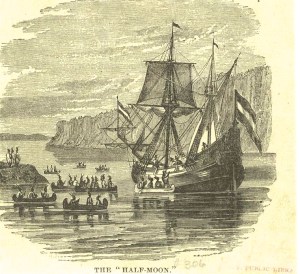
The journey of Jesus to Jerusalem never ends, we believe. It goes on through time as Christian missionaries go through other towns, places, even continents. It took place when European explorers, settlers and missionaries brought faith in Jesus Christ to peoples in North America who never knew him.

“Lord, will only a few people be saved?” Early Christian missionaries may have asked that as they reviewed their attempts to evangelize the native peoples of North America. Historians estimate about 50 million Indians lived in North America before the arrival of Europeans. A hundred years later, only 10 percent survived, mainly because of diseases brought by the newcomers. In a hundred or so years, as European settlers increased in number, most of the native tribes in eastern North America were forced westward or destroyed by war or small pox brought by the Europeans.

H.Hudson halfmoon

Coming to the new world, Catholic missionaries like the Jesuits and Franciscans hoped, not only to convert the native peoples to Christianity, but some thought they might create a fresh, vibrant Christian civilization, without the ancient antagonisms and rivalries of Europe. They looked for new Pentecost, but it did not seem to come.

Their harvest wasn’t great. The two civilizations were very different. The sense of superiority the Europeans brought, colonialism, and the diseases that decimated the native population made the native peoples question Christianity. It seemed to be a faith that brought death not life.

I hope to visit soon the National Museum of the American Indian, located in the old customs house across from Battery Park near the ferry in New York City, a good place to remember the native peoples in the story of America. They were the first the Europeans traded with; they were their guides into an unknown land. The native peoples provided new foods for growing populations in Africa, Europe and America. They had a greater respect for the land than those who came after them. Their story is now largely forgotten.

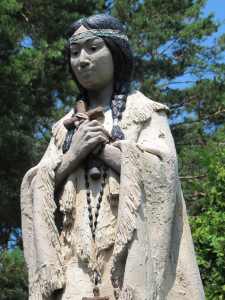
At the museum I’ll remember St. Kateri Tekakwitha, a native American who lived along the Mohawk River past Albany, New York. She offers an insight into the culture and social world of the native peoples. Smallpox brought by the Europeans disfigured and partially blinded her. Other diseases like tuberculosis, measles and malaria brought death to large numbers of native peoples, who were diminished further by wars and greed for Indian lands.

She came to believe in Jesus Christ.KATERI

At the museum I’ll also remember Father Isaac Jogues, the fearless Jesuit missionary, who was eventually killed by the Mohawks at Ossernonon (Auriesville), past Albany on the Mohawk River. A strong faith in Christ brought him to the New World where he experienced the clash of cultures as Christianity entered a native American world. Fleeing from Indian captivity, he came here to New Amsterdam (New York) in 1643 and was put on a ship for France by a kindly Dutch minister. A few years later, he returned still eager to bring the Christian faith to the native peoples, but was killed in 1646.

He wanted them to know Jesus Christ.

What do these old examples say about our mission today as disciples of Jesus to make him known? “Go, therefore, and make disciples of all nations, baptizing them in the name of the Father, and of the Son, and of the holy Spirit, teaching them to observe all that I have commanded you. And behold, I am with you always, until the end of the age,” Jesus says. (Matthew 28,16-20) What does that mean today?

Some today tell us to think more positively of cultures like that of the American native peoples. Some say Christians should simply be present in these cultures and silently profess their faith and work for the common good. Some even say we should not evangelize at all.

Certainly, the Spirit of God has been active in humanity from the beginning and we have missed God’s gifts in cultures and religions not our own. The church today recognizes the good in other religions “The Catholic Church rejects nothing that is true and holy in these religions” (Nostra Aetate, 2) . Still, it regards them as a “preparation for the gospel.” (Lumen gentium 16)

“The church is missionary by her very nature.” (Ad gentes 2) She is called to both dialogue respectfully, work for the common good and proclaim her belief.

We’re not only speaking of other cultures and religions, of course.  What about our own culture, which is becoming increasingly resistant to Christian belief? How do we dialogue respectfully and proclaim our belief to our own, our young people, those who are drifting away?

“Lord, will only a few be saved?”

Friday Thoughts: Walled Garden

Francis and Clare from the movie Brother Sun, Sister Moon Franco Zeffirelli

Saint Francis and Saint Clare from the movie “Brother Sun, Sister Moon”, (Franco Zeffirelli) (1972)


.
A garden enclosed, my sister, my bride,
a garden enclosed, a fountain sealed!

—Song of Songs 4:12

.


.
From memory it is not easy to recall. I do have a clear image, but if it is accurate that remains to be seen. Here we go.

It was downhill. A sloping path. As I approached the stone church, a few people wandered around out front. There was somewhat of a courtyard, well not a courtyard, more like a little wall hugging into existence a welcoming space. This wall was about bench height, made also of stone, and extended outward from the building. It created what I would normally call an out-front patio space, but in Italian terms, perhaps it would be called a terrazza, or maybe even be considered a piazza, or perhaps most accurately, a piazzetta. Then again, maybe it is just a patio to Italians too.

Well, sitting on this low wall was a friar. And running around the open area was a small brown dog with a shaggy little beige beard.

I entered the church. It was small, almost cave like. A curved ceiling. Dark. Old. There was the cross, a crucifix. Not the actual one that spoke to Saint Francis—no, that one was moved up into the Basilica of Saint Clare located in the central part of the still small but no-longer medieval town of Assisi.

The reproduction spoke to me.

I’m an early companion of Francis.
.


.
I remained in the chapel for a while. I’m not sure if I was praying or not. I’m pretty sure I got on my knees. But from that day’s perspective, prayer was not known to me. So from that perspective, I wasn’t praying. But from today’s perspective, I most certainly was. For I was there. I was in Italy, in Assisi, in the Church of San Damiano. I was there intentionally. I was lost but I was found. I was looking, and I was obeying. Obeying what I didn’t know. I had no idea why, but I wanted to be there. And I felt something. It was heavy, literally. I remember feeling bent over. I remember thinking about all the prayer that must have taken place in that small space over the past thousand years. I remember thinking that all that collective belief must have an effect. It did. It does. It will. I was certain that I felt it. It bowed me down. It bent me over. And I remember liking it.

Faith is common.

I was a pilgrim and didn’t know it.
.


.

I don’t remember much about the convent itself. I do remember walking from room to room, the communal rooms where Saint Clare and her companions, her biological mother and two sisters among them, ate and prayed and cared for their sick. I remember the small warm inner garden, with it’s old well. And the spot marked as the place where Clare liked best to sit. I’ve always loved internal courtyards. The thought of being outdoors and yet enclosed. Architecturally, it best represents the beauty of true solitude. Open. Yet safe. Free. Yet sheltered. Alone. Yet surrounded by those who believe the same.

In that sense, solitude—when it’s truly interior, truly spiritual—is like love: you can never get enough of it, and once you have it, once you truly live within it, you’re never again alone.

Solitude is love. And love is never solitary.
.


.

Therefore the Lord himself shall give you a sign. Behold a virgin shall conceive, and bear a son, and his name shall be called Emmanuel.

—Isaiah 7:14

.

.

—Howard Hain

Morning Thoughts: The Clown of God

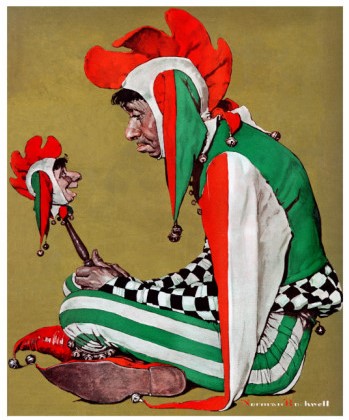
norman-rockwell-jester-february-11-1939

Norman Rockwell, “The Jester”, 1939

.

“Alas, poor Yorick! I knew him, Horatio, a fellow of infinite jest, of most excellent fancy.”

—William Shakespeare, Hamlet: Act 5, scene 1

.


.

Early this morning, Francesca and I had a good laugh.

The sun was up, we were not. We were out late a few days ago. On Saturday night we visited a friend’s home and didn’t get to bed until after 11. That’s pretty late for all of three of us, but for Francesca, from her six-year-old perspective, it was “almost the next day!”

So this morning, the Monday of a new week, we found the consequences of that shortened Saturday-night sleep still catching up with us.

Francesca had made her way from her bedroom to the couch I guess around five. I sat up just about half past, the sun fully making its presence known, and as I looked toward the couch I saw Francesca propped against some pillows, cuddled up in the corner, eyes open, but still quite in sleep mode. I walked toward the kitchen to hit the coffee button, and as I passed in front of the couch I broke into an overly-exaggerated stroll. As I disappeared into the kitchen I caught a peek of Francesca’s smile.

When I reentered her line of vision, just a handful of seconds after hitting the “on” button, she was sitting up straight, smiling broadly, and said quite adamantly: “Do it again.”

“Do what again?”, I smiled.

“Walk like that again!”, she immediately answered back, moving her little arms in a fashion somewhat like I hade moved mine.

“What are you talking about?”, I tried to say with a straight face as I walked the same way back across the room.

“Like that!”, she exclaimed, laughing and pointing at my arms.

And we were off and running, or should I say, “walking”. Over and over again, I would say: “What’s wrong with how I’m walking?”, and then she would point out what was “out-of-order” regarding my gait. Each time I would—with as much seriousness as I could muster— “correct” what she pointed out and then try again, this time adding yet another new “discrepancy”. One time I swung my arms wildly, another time I goose stepped, then I raised my knees too high, one round I walked “perfectly” but made funny noises with my mouth as I moved, and this went on and on, or I should say, we went on and on, and each and every time she was laughing more and more, getting more and more exasperated and adamant about what it was that I was not doing right.

“Just walk normal!”, she would laugh, and I would answer, “I am”, again and again. And then it got really funny. I could barely keep a straight face for even a few seconds. She herself began to illustrate how to properly walk, and seeing her trying to walk “normal”, which only resulted in her walking quite “un-normally”, only added to the Buster-Keaton type ridiculousness taking place in our tiny little living room. And all the while Laurie was just a few feet away still in bed, I wont say still asleep, because I have a hard time believing she could continue to snooze through all that ruckus.

But what really brought the house down was when I began to “really try” to walk right, listening intently to all her instructions, and painfully listing each one, and at the same time actually beginning to get confused. I had to think to myself for a second, “How is it that a person actually does just get up and walk?”. It is amazing what happens, what a mess we can make of things, when we try to understand and take control of what comes so naturally to us, of what comes so easily to almost all of mankind by the very nature of who we are, and seemingly without any effort or consciousness. But this little philosophical reflection didn’t stand a chance, Francesca was still on the scene and a child just wont permit, not even for a second, the antics of self-indulgent adult reflection to get in the way of a good time. She was focused on the action at hand, on the flow, from one act to the next, and she now had herself hysterical about the next and final slapstick scene in our not-so-silent film.

For you see, she discovered something in me that’s just priceless in her estimation. She loved the fact that I developed this little movement, quite unintentionally, as I “prepared” to try again to walk properly. I would kind of slightly waddle in place, lining up and squaring my feet, while at the same time slightly rotating my hips and shoulders, trying to position my feet, hips and shoulders just right. I guess I began to resemble a gymnast right before he launches the big run leading toward a long series of tumbles, or better yet, perhaps a diver in the Olympics right before leaping off the high board. Well, either way, this was more than Francesca could handle. She let out a true belly laugh, and then pointing wildly at my shoulders: “Daddy, do it again!”

At this, she jumped off the stool that she was now teetering upon, trying with all her might to mimic me. We both we’re beside ourselves with laughter. It was an absolute blast. It was creative chaos at its best. All heaven broke loose.

I hadn’t even had a sip of coffee yet. My morning prayers were still in a holding pattern. And then the thought came to me. A thought came to this continually under-occupied, perpetually unemployed forty-four-year-old man who just can’t seem to find his way in this world: “I should be a clown.”

I asked Francesca what she thought about my new career path. She loved the idea!

“Yes!!! Do it Daddy, do it!”

I decided to keep my prayers this morning to a few simple Our Fathers.

God was clearly praying for me since the moment I awoke.

The Spirit groans on our behalf, perhaps He laughs for us as well.

Prayer is prayer. This morning, Francesca’s laugh, and mine as well, was the peal of the morning bell—calling all the world to still attention—before the settling in of the business of another new day:

.

The Angel of the Lord declared unto Mary.

And she conceived by the Holy Spirit.

Hail Mary, full of grace…

.

.

—Howard Hain


Friday Thoughts: Running with the Lord

cezanne bather-with-outstreched-arms 1878

Paul Cezanne, “Bather With Outstretched Arms”, 1878

.

“…into your hands I commend my spirit”

and when he had said this he breathed his last.

—Luke 23:46

.


.

Years ago when I was living in San Francisco, a group of us used to go hiking out in Marin County, just across the giant red expanse of the Golden Gate Bridge. We went often. A group of both men and women, mostly single, mostly without a care in the world. I think every one of us was under thirty, or thereabouts.

My favorite part was running down. Don’t get me wrong, the hike upward was terrific too, that’s when we discussed ideas and dreams and laughed almost all the while, breaking up into smaller groups of two or three or maybe even four, and then drifting back together—like a herd of elk, for they too have not a care in the world—only to once again drift apart, this time usually paired up with a different companion or combination thereof. None of it was planned or had any real intention of course, it just happened: laughter, ideas, silence, stops, gazes outward, waiting, speeding up, sipping water, laughter, drifting apart….it was divine.

 Like the elk, it all seemed to be instinct.

But something special happened when we reached the top. After we reached the top. After we caught our breath, removed our backpacks, and viewed the scape. After we had eaten a little snack or a small sandwich, something light, usually along with an apple or granola bar, maybe even a small handful of assorted nuts and a few of those purple chips that all San Franciscans seem to love. It was time to descend.

My friends used to laugh and say that it was because I’m an Indian. They would go on and on about my “Cherokee” blood, and the fact that the first three letters of my first name spelled “how” only served as additional fodder. But there was some truth in it. Not only because I actually do have some American Indian blood, but more so because at that time I was very much a native. Primitive. Raw. Free.

That’s why I would run down.

I loved it. I would run as fast as I could go. Cutting back and forth, hopping over logs, propelling myself around turns by pivoting hard on the corner tree. I loved it. I loved the way I felt. I loved that my weight added to the speed, that what normally would slow me down, would normally make me huff and puff, now drove me forward, propelled me toward from whence I came.

It was wonderful. I was free. I was free. I was free. It was the closest this man ever came to flying.

This morning, almost twenty years later, in urban New Jersey—just across the Hudson River from Manhattan—I went for a jog. They just opened a new circular path around the old reservoir resting slightly higher than its surrounding cities of Weehawken and Union City. It is very pleasant.

I wasn’t sure how far I’d be able to make it. And after a very short distance I thought to myself, “Oh boy, I’m gonna have to stop already.” But I didn’t. I thought about posture. I thought about positioning of hands. I thought about breath. I quickly realized that the Lord has taught me much.

The posture of prayer is important. How we position ourselves is powerful. And breathing is everything.

I made it around three times. I smiled almost all the way. My pace was pretty good. I did alright, not bad for a man I thought just a few minutes before was getting old. I think even the newly-minted goslings admired my gait. And even if they didn’t, it was nice to be in a place to think that maybe they did.

I walked a lap and then began to make my way back toward my home, my one bedroom apartment that I share with my most recent and till-death-do-us-part hiking companions: my beautiful, delicately strong bride of twelve years, and my precious little girl, who at six-and-a-half runs and laughs like the wind.

I was a few streets away, coming down 18th and crossing Summit, when it happened. I never really noticed it before. The next two blocks were a steady, fairly steep decline. I began to run.

I loved it. I ran as fast as I could go. Cutting back and forth, hopping over the cracks in the sidewalks, propelling myself around the turn by pivoting hard on the corner stop sign. I loved it. I loved the way I felt. I loved that my weight added to the speed, that what normally would slow me down, would normally make me huff and puff, now drove me forward, propelled me toward from whence I came.

It was wonderful. I was free. I was free. I was free. It was the closest this man ever came to flying.

For a moment I thought I was on the outskirts of San Francisco.


.

And with that he breathed on them and said, “Receive the Holy Spirit…”

—John 20:22

.

.

—Howard Hain

5th Sunday of Easter: Bless them All

Audio homily here:

When we read the Acts of the Apostles in the easter season, we see another form of church. The church of Paul and Barnabas is certainly different in structure from the church we know today.

There were no parishes or dioceses then. In Rome, if you asked where the Vatican was, they’d point you to a race course on a hill on the fringe of the city where the emperor had his private games. There were no monasteries or religious communities or other Christian institutions.

When Paul and Barnabas went to different places, they went to the Jewish synagogues where they spoke about Jesus as the Messiah. The reaction to their message was mixed, at best. At times they were violently rejected, but some Jews and some “God-fearing gentiles” – non-Jews who appreciated Judaism and its spirituality– accepted their message about Jesus and his promise of salvation.

The synagogue was the normal “catechumenate” where early Christian missionaries like Paul and Barnabas found converts to the faith. No synagogues, as far as we know, became Christian churches.

Where, then, did new believers go? They gathered in the houses of other believers, in “house churches”, usually bigger houses belonging to merchants. The owners and their families lived in these houses, but they also conducted their business in part of the house. Their servants and slaves would live and work there too.

In his Letter to the Romans Paul sends his greeting to Prisca and Aquila and the “church in their house.” They were husband and wife, a couple of merchants who ran a leather business in Corinth. Paul lived with them for almost two years; he worked and taught in their house. After that, he lived in their house in Ephesus and founded the church in that city. He calls them “ my co-workers in Christ Jesus, who risked their necks for my life. I am grateful to them but also all the churches of the gentiles.”

In Rome there were no churches as we know them till the 4th century, but historians count 25 house churches where  Christians met in the early centuries in that city.

Our church structure developed since then, we can see  a development in our first reading today. Paul is appointing leaders in every church. But there’s something important this early time can teach us. At the end of his Letter to the Romans, after expounding on some of his most profound teachings, Paul remembers a number of people in Rome he wants to greet. Prisca and Aquila and all the church in their house are the first; they must have moved back to Rome.  Then there are  a number of other names that seem to come spontaneously to his mind. They’re the names of ordinary Christians, not just the owners of the houses where Christians meet and their families, but the servants, the slaves, the ordinary people whom Paul lived with and worked with and prayed with side by side.

Unfortunately, this section of his letter is never read in church. It should be; it breathes with affection and appreciation and love for all the people who are the body of Christ. Listen to it.

Greet Prisca and Aquila, my co-workers in Christ Jesus,
who risked their necks for my life, to whom not only I am grateful but also all the churches of the Gentiles; greet also the church at their house. Greet my beloved Epaenetus, who was the firstfruits in Asia for Christ.
Greet Mary, who has worked hard for you.
Greet Andronicus and Junia, my kinsmen and my fellow prisoners; they are prominent among the apostles and they were in Christ before me.
Greet Ampliatus, my beloved in the Lord.
Greet Urbanus, our co-worker in Christ, and my beloved Stachys.
Greet Apelles, who is approved in Christ. Greet those who belong to the family of Aristobulus.
Greet my kinsman Herodion. Greet those in the Lord who belong to the family of Narcissus.
Greet those workers in the Lord, Tryphaena and Tryphosa. Greet the beloved Persis, who has worked hard in the Lord.
Greet Rufus, chosen in the Lord, and his mother and mine.
Greet Asyncritus, Phlegon, Hermes, Patrobas, Hermas, and the brothers who are with them.
Greet Philologus, Julia, Nereus and his sister, and Olympas, and all the holy ones who are with them.
Greet one another with a holy kiss. All the churches of Christ greet you. ( Romans 3,3-16)

Paul doesn’t want to leave anybody out. You can hear his love for them all. That’s the love Jesus had for his disciples. “Love one another, as I have loved you.” That’s the love that should be in our church, no matter what its structure is.