Category Archives: ecumenism

A Little Boy, Five Barley Loaves and Two Fish

Andrew, brother of Peter, says to Jesus when he asked his disciples to provide food for a hungry crowd: “There is a boy here who has five barley loaves and two fish; but what good are these for so many?” (John 6:1-15)

Duk Soon Fwang, an artist friend of mine, has been thinking a good while about that little boy and what he brought to Jesus. “We don’t know the little boy’s name and he only has a few loaves and fish to give. He’s like me,” she said. “But Jesus sees what he brings and makes it more.” 

She’s almost completed a painting of the boy and Jesus, which you can see above. 

At Mass this morning, we read that gospel story before we brought small pieces of bread and a cup of wine to the altar. I remembered what she said. This is our story. We bring what we have and God makes it more.

More on Duk Soon and her work here and here.

The Churches the Apostles Left Behind

Fr. Don Senior, in his  biography of Fr. Raymond Brown the American scripture scholar, says that one of Brown’s best books was “The Churches the Apostles Left Behind.” Scholars like Brown and Senior say the apostles left churches behind, not one monolithic church that was everywhere the same. The Gospel of Mark, for example, is different from the Gospel of John and it comes from a church different from the church represented in John. There was not one orderly church, but squabbling, disorderly churches, yet churches just the same.

The New Testament churches were developing churches, the scholars say. They describe them as being on a trajectory. They’re not set in stone or isolation or perfect; they’re interacting with each other and their time. And by the power of the Spirit they’re developing slowly into the church that Jesus wants to bring about.

These insights have great consequences for ecumenism, for one thing. The churches the apostles left behind help us understand Christian churches today and the challenge to keep on a trajectory towards Christian unity.

That’s true also of the particular church we may belong to. I’m thinking of something one of the people who comes to our 11 o’clock Mass here at the monastery told me recently. She enjoys the different priests who celebrate that Mass here, she said. “You’re all so different. In fact, I don’t know why you don’t kill each other.”

Certainly one of the reasons why we don’t kill each other is the presence and patience of Jesus himself. For all his complaint about his own generation, Jesus never gave up on it, but gave himself to it day by day, as he does for us. Our prayer and liturgy together keeps us on the path that leads to what God wants us to be.

Visiting Gregory the Great; September 3

Church of St. Gregory the Great, lower left, off Via di San Gregorio (google maps)

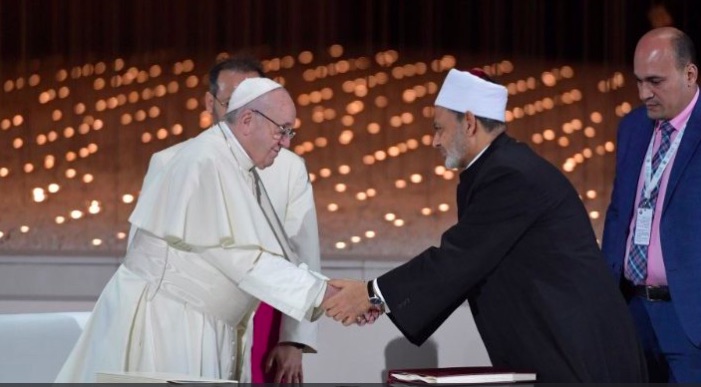
Document on Human Fraternity for World Peace and Living Together


Screen Shot 2019-02-06 at 8.49.53 AM

Pope Francis and the Grand Imama of Al-Azhar, Ahmad el-Tayeb,

“Something is happening.” That’s the way the great reading for our Holy Saturday liturgy, taken from an ancient homily, begins. We don’t see clearly yet, but something is happening.

And that’s the way I felt yesterday watching on YouTube a Mass at Abu Dhabi in the United Arab Emirates where more than one hundred thousand Christian migrant workers in the Middle East celebrated their faith with Pope Francis. Christianity is alive in the Middle East.

In the “Document on Human Fraternity for World Peace and Living Together” signed on Monday afternoon in Abu Dhabi by Pope Francis and the Grand Imama of Al-Azhar, Ahmad el-Tayeb, a path for the two religions and the world itself opened. Something is happening.

The document from leaders of these two great religious traditions, Christian and Muslim, is worth reflecting on.

It begins:
“In the name of God who has created all human beings equal in rights, duties and dignity, and who has called them to live together as brothers and sisters, to fill the earth and make known the values of goodness, love and peace,”

The document speaks for innocent human life, the poor, the destitute and the marginalized, the victims of destruction, calamities and war. It invokes the name of freedom, fraternity, peace and justice, the name of all people everywhere:

“In the name of God and of everything stated thus far; Al-Azhar al-Sharif and the Muslims of the East and West, together with the Catholic Church and the Catholics of the East and West, declare the adoption of a culture of dialogue as the path; mutual cooperation as the code of conduct; reciprocal understanding as the method and standard.”

“We, who believe in God and in the final meeting with Him and His judgment, on the basis of our religious and moral responsibility, and through this Document, call upon ourselves, upon the leaders of the world as well as the architects of international policy and world economy, to work strenuously to spread the culture of tolerance and of living together in peace; to intervene at the earliest opportunity to stop the shedding of innocent blood and bring an end to wars, conflicts, environmental decay and the moral and cultural decline that the world is presently experiencing.”

One commentator Tuesday said a meeting like this takes time for its meaning to be felt. “Something is happening.”

Hurricane Florence is Coming

We not preparing for the disasters brought by climate change, an article in USAToday by Rick Hampson says. “Will repeated exposures to vivid scenes of natural disaster–Western wildfires, a global heat wave, Hawaiian volcano eruptions, the 2017’s hurricane’s anniversary and a suddenly active 2018 season” prepare us to do something? “Experience counsels skepticism. So does human nature.”

“Experts say people aren’t really motivated by disaster until it come to, or through, their door.” Hampson writes.

We forget that “America, the Beautiful” is vulnerable to climate change as other parts of the world are, and our political system doesn’t help us face the change either. The earth doesn’t get to vote.

“Democracies are creatures of the present, because the public focuses on the here and now, not some future hypothetical problem… Our political system makes us vulnerable to distant crises, because we don’t try to anticipate or diffuse them.” (Robert J. Samuelson)

In a previous blog Pope Francis asks us to hear in the changing climate cries of “Our  Sister, the earth” groaning from the abandonment and mistreatment received at our hands. Is Hurricane Florence a cry of creation?

“Save us, Lord, from becoming simply ‘creatures of the present.’ looking after ourselves. Let us hear our earth and sky and sea when they cry out from our abuse and lack of care. We ourselves are dust from the earth, we breathe her air and are refreshed by her waters. May we hear the cries of our Sister, the earth,  and care for her.”


Why I Am A Catholic

by Orlando Hernandez

The Gospel readings for this week are full of harsh, ominous sayings by our Lord Jesus. They are filled with characters worthy of rejection by God: the scribes and Pharisees, the careless servants, the foolish virgins, all headed for damnation, punishments, gnashing teeth, Gehenna! I actually could relate to all these unfortunate souls. In many ways I feel as guilty as them. It was very hard for me to choose a Gospel reading to write about.

Careful re-reading and prayer came to the rescue once again. Incredibly, the threatening reading for Monday (Mt 23:13-22) began to show me a way out of Gehenna. Jesus starts proclaiming the “woes” against the scribes and Pharisees. They “lock the Kingdom of heaven before men” (Don’t I in my mind, do this for so many that I judge as hopeless, cruel people?). Jesus goes on to say:

“ Woe to you, blind guides, who say, ‘If one swears by the temple, it means nothing, but if one swears by the gold of the temple, one is obligated.’ Blind fools, which is greater, the gold, or the temple that made the gold sacred? And you say, ‘If one swears by the altar, it means nothing, but if one swears by the gift on the altar, one is obligated.’ You blind ones, which is greater, the gift, or the altar that makes the gift sacred?”

I do not wish to comment on the historical background for this writing, the bitter conflicts between Pharisaic Judaism and the Church of Matthew at the time, which might have influenced Matthew’s writing. What I need to do is to express what Jesus tells me when I read His attacks on the Pharisees and scribes.

We are not supposed to “swear”, but an oath can be a kind of pledge, a commitment that leads to a way of life. Why are so many people committed to follow the Catholic Church? Is it the “gold,” the grandeur , the power of the institution that calls to us, and gives us some sense of security? When we walk into a church building are we simply mesmerized by the splendor all around, the vastness of the place, the large crowd, the ritual, the gold, the place of leadership, respect, and wisdom that we give to our priests and bishops? Is it because we need to belong to something greater than ourselves? What is this “something” that is so great?

This week, Pope Francis is ministering to an Irish Church that has been greatly diminished. Almost 50% of Irish Catholics have left. New civil laws scoff at the precepts of the Church. Fr. Martin Coffey CP once talked to us Passionist Associates about the incredible wealth and dominance that the Church had over Irish culture and government. Yet the power led to hubris, abuse, and corruption. Many Ministers of God went the way of the pharisees in the Gospel. They forgot to act with “judgement and mercy and fidelity”. The Church was like those cups and graves that were shiny on the outside and dirty on the inside. With the news of recent weeks, we wonder if this process of diminishment has also been accelerated in our own Church in the USA.

For my part, and for millions like me, it was never the “gold of the temple” nor the gifts on the altar that captured me. It was the Living God within that temple, in that altar, that made everything “sacred.” Within the tabernacle we have those humble little pieces of Bread that hold greater power than the Vatican and all the Cathedrals put together can ever have! Yes, these “temples” are holy and we “swear” by them, but they are empty buildings without the Life that dwells in them. In the same manner, out lives as Catholics are just as empty if we don’t just relax, take a deep breath, and let Jesus fill our hearts with the power of His Love. Jesus has always been the one that calls me to “Church.” I go to mass to be with Him. Only then, can I look around and feel the greatest reverence for His people within that building. In this Monday’s Gospel Jesus goes on to tell us: “One who swears by the altar swears by it and all that is upon it ; one who swears by the temple swears by it and by Him Who dwells in it ; one who swears by heaven swears by the throne of God and by Him Who is seated on it.”

I have this great faith that we will overcome all these problems in our Church. Too much bleeding and suffering has gone into it. What gives me the right to feel this way? The loving intimacy with which Jesus Christ, my Lord, has claimed me gives me the right. He is ready to give this to everyone. How dare we approach Him when we have so much in common with those Pharisees, unreliable servants, and careless virgins? Because He died for all of us. The answer to the whole puzzle somehow lies in His Passion, Death, and Resurrection.

“Therefore, brothers [and sisters], since through the blood of Jesus we have boldness to enter into the sanctuary by the new and living way He opened for us through the veil, that is His flesh, and since we have a great priest over the house of God, let us approach with a sincere heart and in absolute trust, with our herts sprinkled clean from an evil conscience and our bodies washed in pure water.” (Heb 19-22)

A few years ago someone said to me, “I don’t go to mass because I just don’t trust those priests.” I love and trust quite a lot of priests, but what I told the man was, “The priest I go to meet at mass is called Jesus Christ.” Jesus is the ultimate Power that can lead us to say : “I am a Catholic.”

“For we do not have a high priest who is unable to sympathize with our weaknesses, but one who has similarly been tested in every way, yet without sin. So let us confidently approach the throne of grace to receive mercy and to find grace for timely help.” (Heb 4:15-16)

Orlando Hernandez

18th Sunday of the Year: Bread, Manna for the Journey

For this week’s homily, please play the video file below:

15th Sunday b: Get your Walking Stick!

For this week’s homily, please play the video below.

13th Sunday b: Touching the Garments of Jesus

For this week’s homily, please watch the video below.

Love Is Not Easy

By Orlando Hernandez

This Thursday’s Gospel continues with the extremely challenging statements that our Lord pronounces in the Sermon on the Mount:

“I tell you, unless your righteousness surpasses that of the scribes and Pharisees, you will not enter into the Kingdom of Heaven. You have heard that it was said to your ancestors, ‘You shall not kill; and whoever kills will be liable to judgement.’ But I say to you, whoever is angry with his brother will be liable to judgement, and whoever says to his brother, ‘Raqa,’ will be answerable to the Sanhedrin, and whoever says, ‘You fool,’ will be liable to fiery Gehenna. Therefore, if you bring your gift to the altar, and there recall that your brother has anything against you, leave your gift there at the altar, go first and be reconciled with your brother, and then come and offer your gift.” (Mt 5: 20-24)

Our faith and religion is the great gift of God, but we can spoil this gift if we use it as an excuse to feel that we are “better” than our neighbor. Even prayer and piety can unfortunately be used as a cover for inhumane behavior. Our Lord points out the dangerous practices of self-righteousness that can lead to the escalation of conflict which condemns us not only to the loss of love of neighbor, but even to the total disregard for the sanctity of human life, whether through unfettered anger, cold calculation, or simple indifference. We find ourselves imprisoned by hate and guilt: “Your opponent will hand you over to the judge, and the judge will hand you over to the guard, and you will be thrown into prison.” (Mt 5: 25)

Abraham Lincoln’s famous quote explores this sad situation when he talks about the two sides in the Civil War: “Both read the same Bible and pray to the same God,and each invokes His aid against the other.” I imagine those prayers and see them as ferocious darts, adding to the countless wounds of our Jesus on the Cross. What is right and what is wrong? Why is there so much divisiveness in our country, in our world? Is our real “opponent” happily leading us in chains to the Judge? Are we already in a hopeless Gehenna, where truth and mercy are incinerated along with God’s goal of human unity within His loving embrace?

My conservative son complains that those on “the left” are merely hypocrites, calling themselves compassionate while they approve of the killing of unborn life. This kind-hearted couple, my friends, who were influential in my conversion, now call themselves “Buddhists.” After decades of being zealous Pentecostals, they now feel betrayed by their fellow fundamentalists, who support so many things that they consider divisive and cruel.

Lincoln goes on to say in his speech, “With malice towards none, with charity for all, with firmness in the right as God gives us to see the right, let us strive on to finish the work we are in, to bind up the nation’s wounds…” How do we begin to do this? How can I gauge what is “the right as God gives us to see?” How can I hold fast to love, to tolerance, to acceptance of so many people who seem so difficult to me? Only in prayer, in faithful surrender to the love of God can I find the way out of Gehenna, to defeat the real “opponent”, the accuser, the divider. Only God can give me the strength.

But oh, sometimes I feel totally bound up by these negative aggressive thoughts. My loving wife sees me there with that disturbed look she knows so well, and tells me, “Snap out of it! Look around!” Out of concern for me she got me this challenging checklist by Richard Rohr OFM, that she got at her last retreat. It sounds a lot like the Sermon on the Mount. And it is titled “What Might A Joyful Spirit Be?” Joyfulness seems to be the only way out of the prison, and this joy is the Grace that only communion with Jesus can give. Here are some examples, which can be fruitful conduits to prayer:
“ When you do not need to be right.
When you no longer need to compete–not even in your own head.
When you do not need to analyze or judge things as in or out, positive or negative, black or white.
When you can follow the intelligent lead of your heart.
When you are curious and interested, not suspicious and interrogating.
When you do not brood over injuries.
When you do not need to humiliate, critique, or defeat those who have hurt you- not even in your mind.
When you can let go of obsessive or negative thoughts.
When you do not divide and always condemn one side or group.
When you can find truth on both sides.
When you can critique and also detach from the critique.
When you can wait, listen, and learn.
When you can admit it was wrong and change.
When you can actually love without counting the cost.
When you can live satisfied without resolution or closure.
When you can find God in all things.”
Amen.

Orlando Hernández