Love, my child. Just love. Leave everything else to me. I know that you ask these questions out of love, and I don’t blame you for asking, but be in love, my child, be in love with me. Stay in love with me. Be living breathing love with me. Your brothers and sisters, our brothers and sisters, are starving. I am starving. You are starving. We all hunger. And I am with you. Do you doubt that I feel everything that you feel? Would I do that to you? Would I leave you alone? I told you, that I will never do. My promises are truth. My words are not from yesterday, they are not for tomorrow. No, my words and my promises are for today, for right now. They are not part of history, they create history. Now go, get up once again, be brave. The power of my love brings life into existence. You carry my death with you. My resurrection can not be stopped. It’s happening right now as you step into this hour. Those that love you are running toward an empty tomb. You are in the garden. Reassure them, reassure them all, reassure everyone you shall meet this very day, that all I say is true.
This weekend we had a program at our monastery in Jamaica, New York, entitled Pope Francis’ Encyclical Laudato Si and the Wisdom of Thomas Berry, Passionist. The main presenters were Mary Evelyn Tucker and John Grim, senior lecturers and research scholars at Yale University.
The program began Friday evening with the award-winning film “Journey of the Universe” produced by Tucker and Grim along with Brian Swimme, which brilliantly portrays the story of our universe as science today explains it. On Saturday Mary Evelyn and John lectured on the pope’s encyclical, the influence of Thomas Berry and the contribution of native peoples to the critical question of the environment. I was among the commentators responding to their presentations:
I was one of Fr. Thomas Berry’s first students. It was at Holy Cross Preparatory Seminary in Dunkirk, NY in 1950. It’s usually not noted in biographical material about him, but Tom taught history to seminarians that year and I was in his class.
I remember the first day he came into class with a stack of booklets in his hands. “We have to know what’s going on today in the world,” he said, “and so we’re going to study The Communist Manifesto.”
Now remember, this was 1950. Senator Joe McCarthy had begun a witch-hunt to root out Communist sympathizers and I think The Communist Manifesto was on the church’s list of forbidden books. We studied it.
Yet, Tom never mentioned Joe Mc Carthy or the threats of a Communist takeover in Europe or what was happening then in China. No, he was interested in where the Communist Manifesto came from. Beyond Karl Marx and Lenin, he traced it back to the Jewish prophets and their demands for justice for the poor and human rights. The long view of history was what interested him.
After the Communist Manifesto, we studied St. Augustine’s City of God. Two loves are building two cities, Augustine said. Again, Tom didn’t dwell much on the historical events used by Augustine to illustrate his theory of history. It was the overall dynamic of the two loves in conflict over time that interested him.
From Augustine, we studied Christopher Dawson and his book The Making of Europe. Dawson, one of the 20th century’s “meta-historians,” wasn’t interested only in Europe; he was interested in the whole panorama of civilizations that came before it. That was Tom’s interest too.
As far as I remember, Tom didn’t speak of the universe and its evolution, his focus in later years, yet you could see him heading that way. He had a mind for the long view of things.
Pope Francis in Laudato Si also has a mind for the long view of things, it seems. The pope doesn’t quote from The Communist Manifesto, but he insists, more strongly than the manifesto, on the rights of the poor, to which he joins a strong insistence on the rights of the earth.
Can we also hear echoes of Augustine’s City of God in Laudato Si? I think so. The pope speaks of two loves in conflict. There’s the love that builds the city of man. How describe it today? How about blind consumerism; we love things too much. We love our vision of material progress too much. We love our technology too much. We love our control over the earth too much. We love ourselves too much. The result is “global indifference” to an environment falling apart. (Laudato Si, 9,14)
Opposing that love is a love the pope sees in Francis of Assisi, “who was particularly concerned for God’s creation, for the poor and the outcast…he would call all creatures, no matter how small, by the name of ‘brother’ or ‘sister’… If we approach nature and the environment without this openness to awe and wonder, if we no longer speak the language of fraternity and beauty in our relationship with the world, our attitude will be that of masters, consumers, ruthless exploiters, unable to set limits on their immediate needs.” (LS, 13)
Berry, like the pope in Laudato Si, accepted science’s view of our environment, yet also like the pope he distanced himself from a major trait of the era of the Enlightenment which unfortunately causes us in the western world “to see ourselves as lords and masters of our environment, entitled to plunder her at will.” (LS, 2)
Science teaches us a lot about our environment and its perilous condition today, but knowledge is one thing and love is another. Two loves are at work. Love doesn’t always follow what we know, especially if our hearts are fixed on something else. Love is hard to change.
I heard the preachers and teachers and ordinary folk in the workshops that followed our workshop presentations bemoan the poor reception the pope’s encyclical has received so far. Why isn’t the environment a critical issue in our parishes, in the media and in the political world? Why aren’t we undergoing what the pope calls “an ecological conversion?”
There are many reasons, I suppose, but one thing seems sure. It’s not going to happen overnight through some quick fix. We need to get ready for the long haul. And what does that mean? We need wise teachers and leaders to guide us, like Thomas Berry and Pope Francis.
“The present time is not a time for desperation, but for hopeful activity.” Thomas Berry, CP
Vincent van Gogh, “The Stone Bench in the Garden of Saint-Paul Hospital” (1889)
.
There is so much “excitement” in the world.
Politics. Sports. Entertainment.
Even in the simple act of kids going back to school there is so much hoopla.
We can’t just do things simply. Everything has to be planned, announced, delved into, broadcast into something “grand”, “life-changing”, “utterly profound.”
But the more we need to insist that something is the case, the less in reality it usually is. For excitement, like authority, is something that by its very nature announces itself—and it decreases in direct proportion to the need to have it proclaimed.
In other words, just because we make “a big deal” about everything doesn’t mean it is. In fact, it is normally quite the opposite.
———
I remember when a child’s birthday party was composed of eight or ten kids sitting around a kitchen table, wearing silly pointy hats, and eating a Duncan Hines cake made the day before by a stay-home mom.
Even catechism lessons seemed a whole lot more straight forward, and effective. For me they took place around that same kitchen table, with those same neighborhood friends, and were taught by that same mom who baked the birthday cake. Now, catechists are expected to act like game-show hosts. And preachers? We’ll they’re expected to be downright celebrities.
Well, there is an answer to all this triviality: The Bench. Whether it’s in the park, in front of your house, or even under one of those little bus-stop canopies on the side of the road.
Sit. Listen. Do nothing. Especially when you are tempted by “boredom”. For that’s exactly what boredom is, a temptation. A temptation to deny the existence of God. For if we are conscious of God’s presence we can never be bored. Every nook and cranny of every “meaningless” daily act and encounter has profound, truly profound significance, if we are conscious of God’s omnipresence and His perfect will.
Sit there peacefully, resting quietly on the cutting edge of boredom. You never know how much good God might do through you: what poor widow you may accompany, what orphan you might help find a home, what angel you may entertain, what authentic prayer you might offer up—now that God and not self-image is in control.
———
Truth flips things on their head. I think it is Saint Bernard who says something along these lines: If we really think about how radical a call the Christian life is, as compared to the way the rest of the world lives, we realize it’s almost the equivalent of us walking down the street on our hands.
If it isn’t Saint Bernard that I’m paraphrasing, well then it is one of God’s other saints, and that is all that matters. For in God’s Kingdom the only credit that is given comes from and returns to God, and God alone. All wisdom is His.
And there it is, there is the crux of it: We have become obsessed with being “original”, with being “special”, with being “one-of-a-kind”—which of course we all are, tremendously so in fact—that is until we stop and think about it, or even worse, try to achieve it through our own means.
Trying to be “original” is the end of all originality. Wanting to be “special” is the death of a truly special purpose.
Pure existence on the other hand can only result in true originality—and it is always special, no matter what Tom, Dick, or Harry it is taking place within.
———
When a human being is existing as God wills, the result is dynamic, truly exciting. And God never wills for us to believe and act as if we are God and He is not.
Put to death once and for all the need to self-promote, to self-proclaim, to self-worship.
Sit on a bench instead. Be still. Exist. You just may be surprised how cool you really are.
Mary Cassatt, “Young Mother Sewing”, 1900 (The Met)
.
A living faith works. It is always active, especially when we are docile to the Spirit.
When we walk by faith we see, we hear, we speak what God intends, especially when we are blind to the cares and anxieties of the world.
Small children are wonderfully active, superbly passive, and at times they seem completely blind, fantastically blind. They are alive. They see. They hear. They speak. They watch. They feel.
Mother Church calls all of us home, even when she is silent. She is always at work. She watches us even when her eyes are busy with the business of the day.
She sews. We just need to obey. To trust. To allow ourselves the freedom to lay across her lap.
In the short description upon the little museum card hanging beneath the painting shown above, God has planted great instruction. The work is by American impressionist Mary Cassatt.
According to the card, about the year 1890 “Cassatt redirected her art toward women caring for children and children alone—themes that reflected her affection for her nieces and nephews and the prevailing cultural interest in child rearing.” And then, after informing us that for this particular painting Cassatt “enlisted two unrelated models to enact the roles of mother and child”, the card completes its little catechesis by blessing us with a precious little anecdote and quote:
Louisine Havemeyer, who purchased it in 1901, remarked on its truthfulness: “Look at that little child that has just thrown herself against her mother’s knee, regardless of the result and oblivious to the fact that she could disturb ‘her mamma.’ And she is quite right, she does not disturb her mother. Mamma simply draws back a bit and continues to sew.”
God are we blessed. So blessed to have such a mother. All of us. Maybe give her a call today. Better yet, perhaps even stop by. She’d love that. She’d love to see your face. You’re always on her mind and in her heart. She lives in the closest church you can find, any building that truly houses her Son.
If she seems a little occupied with the “cooking and cleaning”, with all “the business of life”, don’t let that stop you or cut your visit short. No, throw yourself against your “mother’s knee regardless of the result and oblivious to the fact” that you could disturb your “mamma.”
It most certainly does not.
“Mamma simply draws back a bit and continues to sew.”
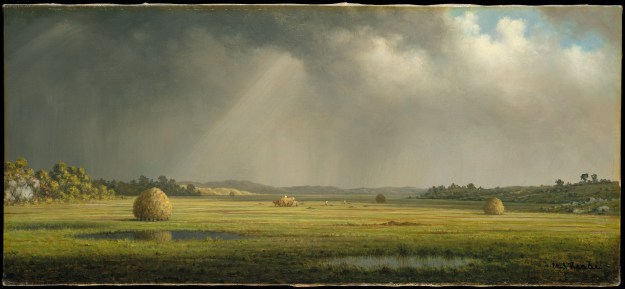
Martin Johnson Heade, “Newburyport Meadows”, (ca. 1876-81) (The Met)
.
Come now, you who say, “Today or tomorrow we shall go into such and such a town, spend a year there doing business, and make a profit”—you have no idea what your life will be like tomorrow. You are a puff of smoke that appears briefly and then disappears.
—James 4:13-14
.
Our cross is daily
And so are our decisions
Step by step we carry
Step by step we decide
Our cross may change…its shape, its size
Our decisions, like shadows, mirror the cross
Lengthening, stretching, thinning out—seemingly to even disappear—only to return—heavier, shorter, more compact—practically on top of us
It all depends on the angle and the path of the sun
———
The Sun of Justice
The Son of God
He walked day-by-day
He was conscious of the hour
He knew when His hour was near
He knew when it was time to slip away
He knew
To heal a stranger
To correct a disciple
To teach the crowds
To challenge a scribe
When to stand still
When to be silent
When to turn the other cheek
When to forgive those who hunted Him down
Christ knew the hour of His sorrowful Passion
Christ Jesus knew how to embrace the Word of the Cross
———
The Son of God knew His Father was trustworthy
He knew how to die
He knew how to live
He knew how to love
Day-by-day
Hour-by-hour
Minute-by-minute
Moment-by-moment
Jesus carried His Cross
He made decisions
Only concerned with fulfilling His Father’s will
Walk like Him
Walk with Him
Carry the cross you discover each new day
Give thanks for the blessings that come in the shape of a couple of crisscrossed beams
Make decisions accordingly
Planning to do more is to presume
—to presume to know what cross you’ll need to carry a few moments from now—
Doing any less is to put the cross gently laid upon your shoulder down
.
But for you who fear my name, the sun of justice
will arise with healing in its wings;
And you will go out leaping like calves from the stall…
Meals of every kind are described in the New Testament. Jesus begins his ministry at a wedding banquet in Cana in Galilee, John’s gospel says. Before his death, he has a meal with his disciples and after his resurrection he has some meals with them again. Martha and Mary and his friends in Bethany celebrate the return of Lazarus from the dead at a meal. His enemies say he ate too many meals with tax-collectors and sinners. Some of Jesus’ most profound teachings and actions take place at a meal.
Today in our reading from Luke’s gospel Jesus is invited to a Sabbath meal at the home of one of the leading Pharisees, but this meal is different from those just mentioned. They were carefully watching him, the gospel says. At a Sabbath meal God is thanked for his gifts, which he gives to all, but at this meal Jesus is being watched. He’s not an ordinary guest as he enters this home. He’s there to be measured and grilled by his hosts and put in his place.
At the time of Jesus it wasn’t unusual for a symposium to take place at a meal, especially in the home of someone like the leading Pharisee in today’s gospel. A symposium was an occasion when there would be a discussion of issues: questions would be raised, controversial matters would be debated. It was a time for people with quick wits and sharp tongues to show off how smart they were.
At this meal Jesus was going to be discussed; questions and controversies about him would be brought up and he would be disposed of. So we might imagine the guests at the Pharisee’s home on that occasion were like spectators at a prize fight, looking for the best seats to watch and maybe even take part in the contest themselves.
If this meal was a symposium, and I think it was, listen carefully to Jesus’ words to those who were there. He doesn’t just tell his hearers about common etiquette; he reminds them what this meal should be all about. This is a Sabbath meal. It’s a time for thanking God for the gift of life. It’s a time for rejoicing, not for showing off how smart you are. This is time when God calls us up higher. “Friend, come up higher.” From our small places here on earth, from the smallness we might consider our lives to be, God calls us up higher. It’s not a time pulling people down with your smart words.
For that same reason, this is a meal where everyone should have a place at the table, not just the wealthy and the privileged, the smart and the powerful, but “the poor, the crippled, the lame and the blind.”
Now, that’s what our Mass is about, isn’t it? Our Mass is our Sabbath meal where we give thanks for the gift of life. We give thanks to God. It’s right and just, our prayers say. We do this at all times, “always and everywhere,” but now we do it as disciples with Jesus our Lord. We listen to his word, we come to him in the bread and the wine, and through them he comes to us.
“Lift up your hearts.” “Friend, come up higher.” We lift up our hearts to the Lord. God calls us to come up higher, to see our gifts and the destiny we’re promised, to recognize our relationship with one another, to let go of the fears and doubts that cloud our minds, to feel the peace and hope God wishes us to have. The Mass prepares us for the life beyond this time. . “The Mass is ended. God in peace.” “Thanks be to God.”
Our Mass is a wonderful teacher, and we’re meant to take what it teaches and make it part of the rest of our lives. Let me give you a simple example, since we’re speaking about meals. Suppose we could make our meals, our eating together, Sabbath meals, where we enjoy the gifts of God we find in food and in one another.
That may sound like a strange suggestion. It sounds strange because eating together is becoming a endangered practice today. For one thing, a lot of people eat alone today, or if they come to a meal they might as well be eating alone.
Wouldn’t it be wonderful if all our meals became times when we experienced those words of the gospel: “Friend, come up higher,” when we build each other up instead of tearing each other down, when we all feel welcome by others, even the stranger and the outsider, when we enjoyed the gifts of God in food and human companionship.
For we are to God the sweet aroma of Christ among those who are being saved and those who are perishing...
—2 Corinthians 2:15
.
We see so many images of Christ Crucified. Museums and churches are full of them. And they should be. It is the greatest paradox ever told.
And to go along with the abundance of visual representations, there are of course also many artworks in written form depicting the Passion of Jesus Christ. Shelf after shelf can be filled with books containing the seemingly endless repertoire of poems, plays, and musical compositions based on the subject.
But none can capture the stench of death.
Smell moves us like no other sense.
It is so powerful. So quick. So nauseating.
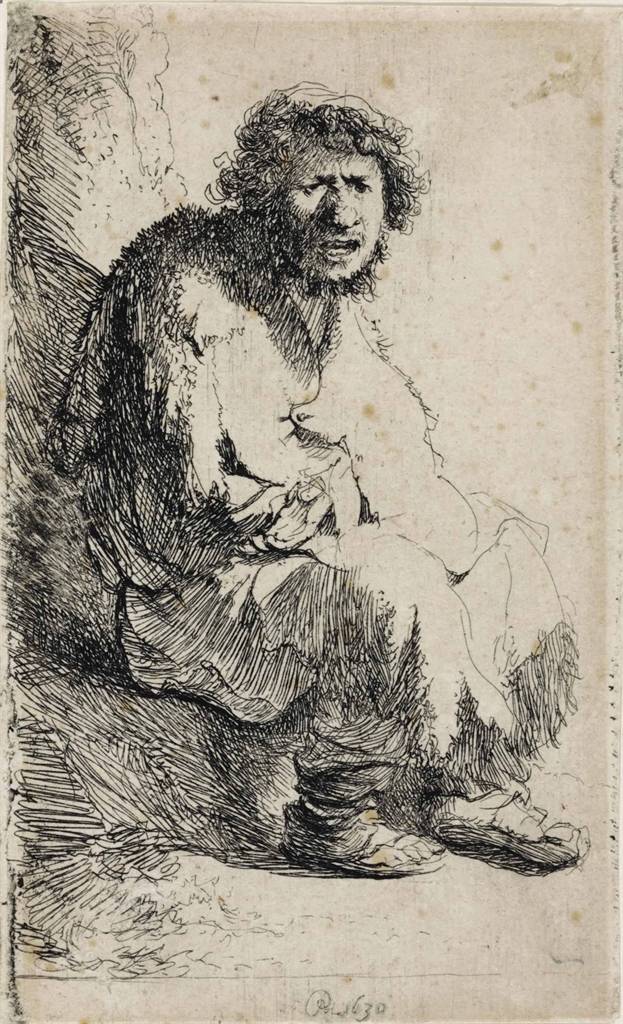
Think of that the next time you’re riding the subway on your way to a museum. Think of that when a homeless man enters your subway car. Think of that when you’re tempted to switch trains at the next stop due to the stench.
Breathe deep instead.
Think of the stench. Think of that poor man—that poor sorrowful man dying right in front of you. The stench of rotting flesh. The stench of death.
No artwork that you’re on your way to see will bring Jesus and His Cross more to life.
Take a deep breath, and pray. You’re on holy ground.
Pray for yourself. Pray for the man. Pray for all those on board. Pray for the entire world.
Pray that that particular stench, that stench of death, right then and there, brings life.
That it brings life to hardened hearts.
That it brings life to senses numbed to the utter poverty of human suffering—suffering that manifests itself in oh so many ways.
That it brings life to what the world says can’t and shouldn’t be redeemed.
And give that gentleman a few bucks.
———
The Metropolitan Museum of Art recommends an entrance fee of twenty-five dollars. Do you know how much consolation that poor suffering Christ riding right next to you would receive if you gave him that much?
Do you know how cheap a price that is to pay to be able to get so close to a living breathing masterpiece of sacrificial life?
Dig in deep. Dig into your pockets. Dig deep into the reserves of your heart.
You will be amazed how such a prayer, such an act of compassion, such a “living faith”, will transform the stench of death into the aroma of life.
Breathe deep. Pick up your cross. Die daily.
Get over yourself.
What a breath of fresh air!
Now that’s truly an entrance fee.
And it’s worth every drop.
.
Then Mary took about a pint of pure nard, an expensive perfume; she poured it on Jesus’ feet and wiped his feet with her hair. And the house was filled with the fragrance of the perfume.
To listen to today’s homily please select the audio file below:
“Lord, will only a few people be saved?” someone asks Jesus on his journey from Galilee to Jerusalem, described in Luke’s gospel, our Mass reading today. He doesn’t answer the question, but instead tells his listeners to respond immediately to God’s call when they hear it.
Why was the question asked anyway, you wonder? Was it because the response wasn’t great when Jesus made his way to Jerusalem? In our first reading Isaiah predicts people from all nations will flock to Jerusalem when the Messiah comes. Were those who followed Jesus few in number then?
Will the response to Jesus sometimes be the same?
The journey of Jesus to Jerusalem never ends, we believe. It goes on through time as Christian missionaries go through other towns, places, even continents. It took place when European explorers, settlers and missionaries brought faith in Jesus Christ to peoples in North America who never knew him.
“Lord, will only a few people be saved?” Early Christian missionaries may have asked that as they reviewed their attempts to evangelize the native peoples of North America. Historians estimate about 50 million Indians lived in North America before the arrival of Europeans. A hundred years later, only 10 percent survived, mainly because of diseases brought by the newcomers. In a hundred or so years, as European settlers increased in number, most of the native tribes in eastern North America were forced westward or destroyed by war or small pox brought by the Europeans.
Coming to the new world, Catholic missionaries like the Jesuits and Franciscans hoped, not only to convert the native peoples to Christianity, but some thought they might create a fresh, vibrant Christian civilization, without the ancient antagonisms and rivalries of Europe. They looked for new Pentecost, but it did not seem to come.
Their harvest wasn’t great. The two civilizations were very different. The sense of superiority the Europeans brought, colonialism, and the diseases that decimated the native population made the native peoples question Christianity. It seemed to be a faith that brought death not life.
I hope to visit soon the National Museum of the American Indian, located in the old customs house across from Battery Park near the ferry in New York City, a good place to remember the native peoples in the story of America. They were the first the Europeans traded with; they were their guides into an unknown land. The native peoples provided new foods for growing populations in Africa, Europe and America. They had a greater respect for the land than those who came after them. Their story is now largely forgotten.
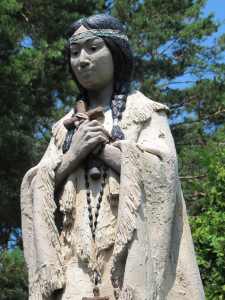
At the museum I’ll remember St. Kateri Tekakwitha, a native American who lived along the Mohawk River past Albany, New York. She offers an insight into the culture and social world of the native peoples. Smallpox brought by the Europeans disfigured and partially blinded her. Other diseases like tuberculosis, measles and malaria brought death to large numbers of native peoples, who were diminished further by wars and greed for Indian lands.
She came to believe in Jesus Christ.
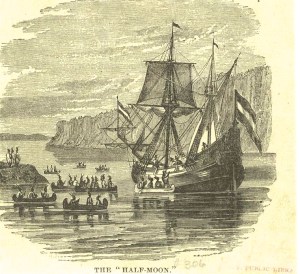
At the museum I’ll also remember Father Isaac Jogues, the fearless Jesuit missionary, who was eventually killed by the Mohawks at Ossernonon (Auriesville), past Albany on the Mohawk River. A strong faith in Christ brought him to the New World where he experienced the clash of cultures as Christianity entered a native American world. Fleeing from Indian captivity, he came here to New Amsterdam (New York) in 1643 and was put on a ship for France by a kindly Dutch minister. A few years later, he returned still eager to bring the Christian faith to the native peoples, but was killed in 1646.
He wanted them to know Jesus Christ.
What do these old examples say about our mission today as disciples of Jesus to make him known? “Go, therefore, and make disciples of all nations, baptizing them in the name of the Father, and of the Son, and of the holy Spirit, teaching them to observe all that I have commanded you. And behold, I am with you always, until the end of the age,” Jesus says. (Matthew 28,16-20) What does that mean today?
Some today tell us to think more positively of cultures like that of the American native peoples. Some say Christians should simply be present in these cultures and silently profess their faith and work for the common good. Some even say we should not evangelize at all.
Certainly, the Spirit of God has been active in humanity from the beginning and we have missed God’s gifts in cultures and religions not our own. The church today recognizes the good in other religions “The Catholic Church rejects nothing that is true and holy in these religions” (Nostra Aetate, 2) . Still, it regards them as a “preparation for the gospel.” (Lumen gentium 16)
“The church is missionary by her very nature.” (Ad gentes 2) She is called to both dialogue respectfully, work for the common good and proclaim her belief.
We’re not only speaking of other cultures and religions, of course. What about our own culture, which is becoming increasingly resistant to Christian belief? How do we dialogue respectfully and proclaim our belief to our own, our young people, those who are drifting away?
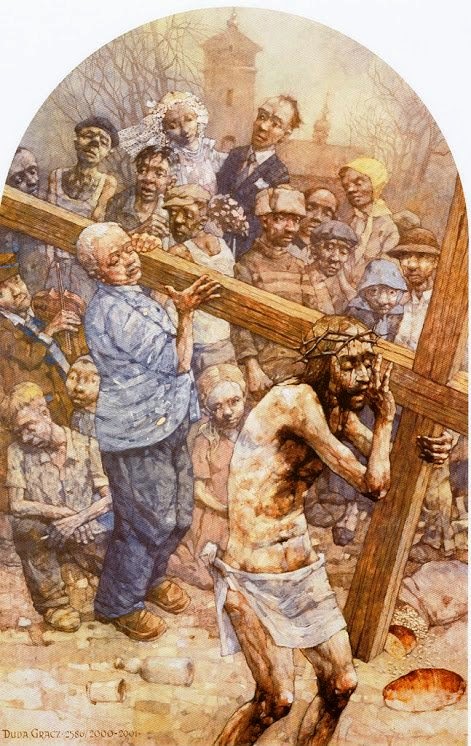
Jerzy Duda-Gracz, “Golgotha of Jasna Gora”, (ca. 2001)
“Do not work for food that perishes but for the food that endures for eternal life…”
—John 6:27
.
On a day such as this, our Lord, our God, our Savior Jesus the Christ was crucified.
It is hard to imagine just what He went through that long, hard day.
It is certainly a good exercise to meditate on Christ’s Passion. It bears great spiritual fruit.
This particular morning, exhaustion is on my mind.
I think of all those who are staggering out of bed. All those faces I shall soon see on the crowded bus, the claustrophobic subway car, the bitterly hot city street.
Of course those faces can also be seen in the suburbs and the country. Those faces are all over the place.
All those Josephs. All those Marys. All those Peters and Pauls. All those just like you and me, like yours and mine—all on their way to work—each carrying a cross made of wood, no matter what the job may entail or what the work may look like, no matter if the “work” performed results in “pay” or not.
Exhaustion. Being spent. Having been completely poured out. Nothing left but fumes.
And many whom I shall see this morning will return this evening to ungrateful companions: spouses, children, in-laws, neighbors…all those in their lives who they provide for, but who rarely think about the effort it takes to generate that provision—let alone, to say, “Thank you”.
Jesus kept walking.
Patience. Strength. Perseverance.
———
Lord, teach us. Show us. Show us Your blessed face.
Can we see You today in the tired, the taken for granted, the exhausted? Can we pour ourselves out on Your behalf? Can we serve those who serve others?
Can we be instruments of encouragement? Can we help the anonymous Jesus right next to us carry His Cross? And can we do all this in complete and perfect union with Jesus and all for the love of You, Lord God?
Father, can we continue to ask You questions such as these? Questions that bring us closer to You, and closer to the Passion of Your Dearly Beloved Son.
I love You, Jesus. Let me never take for granted Your crucifixion. Let me never take for granted Your exhaustive gift—a gift that took every bit of You and yet never runs out—a gift exclusively for me and at the very same time exclusively for each and every other member of mankind.
You, Lord God—Father, Son, Holy Spirit: Most Holy Trinity—are everywhere: on crowded buses, on claustrophobic subway cars, on bitterly hot city streets. You are all over the place. You are in so many who don’t even know that You are in them. Let me see You in them. And may that blessed encounter also be the moment in which he and she comes to recognize Your Divine Presence residing deep within.
You are God.
You died for each of us.
Your Passion continues.
On the Third Day, You rose again.
The Third Day is also today—this very day—this new and blessed day.
You are risen. You are risen, indeed!
.
So they said to him, “What can we do to accomplish the works of God?”
Jesus answered and said to them, “This is the work of God, that you believe in the one he sent.”


 The Victor's Place