Category Archives: Inspiration

28th Sunday C: The Gift of Life


To listen to this week’s homily, please select the audio file below:

Some years ago, I visited the Vietnam Memorial in Washington, DC with a cousin of mine who fought in that war. We were passing along the wall where names of those who were killed in that war were inscribed, when he stopped and pointed to a name.

One day, he said, his artillery unit was ordered to a forward position; he was the officer in charge. Just as he was ready to get into the helicopter, word came that he was wanted for a meeting at headquarters, so he got out of the helicopter and told a junior officer to take over; he would join them as soon as he could.

That day the unit took heavy fire; the name he pointed to on the wall was the officer who took his place.

“Why am I living and he’s not?” That’s a question he keeps asking, he told me. “Why am I alive?”

That’s really the ultimate question in today’s readings. The lepers who were cured by Jesus were facing death. There was no cure for their disease. Leprosy was so frightening then that those affected by it were driven from their homes and families to live in isolated places and forbidden to go near anyone. Jesus gave them the miracle of life.

It didn’t matter if you were rich or poor. Namaan, the Syrian general, whom we read about in our first reading, was one of the most powerful people in the world, but he had leprosy; it was a death sentence. In desperation he went down to Israel looking for a cure, a miracle. Washing in the Jordan River, he received the miracle of life.

The ten lepers were cured, our gospel reading says, but only one was truly thankful. The other nine seem to take the life they were given for granted. Do those nine represent most of us? The one who was thankful was a Samaritan.

Namaan, the Syrian, was also thankful. He went to the prophet Elisha after being cured and offered him gifts. No, the prophet said, life is God’s gift, not mine, and he wouldn’t take anything from the Syrian.

“Then at least let me take some dirt from this place, ‘two mule loads of earth,’” Namaan says, “so that I can take it back with me and  stand on it and remember and give thanks to God for what I have received here. “ He won’t forget the gift of life and how to use it.

That’s the great challenge we all face–not to forget that life is a gift and it’s been given to us by God to live well every moment, each day, as long as God gives it to us.

Our church is a place of thanksgiving. Above all, our church is a place where we give thanks. Our Mass is also called Eucharist, an act of thanksgiving. “Let us give thanks to the Lord our God.” “It’s truly right and just” that we do this. In this place we remember the God of Life who gives us life. Here too we receive a promise of life beyond this, greater than this, through Jesus Christ.

We have been given the gift of life, a precious gift. Don’t take it for granted. We thank God for it and try with all our strength to live it as we should.

Friday Thoughts: Hummingbird and Passionflowers


martin-johnson-heade-hummingbird-and-passionflowers-ca-1875-85

Martin Johnson Heade, “Hummingbird and Passionflowers”, (ca. 1875-85) (The Met)

.

The delicate little bird that resides within each of us.

It hops to and fro. It stands startlingly still.

Very often we are the very ones who chase it away.

But it doesn’t fly far.

Just to the closest branch, that’s just beyond our reach.

And it looks back at us, as if to ask, “Why are you afraid?”

The tiny head of a tiny bird, slightly cocked to the side—a question mark floats from its beak.

It longs to return, to live within us, to build a nest, to raise its young.

But it doesn’t rush back.

No, it waits.

It waits for us to ask for it to return.

It’s a patient creature, that tiny bird.

One may be tempted to say it’s not very smart, but that’s not it at all.

It’s simple. It’s holy. It knows who it is. It’s not afraid of the fall.


.

—Howard Hain

.

http://www.metmuseum.org/art/collection/search/11052

..

27th Sunday C: Faith Like A Mustard Seed

For an audio homily:

Faith like a mustard seed

Like the apostles, we would like a stronger faith. “Increase our faith,” they ask Jesus. Give us faith that understands everything immediately and sees everything clearly–right away! We can hear ourselves asking for faith like that too.

In response, Jesus offers the image of a mustard seed. Look at this tiny seed, he says. With faith like this, you can accomplish the most impossible things. What does he mean?

A mustard seed is so small that you hardly can see it in the palm of your hand, Yet once in the ground it grows into a full sized tree, through cold and heat, nights and days, all kinds of weather. But it takes time.

Faith is like that. It grows, but its growth takes place over time, day by day, through the common experiences that come our way. God dwells in the ground of daily life and it’s there we meet him most of all. That’s why the psalm for today’s Mass insists: “If today you hear his voice, harden not your hearts.”

Today in countless little things, in unassuming moments, God speaks to us. God acts. And even as the moments slip by, God’s plan unfolds. We need a daily faith, a patient faith, a faith like the mustard seed, to wait until it reaches its completion. “The vision still has its time, presses on to fulfillment, and will not disappoint. If it delays, wait for it, it will surely come, it will not be late.”

A daily faith that watches God’s plan unfold in the course of things.

Friday Thoughts: A Simple Landscape

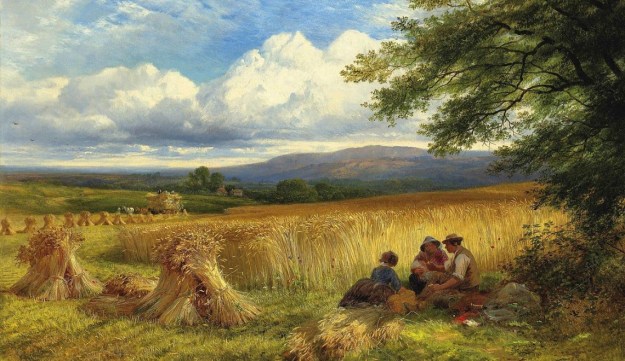
george-cole-harvest-rest-1865

George Cole, “Harvet Rest”, 1865

..

A painter has a great advantage, as does a writer I suppose. He can scratch out, erase, and paint over. He can throw out and start again. He can expand the landscape or focus in on a detail. There is great freedom in creation. Yet none of it has any value unless it comes from and leads back toward God.

The great sweeping landscapes painted throughout the years. I want to dive into so many of them. To run toward the distant hills, to sit beside the babbling brooks, to hitch a ride on the hay wagon making its way round the bend. But most of all I want to join the peasants, working the fields or gathered around the base of a giant oak for a bite of second-day bread, and perhaps even a sip of slightly watered-down wine.

I want to hear the simple strings of a Spanish guitar, the worn-out wood of a French violin, the voice of yet another “Maria” toiling beneath the Italian plein air.

The pleasant thought of resting beside a river bed—of catching a not-so-quick nap within the shade of God’s ever-expanding and contracting canopy of leaves.

Even the bark of an English Foxhound could not interrupt thee!

———

I don’t want to be told that this isn’t reality. I don’t want to be told that it’s a bit romantic.

I want to live simply. I want to work an honest wage. I want to stop at noon to give the good God rightful thanks and praise.

I want to visit the graves of the dead with a bouquet of hope and faith.

I want to truly retire each night.

———

Love is enough.

It is enough for you and for me.

———

There is never enough if that we fail to see.


.

—Howard Hain

.

Morning Thoughts: Counting Drops

massimo-stanzione-pieta-1621-25

Massimo Stanzione, “Pieta”, (1621-25)


.

For now we see only a reflection as in a mirror; then we shall see face to face. Now I know in part; then I shall know fully, even as I am fully known.

—1 Corinthians 13:12


.

Nothing.

Some days all we can do is count raindrops. There seems to be little else on the horizon.

For we walk by faith, not by sight.” (2 Cor. 5:7)

On days such as these, a friend, a family member, a neighbor—perhaps even a stranger—may ask us if anything is wrong.

The answer is short and straightforward: “No, nothing at all.”

Yet, it is precisely that.

“Nothing” is precisely the problem:

The abyss of faith.

It’s hard.

It’s hard to journey in darkness.

It’s hard to swim in a bottomless sea without attempting every once in a while to touch bottom.

It’s also hard not to wonder if there’s something dangerous swimming just below.

But we must resist temptation, no matter its shape or size.

We must keep our eyes on the Island of Hope, with its very distinct Tree of Life, firmly planted, and reaching far above the horizon.

Instead of looking backwards or beneath, we must look to Christ lifted high up upon the Cross.

———

We too must ascend. We too must rise above knowledge, “forgetting what lies behind and straining forward to what lies ahead…” (Phil. 3:13)

And we must never despair. Never.

And why would we? God’s drops of love are everywhere.

Start to count them. Start to count this very day. Count the drops dripping from Christ’s open wounds. His crucified presence abounds; there are so many instances of Christ being put to the test—of Christ being nailed to the Cross—right in front of us, each and every day.

The Crucified Christ we personally discover within our immediate presence, literally within arm’s reach, just may be that same friend, family member, neighbor, or stranger who asked us just a little while ago if anything was wrong.

———

Count your blessings on the outstretched fingers of the Lord.

Order your days according to the Stations of His Cross.

For without the Passion there is no Resurrection.

That’s part and parcel of The Promise:

God became man, so that man may dwell eternally with God.

His promise is everything.

Our doubt is nothing.

And the space in between, the space between His promise and our doubt, is filled with the very real stuff we call “life”— “the nuts and bolts” of daily existence, the building blocks of the Body of Christ—the Kingdom of God.

We just have to continue to walk, in faith, one step at a time. Knowing that we never walk alone.

Christ is always with us. He shares our total existence—in all things but sin—and even that, He got to know well. For the Guiltless One took upon Himself our sins and those of the whole world.

Jesus not only hung upon the Cross, He was yanked on all the while He was up there—the weight of a fallen world ceaselessly pulling down on His spotless hands and feet.

For our sake he made him to be sin who knew no sin…” (2 Cor. 5:21)

———

Nothing.

Absolutely nothing.

Jesus held back not a drop. He gave it all. And we in return are offered everything:

Sons and daughters of God. Co-heirs of the Kingdom.

How can we ever repay such a gift?

That’s the point. We can’t.

It’s grace. Pure grace.

Unwarranted mercy, non-merited compassion and forgiveness, unearned love.

———

Grace-filled moments such as these, when we realize just how small we truly are, bring us astonishingly close to the Creator of all—wonderfully close to Him Whom nothing can be compared.

They fill us with hope, the hope of what is to come, the hope of what Christ Himself promises.

In the meantime, let us keep counting raindrops. They too shall soon cease to fall. For one day, even faith will no longer be needed, for we shall see God “face to face.”


.

Beloved, we are God’s children now; what we shall be has not yet been revealed. We do know that when it is revealed we shall be like him, for we shall see him as he is.

—1 John 3:2


.

—Howard Hain

.

26th Sunday C: Social Justice: What is It?

To listen to today’s homily, please select the audio file below:

The last two Sunday’s our first reading has been from the Prophet Amos. Today’s reading from Amos is linked to the story that Jesus tells in Luke’s gospel. He speaks of a rich man living very comfortably, living luxuriously, who can’t see the poor beggar, Lazarus, outside his door. God judges him severely.

Having these two readings together, we can understand why some people in Jesus’ time thought he was a prophet. Jesus’ message about the poor was like that of the prophets. We can see also how important social justice is in the gospel. We can’t have religion without justice. Religion without justice is an affront to God who wishes all his children be justly cared for and loved.

Let’s take a look, first, at Amos, the prophet. Amos was ordinary sheepbreeder, he bred sheep in northern Israel about 700 years before Christ. In his time Israel was very prosperous and so were the countries around her, Syria, Phoenicia, Egypt, but their prosperity came at a price. They had everything they wanted–at least, the elite of those societies had everything they wanted. More often than not, though, their prosperity came at the expense of the poor.

In our readings these last two Sunday’s you hear Amos’ severe indictment, not only of the people of Israel, but of her neighbors as well. They’re trampling on the needy. He fiercely attacks those who are well off and don’t see the poor of the land.

“…lying upon beds of ivory, stretched comfortably on their couches,” eating the best food, drinking the best wines, not caring at all about those who are falling apart around them.

Amos was an ordinary sheep herder, but he knew what was going on, and he wasn’t afraid to say what he saw. He calls out everyone, kings, rulers, political people, priests, religious leaders, business people, anyone who’s cashing in on the needy and the poor of the land.

The Lord won’t forget what you have done, he tells them.

God won’t forget what you have done. Notice, the prophet doesn’t appeal to economics and say it’s not good economics to neglect the poor and have a society of “have’s and have nots.” No. The prophet doesn’t appeal to politics and say a fractured society isn’t good for a community; it’s going to lead to violence, riots, internal instability. No. The prophet doesn’t appeal to human good feeling and say that being good to the poor will help you feel better about yourself. No.

A prophet like Amos sees the world through God’s eyes and God’s values. That’s who the prophet is: one who sees the world through God’s eyes and God’s values. “Your kingdom come. Your will be done.” The goods of this world are not just for some people, for the few. This world is God’s world, and it’s meant for the good of all. That’s what the prophets say. That’s what the saints say, saints like Mother Theresa say the same thing. They see the world through God’s eyes and God’s values. That’s what social justice means, it’s justice for all.

That’s what Jesus says in his parable today. Notice, Jesus doesn’t say much about the rich man who’s dressed well and eats well. He doesn’t tell anything about the house he lived in, or his status in society or the way he got his money, or his wealthy friends, or where he spends his vacations. No. In fact, he doesn’t even tell us his name.

The only name Jesus offers in the parable is the poor man’s name, Lazarus, who has the same name as the man Jesus raised from the dead. How different too that is from our society, which knows the names of all the rich and famous and forgets the names of the poor.

We need to listen to prophets and saints. We need to listen to the teaching of Jesus in the gospel. We need to see things right. We need to see this world as God sees it.

And we need to act justly in our world, justly to all.

Morning Thoughts: I Have a Dream

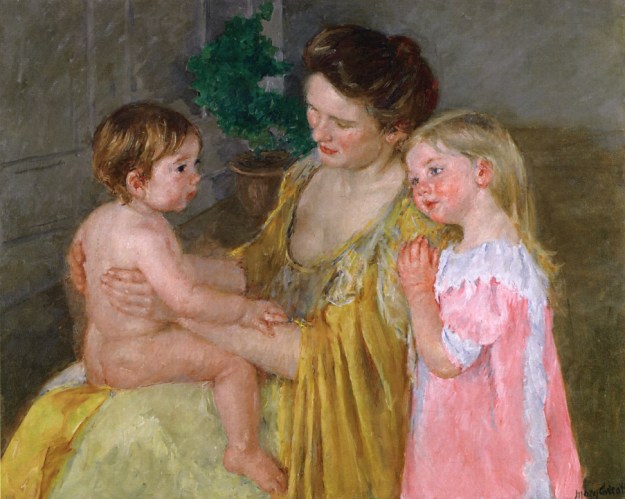
mary-cassatt-mother-and-two-children-1906

Mary Cassatt, “Mother and Two Children”, (1906)

 .

Let us put it all away.

Put away all the toys.

All the distractions.

Let us dream.

Let us dream of peace. Perfect peace. This very day.

I want every human being to love truth. To dwell in beauty. To live in wonder of God’s creation.

To think.

To stop.

To ascend.

To rise above the facts. To float above the circumstances. To kiss God on the cheek.

To laugh.

To cry.

To smile at a child.

To shake hands with a friend. To hug an enemy.

To hope. To believe. To pray.

To give great thanks. To humbly offer praise.

To graciously receive. To generously give.

To be alive.

To not be afraid.

———

I want every human being to ask: Why isn’t it always this way?

———

Perhaps though most of all, I want us to be honest.

Honest about our desire to love. Our desire to be kind.

With no embarrassment, with no shame.

Freed from all worry that people will think it strange.


.

—Howard Hain

.

Sunday Vespers: Head of an Old Fisherman

marble-head-of-an-old-fisherman

“Marble Head of an Old Fisherman” 1st-2nd century A.D.  Period: Imperial. Culture: Roman. Medium: Marble

.

I’ve seen your face before.

We’ve spent time together before today.

You are so beautifully broken.

Made of marble, yet fragile as clay.

The years have chiseled deep.

The salt air has sanded away.

I hope one day to look just like you.

Yes, I know, it’s a lofty goal.

The calm countenance of a wise, humble, seasoned priest.

O, yes you are!

I see right though that meager disguise.

A fisherman, a priest; they’re practically one and the same.

Saint Peter, Saint James, Saint John…

The Fisher-King kept those three extra close.

Plus, your hat gives it away.

Chipped or not, I know it’s really a halo.


.

“Come, follow me…and I will make you fishers of men.”

—Matthew 4:19


.

—Howard Hain

.

http://www.metmuseum.org/art/collection/search/252536

.

Friday Thoughts: Completion


.

Now I rejoice in my sufferings for your sake, and in my flesh I am filling up what is lacking in the afflictions of Christ on behalf of his body, which is the church…

—Colossians 1:24


.

One more day. A few more hours. A couple more minutes.

The joy of wrapping things up. Of finishing strong. Competing well. Seeing things through.

The anticipation of rest. Of a good meal. The best. Of the company of those you love, of those who know you best.

How can there be another round? How can I possibly do one more day?

Questions we ask when we are truly spent.

———

To be in Christ’s Passion is to think that there can’t possibly be more. That this, this very moment, has to be the end.

But Christ continues. So does His Passion.

“My grace is sufficient for you, for my power is made perfect in weakness.”

—2 Corinthians 12:9

———

He’s sweating blood in the garden. He’s scourged at the pillar. He’s crowned with sharp thorns.

He carries His cross. He’s stripped. He’s nailed.

He hangs for hours, for all passing by to see.

———

But He hangs not alone.

A powerful woman, a tender-hearted disciple, a handful of faithful women, a couple of good law-abiding men, a few soldiers doing their duty, an evolving circle of “innocent” bystanders, and of course, a hoard of mockers. They are all on hand.

Yes, the mockers, they are there for sure. But they don’t stay the entire time. Their shame shows them the door.

The evil spirits, on the other hand, they stay till the end. Taunting. Challenging. Hating Christ’s inevitable victory over death:

“Come off that cross, you coward! Fight like a man!”

———

There are times when laughs and cries sound very much the same. When the heart bursts forth from the valley of death.

“Is he laughing?”

“Is he crying?”

“Has he gone insane?”

Or has he finally finished taking upon Himself all the blame?

———

 “It is finished.”

And He bowed His head and gave up His spirit.

—John 19:30

———

And that was just the beginning.

Almost like the first week of school.

Now all of Jesus’ younger siblings get to follow His rule:

.

Let us fix our eyes on Jesus, the pioneer and perfecter of our faith,

who for the joy set before Him endured the cross, scorning its shame

and sat down at the right hand of the throne of God.

—Hebrews 12:2


.

“And behold, I am with you always, until the end of the age.”

—Matthew 28:20


.

—Howard Hain

.

Morning Thoughts: The Promise of a New Day

.

Lord, how long?

Lord, why?

Lord, why so much darkness, so much pain?

Love, my child. Just love. Leave everything else to me. I know that you ask these questions out of love, and I don’t blame you for asking, but be in love, my child, be in love with me. Stay in love with me. Be living breathing love with me. Your brothers and sisters, our brothers and sisters, are starving. I am starving. You are starving. We all hunger. And I am with you. Do you doubt that I feel everything that you feel? Would I do that to you? Would I leave you alone? I told you, that I will never do. My promises are truth. My words are not from yesterday, they are not for tomorrow. No, my words and my promises are for today, for right now. They are not part of history, they create history. Now go, get up once again, be brave. The power of my love brings life into existence. You carry my death with you. My resurrection can not be stopped. It’s happening right now as you step into this hour. Those that love you are running toward an empty tomb. You are in the garden. Reassure them, reassure them all, reassure everyone you shall meet this very day, that all I say is true.


.

—Howard Hain

.