When Mary visited her cousin Elizabeth she said “all generations shall call me blessed, the Almighty has done great things for me, and holy is his name.” All generations know her; at times over the years Mary visits some in apparitions.
Three prominent apparitions of Mary in the last 500 years are commemorated in major Marian shrines –in Mexico City, Lourdes and Fatima. In 1531, she appeared to the Mexican peasant Juan Diego on a hillside outside of Mexico City. In 1858 Mary appeared to 14 year old Bernadette Soubirous in Lourdes in France as she was gathering firewood. In 1917 Mary appeared to three shepherd children in Fatima in Portugal. These are major pilgrimage sites today. Three liturgical feasts in our church calendar honor these apparitions.
The depictions of Mary in art follow closely, if not perfectly, the accounts the visionaries gave of the apparitions. Mary, arms folded in prayer, prays for her children on earth and encourages them to pray with her in the Fatima appearance.
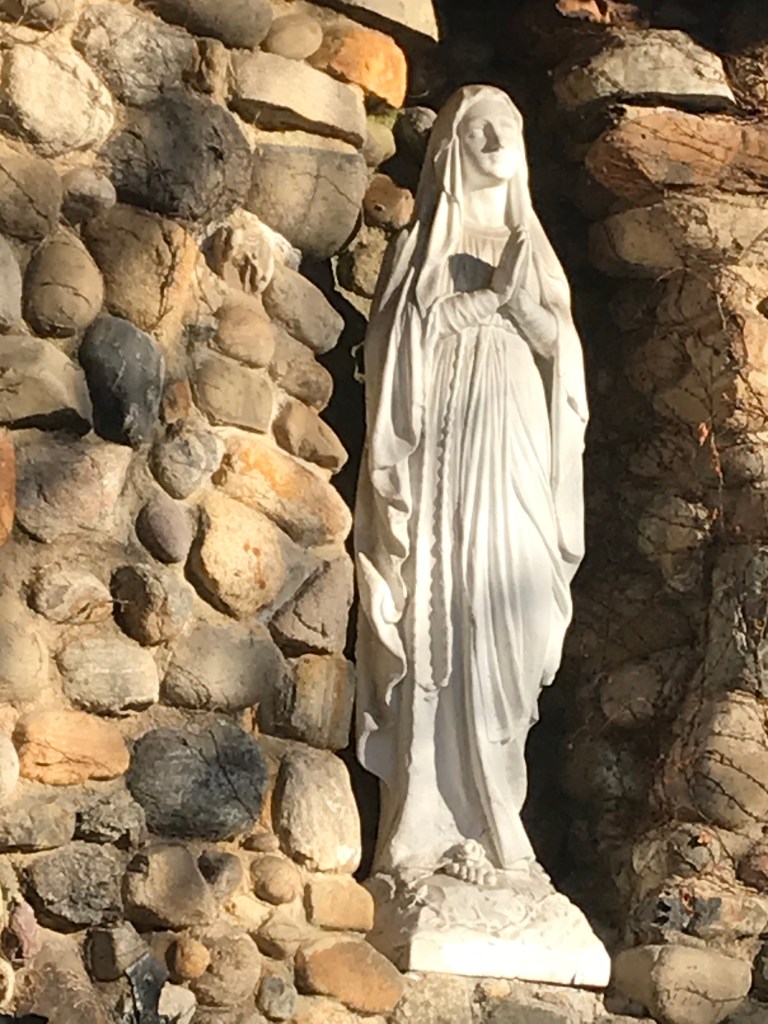
The statue of Our Lady of Lourdes made by Fabisch in 1864 and placed in the grotto at Lourdes in France is a model for the many statues of Our Lady of Lourdes in churches and shrines throughout the world. We have one in our Lourdes Grotto in Jamaica, NY. (below)
Various images of Our Lady of Fatima exist; we have one in our monastery chapel.(above) Her bright white garments witness to the glory the visionaries saw surrounding her. She brings the glory of heaven to brighten the earth, as Jesus did at his transfiguration. “And he was transfigured before them, and his clothes became dazzling white, such as no fuller on earth could bleach them.” (Mark 9:2-3)
Images of Our Lady of Guadalupe show her in the native dress of the time; she identifies with the native peoples then under colonial subjugation.
Contemporaries of Bernadette and the children of Fatima faced trials of another kind than the native peoples of Mexico. Secularizing governments promoted unbelief in society and wars were increasing in number and intensity. Mary’s appearances were not only the occasion of physical cures and healing. To ordinary people then and afterwards Mary’s appearances brought reassurance and renewed faith in the promise of God’s glorious power and presence. Their faith was real.
In his letter Laudato si’ Pope Francis calls upon Mary to visit us today as we struggle to care for the earth we have neglected. I like this image of Mary, holding her Son, which we have in our Mary Garden. Creation seems to raise its voice in praise. Her Son, Jesus Christ, offers us life-giving Wisdom. “We can ask her to enable us to look at this world with eyes of wisdom,” the pope says. May she hold in her hand our wounded world.
It’ s a long way from the creation of the world to sitting on the porch in the morning. How many years before did God, the Creator of all things, bring light and water paving the way for a host of new things, non-living and living. Then, we humans enter the picture. A complex, changing world I belong to, sitting on the porch in the morning, looking eastward at the world before me.
.
Jessica Powers, a Carmelite nun and poet, wrote about our experience of that world– “Song At Daybreak”
This morning on the way,
that yawns with light across the eastern sky
and lifts its bright arms high –
It may bring hours disconsolate or gay,
I do not know, but this much I can say:
It will be unlike any other day.
God lives in his surprise and variation.
No leaf is matched, no star is shaped to star.
No soul is like my soul in all creation
though I may search afar.
There is something -anquish or elation-
that is peculiar to this day alone.
I rise from sleep and say: Hail to the morning!
Come down to me, my beautiful unknown.
“My Beautiful unknown”. Our world is beautiful, but unknown, surprising, with variations that bring “anguish or elation.” People of faith know this, since they believe in God who lives “in his surprise and variation”, but unfortunately we can make God too small. We “think like humans do.”
The Genesis account, which we just finished reading recently and the rest of the Bible, deserve a search for their wisdom. I know there’s a new story that science tells, but the scriptures were there first. We should listen to their special wisdom..
A few years ago Nova on PBS featured a program called“The Secrets of Noah’s Ark.” In early times, floods were common in the “Fertile Crescent,” the area in Mesopotamia {modern Iraq} where the Tigris and Euphrates Rivers and the ancient city of Babylon were located. Floods, sometimes great floods, occurred, so the people had to be ready. You had to keep your boats handy, and a big boat also– you never knew..
But people then, as now, had short memories. “As it was in the days of Noah, so it will be at the coming of the Son of Man. In those days before the flood, they were eating and drinking, marrying and giving in marriage, up to the day that Noah entered the ark. They did not know until the flood came and carried them all away.” (Matthew 24, 37-38)
I suspect some Babylonian priests then– meteorologists and story tellers of the age– came up with a flood story thousands of years before the Noah story in Genesis, to keep people on their toes – and maybe challenge some early climate change deniers too. It reinforced important advice: “ Keep your boats in shape and make sure a big boat’s around for ‘the big one.’”
Jewish priests and scribes in 6th century Babylon saw the story a perfect fit for the story of human origins they were telling their people. For them the take-away from the story was not to keep a big boat handy, but to be faithful to God like Noah and Abraham and their families. If they were faithful, God would save them from the flood and bring them to the Promised Land.
The Nova program showed evidence from today of those big boats there “just in case.”
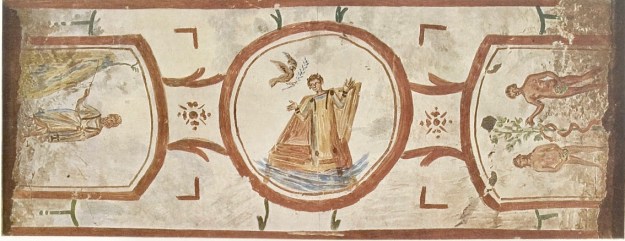
The story gave hope to the Jews driven from Jerusalem to exile in Babylon where, “By the rivers of Bablyon, we sat ad wept, remembering Zion.” (Psalm 137) Christians– the pictures in the catacombs remind us (above)– saw Noah as a sign that the waters of baptism saved them from death and brought them the promise of paradise lost by Adam and Eve.
So the story of Noah and the ark is more than a myth.
The LORD God said: “It is not good for the man to be alone. I will make a suitable partner for him.” (Genesis 2,18)
We usually rush on when we hear these words to the creation of Eve, who becomes “bone of my bone, flesh of my flesh” for Adam, and the human story begins.
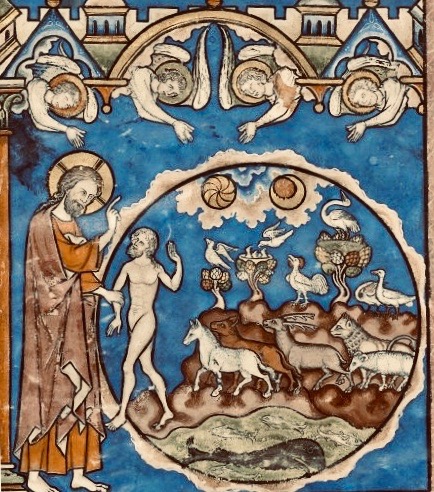
But the Genesis account we read today and the medieval artist above remind us that God first “formed out the ground various wild animals and various birds of the air, and he brought them to the man… but none proved to be the suitable partner for the man.” (Genesis 2,19 ff)
Adam signals to God these new creatures are not enough, but does he dismiss them altogether for Eve?
Whether we realize it or not, we are not meant to be isolated individuals on this planet. We look for human companionship and friendship. But are human beings our only relationship. Besides caring for each other, we have destiny to care for all the creatures Adam names. They’re our partners too and we share this common home with them.
Here’s a favorite picture of mine from the Staten Island Ferry. You say it’s a picture of the New York skyline? I say it’s a picture of water that gave birth to the city. True, isn’t it? The water was here first. The city came to be because water brought the world here, making the city a capitol of world trade and drawing millions of human beings to this place
Now look at it. The man who built the new World Trade Center claims it’s the tallest building in the country, challenging the heavens–like Babel.
Be careful, though, about challenging the heavens and forgetting about the earth. Be careful about the waters that brought you where you are. No fish or oysters here to eat now. Little space for the waters to go when they rise. And they will.
Don’t forget– the water was here first. It’s a “vision thing.” That’s what Pope Francis says in “Laudato si”.
This week’s readings from Genesis are good readings for improving our vision. In the weeks before we read from the Letter to the Hebrews, so you might say that from the heavens we’re now reflecting on the earth.
It’s good to reflect on creation, Genesis reminds us. God looks on what has been made and finds it good. Our account from Genesis today describes the creation of man (“man” here is a term for man and woman). Man is not immediately placed on the bare earth. No, he is placed in a garden where “various trees grow that were delightful to look at and good for food, with the tree of life in the middle of the garden and the tree of the knowledge of good and evil. “
Human beings, created by God, are called like God to find creation good. iThe Genesis account singles our the various trees that are delightful to look at and good for food, but all creation, from the sun and the stars to the simplest organisms, is to be looked at with delight.
We’ll read for two weeks in our lectionary from the Book of Genesis and then we’ll be reading from the Book of Sirach which continues the Genesis message. Learn the Lord’s wisdom from the sands on the seashore, from heaven’s heights and earth’s depths, Sirach teaches. Like the Book of Genesis, it tells us to learn from the world we live in.
The scriptures in our lectionary are not assigned arbitrarily. The compilers of our lectionary after Vatican II carefully planned the way our lectionary unfolds.
Pope Francis, in his encyclical Laudato Si, , invites Christians to turn to the Book of Genesis to understand how they’re related to the earth.
Genesis makes clear in its first chapter that the earth, “our common home,” is God’s work. God works for 5 days to create the world; only on the 6th day does God create man, whom he gives dominion over creation– but not absolute dominion. God made this world, not us, and every created thing enjoys a distinct relationship to its creator.
The dominion we have from God is a gift and is not absolute. We’re to help, respect, understand, tend, care for creation: creation isn’t ours to do what we want with it.
The 2nd chapter of Genesis describes the creation of man. The earth is dry dust, but water wells up making a soft wet clay from the dust. God, like a potter, fashions man from the clay, breathing the breath of life into him and making him a living being.
We’re creatures of the earth, the story says. As we’re reminded on Ash Wednesday, “You are dust and to dust you shall return.”
After creating man, God places him in a garden filled with all kinds of plants and trees. Two trees are singled out, the tree of life, and the tree of the knowledge of good and evil. Man is forbidden to eat from that tree.
What’s the tree of the knowledge of good and evil? Why is it forbidden to eat its fruit? There are different interpretations. Some interpret eating from the tree as a decision of moral autonomy. By eating its fruit, I claim a knowledge of good and evil; I say what’s right or wrong.
Not unusual to hear that today, is it? Some believe they’re in absolute control of their lives. They choose what’s right or wrong, good and evil, rejecting the limits of the human condition and the finite freedom God gives human beings.
Another interpretation sees eating from the tree as a decision to trust only in human experience and human knowledge that we gain as we grow and progress individually and as a people. Like children distancing themselves from their parents, we must be self sufficient, gaining a wisdom on our own. The danger is that human experience and human wisdom become absolute. We distance ourselves from God.
Can we see both these approaches harmful to our environment? The first leads to a possessiveness of created things; they belong to us alone and we can do anything we want with them.
The second way also leads to harming our environment. Pope Francis speaks of the danger of “anthropocentrism,” putting human beings at the center of everything, a trend he traces back to the beginnings of the Enlightenment in the 16th century. Trusting human knowledge and human creativity, some are convinced that science and technology alone can bring about a perfect world.
Technology isn’t enough to meet our present environmental crisis, the pope says, we humans need to change. We need to humbly accept our place in creation, as God meant it to be.
What about the tree of life in the Genesis narrative? In the garden the tree was a promise of continuing life. Once banished from the garden, human beings face death.
When Christ came in the fullness of time, he brought life to the world, Christians believe. In his death on the cross, the sign of death was replaced by a sign of life. His cross is a tree of life.
Here’s Pope Francis from Laudato si:
“The creation accounts in the book of Genesis contain, in their own symbolic and narrative language, profound teachings about human existence and its historical reality. They suggest that human life is grounded in three fundamental and closely intertwined relationships: with God, with our neighbour and with the earth itself. According to the Bible, these three vital relationships have been broken, both outwardly and within us. This rupture is sin. The harmony between the Creator, humanity and creation as a whole was disrupted by our presuming to take the place of God and refusing to acknowledge our creaturely limitations. This in turn distorted our mandate to “have dominion” over the earth (cf. Gen 1:28), to “till it and keep it” (Gen 2:15). As a result, the originally harmonious relationship between human beings and nature became conflictual (cf. Gen 3:17-19).
It is significant that the harmony which Saint Francis of Assisi experienced with all creatures was seen as a healing of that rupture. Saint Bonaventure held that, through universal reconciliation with every creature, Saint Francis in some way returned to the state of original innocence.[40] This is a far cry from our situation today, where sin is manifest in all its destructive power in wars, the various forms of violence and abuse, the abandonment of the most vulnerable, and attacks on nature.”
The Christmas Season closes after the Baptism of Jesus, which we celebrate this Sunday. The Christmas celebrations are over. Ordinary time begins. Does that mean there’s nothing to do till Lent and the Easter season?
Sure there is. Ordinary Time is a time for daily prayer, and daily prayer is never over. The Second Vatican Council’s Constitution on the Liturgy says that daily prayer is at the heart of the Christian life and created a daily lectionary of scripture readings so “ the treasures of the bible be opened more lavishly for the faithful at the table of God’s word.” (SC 51)
The daily lectionary is a treasure for praying with the scriptures, but don’t take it for granted. Treasures, Jesus said, are usually hidden and you have to dig for them. That’s what we do in daily prayer. The liturgy is always a “work”, our daily work, an important work, a daily prayer. It’s the “summit” of the Christian life. We’re always at the beginning, not at the end.
We begin Monday to read the Letter to the Hebrews and the Gospel of Mark from our lectionary. There are feasts of the Lord and his saints to celebrate in the days ahead. It’s a lifelong learning we’re into, a school God provides,and we learn day by day.
The land where Jesus lived spoke to him and inspired so many of his parables. The sea did too.
Jesus went out along the sea. All the crowd came to him and he taught them. As he passed by, he saw Levi, son of Alphaeus, sitting at the customs post. Jesus said to him, “Follow me.” And he got up and followed Jesus. (Mark 2:13)
From the Jordan where he heard his Father’s voice and the Spirit rested on him, Jesus went to Capernaum on the Sea of Galilee where he taught crowds and called disciples.
I remember looking quietly on the waters of the Sea of Galilee years ago on a visit.. At night a stillness centuries old takes over. The waters of the Jordan flow into it on their way to the Dead Sea. The river winds almost 200 miles from the Golan mountains in the north into the Sea of Galilee, then on to the Dead Sea in the south, a direct distance of about 60 miles. The river falls almost 3,000 feet on its way to the Dead Sea,.
.Jesus’ ministry began in the Jordan River. The waters spoke to him more strongly than they do to us today. The Jordan was sacred to the Jews from the time they miraculously crossed it on their way to the Promised Land. The great Jewish prophet Elijah came from a town near the river’s banks. Later he sought safety from his enemies there.
Elijah’s successor, the Prophet Elisha, also came from the Jordan. He told the Syrian general Namann to bathe in the river to be cured of his leprosy, and he was cured. Ancient hot springs near Tiberias on the Sea of Galilee still witness to the river’s curative powers.
At the time of Jesus, the river’s fresh flowing waters were the life-blood of the land, making the Sea of Galilee teem with fish and the plains along its banks fertile for agriculture. Pilgrims from Galilee followed the Jordan on their way to Jericho and then to Jerusalem and its temple. The river always spoke of life.
The Jordan Today
The river is still life to the region. It’s the primary source of its drinking water and crucial for its agriculture. Its water is a major point of controversy today between Israel and its Arab neighbors.
Nourishing Prophets
The Jordan nourished prophets. Somewhere near Jericho John the Baptist preached to and baptized pilgrims going to the Holy City. The place– hardly a desert as we may think of it– offered enough food for survival, like the “ grass-hoppers and wild honey” John ate. It was also an uncultivated place that taught you to depend on what God provided.
Jesus taught this too. “I tell you do not worry about your life, what you will eat, or drink, or about your body, what you will wear… Your heavenly Father knows that you need them all.” (Mt 6, 25 ff) The desert was a place for learning to put worry aside and trust in the goodness of God.
Water is a sign of life. When Jesus entered the waters of the Jordan, he acknowledged his heavenly Father as the ultimate Source of Life, the creator of all things. Like the prophets Elijah and John the Baptist, Jesus remained in this wilderness near the water for forty days before his divine mission. He also baptized and taught there with his first disciples. He readied himself there to depend on God for everything.
The Jordan after Jesus
Later, when the Roman empire accepted Christianity in the 4th century, Christians came to the Jordan River in great numbers on Easter and on the Feast of the Epiphany to remember the One baptized there. They bathed in the sacred waters, and many took some of it home in small containers.
Early Christian pilgrims like Egeria, a nun from Gaul who came to the Holy Land around the year 415 AD, left an account of her visit to the Jordan where Jesus was baptized. Monks who settled near the river knew a place called Salim, near Jericho. The town, associated with the priest Melchisedech, was surrounded by fertile land with a revered spring that flowed into the Jordan close by. Here’s Egeria’s description:
“We came to a very beautiful fruit orchard, in the center of which the priest showed us a spring of the very purest and best water, which gives rise to a real stream. In front of the spring there is a sort of pool where it seems that St. John the Baptist administered baptism. Then the saintly priest said to us: ‘To this day this garden is known as the garden of St. John.’ There are many other brothers, holy monks coming from various places, who come to wash in that spring.
“The saintly priest also told us that even today all those who are to be baptized in this village, that is in the church of Melchisedech, are always baptized in this very spring at Easter; they return very early by candlelight with the clergy and the monks, singing psalms and antiphons; and all who have been baptized are led back early from the spring to the church of Melchisedech.”
A 19th Century Pilgrim at the Jordan
Christians in great numbers visited the Jordan River. Towards the end of the 19th century, an English vicar, Cunningham Geikie, described Christian pilgrims following the venerable tradition of visiting its waters.
“Holy water is traditionally carried away by ship masters visiting the river as pilgrims to sprinkle their ships before a voyage; and we are told that all pilgrims alike went into the water wearing a linen garment, which they sacredly preserved as a winding sheet to be wrapped around them at their death.
“The scene of the yearly bathing of pilgrims now is near the ford, about two miles above the Dead Sea, each sect having its own particular spot, which it fondly believes to be exactly where our Savior was baptized…
“Each Easter Monday thousands of pilgrims start, in a great caravan, from Jerusalem, under the protection of the Turkish government; a white flag and loud music going before them, while Turkish soldiers, with the green standard of the prophet, close the long procession. On the Greek Easter Monday, the same spectacle is repeated, four or five thousand pilgrims joining in the second caravan. Formerly the numbers going to the Jordan each year was much greater, from fifteen to twenty thousand….”(Cunningham Geikie, The Holy Land and the Bible,Vol 2, New York, 1890 pp 404-405)
The Jordan and Christian Baptism
Today, every Catholic parish church has its baptistery where the mystery of the baptism of Jesus is celebrated for new believers. Some eastern Christian churches call their baptisteries simply “the Jordan.”
Today the site of Jesus’ Baptism, according to archeologists, is in Jordanian territory at el-Maghtas, where a large church and pilgrim center has been built following excavations begun in 1996 by Jordanian archeologists. It is probably the “Bethany beyond the Jordan” mentioned in the New Testament where Jesus was baptized and John the Baptist preached.
The Jordan River offers its own commentary on the mystery of death and resurrection of Jesus, expressed in his baptism. At one end of the river is the Sea of Galilee brimming with life, and at the other end is the Dead Sea a symbol of death. The river holds these two realities together, and if we reverse its course we can see the gift God gives us through Jesus Christ.
Like him, we pass through the waters of baptism from death to life.
“No future without history.” Don’t omit faith in that history.
I remember a guide explaining the Black Forest in Germany to visitors years ago. The Romans called it “black”, he said, because it was such a forbidding, dark land. Now, of course, it’s one of the loveliest spots in Europe, where visitors enjoy nature and its farms provide some of the best produce on the continent. It’s become a model for environmental planning in northern Europe.
Monks fleeing from dangerous conditions in the towns along the Rhine River were the first settlers here, our guide said.
Were they just fearful escapees, I asked, or did a vision of faith bring them here? Were they inspired by the Book of Genesis to create a new garden here, where they would live close to the earth, their buildings and lifestyle taking on the rhythms of nature, in the Benedictine tradition. Or were they just refugees?
I wondered too if the many small chapels found in the Black Forest today (see above) suggest that the people coming after the monks absorbed that same ideal?
Europe and North America have become increasingly secularized. It’s not just that people aren’t going to church; it’s evident also in a way people today see and understand things– past, present and future– without reference to the spiritual. I notice it in the documentaries, like Ken Burns’ new documentary on Leonardo DaVinci. A spark of wonder with him started it all.
Our guides on our trip along the Rhine some years ago were polished, informed, personable presenters, but spiritual realities didn’t have much of a place in their explanations.
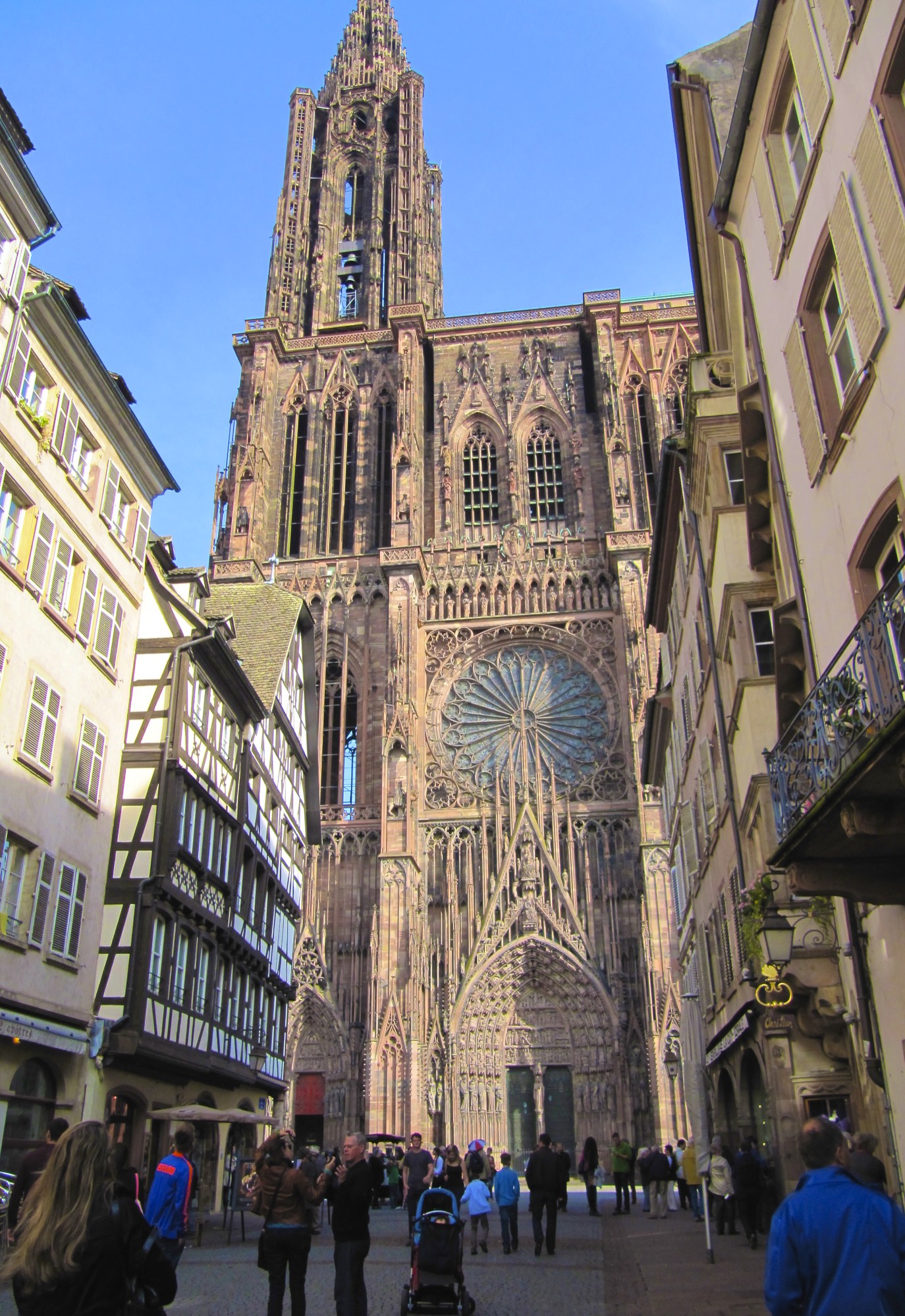
An example? Our guide in Strasbourg on the way to the cathedral through the maze of shops and colorful streets suggested that the great cathedral with its exquisite spire was a beacon drawing shoppers to the city’s abundant bazaars. A medieval version of MacDonald’s Golden Arches?
Medieval planners of the cathedral would be jolted by a suggestion like that. They built their great churches as places of splendor for relieving the monotony, squalor and hardships people experienced in their cities. Seeing them, people walking the streets saw beauty pointing to the heavens. Within them people knew themselves as the people of God.
A billboard for Donald’s? We have no future without history.
For the injustices against the native peoples and the land God provided,“Lord, have mercy.”
For the brave missionaries that ministered to them. “Thanks be to God.”
The native peoples are often forgotten in the story of the “discovery” of America. Our heroes tend to be the settlers who came on ships, built towns and cities, explored the land and gave us what we have today. But it came at a price.
If you ever visit New York harbor by way of the Staten Island Ferry look at the shores now crowded by the buildings and piers of today. Native peoples once fished, hunted and traded in large numbers here. The water was fresher then, fish and shellfish plentiful, the air cleaner, the earth less damaged by human activity.
The National Museum of the American Indian , located in the old customs house across from Battery Park near the ferry, is a good place to remember the role of the native peoples in the story of America. They traded with the Europeans; they were their guides into an unknown land; they provided many of the foods that fed growing populations in Europe and America. They respected the land more than those who came after them.
A young Indian woman, Kateri Tekakwitha and a Jesuit priest, Isaac Jogues, are figures to remember in the customs house. They represent the clash of civilizations that occurred when Europeans and native peoples met. Across the street from the customs house is the statue of Christopher Columbus.
Europeans brought disease. Smallpox disfigured and partially blinded Kateri Tekakwitha, a young Mohawk woman who lived along the Mohawk River past Albany, NY. The native peoples had no immunity to small pox and other diseases. Three out of ten died from it. By some estimates 5 million native people lived in North America when the first Europeans arrived. Within a hundred years there were only 500,000. Besides disease, the major cause of their diminishment, the native peoples also suffered from wars and greed.
At the museum, besides Kateri Tekakwitha remember Father Isaac Jogues, the Jesuit missionary who, while attempting to advance peace-keeping efforts with the Mohawks at Ossernonon (Auriesville) was killed by a war party on October 18, 1646. Previously, in 1642 Jogues had been captured by this same tribe. He escaped in 1643, fled here to New Amsterdam (New York City) and then was put on a ship for France by a kindly Dutch minister.
The French missionaries came to the New World out of the turmoils of the Old World expecting a new Pentecost among the native peoples here, but it didn’t turn out that way. Instead, disease and political maneuvering made the native peoples suspicious of foreigners and the seed of the gospel fell on hard ground.
Letters back to France from the early Jesuits–marvelously preserved in “The Jesuit Relations”–often express the missionaries’ disappointment over their scarce harvest, but it didn’t stop them. They were well grounded in the mystery of the Cross.
“My God, it grieves me greatly that you are not known, that in this savage wilderness all have not been converted to you, that sin has not been driven from it. My God, even if all the brutal tortures which prisoners in this region must endure should fall on me, I offer myself most willingly to them and I alone shall suffer them all.” St. John de Brebéuf
The Indian woman and the priest persevered. We forget how difficult it is when civilizations clash– like now. We remember the Christian missionaries: Saints John de Brébeuf and Isaac Jogues, Priests and their compassions on October 19th..
Columbus, Central Park, NYC
Indian behind symbols of European trade and expansion: Customs House, New York City
Here’s a video on the Jesuit Martyrs at Auriesville:









 The Victor's Place