Pilgims enteing the Church of the Holy Sepulcher, Jerusalem
This ancient ecumenical feast, celebrated by Christian churches throughout the world, commemorates the dedication of a great church in Jerusalem at the place where Jesus died and rose again. Called the Anastasis ( Resurrection) or the Church of the Holy Sepulcher, it was built by the Emperor Constantine and dedicated on September 13, 325. It’s one of Christianity’s holiest places.
Liturgies celebrated in this church, especially its Holy Week liturgy, influenced churches throughout the world. Devotional practices like the Stations of the Cross grew up around this church. Christian pilgrims brought relics and memories from here to every part of the world. Christian mystics were drawn to this church and this feast.
Tomb of Jesus
Calvary
Pilgrims still visit the church and the tomb of Jesus, recently renovated after sixteen centuries of wars, earthquakes, fires and natural disasters. They venerate the rock of Calvary where Jesus died on a cross. The building today is smaller and shabbier than the resplendent church Constantine built, because the original structure was largely destroyed in the 1009 by the mad Moslem caliph al-Hakim. Half of the church was hastily rebuilt by the Crusaders; the present building still bears the scars of time.
Scars of a divided Christendom can also be seen here. Various Christian groups, representing churches of the east and the west, claim age-old rights and warily guard their separate domains. One understands here why Jesus prayed that ” All may be one.”
Egyptian Coptic Christians
Seventeenth century Enlightenment scholars expressed doubts about the authenticity of Jesus’ tomb and the place where he died, Calvary. Is this really it? Alternative spots were proposed, but scientific opinion today favors this site as the place where Jesus suffered, died and was buried.
Before 7 : AM I sit for a few minutes on the porch as the weather gets warmer, watching the birds. There are almost 40 different birds in our garden, just up from the E train. The sparrows and the doves are usual visitors, singing away, but the other day they couldn’t be seen or heard. I soon saw why: a big hawk flew by overhead.
After awhile the birds were back, chirping and moaning as usual. Someone told me our ears are wired to hear the song of birds. Why? They tell us no dangerous enemies nearby, all is well.
Birds singing tell us the world’s in good hands. Is that why Noah sent a dove from the ark? The dove not only brought back olive branches signifying all was well, but sang the good news to those in the closed boat.
The Holy Spirit descends in the form of a dove. The ancients saw birds as mysterious visitors from heaven. I notice something fearless in the doves at our feeder. The sparrows scatter quickly at the least sign of danger; the doves stay and hold their ground. Like the dove, the Holy Spirit is a giver of life to our land and won’t abandon us.
By baptism we’re wired to hear God’s voice. We listen for God’s good news, despite the dangers. We listen for a world redeemed, a higher plan at play. Good reason to begin the day, listening to birds singing..
The first readings this week at Mass from the Acts of the Apostles tell the story of the Greek-speaking deacon Stephen. His fiery preaching against temple worship and “stiff-necked” Jewish opposition to Jesus led to his death and a persecution that drove Greek-speaking Jewish Christians out of Jerusalem. (Monday and Tuesday) But Stephen’s death, like the death of Jesus, brings new life. The church grows. “The death of Christians is the seed of Christianity.” (Tertullian )
Philip the Deacon preaches to the Samaritans north of Jerusalem. Then, led by the Spirit, he converts the Ethiopian eunuch returning home after his pilgrimage to Jerusalem. (Wednesday and Thursday} Following Philip’s activity, Paul, the persecutor, is converted by Jesus himself. (Friday)
Before Paul’s ministry begins, Peter leaves Jerusalem to bless the new Christian communities near the coast; at Joppa he’s told by God to meet the Roman centurion in Caesarea Maritima. The mission to the gentile world begins with that meeting. (Saturday)
The Holy Spirit is at work. in this section of the Acts of the Apostles we see a changing church. The center of the Christian community moves from Jerusalem to Antioch in Syria. The Galilean apostles like Peter, James and John are joined by Stephen, Philip, Barnabas, and Paul, as God’s mysterious plan unfolds. Christian communities leave the Jewish synagogues to become churches on their own, led by bishops, elders, deacons. Christians are no longer only Jews, gentiles from different parts of the Roman world become followers of Jesus.
The Acts of the Apostles reveal a developing, changing church. Change, of course, is not limited to the early church: the church changes and develops in every age. It’s changing and developing now.
The gospel readings this week, from St.John’s gospel– segments of Jesus’ long discourse on the Bread of Life to the crowd at Capernaum after the miracle of the loaves. (John 6) tell us that the Risen Christ remains with us Teacher and Lord in the Eucharist. He is with us in the times we live in.
This is the Second Sunday of Easter. Notice we don’t say the Second Sunday after Easter. We say it’s the 2nd Sunday of Easter because Easter isn’t a one day feast. It’s celebrated every Sunday of the year. Every Sunday is a little Easter. After the yearly feast of Easter we continue to celebrate it for fifty days. Easter isn’t for one day.
Why do we celebrate Easter so extensively? Because the resurrection of Jesus is the center of our faith. It’s central to what we believe. We believe in God who created us and all things. We believe in Jesus Christ, who came among us, died and rose from the dead on the third day. That belief has tremendous consequences for us and for our world.
The story of Thomas the apostle in today’s gospel offers another reason why we celebrate easter as often as we do. Thomas was one of Jesus’ closest followers, “one of the twelve” who heard him teach and saw him work wonders, but Thomas won’t believe the others who tell him they saw Jesus, risen from death.
He’s deeply skeptical. You can hear skepticism in his words: “Unless I see the marks of the nails, and put my finger into the nailmarks, and put my hand into his side, I won’t believe.”
Certainly Thomas isn’t the only one who’s skeptical. You can hear skepticism in the way the other disciples after Jesus rises from the dead. Thomas represents human skepticism, the slowness of us all to believe, the distrust we all have. What’s unique about Thomas is he represents skepticism at its worst.
It’s all right to have some skepticism, you know. We shouldn’t believe everything we hear. We need to check things out. We have to make sure that facts are facts, we need a certain caution in life.
But Thomas’ skepticism seems more than the ordinary. He’s a strong doubter. Yet still, the next Sunday–notice it’s a Sunday–Jesus comes and says “Put your finger here and see my hands, and bring your hand and put it into my side, and do not be unbelieving, but believe.”
Thomas answer, “My Lord and my God!” That’s a beautiful act of faith.
What about us? We’re described in today’s gospel as “those who have not seen, but believe.” and Jesus called us blessed. Yet, we can relate to Thomas. In fact, we live today in skeptical times. We’re skeptical about politics, about our institutions, about our churches, about ourselves. There’s a deep distrust today in the way we speak and in the way we think. We’re wary of others, especially people different from us. It affects our faith too.
Yet, as he did to Thomas, Jesus never abandons us. He gives us the gift to believe. His mercy is always at work. He strengthens us when he comes in the signs of the Eucharist; he strengthens us through the faith we share with each other, week by week, day be day.
Our Sundays may not be the dramatic experience that Thomas had, but something happens here. Our Sundays are always little easters. Jesus come into the room where we are, with our fears and lack of trust. He tells us, as he told his disciples: “Peace be with you.” He shows us the signs of his love and enters our lives. Every Sunday is a happy Easter. Jesus gives us life.
APRIL 21 Mon Octave of Easter Acts 2:14, 22-33/Mt 28:8-15
22 TueOctave of Easter Acts 2:36-41/Jn 20:11-18
23 Wed Octave of Easter Acts 3:1-10/Lk 24:13-35
24 ThuOctave of Easter Acts 3:11-26/Lk 24:35-48
25Fri Octave of Easter Acts 4:1-12/Jn 21:1-14
26 SatOctave of Easter Acts 4:13-21/Mk 16:9-15
272nd SUNDAY OF EASTERActs 2:42-47/1 Pt 1:3-9/Jn 20:19-31
The gospel readings this week recall the Easter appearances of Jesus to his disciples, to , Mary Magdalene and the women at the tomb, to Peter and John, to the Emmaus disciples, to Thomas and the disciples from Galilee who came up with him to Jerusalem. We could call this week “a long day.” Every day this week is a solemnity, like Easter itself. Unfortunately, we limit feasts like Christmas and Easter to a day. We need to savor these feasts and let them sink in.
The Acts of the Apostles, which continues St. Luke’s Gospel and is an important reading in the Easter season, describes how the first witnesses, guided by the Holy Spirit, gave testimony and were received. Looking at the church then can help us understand the church now.
In our readings from Acts on Monday, the witnesses begin to speak. Peter is the first. Just as with Jesus in life, his words are accompanied by a sign from God. The crippled man, a temple regular whom everyone knows, is cured by Peter and John as they come to the temple to pray. He follows Peter and listens to him. He will be a sign that’s contradicted; the temple leaders refuse to credit him as a sign. (Acts, Wednesday to Friday)
From its beginnings in Jerusalem the church gradually spreads into the Roman world, incorporating gentiles, non-Jews, and eventually reaching Rome itself. Believers in the Risen Christ who give their testimony and signs that accompany their witness cause it to grow..
Morning and Evening Prayers here. Week I, Sunday readings all week.
Today’s Tenebrae psalms (Psalms 15, 4, 24) speak of Jesus’ burial in the earth. He is the seed that falls to the ground, but he will rise and bring life:
“My heart rejoices, my soul is glad, Even my body shall rest in safety, For you will not leave my soul among the dead Or let your beloved know decay.” Psalm 15
Jesus gives the gift of risen life, not only to humanity, but to the earth itself. “Cry out with joy to the Lord, all the earth. Serve the Lord with gladness.”“
It’s a gift we doubt is ours:
O men, how long will your hearts be closed
will you love what is futile and seek what is false"
It is the Lord who grants favors to those whom he loves. Psalm 4
The gates of heaven open to Christ, risen from the dead, they are lifted high for all he loves:
O gates lift high your heads, grow higher ancient doors,
let him enter the King of Glory.
Who is the King of Glory, the Lord the mighty and valiant,
the Lord the valiant in war! Psalm 24
Tenebrae for Holy Saturday ends with an ancient homily: “Something strange is happening—there is a great silence on earth today, a great silence and stillness. The whole earth keeps silence because the King is asleep. The earth trembled and is still because God has fallen asleep in the flesh and he has raised up all who have slept ever since the world began. God has died in the flesh and hell trembles with fear.”
“The earth trembled and is still…”
The Passion of Jesus is not only a human story; creation has part in it too. At his death “the earth quaked, rocks were split” Matthew’s gospel says. (Matthew 27,51) “From noon onwards darkness came over the whole land till three in the afternoon,” Matthew, Mark and Luke all say..
The sun that rules the day, the moon that rules the night respond as Jesus cries out in a loud voice and gives up his spirit. Artists through the centuries place sun and moon at the cross of Jesus.
Remember too blood and water, those great elemental realities blood that John’s gospel says flowed from the side of Christ when a soldier pierced his side. Water refreshed with contact with the Word of God; blood source of life for living creatures come from the side of Jesus. They also share in the mystery of redemption.
The homily for today says that Jesus at his death goes “to search for our first parent…to free from sorrow the captives Adam and Eve…I am your God, who for your sake have become your son. Out of love for you and for your descendants I now by my own authority command all who are held in bondage to come forth, all who are in darkness to be enlightened, all who are sleeping to arise. Rise up, work of my hands, you who were created in my image. Rise, let us leave this place, for you are in me and I am in you; together we form only one person and we cannot be separated.”
Artists from the eastern Christian traditon see the Passion of Jesus leading to a great redemption. Jesus does not rise alone, but humanity and creation itself will follow him.
You are the light of the world. A city set on a mountain cannot be hidden. Nor do they light a lamp and then put it under a bushel basket; it is set on a lampstand, where it gives light to all in the house.
Matthew 5:14-15
Jesus, the light of the world, purifies hearts and illuminates minds in the truth, restoring lost sons and daughters to the Father. Every child redeemed by the Lamb of God is a Christ-bearer and therefore, a light-bearer, but from where does the light shine?
In a reading by St. Maximus the Confessor, he identifies the lamp of the parable with Jesus Christ and the lampstand as Holy Church. As the Head and the Body are inseparable, the lamp and the lampstand together illumine the “house, which is the world,” filling all people with divine knowledge.
In an age of profound skepticism and disappointment in the institutional Church, St. Maximus’ vision challenges us to lift up our eyes to the mountain of the Lord (Zechariah 8:3), praying to become one with Christ collectively in the communion of saints. For it is by the virtuous lives of the saints that a world parched for mercy and truth is drawn to the Church as its Mother.
In the old covenant, “the word was hidden under the bushel, that is, under the letter of the law,” veiling the eternal light. In the new covenant of grace in the Father, Son, and Holy Spirit, Christified saints become living letters of the law inscribed not on tablets of stone but on hearts of flesh, vivified by the Spirit (2 Corinthians 3:3).
Bereft of the lamp, the lampstand is dark and empty—a tomb of death and despair. Catholics experience the effects of the empty lampstand in the Church on Good Friday to Holy Saturday every year when the Blessed Sacrament is removed from the sanctuary. At dawn on Easter morning, with millions of candles piercing the darkness around the world, the Body of Christ rises with its Head from the empty tomb, joyfully singing “Alleluia! Christ is risen!”
From an inquiry addressed to Thalassius by Saint Maximus the Confessor, abbot
The light that illumines all men
The lamp set upon the lampstand is Jesus Christ, the true light from the Father, the light that enlightens every man who comes into the world. In taking our own flesh he has become, and is rightly called, a lamp, for he is the connatural wisdom and word of the Father. He is proclaimed in the Church of God in accordance with orthodox faith, and he is lifted up and resplendent among the nations through the lives of those who live virtuously in observance of the commandments. So he gives light to all in the house (that is, in this world), just as he himself, God the Word, says: No one lights a lamp and puts it under a bushel, but on a stand, and it gives light to all in the house. Clearly he is calling himself the lamp, he who was by nature God, and became flesh according to God’s saving purpose.
I think the great David understood this when he spoke of the Lord as a lamp, saying: Your word is a lamp to my feet and a light to my path. For God delivers us from the darkness of ignorance and sin, and hence he is greeted as a lamp in Scripture.
Lamp-like indeed, he alone dispelled the gloom of ignorance and the darkness of evil and became the way of salvation for all men. Through virtue and knowledge, he leads to the Father those who are resolved to walk by him, who is the way of righteousness, in obedience to the divine commandments. He has designated holy Church the lampstand, over which the word of God sheds light through preaching, and illumines with the rays of truth whoever is in this house which is the world, and fills the minds of all men with divine knowledge.
This word is most unwilling to be kept under a bushel; it wills to be set in a high place, upon the sublime beauty of the Church. For while the word was hidden under the bushel, that is, under the letter of the law, it deprived all men of eternal light. For then it could not give spiritual contemplation to men striving to strip themselves of a sensuality that is illusory, capable only of deceit, and able to perceive only decadent bodies like their own. But the word wills to be set upon a lampstand, the Church, where rational worship is offered in the spirit, that it may enlighten all men. For the letter, when it is not spiritually understood, bears a carnal sense only, which restricts its expression and does not allow the real force of what is written to reach the hearer’s mind.
Let us, then, not light the lamp by contemplation and action, only to put it under a bushel—that lamp, I mean, which is the enlightening word of knowledge—lest we be condemned for restricting by the letter the incomprehensible power of wisdom. Rather let us place it upon the lampstand of holy Church, on the heights of true contemplation, where it may kindle for all men the light of divine teaching.
Reference
The passage from St. Maximus the Confessor can be found in the Office of Readings for Wednesday of the 28th Week in Ordinary Time.
The Passionists celebrate the Feast of the Glorious Wounds of Jesus on Friday of the second week of Easter. The four gospels tell the great story of the passion of Jesus, each in its own way. More than the others, John’s gospel focuses on his wounds, unlikely signs revealing the mystery of the Word made flesh.
On Calvary a small symbolic group stands beneath the cross of “the King of the Jews”– Mary, the mother of Jesus, the disciple whom he loved, and a few others. A gentile soldier joins them.
This group represents the “new Jerusalem,” “the inhabitants of Jerusalem who look on the one whom they have pierced…and mourn for him, as one mourns for an only child.” (Zechariah 11, 10 )
They receive a precious gift. “It is finished!” Jesus declares, and bowing his head, he pours out his spirit on them. A Roman soldier thrusts a spear into Jesus’ side. “Immediately blood and water flowed out.” (John 19, 34)
Blood, a sign of his life, flows on those standing beneath his cross. Water, signifying the Spirit within him, is poured out on the world they represent. Far from ending his life, his death is the moment Jesus shares his life.“This is the one who came by water and blood, Jesus Christ.” (I John 5,6)
Artists afterwards picture the wounds of Christ as cosmic signs. They place the grave of Adam beneath the cross — generations wait for the new life Jesus brings. Creation, symbolized by the sun and moon, looks on expectantly, for Calvary is where creation too is redeemed. Angels collect the blood and water from Jesus’ wounds in cups representing the mystery of the Eucharist. All days are found in this one day. On Calvary, the glory of the Lord is revealed in his wounds.
St. Paul of the Cross in his letters often wished the one to whom he’s writing to be placed in the “wounds of Christ” or the “holy Side of Jesus” or his “Sacred Heart.” “I am in a hurry and leave you in the holy Side of Jesus, where I ask rich blessings for you.”
These expressions may seem pious phrases until we read the story of Thomas from John’s gospel. Jesus shows the doubting disciple the wounds in his hands and side, and Thomas believes.
Belief is not something we come to by ourselves. God gives this gift through Jesus Christ. We all stand beneath the life-giving Cross of Jesus. May his life give new hope to us and our world.
April showers. Spring rains. A bowl of Easter Water stands near our altar during the Easter season.
Cyril of Jerusalem has a wonderful sermon on water that he preached to catechumens centuries ago. Here are a couple of lines:
“Water comes down from heaven as rain, and although it is always the same itself, it produces many different effects, one in the palm tree, another in the vine, and so on throughout the whole of creation. It does not come down, now as one thing, now as another, but while remaining essentially the same, it adapts itself to the needs of every creature that receives it.”
The saint goes on to say that just as water adapts itself to every creature, the Holy Spirit gives life to each one according to its needs and to benefit the common good. The Spirit’s coming is gentle, not felt as a burden, with tenderness, as a true friend, to save, heal, counsel, strengthen and console.
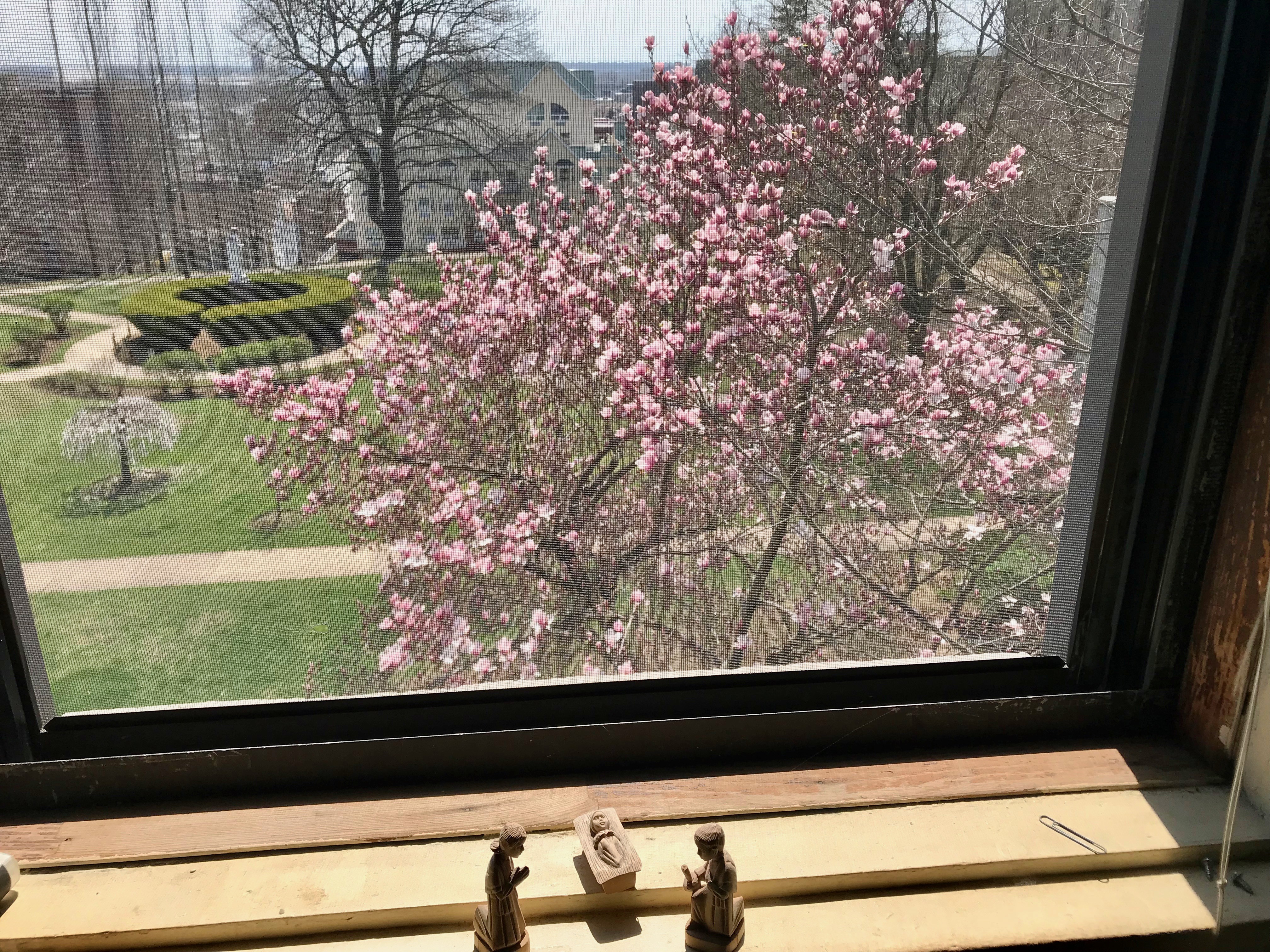
So back to spring rains. They have come this year. The magnolia trees outside my room testify they’ve come, and the other trees and plants in our garden testify too. The rain falling on the earth does what it always does. Like the Spirit of God, water brings life.
Might we learn from the spring rains bringing life to all the varied plants, all shapes, all sizes, even some we might think useless or of no account?. Might we learn from the spring rains?
Send the spring rains, Lord, on our varied earth and human family.
Photo art by Fr. Victor Hoagland, C.P. and Gloria M. Chang
The Regina Caeli is a 12th century antiphon in honor of the Blessed Virgin Mary that is prayed during the Easter season in place of the Angelus. A legend records that during a pestilence in Rome, while the Regina Caeli was being prayed in procession with her image, angels were heard singing along and an end was put to the plague. Let us pray to our Queen with the angels to bring healing to our world.





 The Victor's Place
