Category Archives: contemplation

December 18: Joseph, Son of David

Nativity

In the gospel of Matthew  Joseph, the husband of Mary, has an important role in Jesus’ birth and early years. Mary points to him to tell the story of the birth of Jesus in the illustration above.

Matthew’s gospel calls Joseph  a just man, someone who listens to God rather than to himself. He does God’s will. He’s a carpenter, the gospels say, certainly not someone privileged – but he’s a “son of David” from the royal family who gives the world a Messiah.

During their betrothal, which in Jewish tradition was more than the modern engagement we know, Joseph finds that Mary is pregnant. A just man, he struggles to find a way to divorce her quietly when, in a dream, an angel of God tells him not to be afraid to take Mary as his wife.

Here is the key part of the angel’s message: “For it is through the Holy Spirit 
that this child has been conceived in her. She will bear a son and you are to name him Jesus, because he will save his people from their sins.”

Like Mary, Joseph believes God’s message. Like Mary, he sees more than human eyes and a human mind sees. “When Joseph awoke, he did as the angel of the Lord had commanded him and took his wife into his home.” He believed what we say in our creed: “(Jesus) was conceived by the Holy Spirit, born of the virgin Mary.” Jesus became one of us, God was with us.

Artists early on pictured Joseph with his head in his hands, listening in sleep to the angel’s message. In a dream later he heard the angel telling him to take the child and his mother to Egypt to escape Herod, the king. He was a man of great faith.

The medieval artist who painted the picture above has Mary pointing to Joseph as a witness to whose Child this is who’s’ born in a stable. They are the first to believe and they will care for Jesus with all the love and care they can give him.

Joseph has his hand on his head.. The angel spoke to him in dreams. Faith is like a dream where God speaks to us in another way.

O Leader of the House of Israel,
giver of the Law to Moses on Sinai:
come to rescue us with your mighty power!

The gospels for the remaining days until Christmas are from St. Luke, recalling the angel’s visit to Mary and her relative Zechariah. Matthew’s gospel will be read again after the birth of the Child, when Joseph will be warned of danger and takes the Child and Mary to Egypt and then to Nazareth..

Wednesday, 2nd Week of Advent

Isaiah


In yesterday’s first reading for Advent, Second Isaiah repeats to the exiles in Babylon words he hears from God: “Comfort, give comfort to my people, says your God.” In today’s gospel reading Jesus says:“Come to me, all you who labor and are burdened, and I will refresh you.” A favorite reading for so many of us.

Notice Jesus speaks to the “crowds” in Matthew’s gospel, not just to the disciples who know him, or the Jewish Christian church Matthew wrote for at the end of the first century.  God’s love and God’s promises reach far beyond the circle of disciples or the church.  Jesus Christ came to refresh the world that labors and is burdened, even if it doesn’t know him.

 Second Isaiah in today’s readings appeals to Jewish exiles to remember the eternal God, creator of the ends of the earth. Do not to abandon God for the Babylon’s gods who are too small, he tells them and us all.  

“To whom can you liken me as an equal?
says the Holy One…
Do you not know
or have you not heard?
The LORD is the eternal God,
creator of the ends of the earth.
He does not faint nor grow weary,
and his knowledge is beyond scrutiny.”

God still holds us in his hands, sustains and comforts us, even if we do not know him or seem to care. God’s Spirit does not faint or grow weary

The Maccabees: Restoring the Temple

This week’s Mass readings from the 1st Book of Maccabees tell the story of the re-dedication of the temple of Jerusalem three years after its profanation  by Antiochus Epiphanes.  About the year 167 BC,  Jews under Judas Maccabeus took up the weapons of their time, re-conquered Jerusalem and restored the temple, the heart of their religion.

The first reading on Friday describes the rededication of the temple to its former glory. The Jews continue to celebrate it in the feast of Hannukah. (1 Maccabees 4,36-61}

The New Testament writers, certainly aware of this historic event, recall Jesus cleansing the temple.(Friday’s gospel) Entering Jerusalem after his journey from Galilee, “ Jesus went into the temple area and proceeded to drive out those who were selling things, saying to them, ‘It is written, My house shall be a house of prayer, but you have made it a den of thieves.’” Then, “every day he was teaching in the temple area” until he was arrested and put to death. (Luke 19,45-48)

Cleansing the temple was a symbolic act. By it,  Jesus signified  he is the presence of God, the Word made flesh, the new temple of God.

Luke says Jesus taught in the temple “every day.” Even from his early days he taught in the temple, Luke writes. As our eternal high priest, he teaches us every day and brings us every day to his Father and our Father.

Jesus is the indestructible temple, the indestructible Presence of God among us. Witnesses at his trial before he died were half right when they said he spoke of destroying the temple. He was speaking of the temple of his own body. Death seemed to destroy him, but he was raised up bodily on the third day.We share in this mystery as “members of his body.”

Still, as sacramental people we need places like temples and churches to come together, to pray and to meet God who “dwells among us.” We need churches and holy places and instinctively revolt seeing them go, or not frequented.

Old stories, like the story of the Maccabees, carry lessons and raise questions. The Maccabees took the military option to restore and pursue the Kingdom. What are our military options today when we have atomic weapons, drones, cryptoweaponry at our disposal? New laws? Persuasion?

Old stories raise questions.

Wisdom

img_0325

Everyday this week, the 32nd week of the year, we’re reading at Mass from the Book of Wisdom. the Bible’s wisdom literature –Proverbs, Job, Ecclesiastes, Wisdom, Sirach– is not primarily spiritual wisdom or the high-level learning of graduate school. It’s  wisdom from the school of everyday.

Jesus’ parable of the wise and foolish virgins from Matthew’s gospel is an example.  Why didn’t the foolish virgins bring enough oil to the wedding like the wise virgins did? They didn’t learn from their own experience. Simple as that. (Matthew 24, 1-13)

Learn from your own life experience and the experience of others, the wisdom traditions says.  Yes, God’s help is there, but God expects us to help ourselves, and we have to do that everyday.

“The beginning of wisdom is: get wisdom; whatever else you get, get understanding.” (Proverbs 4,7)

Keep learning, from childhood to old age; it’s imperative. Search for wisdom every day, whether the day is easy or dark, whether there’s joy or suffering. (Book of Job)

The wisdom literature recognizes the search for wisdom is hard. We get fixated on things like success, careers, money, pleasure, health, politics, but the school of life is bigger than any of these.

The wisdom literature recognizes too that we’re drawn to a greater reality. “Fear of the Lord is the beginning of wisdom.” We’re made to wonder before what’s greater than we are. We’re not satisfied with small things. “Our hearts are restless, till they rest in you.”

“Resplendent and unfading is Wisdom, and she is readily perceived by those who love her, and found by those who seek her.

She hastens to make herself known to those who desire her; one who watches for her at dawn will not be disappointed, for she will be found sitting at the gate.” (Wisdom 6, 12-14)

Are We Caring for Our Common Home?


Pooe Leo began an important conference in Rome October1 on the environment with that question posed by Pope Francis ten years ago in his letter Laudao si’.Looks like many of the countries of the world, especially the USA, are turning away from that question. We are absorbed in our wars and political fights.

“ Our Sister Earth cries out, pleading that we take another course. Never have we so hurt and mistreated our common home as we have in the last two hundred years. Yet we are called to be instruments of God our Father, so that our planet might be what he desired when he created it and correspond with his plan for peace, beauty and fullness.

The problem is that we still lack the culture needed to confront this crisis. We lack leadership capable of striking out on new paths and meeting the needs of the present with concern for all and without prejudice towards coming generations. The establishment of a legal framework which can set clear boundaries and ensure the protection of ecosystems has become indispensable; otherwise, the new power structures based on the techno-economic paradigm may overwhelm not only our politics but also freedom and justice.

It is remarkable how weak international political responses have been. The failure of global summits on the environment make it plain that our politics are subject to technology and finance. There are too many special interests, and economic interests easily end up trumping the common good and manipulating information so that their own plans will not be affected. Any genuine attempt by groups within society to introduce change is viewed as a nuisance based on romantic illusions or an obstacle to be circumvented.”

Pope Francis, Laudato SI 54-55

Today at the Vatican Gardens outside Rome evironmental leaders of the world gathered to answer that question: Are we caring for our common home?

One thing to notice about this conference, which involved artists,scientists, politicians, business people, ordinary people. Pope Leo sat among them, not before them, as if to signify their equal task in the care of the environment. They bring an equal wisdom to the challenge of caring for the earth. It’s not just the task of religious people, or a pope. It’s a common task for a common good.

Prayer to My Guardian Angel

“Prayer to My Guardian Angel” (abridged)
Matthew 18:1-5, 10
Memorial of the Holy Guardian Angels
©️2021 Gloria M. Chang

At that time the disciples approached Jesus and said, “Who is the greatest in the kingdom of heaven?” He called a child over, placed it in their midst, and said, “Amen, I say to you, unless you turn and become like children, you will not enter the kingdom of heaven. Whoever humbles himself like this child is the greatest in the kingdom of heaven. And whoever receives one child such as this in my name receives me.

See that you do not despise one of these little ones, for I say to you that their angels in heaven always look upon the face of my heavenly Father.”

Matthew 18:1-5, 10

Guardian Angels Guide Us to the Father

God, the Father Almighty, maker of heaven and earth, of all things visible and invisible, placed Christ at the center of the angelic world. Every child made in the image of the Incarnate Son of God receives a guardian angel at conception to guide them in their journey home to the Father. As “their angels in heaven always look upon the face of my heavenly Father,” they intercede and light the way through Christ in the Spirit to the heart of the Father.

From its beginning until death, human life is surrounded by their watchful care and intercession. “Beside each believer stands an angel as protector and shepherd leading him to life.” Already here on earth the Christian life shares by faith in the blessed company of angels and men united in God.

Catechism of the Catholic Church 336

Prayer to My Guardian Angel

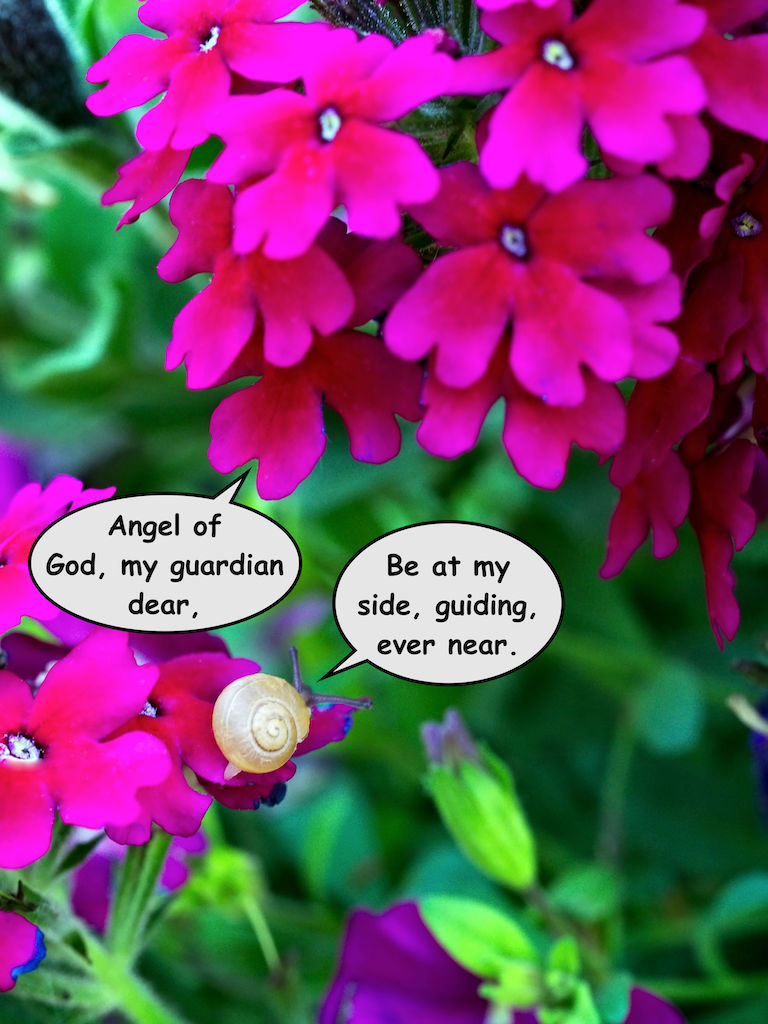
Angel of God, my guardian dear,
to whom God’s love commits me here,
ever this day be at my side,
to light and guard, to rule and guide. 
Amen.

Angel of God, my guardian dear,
Be at my side, guiding, ever near.


This content by Gloria M. Chang was originally published online at Shalom Snail: Journey to Wholeness.

Saint Lawrence, the Deacon

August 10th is the Feast of St. Lawrence, the deacon, who ranks after Peter and Paul as a patron of the Church of Rome. The Emperor Constantine built a church honoring him on the Via Tiburtina, near one of the major gateways to the city in the 4th century. Lawrence was a Christian martyr, but he was something more.

Lawrence was a deacon of the Roman church in the middle of the 3rd century when Rome began experiencing wars and political instability. Gothic tribes breached the Roman lines along the Rhine River and the Persians invaded in the east.

The only thing to do was expand the army, and that’s what the Emperor Valerian did. He built walls and expanded armies. That cost money, of course, and in Rome the burden fell heavily on the poor. Famine and plague only worsened their situation.

The Christian church stepped in to help. Christians were still relatively few in numbers then, not wealthy, but they gave generously to the poor, and the Roman people admired what they saw.

Lawrence, the deacon, was behind this extraordinary Christian effort. After all, Jesus said: “I was hungry, and you gave me to eat; I was thirsty, you gave me to drink; I was sick and you visited me.”

Lawrence giving to the poor: Fra Angelico

Rome’s leaders became upset by the church’s growng popularity. They also wondered if the church’s money couldn’t be channeled towards their war effort. And so, in 257 an edict was published to imprison church leaders and confiscate church money. A second edict in 258 caused blood to flow. Pope Sixtus II and four deacons were seized in the catacombs of St. Callistus and executed on August 6th. Lawrence, the deacon, was seized and executed on August 10th. That’s why his feast day is today.

Popular stories later offered a colorful account of Lawrence’s martyrdom shaping his story and the way artists pictured him:

The Roman prefect, anxious for the church’s money, promised Lawrence freedom if he would transfer it over to him. Lawrence asked for three days to get the church’s treasures together for delivery to the prefect’s house. Then, after distributing the church’s monies to the poor, he gathered them and brought them to the prefect’s door. “Here are the church’s treasures,” he told the official, “ – the blind, the lame, the orphans and the old.”

The prefect ordered Lawrence burned alive on a gridiron. Those witnessing his execution said the saint went to his death cheerfully, even joking with his executioners. “Turn me over, I’m done on this side.”

After these events the Roman church gained a flood of converts. Respect for Christianity grew, not just because of its brave martyrs, but because of its outreach to the poor.

Constantine honored Lawrence, not just because he died for his faith, but because of his care of the poor. He would rely on the church, not just for its political support, but for its care of the poor.

Wherever you go in Rome, you are going to find Lawrence. There are other churches honoring him; he’s often pictured with Peter and Paul, the founders of the Roman church; Michelangelo has him among the blessed at the last judgment in the Sistine Chapel. Lawrence represents something important in the church.

A large fresco of the saint stands at the entrance to the Vatican Museum’s Chapel of Nicholas V with its priceless works of art. Lawrence seems blind to the riches all around him as he boldly proclaims the message inscribed beneath his feet: The Poor are the Treasures of the Church.

They should always be the treasures of the church.

Here’s a video on St. Lawrence

St. Bridget of Sweden: July 23

St. Bridget of Sweden, whose feast is July 23rd, was a 14th century mystic.She was a woman who challenged the powerful of her day, first the court of Sweden and later the papacy. She influenced Christian spirituality and art,

Born into a powerful Swedish family with ties to the royal court. Bridget married Ulf Gudmarrson when she was 14. They had 8 children, one of whom is also honored as a saint, Catherine of Sweden. Bridget was known for the care she took of the sick around her. She brought her children with her on her visits, to teach them this work of mercy.

As a child of 10 Bridget was attracted to the mystery of the Passion of Jesus and that mystery inspired her prayer and spirituality ever afterwards. Her deep understanding of his mystery made her fearless in challenging injustice when she saw it. Bridget protested the wanton living of Swedish royalty and its uncaring attitude towards the poor. After her husband’s death in 1334 she founded a religious community, continuing to speak out fearlessly against the lifestyle and privileges of the powerful.

In 1350 Bridget went to Rome to gain approval for her Order of the Most Holy Savior, the Brigittines. There she was inspired to confront the papacy. The pope , fearing the turmoil in the Papal States, had fled to in Avignon in France. Bridget strongly urged him to return to Rome. The pope was a shepherd, she said; he should be with his sheep, especially in times of turmoil.

Bridget’s prayers and revelations, widely circulated in her time, were reminders of what Jesus said and did, especially the example he gave in his Passion. She inspired people to meditate on the mysteries of Christ for their wisdom.

Artists were inspired in their portrayals of the mysteries of Christ. She saw in a vision Mary and Joseph adoring the Child lying on the ground. His Incarnation made the earth his home. Previously, Mary was portrayed at the crib, lying down after giving birth. In Bridget’s portrayal she joins Joseph, the shepherds (humanity) and the earth itself adoring the Word made flesh.

Jesus birth
Adoration of the Child, Giorgione, 1507, National Gallery, Washington

Bridget also inspired the portrayal of Mary holding the body of Jesus after his crucifixion and the devotion of the Pieta. Cradling him in her arms,, she recalls holding him at his birth in Bethlehem, Bridget said.

Rhine Valley, 14th century

In 1371, Bridget and some of her family went on pilgrimage to the Holy Land; her vivid accounts from there further stimulated the religious imagination of her contemporaries. On July 23, 1373 she died in Rome. Bridget is a patron of Sweden and of Europe.

The church always needs strong women like Bridget, firm in faith and unafraid to speak out. Society too needs women like her in politics and business to steer its course into the future.

Our church today seems to be alive with visionaries, people who claim God has revealed something to them. Bridget was always aware of the possibility that her visions could come from another source rather than God. She prayed to be saved from delusions and pride. This 15th century Swedish painting depicts Satan trying to influence her, but is hit over the head by an angel.

Prayer of St. Bridget

Jesus, true and fruitful Vine! Remember the abundant outpouring of blood shed from your sacred body as juice from grapes in a wine press.    From your side, pierced with a lance by a soldier, blood and water poured out until not a single drop was left in your body.

Through your bitter Passion and your precious blood poured out, receive my soul when I come to die. Amen.

O good Jesus! Pierce my heart so that my tears of penance and love will be my bread day and night; may I be converted entirely to you, may my heart be your home, may my conversation please you, may I merit heaven at the end of my life and be with you and your saints, to praise you forever. Amen

St. Cyril of Alexandria (d.444)

To be a saint doesn’t mean you’re perfect, Pope Francis says in his exhortation “Gaudete et exsultate“, on holiness in today’s world. That’s good to remember when we consider St.Cyril of Alexandria, the 4th century bishop of Alexandria and doctor of the church, whose feast is today, June 26th.

If you read his online biography in Wikipedia–where many today look for information about saints – you’ll find that he was deeply involved in the messy partisan politics of his time, when Christians, Jews and pagans fought and schemed to control over Alexandria, the city then probably the most important city in the Roman empire. Some called him a “proud Pharaoh;” “ a monster” out to destroy the church, an impulsive, scheming bishop in a riotous city. The Wikipedia biography mainly sees him that way.

He was a saint, other biographies say. Why a saint? Well, Cyril was absorbed in understanding and defending the Incarnation of the Word of God. How did the Word of God come among us? Who was Jesus Christ? Pursuing that mystery defined Cyril during life. It was at the heart of things for him, and the voluminous collection of sermons, letters, commentaries and controversial essays he left bears out that interest.

He thought and wrote extensively about this mystery. The way he came to express it was used at the Council of Ephesus (431) and became the way we also express it in our prayers. Mary was the Mother of God. The One born of her was not simply another human being. Her Son was true God, who would be truly human and eventually die on the Cross. God “so loved the world” that he came among us as Mary’s Son.

What we see as “the totality” of Cyril’s life, his “life’s jouney”, the “overall meaning of his person”, to use the pope’s words, is not his involvement in the violent politics of his day. Yes, that was there. But his abiding quest was to know Jesus Christ.

“‘The Word was made flesh’ [John 1:14], can mean nothing else but that he became flesh and blood like ours; he made our body his own and came forth man from a woman, not casting off his existence as God, or his generation of God the Father, but in taking to himself flesh remaining what he was. 

“This is the correct faith proclaimed everywhere. The holy teachers taught this and so they called the holy Virgin, the Mother of God, not as if the nature of the Word or his divinity began from the holy Virgin, but because that holy body with a rational soul, to which the Word, personally united, was born of her according to the flesh.”

— St. Cyril of Alexandria, First Letter to Nestorius

“When poisonous pride swells up in you, turn to the Eucharist; and that Bread, which is your God humbling and disguising himself, will teach you humility. When the fever of selfish greed rages in you, feed on this Bread; and you will learn generosity. When you feel the itch of intemperance, nourish yourself with the Flesh and Blood of Christ, who practiced heroic self-control during His earthly life, and you will become temperate. When you are lazy and sluggish about spiritual things, strengthen yourself with this heavenly Food; and you will grow fervent. Lastly, when you feel scorched by the fever of impurity, go to the banquet of the Angels; and the spotless Flesh of Christ will make you pure and chaste.”

Tenebrae: Holy Saturday

Today’s Tenebrae psalms (Psalms 15, 4, 24) speak of Jesus’ burial in the earth. He is the seed that falls to the ground, but he will rise and bring life:

“My heart rejoices, my soul is glad,                                                                                        Even my body shall rest in safety,                                                                                             For you will not leave my soul among the dead                                                                       Or let your beloved know decay.” Psalm 15

Jesus gives the gift of risen life, not only to humanity, but to the earth itself. “Cry out with joy to the Lord, all the earth. Serve the Lord with gladness.”“

It’s a gift we doubt is ours:

O men, how long will your hearts be closed
will you love what is futile and seek what is false"
It is the Lord who grants favors to those whom he loves.
Psalm 4

The gates of heaven open to Christ, risen from the dead, they are lifted high for all he loves:

O gates lift high your heads, grow higher ancient doors,
let him enter the King of Glory.
Who is the King of Glory, the Lord the mighty and valiant,
the Lord the valiant in war! Psalm 24

Tenebrae for Holy Saturday ends with an ancient homily: “Something strange is happening—there is a great silence on earth today, a great silence and stillness. The whole earth keeps silence because the King is asleep. The earth trembled and is still because God has fallen asleep in the flesh and he has raised up all who have slept ever since the world began. God has died in the flesh and hell trembles with fear.”

“The earth trembled and is still…” 

The Passion of Jesus is not only a human story; creation has part in it too. At his death “the earth quaked, rocks were split” Matthew’s gospel says. (Matthew 27,51) “From noon onwards darkness came over the whole land till three in the afternoon,” Matthew, Mark and Luke all say..

 The sun that rules the day, the moon that rules the night respond as Jesus cries out in a loud voice and gives up his spirit. Artists through the centuries place sun and moon at the cross of Jesus.

Remember too blood and water, those great elemental realities blood that John’s gospel says flowed from the side of Christ when a soldier pierced his side. Water refreshed with contact with the Word of God; blood source of life for living creatures come from the side of Jesus. They also share in the mystery of redemption.

The homily for today says that Jesus at his death goes “to search for our first parent…to free from sorrow the captives Adam and Eve…I am your God, who for your sake have become your son. Out of love for you and for your descendants I now by my own authority command all who are held in bondage to come forth, all who are in darkness to be enlightened, all who are sleeping to arise. Rise up, work of my hands, you who were created in my image. Rise, let us leave this place, for you are in me and I am in you; together we form only one person and we cannot be separated.”

Artists from the eastern Christian traditon see the Passion of Jesus leading to a great redemption. Jesus does not rise alone, but humanity and creation itself  will follow him.