Category Archives: art

First Snow in Our Mary Garden

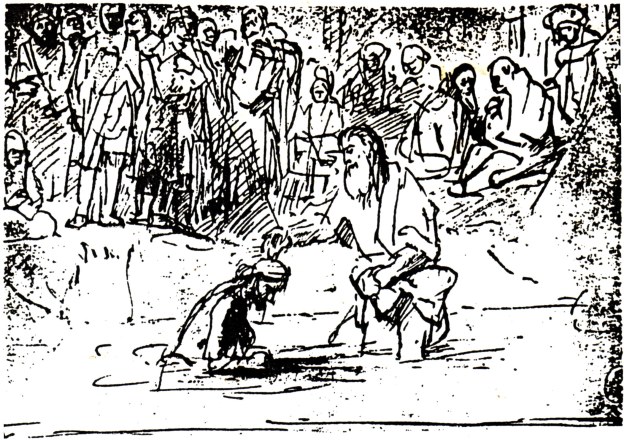
Jesus Preaching, by Rembrandt van Rijn

How do you draw the face of the most perfect man who ever lived, never having seen him? That was Rembrandt’s challenge, and he met it as he composed this serene, gentle and questioning countenance.

It is amazing how often, in discourse and conversation, our Lord asked questions. And these questions continue to contain answers a hearer can discover, the more he reflects upon them.

That was the way Socrates taught, realizing that a really good question should already contain its answer, if the question be truly understood.

That’s why the best teacher I ever had required us, in a final exam, not to answer his questions, but to ask ten questions that would prove how well we could synthesize his course. The questions, he’d say, should grow out of and toward one another, containing the answers as a seed contains the bud.

Here Jesus seems to be asking, “What can a man offer in exchange for his life?” (Mark 8:37) The answer is there, if we properly evaluate each word. It is implicit, too, in his question, “Who do you say that I am?” (Matthew 16:15) Peter gave answer for us all, since to know Jesus is to have seen the Father also. (John 14:9)

A true answer is always the echo of a question. So it should be our ambition to echo, without distortion, the question he continues to ask us: “Will you also go away?” (John 6:67) Then everything we say or do will proclaim that Jesus has the words of eternal life, that there is no other way to truth that has not found life in him.

From Meditations on Some Art I Have Loved

By Fr. Hilary Sweeney, C.P.

The Art and Imagination of Duk Soon Fwang

The Baptism of Jesus, by Rembrandt van Rijn

We are at a point along the lowest level of the earth’s surface, at that solemn moment in time when God’s own Son is about to begin his ministry of salvation. 

Along the farther bank, a small group of people are observing the men in the river. Jesus crouches down into the water, head bowed, as John the Baptist pours a shell full of water upon our Lord’s head. John’s face radiates loving admiration, while that of Jesus is one of utter humility.

This, of course, was not the sacrament of baptism. It was a simple ritual washing for repentant sinners who were invited to be symbolically cleansed of their moral defilements.

John’s “baptism” was one of many previous such ritual washings which, in fact, go on to this day in the River Ganges.

We believe that God’s Son, though born of a woman, was sinless. Why, then, did He submit to what must seem an indignity upon His holiness?

He entered the water and submitted to this “baptism,” not to be cleansed (of sin), but, symbolically, to be defiled by it. It was a prophetic action familiar to the non-verbal preaching of the great prophets of Israel.

Jesus was claiming (as far as it was possible to do so) His solidarity with our sinful race, since He was already, through Mary and by the power of the Holy Spirit, one with us in our humanity.

This was as close as Jesus would come to sin—not to be invaded by it, but to share its unhappy consequences in the pain and death He would endure for us.

From Meditations on Some Art I Have Loved

By Fr. Hilary Sweeney, C.P.

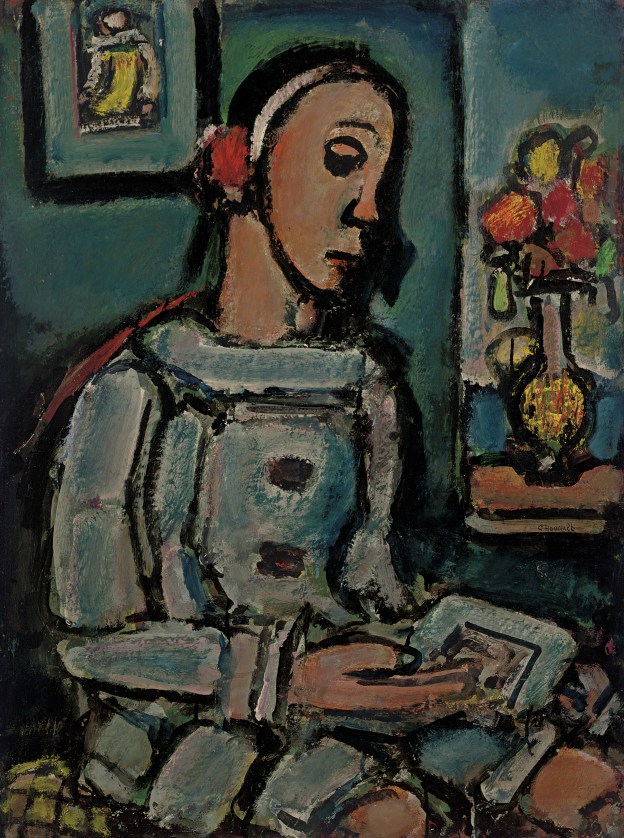
The Wise Pierrot, by Georges Rouault

Is this clown wise because he is reading a book? Are the illiterate necessarily stupid? Are books the best source of truth? Not at all. 

In this life, the true medium of the best message has been, is and always will be—sorrow. Carl Jung and Rollo May are emphatic on this point. Add St. John of the Cross, and Melville too: ‘The truest of men was the Man of Sorrows.’

So don’t pity this sad clown. He is learning, and Shakespeare put it well: ‘Knowledge has a bloody entrance.’

Painless learning is a delusion—especially that learning which must begin with self. ‘Lord,’ cried St. Augustine, ‘May I know myself, may I know Thee.’ A courageous prayer and a necessary one, for anyone who would really know God.

For, to look into one’s heart and search out one’s true motives; to face, as in a mirror, the real blotches, wrinkles and wastes of one’s spirit is not a discipline for a fool. And only he is truly wise who sees himself as nearly as he is, and accepts his gifts without smugness, his handicaps without regret.

Yes, indeed, wisdom is what’s left, when all your courses and readings are forgotten.

From Meditations on Some Art I Have Loved

By Fr. Hilary Sweeney, C.P.

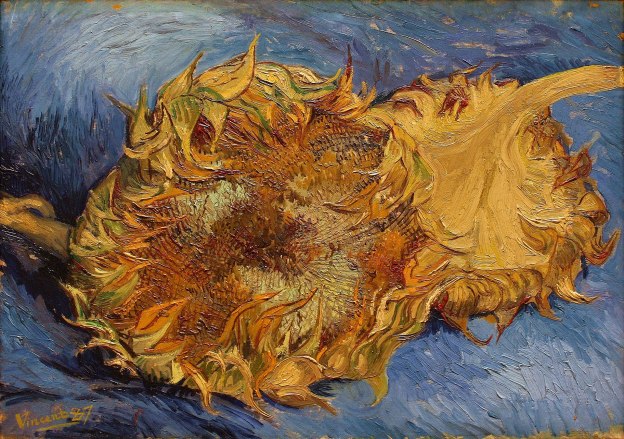
Sunflowers, by Vincent van Gogh

It has always fascinated me that when the giant sunflower plant bursts out to its glorious flower head, it is not long before it droops down (heavy with seed), upon the neck of its thick trunk. So intimately, even in nature, is humility joined to exaltation. “Whoever humbles himself shall be exalted.”

Vincent made many attempts to picture the wondrous sunflower, and here he gives us the plant’s apotheosis and its declension side-by-side. This tells us that the seeds within the flower head do not reach maturity until the plant bows low.

How exalted we’ve all felt, at times, in our youth and in our burgeoning years—to have accomplished something really good. And yet it was only when the weight of that glory (Augustine’s pondus gloriae) made us bow down before God in adoration—that our work was indeed well done. 

I honor the Chinese tradition that finds in the chrysanthemum (the last of summer’s flowers) a symbol of old age. But here in the West, the sunflower serves us even more tellingly.

It is only when life seems to have ended that it really begins. Whoever loses his life keeps it. So, when we are beset with discouragement over the goods we lose or that are taken from us, it is important to remember that Jesus never did so much for this world as when He seemed to be doing nothing—on the Cross.

There is great feeling in this painting. The flowers seem to elicit the reach of your hand, the feel of your fingertips upon their surfaces—those marvelous double helix packages.

From Meditations on Some Art I Have Loved

By Fr. Hilary Sweeney, C.P.

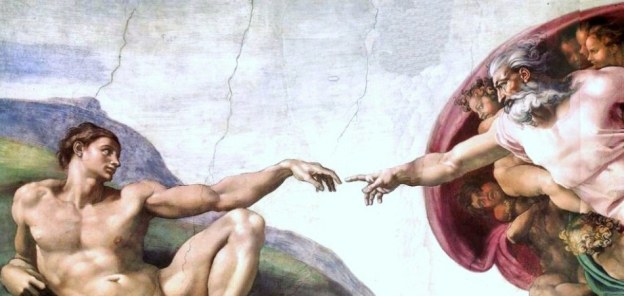
The Creation of Man, by Michelangelo

It was a stroke of genius to have left a space between Adam’s reach and His Maker’s. For, if it is man’s innate need to reach for God, it is in God’s power alone to satisfy that need.

Man, at his best, strives. He is most truly himself when he reaches beyond himself—to God. And yet the space between man and God is never so little that it is not infinite.

Man lives upon spaces, pauses. He can breathe and speak in no other way. And no matter how earnestly he strives, he must learn that waiting is the only way to meet God. For God comes to us, not we to Him.

Before completing His work of creating Mankind, God put Adam to sleep. In a sense, then, rest is the Creator’s visible signature upon our flesh. For sleep, or rest is an interval between nothing and something. And no truer description of man’s way to God was ever made than the Psalmist’s cry—“Wait for the Lord.” Nor did anything more truly describe our Lord’s humanity than the need He felt to wait for ‘the hour’ appointed by the Father—a waiting which Jesus described as an ordeal. (Luke 12:52)

It is very human to think: ‘If only there were something to hope for, I could be patient.’ But Paul reveals how far God’s ways are from ours, when he writes, ‘We wait for hope with patience.’ (Romans 8:25) So—patience first, then hope!

Let’s not put limits on God, Whose designs are beyond our measuring, while our own were limited before they began. (Psalm 139)

Be patient, then, when your situation seems hopeless—even as, in Faith, you believe what you do not see, and in Charity, you love what is naturally unlovable. Such is the nature of any virtue worthy to be called ‘theological’, that is, a virtue whose object is God Himself.

From Meditations on Some Art I Have Loved

By Fr. Hilary Sweeney, C.P.

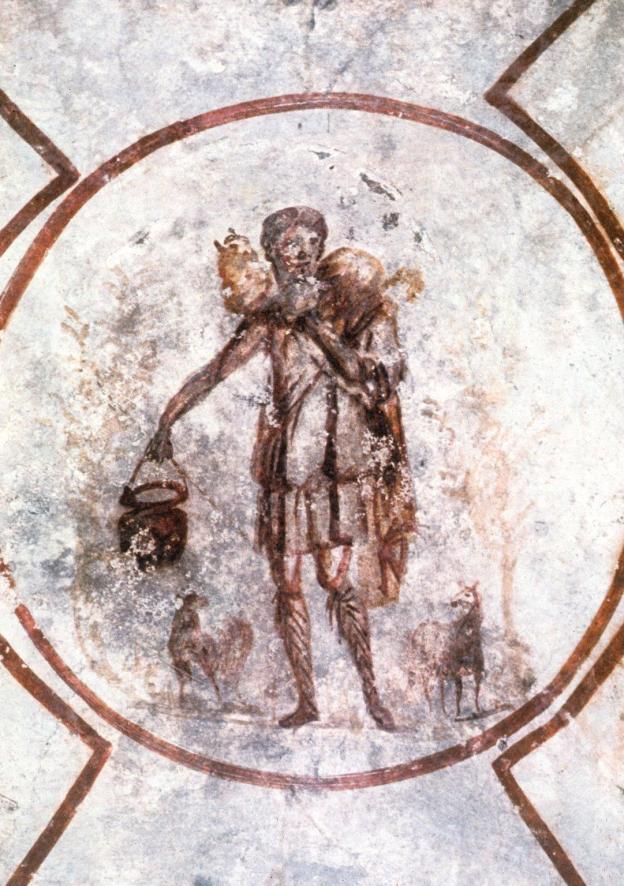
The Good Shepherd, 260 A.D. (Anon)

This is one of the oldest Christian paintings on plaster. It comes from the catacomb of the martyr, St. Callistus, in Rome.

Bearing an injured sheep across his shoulders, the shepherd carries a pot of burning oil in his right hand—away from his thighs—while two other sheep follow close by.

Obviously it portrays Jesus in his essential role as Savior.

This Christ has the face of a man hardly twenty years old. It isn’t clear whether he is slightly bearded, but he wears no moustache, and his tunic is short, cut well above the knees.

These are little touches, but they suggest an unpretentious Christ who could be facing a cave entrance where he’ll bed down for the night, the sheep sharing the warmth and flicker of the little fire, as His body blocks the cave entrance against attack.

It is a picture of utter selflessness and devotion, and it elicits, not worship, but love. It is a good beginning for Art that can only portray Jesus in human perspective or be false to its own limitations and those freely shared with us by God’s own Son.

From Meditations on Some Art I Have Loved

By Fr. Hilary Sweeney, C.P.

Friday Thoughts: Francesca and William

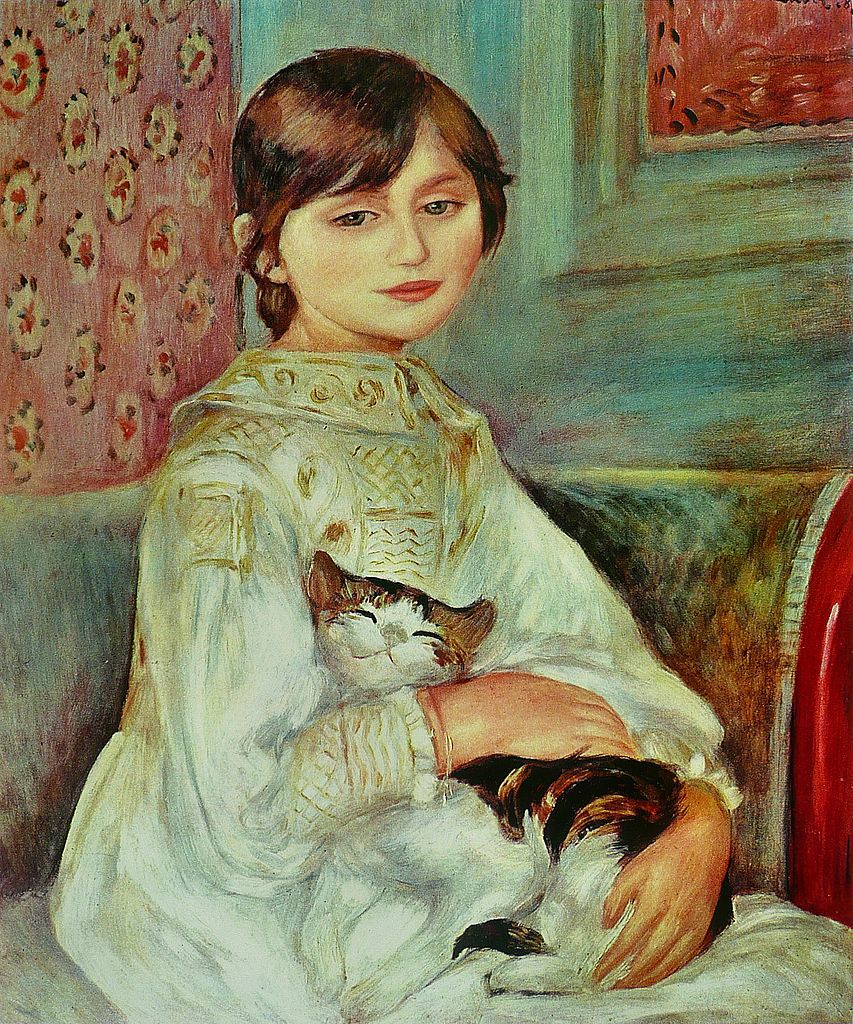
pierre-auguste-renoir-julie-manet-with-cat-1887

Pierre-Auguste Renoir, “Julie Manet with cat”, 1887


Francesca, like most 4-year-olds, is not particularly gentle when it comes to petting a cat. Well, let me put it another way, her gentleness as compared to her zeal when It comes to petting a cat is somewhat lacking. Hence, our cats spend most of their time in the attic of our apartment, hiding from the over-affectionate hand of Francesca.

One morning I was on the couch and Francesca was sitting at the coffee table working on a coloring book. From the door leading to the attic peaked the head of William. Francesca saw him and quickly looked at me, and for some reason this time she attempted to implement what she had been told many times before.

In a barely audible whisper, she looked for affirmation: “Daddy, I shouldn’t move, right?”

“No, Francesca, stay still…”, I whispered back, “…let him come to you. Just leave your hand down by your side.”

And lo and behold, William began to make his way toward us, and began to even approach Francesca’s still fingers. He sniffed. He balked. He approached again. Francesca went to move and stopped. William and Francesca courted each other, one filled with fright, the other excitement, both nearly shaking with emotion.

Francesca broke the tension and attempted to pet his head. William allowed it but could not hold together the nerve to stay put once Francesca’s hand moved past his neck. Off and up the stairs William went.

I realized something. Sometimes, when a person is filled with fear he can not be approached. No matter how kind, soft, sincere our intention, he just can not take the approach, any approach. He needs to make the first move. And we on our part need to simply stay still, patiently waiting for him to come closer, and then maybe, just maybe, we can make a kind gesture. But even if the person runs away at that point we need not take it personal. It is fear that is the cause. Neither the person giving nor the person receiving is to blame.

But unlike cats, who usually show fear just as it is, perhaps with an occasional threatening hiss, humans on the other hand show fear through a different type of tremble. They often preemptively throw insults, curses, mocks, pushes, and even outright physical strikes.

And just as it is hard to ignore the sharp claws of a frightened kitten digging into your arm—even when we fully understand that the kitten truly means no personal harm to us—it is hard to ignore such “attacks” from our fellow man. It is hard to strip them down to what they really are: pathetic attempts at self-preservation. But then again, was not Jesus striped down? And shouldn’t we always keep Christ’s Passion in our hearts? Well, then, as a sign of gratitude, we owe it to Jesus to see His Passion in all our interactions, especially the encounters that cause us pain, be it a superficial abrasion or a wound that pierces the core of our soul.

Let us then employ God’s grace in seeing all harshness, in any form, from any human being toward us, as fear. And by doing so we find ourselves very much in the actual footprints of Christ. For what nailed Him to the Cross was not jealousy nor anger nor even resentment, but fear, fear of the worst kind, fear of the truth. And in the case of Jesus, Truth had a very real face.

But we too are alive. We too have within us the divine presence, a presence that some find dreadfully frightening.

No, we can not like Jesus be sinless, but we can see our persecutors as he did: men to be pitied not punished, men that need mercy not condemnation, men who if we don’t offer forgiveness to are less likely to find it within themselves when they are at the other end of the sword—when it is their turn to be insulted, cursed, mocked, pushed, and even outright physically struck for simply wanting to love.

In the mean time, Francesca continues to color and William sleeps peacefully up in a tight nook of the attic. In the fullness of time, they’ll see eye to eye, as shall you and me.


.

—Howard Hain

.

Morning Thoughts: Saint Francis for 4-year-olds (and you and me)


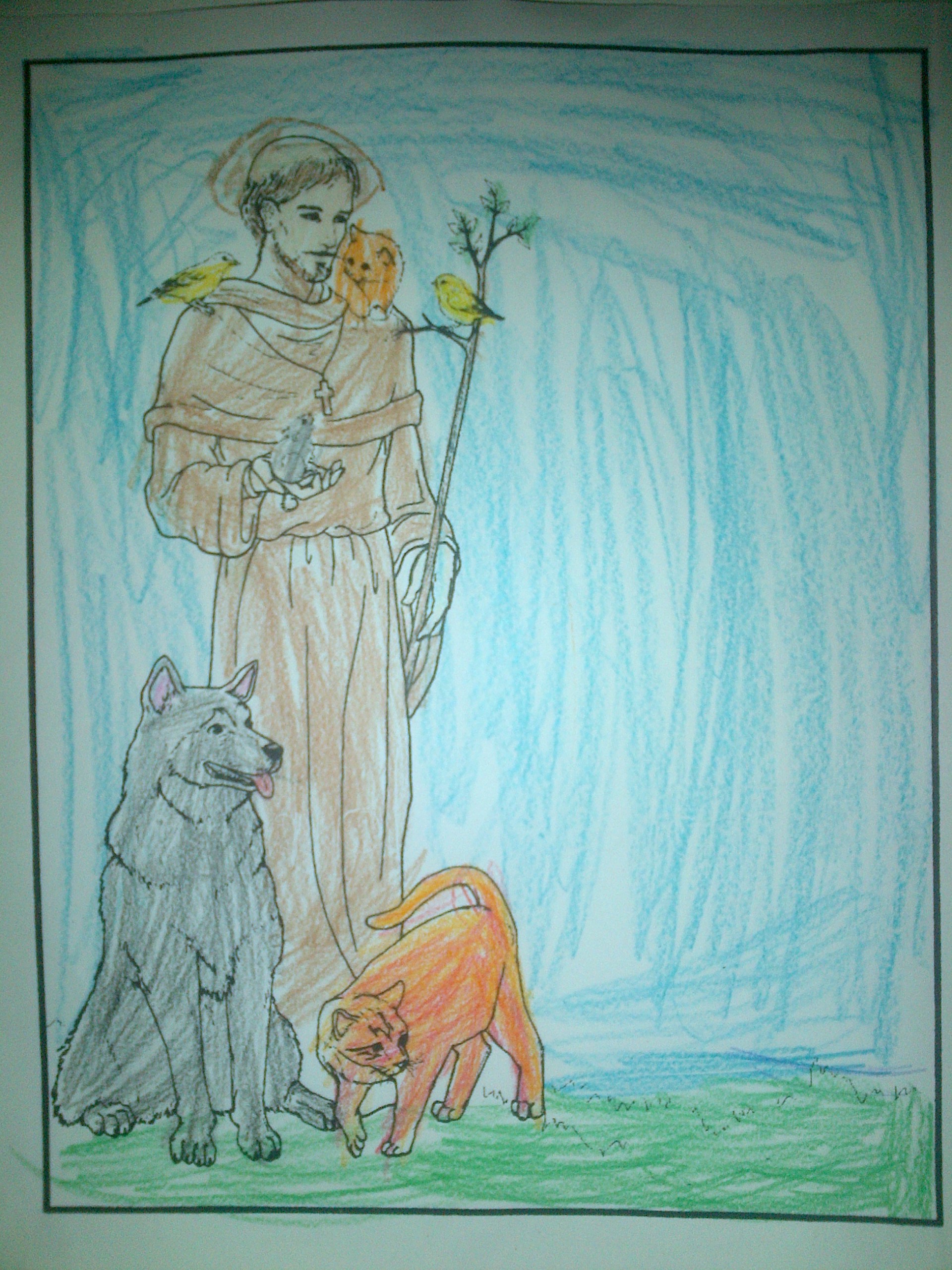
saint-francis-coloring-page

“Saint Francis of Assisi”, coloring book page, colored by a “4-year-old”


(My wife teaches 4-year-olds in a Catholic elementary school. The school’s patron saint is Saint Francis. They call this week “Saint Francis Week” and hold various events throughout the week to celebrate the feast of this great saint (Oct. 4th). My wife and her co-teacher were looking for a short, simple biography that would be appropriate for their 4-year-old students. They didn’t find anything that seemed to be the right fit. So here’s what I jotted down for their pre-K-4 class. The kids really seemed to enjoy it. Maybe you will too. Let us “become like little children”.)


.

Saint Francis, a Knight for God

———

There once was a young man. He lived in a land called Italy. He lived a very long time ago. He lived over 800 hundred years ago!

He lived with his family in a small city named Assisi.

The young man was quite silly. He loved to dream and he loved to sing and he loved to dance. He loved to play with his friends all day long.

The young man’s name was Francis.

His father wanted Francis to be more serious. His father wanted Francis to be just like him. He wanted him to sell expensive fabric to people who were very rich. Fabric is what you use to make pretty things like curtains, tablecloths, and clothes.

Francis’ father wanted him to work in the family shop. But Francis was not very interested in that kind of work. Francis wanted to be a great knight!

And one day Francis went off to do just that.

Francis went off to become a knight. He began to travel to another city where he would fight with a sword and a shield. Francis thought that he would become a great hero.

But on his way Francis got very sick. He had to return to his home. His mother took care of him. And while Francis was getting better he began to dream of different adventures.

He began to spend a lot of time walking around the woods and looking at the flowers and at the trees. He began to watch closely all the animals, especially the birds that flew high up into the sky. Francis began to think a lot about God!

Francis began to dream about heaven. He began to wonder about love. He saw that there was another kind of knight!

Francis decided that he would be a knight for God.

Francis wanted Jesus to be his king and for Mary to be his queen.

Francis no longer wanted to use a sword or a shield. No, Francis wanted to teach all the world how to love. Francis wanted to sing and dance and show everyone how be more like Jesus.

He began to live very simply. He had very few things. His only clothing was an old brown robe. He lived almost like a little animal in the forest. Francis was very free. Francis was filled with joy. He was very happy.

And soon many other young men came to join him. They too wanted to be knights for God. They all lived together. They called each other brother. They shared all they had. They were kind to each other. They loved God together.

And one day, even a young lady wanted to join. She brought other ladies and they started a home of their own. They called each other sister. That young lady’s name was Clare.

A new type of family was beginning to grow. A family who lives very much like Jesus. We call them Franciscans.

We now call that young man, Saint Francis. We now call that young lady, Saint Clare.

Saint Francis and Saint Clare are now in heaven with Jesus and Mary and all the holy angels and saints. They live in perfect peace with God the Father and the Holy Spirit. They see us right now. They pray for us too.

Hey, who knows, maybe one day a few of you boys and girls may become knights and ladies of God, like our patron saints, Saint Francis and Saint Clare!


..

—Howard Hain

.