Author Archives: vhoagland

Resurrection Thinking

Some  years ago  Anglican Bishop N. T. Wright, a highly regarded New Testament scholar, addressed the Catholic Bishops of Italy on the resurrection of Jesus Christ.  His thoughts on the  resurrection were particularly interesting. The theme of the Italian bishops’ conference was “Jesus, our Contemporary.”

He began  with this challenging picture of the Risen Christ.

“ On the one hand, it is precisely because Jesus is risen from the dead that he is alive in a new, unique way; that he is able to be with us as a living presence, which we know in prayer and silence, in reading scripture and in the sacraments, and (not least) in the service of the poor.

“Jesus is truly our contemporary. But at the same time in his resurrection Jesus stands over against us. He is different. He is the first fruits; we are the harvest that still awaits. He has gone on ahead while we wait behind.

“What is more, the meaning of his resurrection cannot be reduced to anything so comfortable as simple regarding him as ‘contemporary’ in the sense of a friend beside us, a smiling and comforting presence. Because he is raised from the dead, he is Lord of the world, sovereign over the whole cosmos, the one before whom we bow the knee, believing that in the end every creature will come to do so as well.

“It’s not enough that Jesus intervenes at the moment of our death. He is the Lord of creation.”

According to Wright our belief in Jesus as Lord of creation has been undermined by the thinking of the Enlightenment, which placed God (if God exists) beyond our world. We are the lords of creation. This life and all in it is in our hands to shape and control as we think best.

Our belief in the Risen Christ is influenced by this thinking, Wright believes. The only role we give to the Risen Lord is to save us from death and bring us to heaven. But he is Lord of Creation, present here and now. We must live in him today and continue his work, not in a heavy-handed way, but humbly as Jesus called for in his teaching on the beatitudes.

“This is how Jesus wants to run the world: by calling people to be peacemakers, gentle, lowly, hungry for justice. When God wants to change the world, he doesn’t send in the tanks; he sends in the meek, the pure in heart, those who weep for the world’s sorrows and ache for its wrongs. And by the time the power-brokers notice what’s going on, Jesus’ followers have set up schools and hospitals, they have fed the hungry and cared for the orphans and the widows. That’s what the early church was known for, and it’s why they turned the world upside down. In the early centuries the main thing that emperors knew about bishops was that they were always taking the side of the poor. Wouldn’t it be good if it were the same today.”


The Hellenists’ Complaint

The 6th chapter of Luke’s Acts of the Apostles which we started to read on Saturday of the 2nd week of Easter begins with a social problem we shouldn’t overlook.  Some new converts to Christianity are being treated unfairly. “As the number of disciples continued to grow, the Hellenists complained against the Hebrews because their widows were being neglected in the daily distribution.”( Acts 6:1. Saturday, 2nd week of Easter) 

If we substitute “Immigrants” for “Hellenists” in that text a more familiar situation emerges. New-comers are plainly not treated fairly, especially the poorer among them and they’re looking for something more.

The “Hebrews” are the first followers of Jesus, mostly Jews from Galilee. They’re Jewish Christians at home in the Jewish world, who fit into the religious and political Judaism of their time in spite of the friction that came from following Jesus of Nazareth.

They’re the establishment.

In every age immigrants, once they gain a footing in their new home, learn to speak out for their needs. The Hellenists, led by Stephen, began to speak out. Stephen’s fiery words seem to be only about  religious matters, but he’s also criticizing the closed world of Judaism. Should we add the closed world of early Jewish Christianity as well? 

Stephen’s criticism cost him his life and initiated the Jewish reaction that led to the expulsion of the Hellenists. They become immigrants again but, as Luke notes, they bring the gospel to new peoples.

It’s  a misconception to believe, as some do, that Christianity spread easily without problems and sufferings early on. It’s also a misconception to believe that it spread solely due to the genius of Paul the Apostle. Paul was a great figure in the spread of Christianity, but the Acts of the Apostles read this week reminds us there were others, like the deacon Philip, who brought the gospel to Samaria. (Wednesday)

We wonder, too, about the Ethiopian official Philip baptizes. He surely brought the gospel to Africa. (Thursday) There were many others, not just apostles, not solely Paul, but immigrants like Stephen, who fulfilled  a divine plan they hardly understood.

Luke concentrates of Paul’s mission and pays scant attention to the other missionaries who brought the gospel to world around them. Nor does Luke recognize social factors, like immigration, that led the spread of Christianity. He doesn’t tell the whole story. 

We are in the midst of an age of massive immigration, due to wars, climate change, religious discrimination and other issues. We tend to see these issues only in social or political terms.

This week’s readings from Luke remind us there’s more. God’s plan is also being fulfilled.  

Glorious Wounds

On the Feast of the Glorious Wounds of Jesus Christ, which the Passionists celebrate in the Easter Season, St. Bonaventure looks to the flowers of the field,  brightening the world in spring, to describe the love of Jesus in his Passion. Each wound in his hands, his feet and his side is a red rose revealing God’s love for us. It is an ardent and intense love. 

Jesus is the flower of heaven which, once closed by the chilling night of Adam’s sin,  opens like a rose in the rising sun of God’ great mercy. 

“This flower of heaven, warmed by the rays of ardent love,  opens wounds in every part of his body…  See his entire body: Is there a place where the rose is not found?  See one hand, then the other; see one foot, then the other.  Can you not see the rose? See the wound in his side, for the rose is there too,  although it is of a paler red because of the admixture of water, for there came out blood and water.  Yes, this is he who came  in water and in blood, Christ Jesus all-good.

Lord and Savior of all, good Jesus, how can I thank  you,  who from the dawn of your life to your cruel death yes, even after it, have shed so much of your blood for me?  How can I thank you who revealed a surpassing love by shedding  your blood? How full this rose with its many petals! Who can count them all?

The first reading at Mass for this feast looks into heaven where the heavenly hosts praise the Lamb who was slain: “With your blood you purchased for God men of every race and tongue, of every people and nation. You made of the a kingdom and priests to serve our God and they shall reign on the earth.” ( Revelations 5:5-12)

John’s Gospel recalls the night Jesus revealed his wounds to Thomas, who refused to believe. “My Lord and my God,” the disciple said, worshipping him. (John 20:24-29)

“You will draw water joyfully from the springs of salvation.” Our responsory psalm says. 

Life Comes from His Wounds

ICON

The Passionists celebrate the Feast of the Glorious Wounds of Jesus on Friday of the second week of Easter. The four gospels tell the great story of the passion of Jesus, each in its own way. More than the others, John’s gospel focuses on his wounds, unlikely signs revealing the mystery of the Word made flesh.

On Calvary  a small symbolic group stands beneath the cross of “the King of the Jews”– Mary, the mother of Jesus, the disciple whom he loved, and a few others. A gentile soldier joins them.

This group represents the “new Jerusalem,” “the inhabitants of Jerusalem who look on the one whom they have pierced…and mourn for him, as one mourns for an only child.” (Zechariah 11, 10 )

They receive a precious gift. “It is finished!” Jesus declares, and bowing his head, he pours out his spirit on them. A Roman soldier thrusts a spear into Jesus’ side. “Immediately blood and water flowed out.” (John 19, 34)

Blood, a sign of his life, flows on those standing beneath his cross. Water, signifying the Spirit within him, is poured out on the world they represent. Far from ending his life, his death is the moment Jesus shares his life.“This is the one who came by water and blood, Jesus Christ.” (I John 5,6)

Artists afterwards picture the wounds of Christ as cosmic signs. They place the grave of Adam beneath the cross — generations wait for the new life Jesus brings. Creation, symbolized by the sun and moon, looks on expectantly, for Calvary is where creation too is redeemed. Angels collect the blood and water from Jesus’ wounds in cups representing the mystery of the Eucharist. All days are found in this one day. On Calvary, the glory of the Lord is revealed in his wounds.

St. Paul of the Cross in his letters often wished the one to whom he’s writing to be placed in the “wounds of Christ” or the “holy Side of Jesus” or his “Sacred Heart.”  “I am in a hurry and leave you in the holy Side of Jesus, where I ask rich blessings for you.”

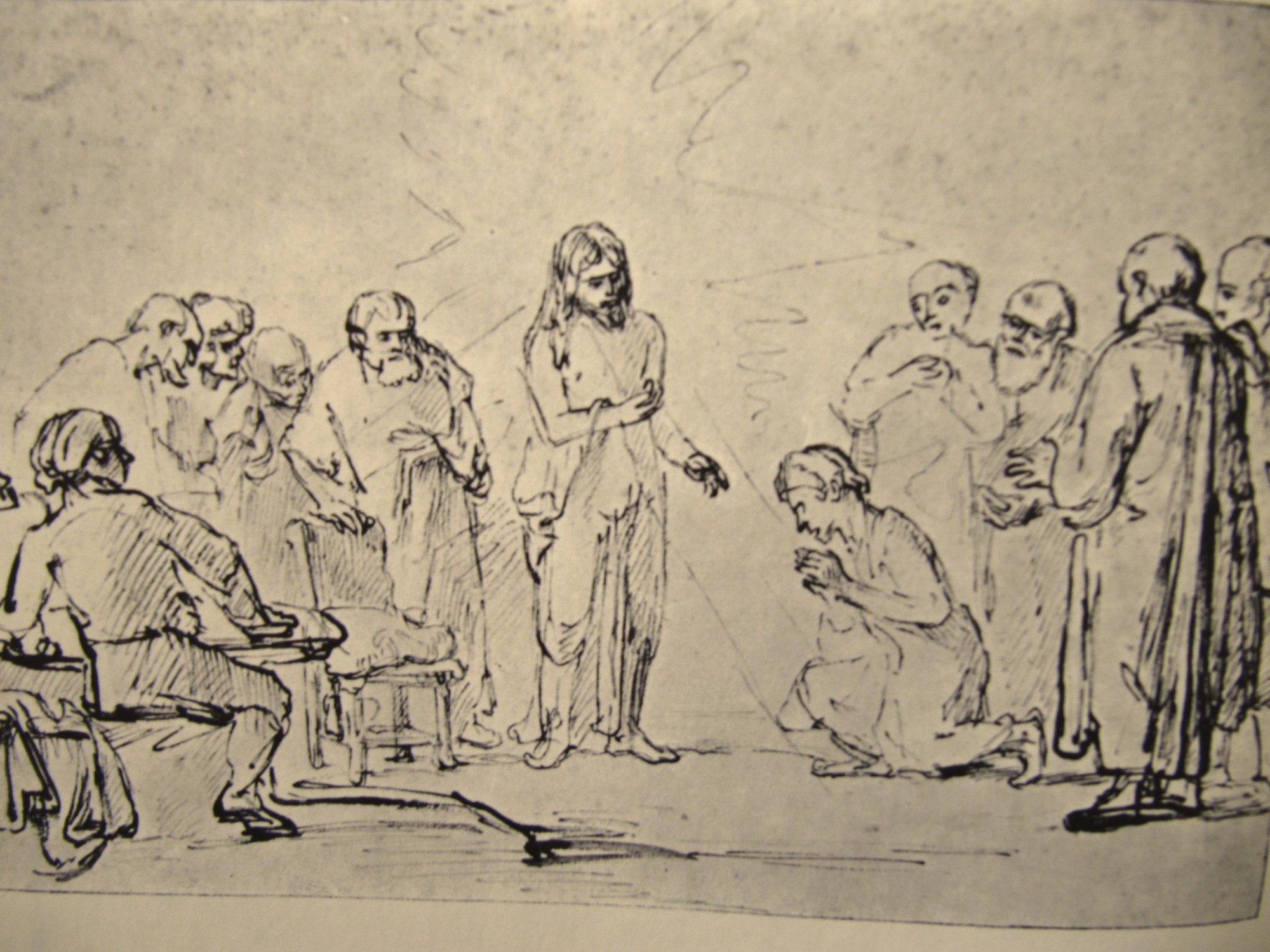
These expressions may seem pious phrases until we read the story of Thomas from John’s gospel. Jesus shows the doubting disciple the wounds in his hands and side, and Thomas believes.

Belief is not something we come to by ourselves. God gives this gift through Jesus Christ. We all stand beneath the life-giving Cross of Jesus. May his life give new hope to us and our world.

The Spring Rains Come

 April showers. Spring rains. A bowl of Easter Water stands near our altar during the Easter season.

Cyril of Jerusalem has a wonderful sermon on water that he preached to catechumens centuries ago. Here are a couple of lines:

“Water comes down from heaven as rain, and although it is always the same itself, it produces many different effects, one in the palm tree, another in the vine, and so on throughout the whole of creation. It does not come down, now as one thing, now as another, but while remaining essentially the same, it adapts itself to the needs of every creature that receives it.”

The saint goes on to say that just as water adapts itself to every creature, the Holy Spirit gives life to each one according to its needs and to benefit the common good. The Spirit’s coming is gentle, not felt as a burden, with tenderness, as a true friend, to save, heal, counsel, strengthen and console.

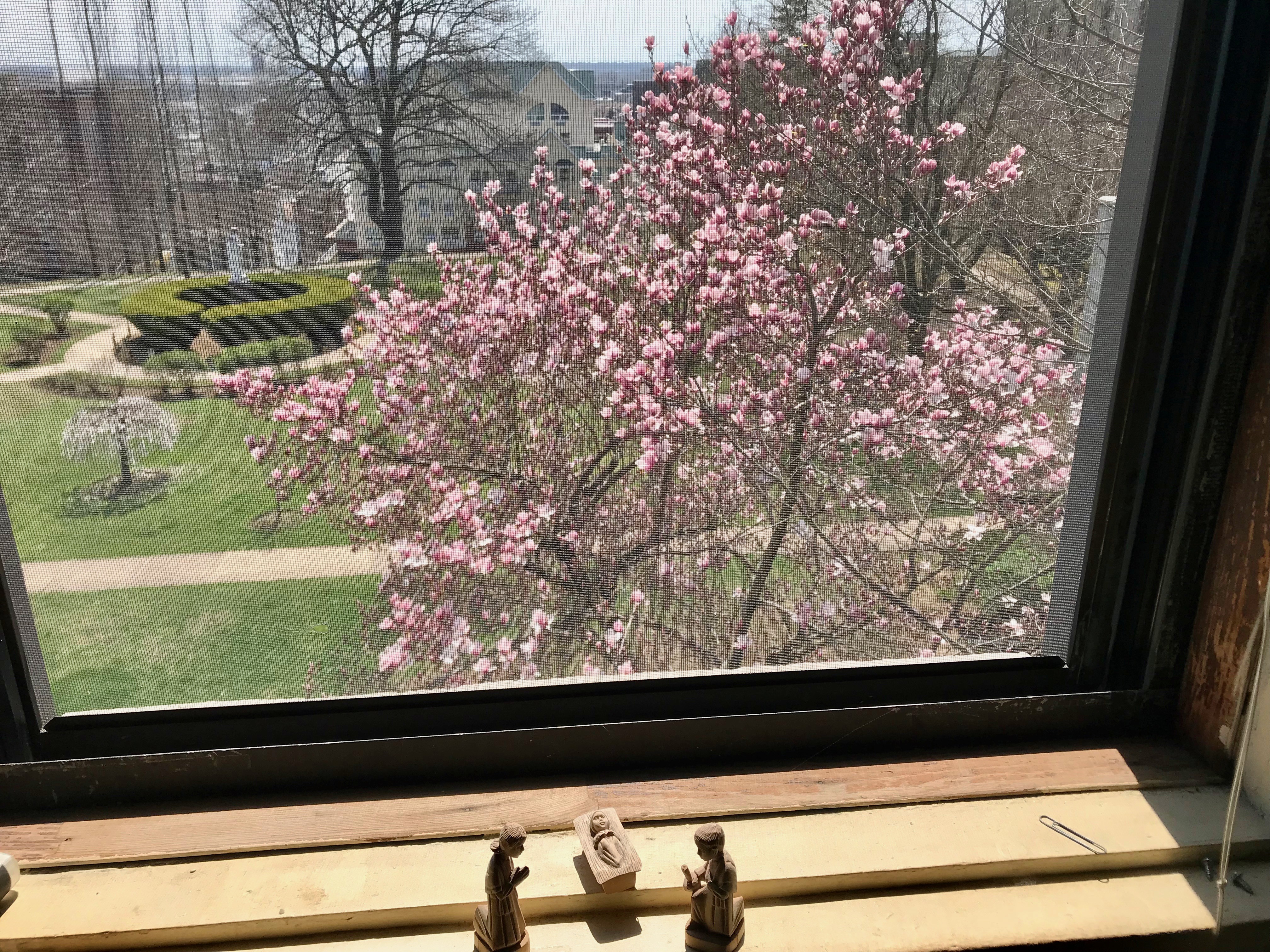
So back to spring rains. They have come this year.  The magnolia trees outside my room testify they’ve come, and the other trees and plants in our garden testify too. The rain falling on the earth does what it always does. Like the Spirit of God, water brings life.

Might we learn from the spring rains bringing life to all the varied plants, all shapes, all sizes, even some we might think useless or of no account?. Might we learn from the spring rains?

Send the spring rains, Lord, on our varied earth and human family.

The Word of God Unchained

Peter in Chains, Antonio de Bellis, (1600)

I went through the recent book lists from the New York Times the other day and as far as I can judge religion is off the charts. It’s not mentioned in the media. People are leaving the churches. You might say religion has been put in jail, like the apostles in our reading from Acts yesterday. (Acts 5: 17-21) and Peter later (Acts 12: 1-19).

Peter’s release from his chains is a dramatic narrative. He’s not only freed from prison but heads out to Caesarea where another dramatic event occurs: the conversion of the Roman solider Cornelius and his household. The gospel is received by the Roman world.

The Word of God can’t be chained and banished from society. It will be unchained. God will give it new power over human hearts and minds.

I made a virtual pilgrimage to the church of St. Peter in Chains these days and saw the chains from Jerusalem and Rome. They’re signs something’s coming.

The Incarnation of the Lord

The Solemnity of the Incarnation of the Lord, usually celebrated on March 25, is celebrated this year on April 8.  The Angel Gabriel came to Nazareth and invited Mary to become the mother of Jesus. ”Behold the handmaid of the Lord,” she said. On this day we celebrate the Word becoming flesh and dwelling among us. (John 1)

This feast is celebrated by all the ancient Christian churches. The feast is closely connected to other mysteries of Christ. We celebrate Jesus conceived in Mary’s womb today. Nine months from now her pregnancy ends and we celebrate the birth of Jesus at Christmas. Some ancient church calendars also saw March 25th as the day Jesus was crucified and then rose from the dead, so this feast is linked to the Easter mysteries. Some calendars also celebrate the creation of the world on March 25..

I remember a PBS special “What Darwin Never Knew” produced by Nova awhile ago. I don’t remember or understand a lot of the scientific material it contained, but its description of DNAs and embryonic development caught my attention.

According to scientists, embryos from different living beings–humans, animals, birds, fish– appear remarkably alike at their early stage of development, as if they were from the same source. Then, something triggers a different development in each species. Humans sprout arms and legs and begin human development.  Other species develop in their own way.

It’s a complex, fascinating path all living things take in their embryonic development.  The Letter to the Hebrews in today’s Mass emphasizes the bodily existence of Jesus.“ A body you prepared for me… behold, I come to do your will, O God.’’ He shares a bodily existence with all human beings and with all creatures.  All creatures journey into life. All creation is on a journey to life through Jesus Christ, the Word of God.

“The Word was made flesh.” The early Gnostics denied or depreciated the body, and so early theologian theologians, like St. Irenaeus, emphasized the bodily existence of the Word. Jesus followed the same process of development within the womb as we do and after his birth continued to develop “in wisdom and age and grace” as humans do. He faithfully followed the path of human development. 

The early theologians also said that through the body  Jesus Christ assumed all that he would redeem. In his body he took on human nature. By becoming flesh he also took to himself the created world. From the very beginning, at his conception in the womb, Jesus Christ brought all creation to himself to redeem it. 

“Blessed is the fruit of your womb,” Elizabeth says to Mary.(Luke 1,42)  The Feast of the Annunciation calls us to renew our respect for life, from its beginning to its end. It’s a time to remember Mary’s acceptance of human life and her respect for the life in her womb.

“ Blessed are you among women and blessed is the fruit of your womb, Jesus.”