Author Archives: vhoagland

Voice of the Faithful

Apollos is mentioned  in Saturday’s reading from the Acts of the Apostles (18,23-28).   He reminds us that Peter, Paul and the other apostles were not the only teachers in the early church. Others brought the message of Christ to the cities and towns of the Roman Empire. Apollos was one of them.

He’s an eloquent, learned teacher who came to Ephesus from Alexandria, one of the great centers of Jewish and Christian learning, and he drew a following by preaching about Jesus. But Apollos doesn’t know everything, so a Jewish couple, Priscilla and Acquila, “took him aside and explained to him the Way of God more accurately.”

They were disciples of Paul who supported him with a job in their tent business. They traveled with Paul and certainly listened to his teaching, but I don’t think they were ever considered teachers as he and Apollos were. They were considered “hearers of the word,” more likely. Well informed, for sure, but still among those we would call today “the faithful.”

Yet, let’s not forget what important teachers “the faithful” are, as Priscilla and Aquila remind us.

I remember a story a brilliant priest told me long ago about a baptism he was conducting for an infant born to a member of his family. His father was the baby’s sponsor and according to the rite then was expected to recite the Creed.

“Can you say the Creed, Dad?” the priest said to his father.

“Who do you think taught it to you?,” the father sharply replied.

Faith can’t survive in this world without the faithful, ordinary Priscillas and Aquilas explaining it and  passing it on. It begins with parents, godparents and family passing on the faith to children. It continues in daily life as ordinary Christians share their faith with others. The church today needs to strongly acknowledge this key mission of the laity.

Pope Francis is urging the laity to speak out in his call for a synodal church.

Reinterpreting Life

IMG_0500

Reinterpreting life is at the heart of the Easter mystery. It calls us to see life differently. Like the artist who reinterpreted the Cross on Calvary and made it the glorious sign we see above, we’re called to reinterpret the Calvary of our world today. Listen to the 4th century Saint Ephrem the Syrian:

Glory be to you, Lord,
You raised your cross like a bridge to span the jaws of death, that we might go from the land of death to the land of the living.
Glory be to you, Lord,
You took on a human body that every human being might live.

You are alive. Those who killed you sowed your living body in the earth as farmers sow grain, and it sprang up and brought forth an abundant harvest of human beings from the dead.

Come, brothers and sisters, let’s offer our love. Pour out our treasury of hymns and prayers before him who offered himself on the cross to enrich us all.”

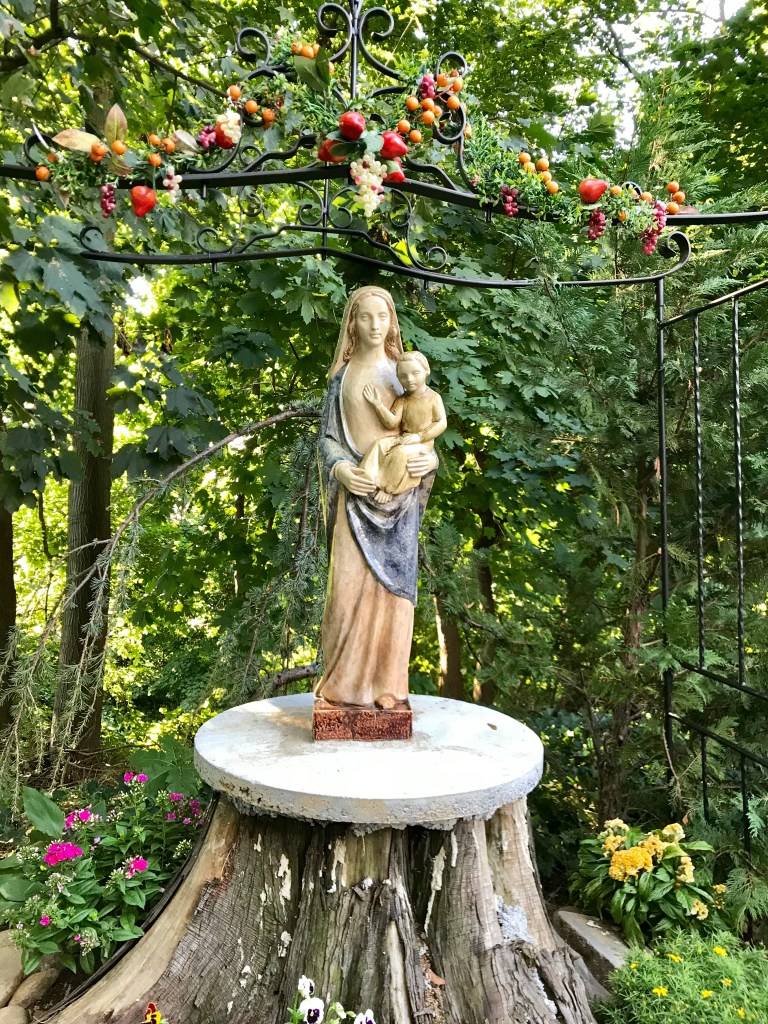
Reinterpreting life through the mystery of the Cross is at the heart of the charism of my community, the Passionists. In our Mary Garden here at the monastery, Mary stands with her Son on the stump of a cedar tree. A dead tree, yet brought to life by the presence of Jesus carried in Mary’s arms.

The Cross of Jesus helps us see life in our world, a “Faithful Cross” it’s called in an ancient hymn. And it is.

There is so much death in our world today. We need to reinterpret our time by the light of the mystery of the Cross of Jesus.

St. Paul at Thessaloniki, Philippi and Athens

We’re reading about the journeys of St. Paul from the Acts of the Apostles this week of the Easter season. Luke carefully notes the various places Paul and his companions set up churches as they go from Jerusalem to Rome. The gospel must be preached everywhere in the world, Jesus said. 

Paul’s journeys are often called travel journeys and our Bibles supply maps to help us follow them. But Paul’s journeys are more than journeys of travel; Luke sees the gospel being proclaimed to the world in many dimensions. There are twists and turns that reveal God’s surprising ways his plan for the church develops.

Look at the accounts this week. On Monday Paul speaks to women at their place of prayer along the water in Thessaloniki and he invites Lydia–or rather she invited herself–-to join him in his mission. Just as he does in his gospel, Luke wants us to see that women are meant to hear the Good News and have a role in bringing its message to others.

On Tuesday Paul and Silas are thrown into prison at Philippi. (Acts 17:22-34) Not only is the jailor and his household converted to the gospel, but Luke tells us the prisoners were listening as they prayed in the night. And so, as he does often in his gospel, Luke points out that the poor must hear the gospel. Most of these prisoners will never get to one of Paul’s house churches, but they must hear the gospel all the same.  

On Wednesday, Paul speaks to the intellectuals in Athens.The results of his preaching don’t seem promising, only a handful seem to respond. But the gospel has to be brought to places like Athens. The gospel has to be brought into the world of learning and science, a world often a showcase of human pride. Still, it has to be proclaimed to those searching for the truth.

The missionary journeys are more than careful, well-planned journeys from place to place conceived by Paul for establishing churches. They are God’s way for the spread of the gospel. His plan is not ours, and that’s why it’s hard for us to understand.

5th Sunday of Easter: Signs

For this week’s homily please watch the video below.

The Feast of St. Mark

Mark
April 25th is the Feast of St. Mark, author of one of the gospels. We may forget that real people wrote the gospels, but the medieval portrait above shows the evangelist real enough as he adjusts his spectacles and pours over a book, surely his gospel. A lion looks up at him, the powerful voice of God.

He’s an old man, his eyes are going,  He has to be old if he’s a disciple of Peter, as tradition claims. (cf. 1 Peter 5:14)  Mark’s gospel appears shortly before or after the destruction of the Jewish temple in Jerusalem by the Romans in 70 AD. If he’s the author of the gospel, as it’s said,  he’s in his 70s at least.

He may have written his account in Rome, where he came with Peter, who calls Mark in his 1st Letter “my son.”  In 64 AD, Roman Christians  experienced a vicious persecution at the hands of the Emperor Nero. Peter and Paul died in that persecution. For years afterwards, Christian survivors were still asking themselves, no doubt, why it happened.

They say Mark wrote his gospel in answer to that dreadful experience. He would have heard Peter’s witness to Jesus many times; he knows his story.

Yet Mark was not just a stenographer repeating Peter’s eyewitness account; he’s adapted the apostle’s story, adding material and insights he had gathered on his own. For a long time Mark’s gospel was neglected by the church, thought to be simply a synopsis of Matthew’s gospel.  Today scholars admire it for its simplicity and masterful story telling. It’s the first gospel written and Matthew and Luke derive much of their material from it.

I like the wonderful commentary: The Gospel of Mark, in the Sacra Pagina series from Liturgical Press, by John Donohue,SJ and Daniel Harrington, SJ (Collegeville, Min. 2002). A great guide to this gospel and its rich message. We read Mark in the lectionary from the Feast of Baptism of Jesus up to Ash Wednesday, the beginning of Lent.

Mark’s Gospel offers a unique wisdom. It does not flinch before the mystery of suffering and does not try to explain it away. There’s a darkness about this gospel that makes it applicable to times like ours. We’re disciples of Jesus who must follow him, no matter what.

Our gospel for the feast is the final commission Jesus gives to his disciples, according to Mark.
“Go into the whole world
and proclaim the Gospel to every creature.
Whoever believes and is baptized will be saved;
whoever does not believe will be condemned.
These signs will accompany those who believe:
in my name they will drive out demons,
they will speak new languages.
They will pick up serpents with their hands,
and if they drink any deadly thing, it will not harm them.
They will lay hands on the sick, and they will recover.”

Like Jesus, his disciples will drive out demons and speak new languages. They’ll pick up serpents and drink poison, yet be unharmed. They will even believe, without understanding everything. In answer to Jesus’ command, tradition says Mark went to Egypt and founded the church in Alexandria.


Father,
You gave St. Mark the privilege of proclaiming your gospel. May we profit by his wisdom and follow Christ more faithfully. Grant this, through Christ, your Son.

Earth Day: God So Loved the World

Today is Earth Day. As Christians we see the earth through eyes of faith. The earth is God’s creation

God created and cares for more than the human family. You are the “hope of all the earth and of far distant isles”, Psalm 65 says. “You uphold the mountains with your strength, you still the roaring of the seas…The ends of the earth stand in awe at the sight of your wonders. The lands of sunrise and sunset you fill with your joy.

“You care for the earth, give it water, you fill it with riches. Your river in heaven brims over to provide its grain. And thus you provide for the earth; you drench its furrows; you level it, soften it with showers; you bless its growth. You crown the year with your goodness. Abundance flows in your steps, in the pastures of the wilderness it flows. The hills are girded with joy, the meadows covered with flocks, the valleys are decked with wheat. They shout for joy, yes they sing.” (Psalm 65, Tuesday. Morning Prayer, week 2)

Along with the human family, the earth praises God, its creator,. The natural world, as a vital part of God’s creation, shouts for joy and sings. There’s even surprise in the psalms that God, the Almighty, creator of heaven and earth, could have a special care for the human family. “When I see the heavens, the work of your hands, the moon and the stars which you arranged, what is man that you should keep him in mind, mortal man that you care for him?”  ( Psalm 8, Saturday Morning, week 2, 4 )

The view of God’s close engagement with the natural world proclaimed by the psalms and the scriptures fell into disfavor when science became the primary way of looking at the natural world with the age of the Enlightenment. Science became our guide and the human world became the center that controls everything. God’s engagement with the natural world and the human world came into question. The scriptural accounts were just poetry.

But poetry can also be true.  

As we hear the Risen Jesus in the Easter season using the great images of bread from heaven, the shepherd, the vine, we shouldn’t miss their cosmic import. Images point out many things. Certainly “bread from heaven” points to the sacrament of the Eucharist; the shepherd and vine point to the life of the church and the intimacy we enjoy as branches grafted into the vine that is Jesus Christ.

But let’s not forget God’s rule over the whole world. We know so much more about it now. We also know how endangered it has become because of human neglect. More than ever, we need to acknowledge its dignity before God, who still covers the meadows with flocks, “the valleys are decked with wheat.” The natural world shouts for joy and sings during the Easter season. Its Shepherd guides it; it receives daily bread.  It shares in the promise of the Risen Christ.  

Readings: 4th Week of Easter

This week’s readings from the Acts of the Apostles describe the growth of the church in the Gentile world. Peter journeys to Joppa, the seaport  Jonah embarked from on his mission to Nineveh. On his way he raises up a paralyzed man at Lydda and in Joppa  he raise a young girl, Tabitha, from the dead–signs similar to those Jesus worked.(Saturday, 3rd Week of Easter) 

Some, however, question Peter for baptizing the Roman soldier Cornelius and eating at table with him. (Monday) “God has given life-giving repentance to the Gentiles too,” Peter responds, initiating a new phase in the church’s growth. His response is based, not on human judgment, but because he has seen signs from the Spirit.

The readings from Acts from Wednesday to Saturday describe Barnabas and Saul’s opening campaign into the Gentile world. Let’s not ignore, though, the reading from Tuesday which recalls the unknown survivors of the persecution of Stephen who, driven into the Gentile world, “speak to the Greeks, proclaiming the Lord Jesus to them. The hand of the Lord was with them and a great number turned to the Lord.” Clearly, others besides those we know brought the gospel to the Gentiles.

We are all involved, not just a chosen few, in bringing the gospel to the world.

In the  Gospel readings from John (Monday-Wednesday) Jesus continues to speak of himself as the Good Shepherd. As Risen Lord, he goes before us, guiding his flock to final pasture. We hear his voice, not the voice of a stranger. His voice is the same as the Father’s voice.

On Thursday, the readings from John bring us back to the supper room. For the remaining days of the Easter season, we will listen to Jesus’ words of encouragement and love for his own who are in this world.