Thursday is ThanksgivingDay in the USA, a day we spend at home with family and friends. The readings for most of this week, from the Book of Daniel and the Gospel of Luke, describe a world turned upside down. Hardly readings for enjoying a family feast in the security of your home.
Three martyrs also are remembered this week.
But faith embraces a world upset and a world secure.
Two November feasts take us into the future to heaven itself where God’s mysteries are made known.
All Saints
The Feast of All Saints reveals humanity’s destiny. God calls all humanity to be numbered in that “ great multitude, which no one could count, from every nation, race, people, and tongue,” which the apostle John sees in a vision of heaven. {Revelations 7, 9-13)
We are called to be children of God. “See what love the Father has bestowed on us that we may be called the children of God.Yet so we are…Beloved, we are God’s children now; what we shall be has not yet been revealed.” (1 John 3: 1)
The Book of Revelation describes the revelation heaven shall be in symbolic terms. It’s “the wedding feast of the Lamb.” Gathered before the throne of God at that feast, as God’s children and bride, the saints sing. Here’s how it’s revealed in the Book of Revelation:
“O Lord our God, you are worthy
to receive glory and honor and power.
For you have created all things;
by your will they came to be and were made.”
God will reveal to us, his children and bride, the glories of creation, “all things that came to be and were made.” What we only see partially now, we will see fully then. We will know then more completely what science has begun to know now. We will see then with new better eyes what mystics and poets see now in a small way.
There’s also a revelation of Jesus Christ, “the Lamb that was slain.”
Jesus Christ reveals himself as “the Lamb that was slain.” God reveals his love. We see God who emptied himself and took the form of a slave, who took on human likeness and human weakness, who took on death, even death on a cross.
The love of God that was hidden, unknown, unappreciated, not understood, is revealed. We will see the love of God that was disguised as it worked through human complexity, human sinfulness, the tragic circumstances of life and the world we live in. We will see the power of Christ’s blood, his wounds, his tears, his prayers, his patience, his mercy that fashioned a kingdom, a people from every race and nation, and we will sing.
“Alleluia, the Lord our all-powerful God is King; let us rejoice and give him praise, Alleluia”
All Souls
On All Souls Day we hear humanity, weak and sinful, saint and sinner, seeking the mercy of God. We lose hope so easily in God’s call and in our own ability to respond to our God, and so we ask God to be merciful to us and those who have gone before us in death. Our prayers on All Souls Day begin with the promise of God St. Paul recalls in his letter to the Corinthians: “Just as Jesus died and has risen again, so through Jesus God will bring with him those who have fallen asleep, and as in Adam all die so also in Christ all will be brought to life.”
All humanity seeks the merciful face of God on All Soul’s Day, not just those who hope in the resurrection of Christ.
“Remember our brothers and sisters, who have fallen asleep in the hope of the resurrection, and all who have died in your mercy. Welcome them into the light of your face.
And have mercy on us all, we pray, that with the Blessed Virgin Mary, with the blessed Apostles and all the saints who have pleased you throughout the ages, we may be coheirs to eternal life and may praise and glory you, through your Son, Jesus Christ.”
( 2nd Eucharistic Prayer)
Death and our strong ties to this world saddens us and weakens our faith. Praying for the dead not only benefits those who have gone before us but also deepens our faith in the power of Christ’s resurrection and the fullness of his mercy.
Listen kindly to our prayers, O Lord,
and, as our faith in your Son,
raised from the dead is deepened,
so may our hope of resurrection for your departed servants
also find new strength.
Through our Lord Jesus Christ, your Son, who lives and reigns with you and the Holy Spirit, world without end. Amen
The feasts of November point us to the life we’re promised. At the same time, they strengthen us to wait “in joyful hope.” God is with us.
O God, you are my God, for you I long;
for you my soul is thirsting.
My body pines for you
like a dry, weary land without water.
So I gaze on you in the sanctuary
to see your strength and your glory.
For your love is better than life,
my lips will speak your praise.
So I will bless you all my life,
in your name I will lift up my hands.
My soul shall be filled as with a banquet,
my mouth shall praise you with joy. Psalm 62
Here’s Handels magnificent ending to his Oratorio, The Messiah:
[Saint Albert the Great, Bishop and Doctor of the Church]
1 Mc 1:10-15, 41-43, 54-57, 62-63/Lk 18:35-43
16 Tue Weekday
[Saint Margaret of Scotland; Saint Gertrude, Virgin] 2 Mc 6:18-31/Lk 19:1-10
17 Wed Saint Elizabeth of Hungary, Religious Memorial 2 Mc 7:1, 20-31/Lk 19:11-28 (
18 Thu Weekday [The Dedication of the Basilicas of Saints Peter and Paul, Apostles;
USA: Saint Rose Philippine Duchesne, Virgin] 1 Mc 2:15-29/Lk 19:41-44
19 Fri Weekday 1 Mc 4:36-37, 52-59/Lk 19:45-48
20 Sat Weekday [BVM] 1 Mc 6:1-13/Lk 20:27-40
21 SUN OUR LORD JESUS CHRIST, KING OF THE UNIVERSE Solemnity
Dn 7:13-14/Rv 1:5-8/Jn 18:33b-37
The readings from Luke’s gospel this week begin with Jesus’ ascent to Jerusalem from Jericho where he meets the blind beggar and Zacchaeus, the publican. The ascent and the meeting are part of a messianic event. The gospels for the remainder of the week describe him entering the city, weeping over it and cleansing the temple. The Messiah has come.
The readings from Maccabees remind us that our Jewish brothers and sisters are celebrating Hanukkah.
This liturgical year is ending. The Feast of Christ the King announces it.
Today I preached the homily for a good friend of mine who has been failing for some years and died Wednesday, November 3.
Father Timothy Fitzgerald came to our community here in Jamaica right before Christmas last year, and we were happy to have him. He’s an outstanding member of our province.
Over the years he held important positions in our province and our community. He was secretary to our superior general in Rome, novice master, rector, spiritual director, preacher of missions and retreats. He was a wise, holy man, widely read and widely respected. He could tell you what theologians, new and old, were saying. He could tell you about movies he saw when he was a kid. In one sense, he was a living Wikipedia.
But he was also an accomplished listener; he listened to you. That combination made him a wonderful spiritual director, and a wonderful friend.
Whenever I saw him I would say. “What are you reading, Tim? What do you want to tell me about?” And he would. He was always into something interesting.
If I ask that question now I think he would point to the readings he chose for this Mass. They represent his goals in life, what he wanted to be.
The spirit of the Lord GOD, is upon me, Isaiah says, to bring good news to the afflicted, to bind up the brokenhearted, To proclaim liberty to captives, release to prisoners, to comfort all who mourn so that they could build God’s Kingdom. That was what Tim was, a bringer of good news. The spirit of God was upon him. He was a builder of God’s kingdom. (Isaiah 61)
The second reading he chose is from St. Paul’s Letter to the Philippians:
“I consider everything as loss because of the supreme good of knowing Christ Jesus my Lord. For his sake I have accepted the loss of all things that I may gain Christ. Through faith in Christ I know him and the power of his resurrection and [the] sharing of his sufferings by being conformed to his death, Our citizenship is in heaven. Jesus Christ will change our lowly body to conform with his glorified body.”
That’s what Tim believed and that’s what he lived, even to the end.
The other day in our library I saw Fr. John Fidelis reading something. He’s a lot like Tim and a good friend of his. ”What are you reading, John.” “Something Tim wrote, it’s really good. It’s from the Pittsburgh Catholic a few years ago.”
He was right. I would like to read some of that article to you. You can hear Tim himself speaking.
“We know it had to happen some day. Suddenly or gradually we can no longer do what we seemed to be doing forever. Limitations set in, muscles and bones ache, serious heath issues appear. The spirit is willing, but the flesh is weak. As we change or lose control, we suffer.
In my life as a priest I’ve preached about facing limitations and suffering. Like a doctor who prescribes the right medicine, but is not sick himself, I blithely (yet truly) counseled others to see suffering not only as a mature human experience, but more profoundly as following our crucified Lord.
Now I find myself no longer able to do the ordinary joys of my ministry: offering Mass publicly, preaching, sharing spiritual direction. People assure that I’m not a burden, but that’s how I feel. So I must return to the advice I so freely gave to others and listen myself. Here are some time-honored ideas of faith, the accumulated wisdom from Christ that sustain me.
We owe nothing to God but our thanks. God is not the cause of our suffering, he is the reason to suffer patiently. Suffering is not the result of a capricious or unjust God, for God so loved the world that he sent his only Son to be our Savior. ( John 3:16) How ungrateful would we be, if for one moment we blame God or resent him. God is all gift. (Romans 5:12-21)
We are not excess baggage. As Christians we firmly believe we are God’s chilldren. Our dignity and worth do not depend on what we do, but who we are. Not productivity, achievements, intelligence, age, health, loss of memory, even sinfulness, change that. We are God’s children in Christ. ( Romans 8:31-39)
Suffering in union with Christ brings growth. Each crucial moment in life is a death to a previous security. With Christ we ascend to light not darkness. In Christian life the pattern of growth is in harmony with the death-life cycle of Jesus’ passion and resurrection. Jesus did not bring the cross. He found it already in our human limitations which he took on completely, only without sin. Jesus’ mind and heart shapes our minds and hearts. We absorb his mind, his absolute trust of the Father. We accept limitations and sufferings not as an end in themselves (which would be insane) but as a way of following Christ for the good of the church and the world.
We belong to a communion of saints. There’s a great cloud of witnesses cheering us on to follow our leader Jesus. ( Her. 12;1-4) They’re not only canonized saints, but also the holy ones on earth who surround us with compassion, patience, presence and prayers. In turn, we pray for others. Our faith is strong enough to believe that effectiveness in prayer is not confined to the strong and healthy. After all, a tubercular St. Therese is as much a patron of the missions as the globe-trotting Francis Xavier. Our faith is so breathtakingly wide that a handicapped person who never leaves home joins hands with a St. Patrick or a St. Francis of Assisi to spread the kingdom of God.
These are some of the ways our Catholic tradition strengthens people who suffer physically or are otherwise limited. This beautiful wisdom is hard to keep in mind when pain intervenes or memory fades. We always turn to our crucified Lord who when he was so weak, helpless, seemingly forsaken, was actually saving the world. May the Passion of Christ be always in our hearts.” (Pittsburgh Catholic, June 2013)
That’s Tim speaking for himself, on June, 2013. I think we can say that what he said then was how he lived as he went from one stage of life till the moment of his death last Wednesday, 2021.
As we said the prayers for the dying last Wednesday with him – most of our community were there – I think we all realized we were commending to God a marvelously consistent man of deep faith.
As we commend him to God today here at Mass, a sacrament he deeply loved and participated in till his death, with his family and the community he also deeply loved, we hear what the angels said to the women at the tomb of Jesus: “He is not here, he has been raised.” He’s among the living, in a communion of saints, now cheering us on, waiting for the final resurrection of the dead, and life everlasting. Amen.
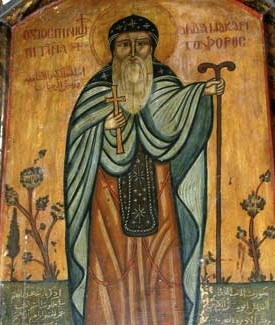
Macarius, a monk from 4th century Egypt, tells us why God sent Jesus, his Son, into a world that’s become a desert, an empty house, an unused path. One reason monks like him preferred to live in the desert was their belief that a redeeming God could make a desert flower again.
“When a farmer prepares to till the soil he must put on clothing and use tools that are suitable. So Christ, our heavenly king, came to till the soil of humanity devastated by sin. He assumed a body and, using the cross as his ploughshare, cultivated the barren human soul. He removed the thorns and thistles which are the evil spirits and pulled up the weeds of sin. Into the fire he cast the straw of wickedness. And when he had ploughed the soul with the wood of the cross, he planted in it a most lovely garden of the Spirit, that could produce for its Lord and God the sweetest and most pleasant fruit of every kind.”
Artists, like the one who painted Macarius (above), clothed the desert monks in the finest, brightest clothes, though in real life they were surely quite shabbily dressed. Yet because they were God’s redeemed they were robed in fine cloths, no matter how their neighbors saw them. They walked in a “lovely garden of the Spirit that could produce for its Lord and God the sweetest and most pleasant fruit of every kind.”
It’s no secret that today a good number of people don’t go to church to get married, get their children baptized, bury their dead, or to pray. Part of it may be the Covid pandemic, but the trend was there before Covid. Many of our churches are failing because people don’t come to them.
Today’s Feast of the Lateran Basilica in Rome is a good time to think about our churches. That ancient church was often in danger of falling down over the centuries because of its location in the city and the fortunes of the city itself.
One critical occasion was when Innocent III was pope in the 12th century. St. Francis of Assisi and 12 companions came to the pope, whose church in Rome then was the Lateran Basilica, to ask his permission to begin a new order for reforming the church.
The pope, they say, had a dream the basilica was falling down and Francis had come to build it up. He gave Francis permission and a great movement for church renewal began.
I wonder if today Pope Francis has that same sense that the church is falling down and needs renewal and reform? I wonder if that isn’t his goal for the present Synod he’s called.
The liturgy we celebrate today for the Dedication of a Church offers some beautiful insights into what a church should be. “Zacchaeus, hurry down, I mean to stay with you today.” So beautifully personal. Jesus call to the tax-collector from Jericho is a reminder the church is for people, even outsiders like Zacchaeus, not just for regular parishioners.
The church is a house of prayer Jesus reminds us when the cleanses the temple. It’s a place never finished, always being built. It’s for living stones, each having a place in the building.
It’s easy to blame the people who don’t come when a church is falling down. Better to look at those still in it.
9 Tue The Dedication of the Lateran Basilica Feast
Ez 47:1-2, 8-9, 12/1 Cor 3:9c-11, 16-17/Jn 2:13-22
10 Wed Saint Leo the Great, Pope and Doctor of the Church Memorial
Wis 6:1-11/Lk 17:11-19
11 Thu Saint Martin of Tours, Bishop Memorial Wis 7:22b—8:1/Lk 17:20-25
12 Fri Saint Josaphat, Bishop and Martyr Memorial Wis 13:1-9/Lk 17:26-37
13 Sat USA: Saint Frances Xavier Cabrini, Virgin Memorial Wis 18:14-16; 19:6-9/Lk 18:1-8
14 SUN THIRTY-THIRD SUNDAY IN ORDINARY TIME Dn 12:1-3/Heb 10:11-14, 18/Mk 13:24-32
The weekly readings and feasts are a wonderful opportunity to explore our faith. The readings from the Book of Wisdom and St. Luke’s Gospel this week, for example, take us into the Old and New Testaments. The scriptures are a catechism.
Then, the feasts and saints this week. The Dedication of the Lateran Basilica in Rome (Nov 9), the first of the great churches built after Constantine brought an end to Christian persecutions in the 4th century. Why do we have churches anyway? Is the CoVid epidemic a step towards their disappearance?
Pope Leo (Nov 10) is called great because he led a church threatened with destruction by barbarian armies. God always provides the leaders we need.
Martin of Tours(Nov 11), the soldier who gave half of his cloak to a freezing beggar, later revealed to be Christ. What are we doing for the poor? November 11 was chosen for his feast because it was when European farmers were butchering their cattle, getting ready for the winter. Martin reminded them to put aside something for the poor. Are we doing that?
Josephat (Nov 12) was a bishop seeking the unity of Orthodox and Roman Catholic Churches. He suffered martyrdom for his efforts. Keeping our church together is a big task that concerns us all.
Mother Cabrini ( November 13) a dynamic little Italian nun, championed poor Italian immigrants who came to the United Stats expecting streets paved in gold, but found hard cold cobblestones instead. Who’s championing immigrants today?
The readings and feasts are our catechism. They ask us questions and we question them. Be part of the liturgy day by day.



 The Victor's Place