Monthly Archives: August 2025

St.Mary Major: August 5

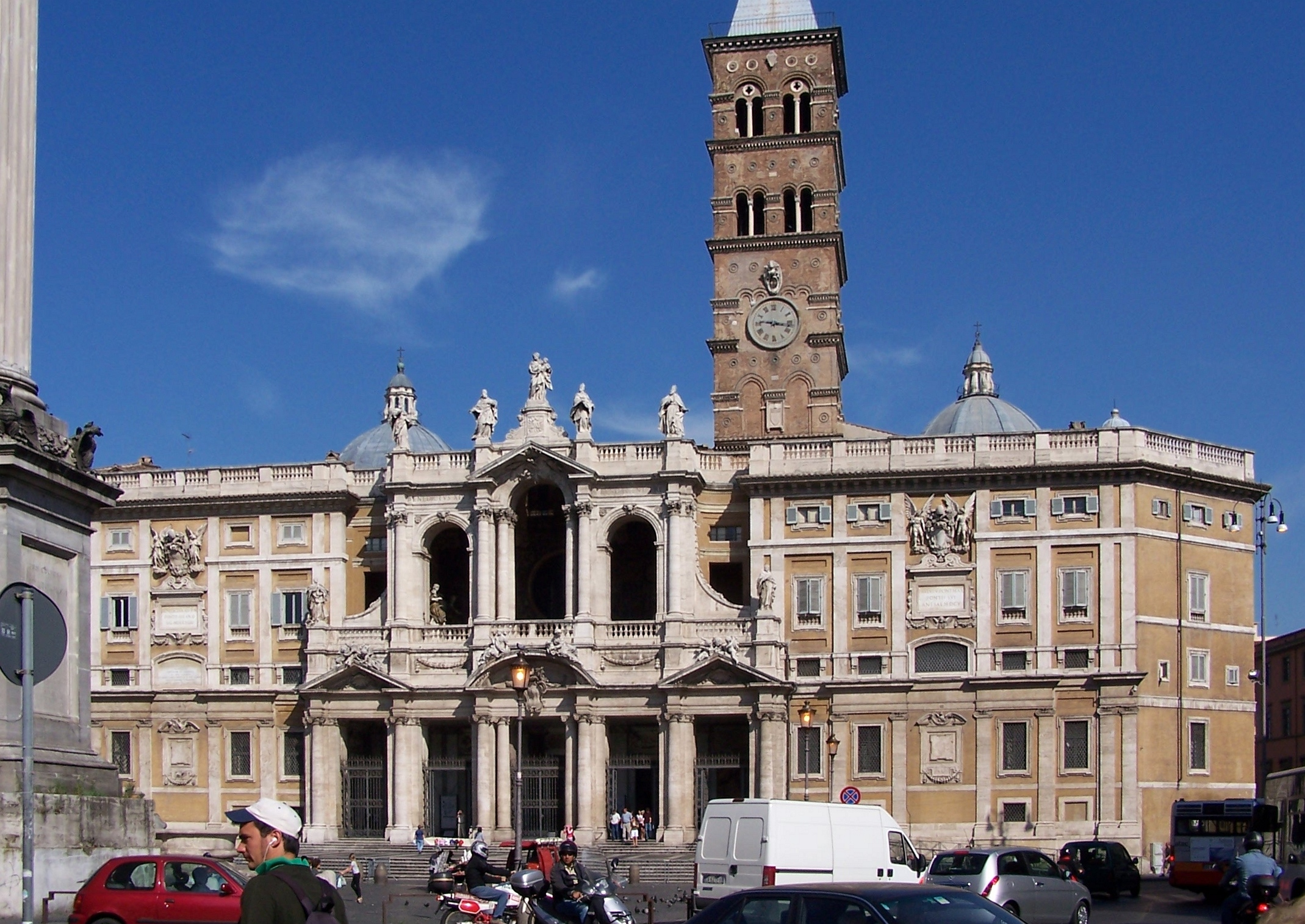
Basilica of St. Mary Major

On the summit of the Esquiline Hill, a short distance from the Lateran Basilica, is the church of St. Mary Major, begun in the early 5th century and completed by Pope Sixtus III (432-440.)

Salus Populi Romani, c 5th century

Mary, the mother of Jesus, is honored here as the Mother of God. .  In 431, the Council  of Ephesus repudiated Nestorius, the patriarch of Constantinople, for refusing to call her “Mother of God.”

The title is important because it safeguards Christian belief in the mystery of the Incarnation: Jesus is God and man, the council said. For the Christian world Mary is the defender of Jesus, her son, who was both human and divine.

Devotion to Mary ran high in the Christian world after the Ephesus council, and churches dedicated to Mary arose everywhere. In the city of Constantinople alone, 250 churches and shrines in her honor were built before the 8th century. Pictures, icons of Mary holding her divine child multiplied, especially in churches of the East, where they became objects of special devotion.

Mary’s title, Mother of God, does not make her a goddess, otherwise how could she have given birth to Christ who is truly human? Yet, she can be called Mother of God, because Jesus who is truly her human son is truly Son of God from all eternity as well.

The 5th century, however, was hardly a good time to build a church in Rome. In 410, Alaric and his Goths shocked the Roman world by sacking a city all thought invincible. In 455 the Vandals under Genseric vandalized Rome. Twice more in the century other barbarian tribes invaded.

In far off Palestine St. Jerome cried out in disbelief at Rome’s misfortunes, which he saw heralding the end of the world. In Africa St. Augustine wrote “The City of God” in response to the followers of Rome’s traditional religions, who said Christian weakness caused the city’s devastation. Christians were not the cause of the city’s misfortunes, St. Augustine wrote; two loves are at work in the world building two cities. One love builds an evil city; Christianity builds the City of God, promoting love and justice.

The English historian Edward Gibbon called this period a time of decline and fall, the end of the Roman Empire. God’s plan does not lead to decline and fall, they say, but to triumph in Christ. God’s plan does not lead to decline and fall, they say, but to triumph in Christ. God’s plan does not lead to decline and fall, this church says. On the walls of St. Mary Major has stories from the Old and New Testaments calling for courage and hope.

In the church of St. Mary Major, Mary appears as Jesus’ mother and closest disciple. To use a phrase of St. Pope John Paul II, this church is “a school of Mary” who teaches mysteries she has learned. A noticeable number of women from the Old and New Testaments surround her: she represents those who seem powerless, but are empowered by God.

The great 13th century mosaic in the church’s apse of Mary crowned by Jesus Christ as heaven’s queen proclaims God’s triumph in her, but also his triumph in the church as well. She is taken up to heaven “to be the beginning and pattern of the church in its perfection, and a sign of hope and comfort for your people on their pilgrim way.” (Preface of the Assumption)

It shouldn’t surprise us that many of the mysteries in which Mary had a special role were first celebrated  here as liturgical feasts. The Christmas liturgy, especially the midnight Mass on December 25th ,  began in this church  in the 5th century and spread to other churches of the west.

A replica of the cave under the church of the Nativity at Bethlehem, the traditional site of Jesus’ birth, was constructed here early on.. After the Muslim conquest of the Holy Land in the 7th century,  Christian refugees placed relics here purported to be from the crib that bore the Christ Child and relics of St.Matthew, an evangelist who told the story of Jesus birth.

Relics of the Crib from Bethlehem

Besides the Christmas liturgy, other great Marian feasts, such as her Immaculate Conception and Assumption, developed their liturgical forms in this church.

Built on a hill where all could see it, near Rome’s eastern walls so often threatened by barbarian armies, St. Mary Major affirms Christianity’s ultimate answer to its enemies. It is not military might, but the power of faith and love that triumphs in the end.

Visiting St.Mary Major

The church’s 18th century façade was built to enhance the appearance of this important church at a time when many visitors, especially  from England and Germany, were traveling to Rome on the Grand Tour to visit its classical and religious sites.

The church’s interior, with its splendid 5th century mosaics along the upper part of the nave, retains its original form better than any other of the major basilicas of Rome.

The Sistine Chapel at the right hand side of the nave was built to house a silver reliquary with relics of the crib brought from the Holy Land in the 8th century. Two popes, Sixtus V and Pius V are buried there.

The Borghese Chapel at the left hand side of the nave honors the ancient icon of the Virgin and Child,”Salus populist Romani”, that Roman Christians have reverenced for centuries. A reproduction of the icon is a nice remembrance to bring home. Pope Francis has requested to be buried here.

The magnificent 13th century mosaic in the apse of the basilica presents the Coronation of Mary in heaven. It’s surrounded by 5th century mosaics depicting scenes from the birth of Jesus and the life of Mary.

Website:

http://www.vatican.va/various/sm_maggiore/index_en.html

St. John Vianney

images

August 4th  is the feast of St. John Vianney, (1786-1859) the patron of parish priests. Born in Lyon, France, he wanted to become a priest but had to wait because of family obligations. He struggled to become a priest because of his limited education.

Once ordained he was made pastor of a small parish in an out of the way place called Ars. “He cared for this parish in a marvelous way by his preaching , his mortification, prayer and good works,” his biography says. He was especially good hearing confessions and soon people were coming from everywhere to Ars.

Good to pray for parish priests, struggling to minister in the church today as it goes through difficult times of change and questioning.We need more John Vianneys.

John Vianney knew the value of prayer. He wanted to become like St. Francis of Assisi and St. Colette who “used to see our Lord and talk to him as we talk to one another. How unlike them we are! How often we come to church and have no idea what to do and what to ask for. We know how to speak to another human being, but not to God. “

His simple sermons challenged and changed those who heard him. Hurray for simple sermons and priests who preach them.

A Catechism on prayer, by St John Mary Vianney

The noble task of man, to pray and to love

Consider, children, a Christian’s treasure is not on earth, it is in heaven. Well then, our thoughts should turn to where our treasure is.
  Man has a noble task: that of prayer and love. To pray and to love, that is the happiness of man on earth.
  Prayer is nothing else than union with God. When the heart is pure and united with God it is consoled and filled with sweetness; it is dazzled by a marvellous light. In this intimate union God and the soul are like two pieces of wax moulded into one; they cannot any more be separated. It is a very wonderful thing, this union of God with his insignificant creature, a happiness passing all understanding.
  We had deserved to be left incapable of praying; but God in his goodness has permitted us to speak to him. Our prayer is an incense that is delightful to God.
  My children, your hearts are small, but prayer enlarges them and renders them capable of loving God. Prayer is a foretaste of heaven, an overflowing of heaven. It never leaves us without sweetness; it is like honey, it descends into the soul and sweetens everything. In a prayer well made, troubles vanish like snow under the rays of the sun.
  Prayer makes time seem to pass quickly, and so pleasantly that one fails to notice how long it is. When I was parish priest of Bresse, once almost all my colleagues were ill, and as I made long journeys I used to pray to God, and, I assure you, the time did not seem long to me. There are those who lose themselves in prayer, like a fish in water, because they are absorbed in God. There is no division in their hearts. How I love those noble souls! Saint Francis of Assisi and Saint Colette saw our Lord and spoke to him as we speak to one another.
  As for ourselves, how often do we come to church without thinking what we are going to do or for what we are going to ask. And yet, when we go to call upon someone, we have no difficulty in remembering why it was we came. Some appear as if they were about to say to God: ‘I am just going to say a couple of words, so I can get away quickly.’ I often think that when we come to adore our Lord we should get all we ask if we asked for it with a lively faith and a pure heart.

People, Old and New

The Lectionary Readings this week from the Book of Numbers and the Book of Deuteronomy continue to describe the journey of the Israelites to the Promised Land led by Moses. Not an easy journey, not an easy people.

They grumble, they/re jealous, they doubt.  They’re hardly heroic as they journey on. Listen to their laments:  “Would that we had meat for food! We remember the fish we used to eat without cost in Egypt and the cucumbers, the melons, the leeks, the onions, and the garlic. But now we are famished; we see nothing before us but this manna.”

 Moses is hardly a secure leader. unaffected by them: 

“Why do you treat your servant so badly?” Moses asked the LORD.”Why are you so displeased with me that you burden me with all this people?Was it I who conceived all this people?  Or was it I who gave them birth, that you tell me to carry them at my bosom, like a foster father carrying an infant,to the land you have promised under oath to their fathers?Where can I get meat to give to all this people? For they are crying to me, ‘Give us meat for our food.’ I cannot carry all this people by myself,for they are too heavy for me If this is the way you will deal with me, then please do me the favor of killing me at once, so that I need no longer face this distress.”

Exhausted by the journey, Moses has hqd enough.

Are the new people of God so different from their ancestors in the desert? Are its leaders better than Moses?

One reason we read the Old Testament is it’s a mirror for the New.

18th Sunday c: Following Jesus

For this week’s homily please watch the video below.

( I preached this homily today at the Maritime Academy in Kings Point, NY)

For the last four Sundays our readings from St. Luke describe the journey Jesus takes from Galilee to Jerusalem where he’ll suffer and die and rise again. 

He calls people to follow him, some don’t want to follow him at all. Some don’t understand what following him means.

Two weeks ago in our Sunday gospel, for example, a teacher of the law asks Jesus 

“What must I do to inherit eternal life?” Jesus tells him to love God and love his neighbor.

You get the impression the teacher of the law isn’t really interested in Jesus’ answer. Rather he’s trying to make a point. He wants to discredit Jesus, or perhaps he just wants to show off what he knows. Some people today are like him.

Today’s gospel is about another person who approaches Jesus: “Someone in the crowd said to Jesus “Teacher, tell my brother to share the inheritance with me.” 

He’s not interested in following Jesus either, he just wants Jesus to back him up. He’s interested in money. He’s fighting with his brother over an inheritance–not an unusual story, by the way. A lot of families fight about money.

Jesus tells the man “I’m not here as your lawyer or financial advisor.” Then, he cautions him about greed. “Life is not about all the things you have.”

He continues with the story of a rich farmer feverishly building barns for storing his wealth and his harvest:  “This will do it! I can eat, drink and be merry for the rest of my life.”

“You fool,” God says. “You and your wealth can go in a night.”

The rich farmer only thinks about himself, not about others or the land he farms.

Now, suppose the parable became a parable about a fisherman who makes his living on the sea, or about someone like you pursuing a career on the sea. How do you look at your role as maritime people. Just a job? The sea just a place to make money?

Or do you have a call to care for the sea?

Tomorrow some friends and I are going up to Auriesville and Fonda, two towns along the Mohawk River that centuries ago were Indian villages. Auriesville was where a Jesuit priest, Isaac Jogues, and three companions were martyred in the 17th century. St. Kateri Takakwitha was born in the Indian village of Auriesville and lived for 24 years in nearby Fonda. 

The native peoples in those villages on the Mohawk River centuries ago likely came to fish and trade in the waters here around New York City. The waters teemed with fish then. New York Harbor was home to some of the largest oyster beds on the planet. The early European explorers marveled at our harbor, its rivers and waterways, a place of paradise.

What are its waters like now? Mostly polluted. Still a trading place for ships great and small, but no fish and or oysters worth eating. Greed and human ignorance have taken away valuable water resources from our city. We made water a commodity. 

Greed and human ignorance threaten the waters of our world today. So many regard them only as commodity to be plundered for whatever minerals we need.  

“If today you hear his voice, harden not your hearts.” 

Is God’s word meant for you? Today’s psalm says it is. The native peoples long ago delighted in the waters you look at every day. They cared for them better than we do.  

Your life is more than making money and eating, drinking and making merry. Learn about the waters of the earth.  Care for them. They need caring for. 

St. Alphonsus Liguori: August 1

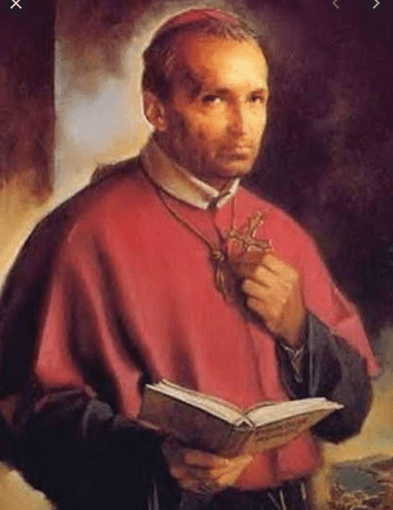
Alphonsus Liguori (1696-1787) was born near Naples, Italy, into a noble family. He began life as a lawyer but gave up law to become a priest and devote himself to bringing the gospel to the poor. His sermons and instructions were simple. “I never preached a sermon that the poorest old woman in the congregation didn’t understand,” he claimed. In 1732 he founded the Redemptorists, the Congregation of the Holy Redeemer. 

A prolific writer, poet and musician, Alphonsus authored a series of devotional books on Mary and important works on moral theology.  He advocated leniency and mercy towards people, steering a course between severity and laxity.  In hearing confessions, he said he never denied anyone absolution. We can see why he’s an example for pastoral workers today.

 In 1762, he became bishop of Sant Agata dei Goti, a small diocese near Naples, where he worked to reform the clergy and renew its people in their faith. In 1775 he resigned his bishopric because of his health, but continued writing religious and devotional tracts till his death in 1787. In 1816 he was canonized by Pope Gregory XVI. Pope Pius IX declared him a doctor of the church in 1871.

“Hasn’t God a claim on our love? From all eternity God has loved us. ‘ I first loved you. You had not yet appeared in the light of day, nor did the world yet exist, but already I loved you. From all eternity I have loved you.’

God gave us a soul endowed with memory, intellect and will; he gave us a body equipped with the senses; it was for us that he created heaven and earth and all things. The truth is the eternal Father went so far as to give us his only Son. 

  By giving us his Son, whom he did not spare precisely so that he might spare us, he bestowed on us at once every good: grace, love and heaven; for all these goods are certainly inferior to the Son. He who did not spare his own Son, but handed him over for all of us: how could he fail to give us along with his Son all good things?”

The prayer for his feast day points out it’s our turn to do what Alphonse’s did:

O God who constantly raise up in your church new examples of virtue, grant that we may follow so closely in the footsteps of the Bishop Saint Alphonsus in his zeal for souls as to attain the same rewards that are his in heaven.