The Venerable Bede (672-735), whose feast day is May 25th, was destined from his birth to be a monk. Born near Wearmouth Abby in England, he spent his life in that monastery from his earliest years, and became a scholar, teacher and spiritual guide. His commentaries on scripture and the history of England were known far beyond the place where he lived. He is considered the most learned man of his time.
“It’s ever been my delight to learn, to teach and to write,” he said, and he shared his learning with those he lived with; his wisdom inspires us today. Besides the scriptures and historical studies, Bede delighted in music, mathematics and learning about the natural world. He’s honored as a Doctor of the Church.
You can see from an account of his life by Cuthbert, a contemporary, that his brothers in the monastery liked him and held him in esteem. And he liked them. Until the day of his death he continued to think and teach and write. On the day he died he was finishing up one of his studies, a commentary on the scriptures. When it was done “on the floor of his cell, he sat and sang “Glory be to the Father and to the Son and to the Holy Spirit”; and as he named the Spirit, the Breath of God, he breathed the last breath from his own body. With all the labour that he had given to the praise of God, there can be no doubt that he went into the joys of heaven that he had always longed for.”
Before he died, he wrote this:
“Before setting forth on that inevitable journey, none is wiser than the man who considers—before his soul departs hence—what good or evil he has done, and what judgement his soul will receive after its passing.”
Lord, give us a love of learning and a delight in your wisdom and truth, and the courage to look at ourselves.
For this week’s homily, please watch the video below.
As we all know we have a new Pope Leo XIV. I can’t remember any pope in my time – and I’ve lived under 5 popes– receiving the media coverage he has gotten. As the media keeps reminding us, he is head of about 1.3 billion Catholics in the world.
What does the pope do? What does it mean when we say he is head of 1.3 billion Catholics in the world? What does leading the Catholic Church mean?
I ask these questions because our first reading at Mass today describes a very important event that took place at the beginning of our church. It determined, not only what a pope should do, but the very nature of our church and how we should understand it. (Acts 15:1-29)
Our first reading describes what’s called the Council of Jerusalem, a council that took place in Jerusalem after the resurrection of Jesus, as his follower began to bring his message to the world of their time.
A problem arose. Jesus and his first followers were all Jews, firmly attached to their Jewish tradition. Jesus never went beyond Palestine; his ministry was mostly to Jewish people. But after his resurrection, he told his followers to go to all nations with his message. Make disciples of all nations.
Some of his followers thought that meant reaching out only to Jews all over the world. Actually, the first outreach of Jesus’ disciples began in Jewish synagogues. For some of his followers to follow Jesus you had to first be a Jew. Paul and Barnabas, mentioned in today’s reading. thought otherwise as many non-Jews, Gentiles, were drawn to follow Jesus. Peter, after some hesitation, thought the same thing,
To settle the matter, all the apostle gathered in Jerusalem to decide. Their decision– which they saw as coming from the Holy Spirit as well as from themselves– was that all people, not just the Jews, were called to follow Jesus. You didn’t have to join a synagogue or follow Jewish practices. God is the God of all, all nations, all peoples, are races. God is the God of heaven and earth.
That decision is why our church is called the Catholic Church. Our church is by nature a global church. It’s all over the world.
The universality of our church may be a special gift to the world today, when wars are pitting one country against another, when so many countries are closing their borders in fear of foreigners, when nations are looking only to their own interests. We’re living in a divided world. It’s longing for a voice reminding us of our common humanity. We’re all children of God. .
Our church is called to be a model of what the world should be. A home for all, whatever your race, or color, or place on the social ladder. I think that’s one reason Leo XIV got the worldwide welcome he did.
What does a pope do? He shepherd’s a church that’s a home for all. He proclaims the message of Jesus, God’s only Son. That’s why Pope Leo was chosen, not because he’s an American, but because he’s a missionary at home in the world itself.
On the day of his election, the new pope told the cardinals who elected him to join him in a mission to the world. On the day after, he asked the crowds in St. Peter’s square to join him too on that mission, to follow Jesus Christ and bring his message to all peoples.
We belong to the Catholic Church. We have to keep our church catholic. We have to be catholic ourselves.
Jesus said to his disciples: “This is my commandment: love one another as I love you. No one has greater love than this, to lay down one’s life for one’s friends. You are my friends if you do what I command you. I no longer call you slaves, because a slave does not know what his master is doing. I have called you friends, because I have told you everything I have heard from my Father. It was not you who chose me, but I who chose you and appointed you to go and bear fruit that will remain, so that whatever you ask the Father in my name he may give you. This I command you: love one another.”
Jesus asks that we love one another. What’s the love he calls us to have? Love can be of two kinds. We can love someone for what they do for us, what they give us, what we gain from them. That’s called “love of concupiscence.”
Another kind of love is a love that gives to another rather than receives. That’s called a “love of benevolence.” A love that gives.
Jesus loves us, not because we are slaves who can serve him and do something for him, but as friends whom he freely shares with. He loves to the extent that he lays down his life for us. His love is a love that gives life.
His love is life–going. It makes us able to give life, as his Father gives life. The love he describes is the love found in the Trinity, Father, Son and Holy Spirit.The human family is meant to be joined in a trinitarian love.
The Council of Jerusalem, recalled in our readings these last few days, (Acts 15:1-29}, opened the church to the peoples of the world. Over the centuries church councils, as instruments of the Holy Spirit, have guided generations of Christians on their journey to the Kingdom of God. It’s important to study them when we hear, as we do today, criticisms of the Second Vatican Council, which the Catholic Church follows in our time.
Early 4th century councils, like Nicea, Ephesus and Chalcedon explored the mystery of the Trinity and the mystery of Christ. We still recite creeds that summarize their teaching. Churches like St. Peter’s, St. John Lateran and St. Mary Major in Rome recall their work. The good resulting from these councils was not immediately obvious, however. Only in time do councils unfold and reveal their gifts.
The Council of Trent (1545-63), gave us decrees and a catechism for renewing the church following the Protestant Reformation. The basilica of St. Peter was rebuilt at the time under the leadership of the popes. The council’s calls for reform were not immediately or easily implemented.
The First Vatican Council (1869-70) continued Trent’s efforts of reform, but was abruptly cut short due to the political situation of the time. Fr. John O’Malley, SJ, an historian of the councils, gives a short history of the First Vatican Council.
The Second Vatican Council
The Second Vatican Council (1962-65) was convened by Pope John XXIII to update church practices, foster the reunion of Christian churches and contribute to the well being of the modern world. Its decrees provide a path for the Catholic Church into the future; it shapes the decisions and actions of our church today.
There was much interest and hope among Catholics for the Second Vatican Council as it ended, but that interest declined, in fact some now see the council as a failure. Like all the great councils, however, the Second Vatican Council must be seen as the work of the Holy Spirit, who works in God’s time and not ours. Here’s Bishop Barron:
The Second Vatican Council shaped Catholic life through its reform of the church’s liturgy. The renewed liturgy of Vatican II is the primary prayerbook and the basic catechism of the Catholic Church.
How is it our prayerbook? We celebrate the mystery of the Risen Christ each Sunday and every day of the year in prayer and sacraments. To know the Risen Christ the council called for a liturgy enriched by the treasures of the scriptures. It accepted insights into scripture that modern studies provide. From a church strongly tied to devotional prayer, the council provided a liturgical prayer rooted in God’s word so that the faithful could engage wisely in the modern world.
How is it our catechism? The council affirmed the faith found in all the councils of the past. At the same time, It called for a church that is the people of God, united under its pastors, and so asked for a church where all its members have their voices heard and their gifts accepted.
If we look at the history of previous councils, a council’s work is never immediately evident or fulfilled. A council takes time to unfold. This blog is a humble attempt to follow the path of Vatican II.
Father Justin Mulcahy, CP, a beloved teacher and musician who taught generations of Passionists in my province, wrote a hymn anonymously “Mary, the Dawn” under the name “Paul Cross” – St. Paul of the Cross is the founder of the Passionists.
It’s a wonderful hymn and prayer for a Mary Garden describing Mary’s role in the life of Jesus through simple earthly images. She’s the Dawn, he’s the perfect Day, the root, he’s the mystic vine, the grape, he’s the sacred wine, the wheat, he’s the living bread, the rose, he’s the rose blood-red.
I hope we can sing this song in procession to our Mary Garden for the Feast of Mary’s Visitation. Here it is,, with a few added stanzas at the beginning. I’m adding an organ melody by Greg Martinez
Prayer
Mary, full of grace, Mother of us all All sing your praise, Pray for us all.
Mother of Jesus, Mother of us all Show us your Son Savior of us all.
Mother of seasons, Earth and sky and sea, In all our ways Help us count our days
Mary the Dawn, Christ the Perfect Day; Mary the Gate, Christ the Heav’nly Way!
Mary the Root, Christ the Mystic Vine; Mary the Grape, Christ the Sacred Wine!
Mary the Wheat, Christ the Living Bread; Mary the Rose, Christ the Rose Blood-red!
Mary the Font, Christ the Cleansing Flood; Mary the Chalice, Christ the Saving Blood!
Mary the Temple, Christ the Temple’s Lord; Mary the Shrine, Christ the God adored!
Mary the Mother, Christ the Mother’s Son. Both ever blest while endless ages run. Amen.
Our reading at Mass from the Acts of the Apostles (Acts 15, 7-21) brings us to a critical moment in the life of the early church– the Council of Jerusalem, which decided whether and on what terms gentiles would be accepted into the new Christian movement. Its decision to admit the gentiles led to a rapid expansion of the church as non-Jews from all parts of the Roman world embraced the faith.
Luke Timothy Johnson has a fine commentary on this crucial event. (Acts of the Apostles: Sacra Pagina, Liturgical Press 1992)
Did a meeting really take place? Johnson writes “we can state with considerable confidence that in the first decades of the Christian movement an important meeting was held concerning the legitimacy and basis of the Gentile mission; that participants included Paul and Peter and James and Barnabas; that certain agreements were reached which, in one way or another, secured the basic freedom of the Gentile initiative. The most striking agreement between the sources comes, in fact, at the religious level. With only very slight variation, both Luke and Paul agree that the basis of the mission to the Gentiles was a matter of God’s gift, (Acts15,11. Gal 2,9) and that God was equally at work in the Apostle Paul as he was in the Apostle Peter. (Acts 15,7-8.12; Gal 2,8)”
Notice the hesitancy of the original Jewish followers of Jesus to accept gentiles into their ranks. That’s evident in Peter’s strong reluctance to meet the Roman centurion Cornelius as he visits believers of his own kind around Joppa. Not only are the disciples slow to recognize their Risen Lord, they’re slow to accept his plans for expanding their ranks. Peter must see signs of God at work in Cornelius before baptizing him and his household. Paul, James and Barnabas also must see God’s gifts in the outsiders they meet before they recognize that God is calling them to believe.
God sows seeds of faith, but we’re as slow to recognize the action of God in others as the first disciples were. We have trouble seeing God’s action in the stranger and in the unexpected. We need enlightenment.
Johnson notes that the Church’s journey through time is marked by conflict and debate. We must accept those conditions today too. Those who follow Jesus will not always agree with each other; there are strong opinions and differences among believers.
One thing I would add. Besides conflict and debate, our reading today speaks of the “silence” that comes as they debate. We’re in the presence of our transcendent God, whose ways and thoughts are above ours. We need silence to discern God’s will. Too much talk can get in the way.
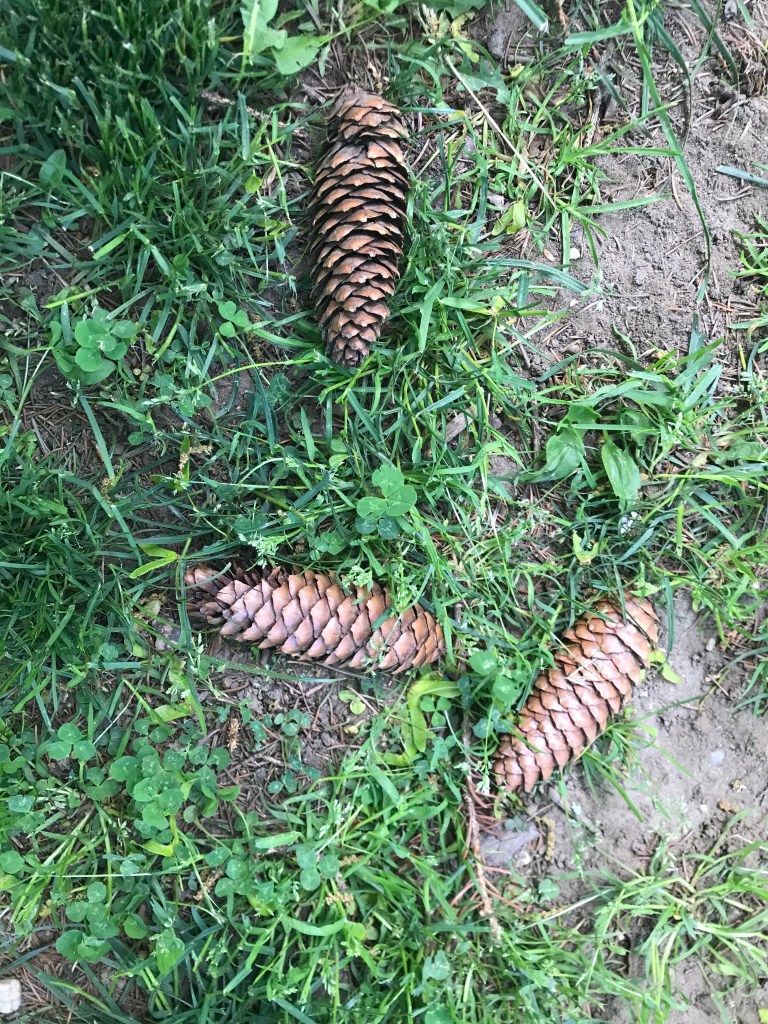
Springtime is a busy time in our Mary Garden. Birds fly in to the fountain to drink, a stray cat wanders through occasionally ready to pounce on one of them. Insects, a solitary butterfly, flit through the spring flowers. But seeds are our main visitors these days, seeds in abundance, mostly from the Norway Maples, oaks and conifers, but there are others. Small seedlings we didn’t plant and don’t recognize are showing up all over our garden floor.
“We live in a world of seeds. From our morning coffee or bagel to the cotton clothes we wear and the cup of cocoa we might drink before bed, seeds surround us all the day long.” Thor Hanson writes in his delightful book, “Seeds” (New York, 2016)
Seeds are the way plants reproduce, and this is that time. Hanson describes a seed as “a baby in a box with its lunch.” They come in all shapes and sizes. Seeds from our Norway Maples have wings; the conifers send our their seeds in armored cars. They come in abundance. Some of these babies will be grow to be maples and conifers.
Here we are in spring, seed time, an abundant time. The seeds tell us that. Do we also learn from them about God, a Springtime God, a Seedtime God?
Seeds nourish, unite, endure, defend, travel, Hanson says in his book. They’re traveling now. Grasses, like wheat and rye and others, travel most. They’re built to travel far, every where.
Early Christian commentaries often speak of the Bread of the Eucharist made up of so many grains of wheat. They’re seeds gathered into Jesus Christ, and then scattered again to bring life wherever they go, everywhere. Our gardens and the earth at springtime are a book to learn from.
These days were rogation days in our previous church calendar. Today we shouldn’t forget to ask for God’s blessing by blessing our fields, our gardens, our backyards. There’s a beautiful blessing prayer in the church’s Book of Blessings, which begins by recalling scripture readings, like the parables of Jesus- the sower, the mustard seed, etc…
From despair in time of drought… Deliver us, O Lord.
From wastefulness in times of plenty…Deliver us, O Lord.
From neglect of those in need…Deliver us, O Lord.
From blindness to your presence in our world…Deliver us, O Lord.
From hunger and thirst…Deliver us, O Lord.
Lord of the harvest, you placed the gift of creation in our hands and called us to till the earth and make it fruitful, We ask your blessings as we place these seeds and plants in the earth, May the care we show them remind us of the tender care you give your people. Amen.
The Jesus Seminar, a group of scripture scholars formed about 30 years ago, aimed at discovering the authentic words of Jesus. They claimed the words of Jesus in this part of John’s gospel are so different from his words in other gospels that they are not his, but were created by a later disciple. New Testament scholarship has moved on since then and the Jesus Seminar doesn’t have much support these days.
Many New Testament scholars, among them Raymond Brown, see the Last Supper Discourse as an example of the way many ancient writers summarized the teachings and mission of great figures as they leave their disciples in death. John’s gospel summarizes Jesus’ teaching and mission at the Last Supper, the night before he died. It’s a Passover celebration. Jesus addresses them as “little children”, as a father might address his children during Passover, explaining to them the message of that saving feast.
Jesus announces his glorification. He is going to the Father. His disciples will participate in his glory. “ I am the vine, you are the branches.” (John 15:1-8) They are to love one another as he has loved them. Loving one another is his supreme command to them. If they keep his commandments Jesus promises them a joy that no one can take from them.
Yet, they will not see him for “a little while.”
The Last Supper Discourse is a summary of Jesus’ teaching and mission, but it also reveals how he is with them and with us during the “little while.” “I will not leave you orphans. “ In sacraments, especially the Eucharist. Jesus promises his disciples he will remain with them. He fulfilled that promise in sending them the Paraclete; he also promised he and his Father will come and dwell with them.
We can hear in the Last Supper Discourse words Jesus spoke to his disciples then, words he spoke during his mission, and also words he spoke in the days after his resurrection. After Jesus rose from the dead, Paul tells his hearers in Antioch in Pisidia, “for many days he appeared to those who had come up with him from Galilee to Jerusalem. These are now his witnesses before the people.” ( Acts 13:30-32) In the “many days” he appeared to those who came up with him from Galilee to Jerusalem Jesus prepared them for his sacramental presence among them in signs. We can imagine they questioned him like Thomas and Philip and the others did. They were unsure and uncertain. As he ate with them and drank with them he assured them he would remain with them in signs in that period of time, ”a little while.”
“A little while” is our time now. He is with us in this “little while.”
his icon, Christ the Vine, was painted by a famous fifteenth-century Cretan iconographer Angelos Akotantos (d.1450) before the Byzantine Empire collapsed, leading to the separation of Eastern and Western churches. The icon is a call for unity of the churches.
We take for granted the ground we stand on. We live at 86-45 Edgerton Boulevard, Queens, Long Island, New York, USA, but the ground we stand on goes deeper than that.
The monastery we live in stands on the highest point of a spine of volcanic rock that goes back at least 400 million years, when the continent was being formed.
About 22,000 years ago the last glacier, the height of a skyscraper, came down from Canada and stopped here. Our monastery stands where the glacier stopped. As it receded and melted the glacier gave us the land we stand on now.
Southeast of us the glacier formed clay flatlands and sandy beaches facing the Atlantic Ocean. The winding depressions in our area, like Midland Parkway next to us, were streams from the glacier bringing sand and clay and rocks to the flatlands east of us.
North of us the last glacier left the waters that became Long Island Sound. The glaciers also left water in the aquifer that still provides drinking water for most of Long Island today.
About 12,000 years ago, the first humans arrived here. Small bands of Indians lived in settlements near streams and waterways where they fished and hunted for game.Then, we came here.
Pope Francis says in his encyclical Laudato Si that we need a long view of life for the days ahead, because we’re facing a world that will be radically transformed by climate change. To prepare, Pope Francis says, we need “an ecological conversion.”
That certainly means knowing more about the physical world we live in, so that we can understand it and care for it. Some say since the time of the Enlightenment in the 17th century we have concentrated too much on the human world and prioritized it too much. We’ve neglected creation and the ground we stand on.
That means also remembering that God created the heavens and the earth and God has a plan for the world. God must remain in the picture of the changing physical world, otherwise life becomes chaotic. We can’t depend on science alone.
Pope Francis, in Laudato Si, while accepting science and its findings, said that besides scientific knowledge, we should mine our own religious traditions for the wisdom and hope they give and he said to look at the Book of Genesis and our spiritual and sacramental traditions to face the future.
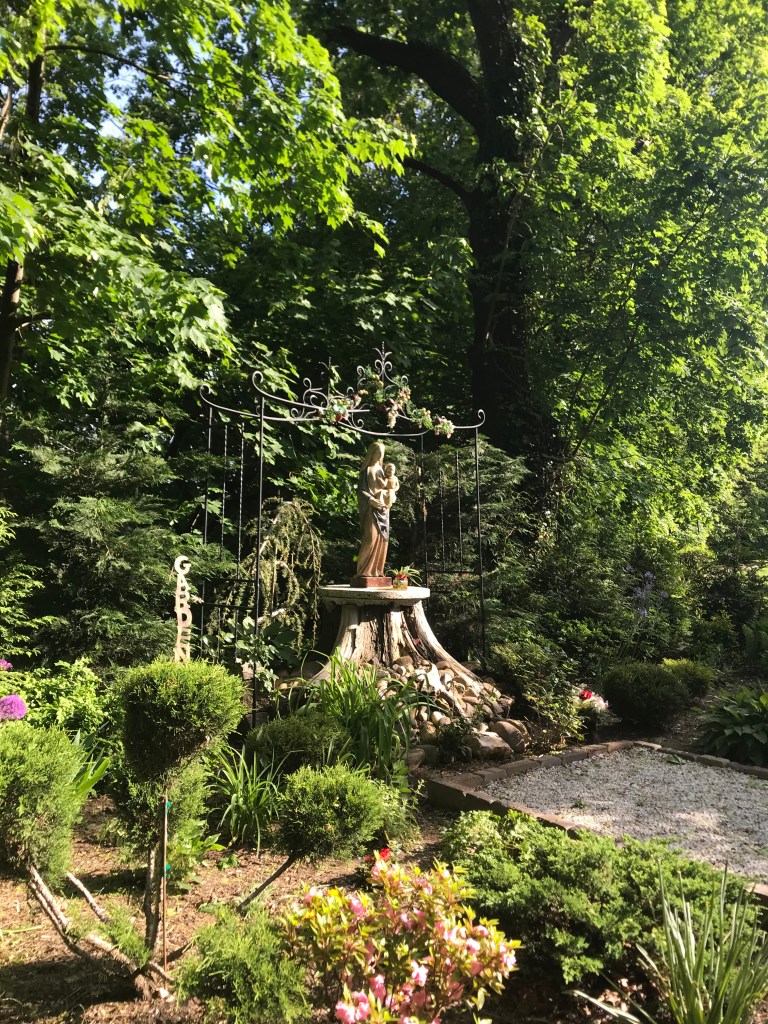
Our location here in Queens, particularly our garden, on the edge of a spine of volcanic rock, offers a valuable place for cosmic reflection. Our Mary Garden, based on the garden of Genesis, sees creation with eyes of faith and also with eyes of earthy experience. Water creates the garden, bringing life to everything else. Four rivers flow to the four corners of the earth. The plants in the four quadrants of the garden represent the staples of life– beauty, medicine and food.
Mary stands in our garden as the representative of redeemed humanity, holding in her arms Christ, the Redeemer. She rejoices in creation before her and presents the one, “through whom all things were made,” who blesses the world with hope. Mary also, as a witness to the resurrection of Jesus, knows he has promised a new heaven and a new earth. “Behold, I make all things new,”
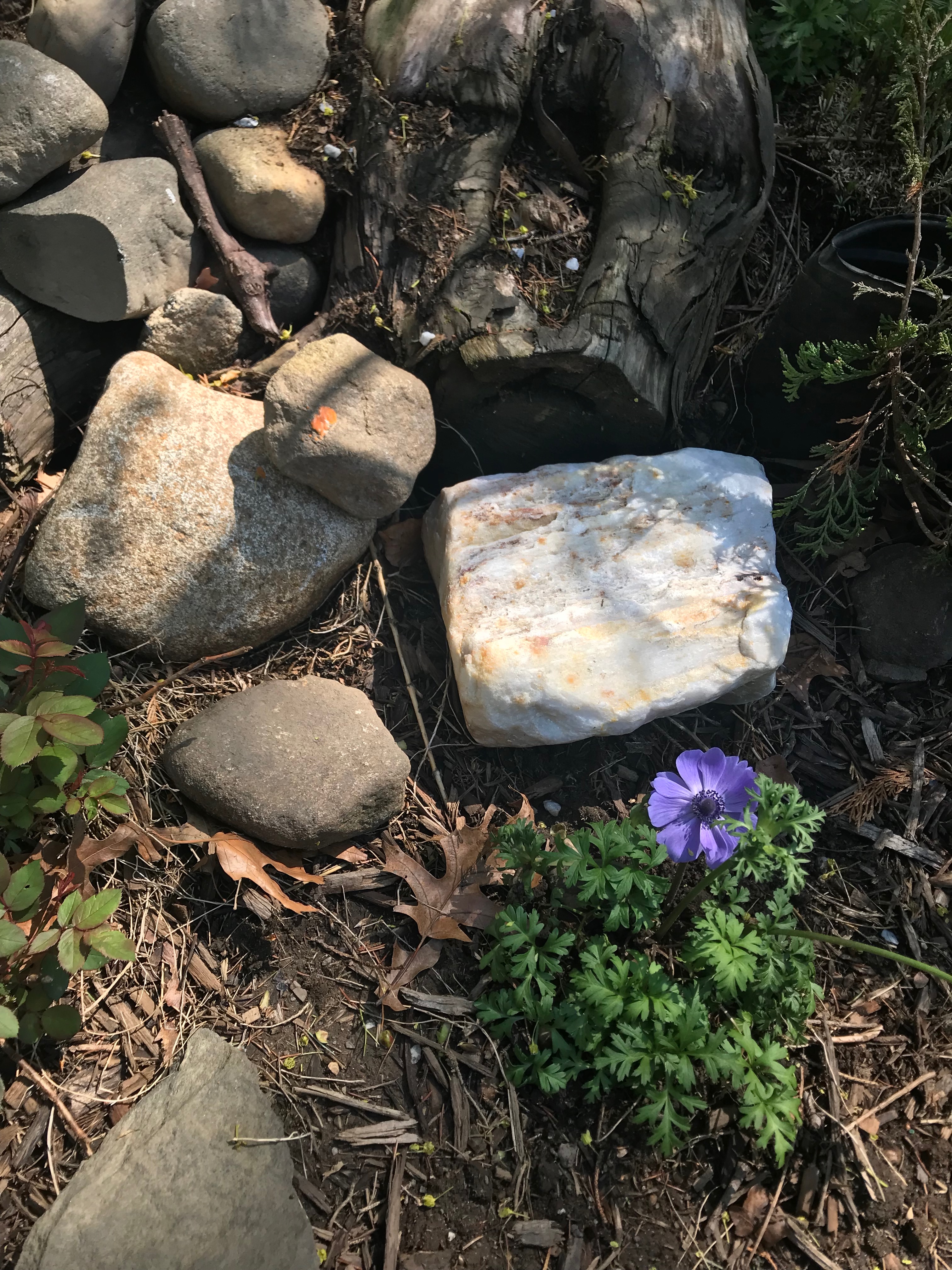
Mary’s statue stands on the stump of a large cedar tree, a tree whose roots reach deepest into the earth. At the base of the stump are rocks; most come from parts of our continent swept up by the ancient glacier and deposited here. We put some rocks from the Holy Land there, and a friend recently gave us a rock from Ireland to add to it.
The flowers in the Mary Garden bring the various colors and shapes of the world’s plant life here. Flowers are perhaps the most popular “immigrants” of the plant world, coming from everywhere, welcomed everywhere. Many of them, like the marigold, “Mary’s Gold”, are particularly associated with the Mother of Jesus.
Our Mary garden stands next to a grotto recalling Mary’s appearance at Lourdes in the 19th century when faith in France was eroding in an age of skepticism. Her appearances later at Fatima and the strong devotion to her that persists today remind us she is a permanent witness to Jesus Christ, who promised to remain with us “all days”, even days when the foundations of the earth are shaken. Mary’s a witness who comes when times are bad.
The concept of the Mary Garden developed in 13th century Europe when, during the “Black Death”, people believed a cursed earth caused millions to die. Today as the earth enters its own “passion” the Mary Garden offers a rich resource of Christian wisdom and hope for the days ahead.
Mary Garden, Immaculate Conception Monastery, Jamaica, NY
We celebrate Easter through the month of May. The Risen Lord stays with his church on her pilgrim way and walks with her step by step. Jesus is with us; he won’t leave us orphans. He gives us his gifts.
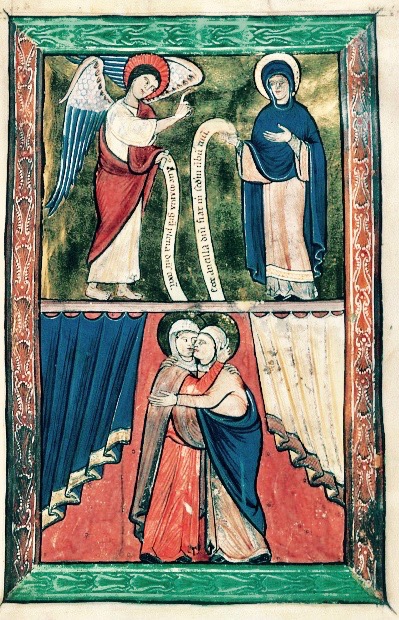
One gift is Mary, his Mother. We honor her in May and ask her to guide us into the mysteries of Jesus, her Son. She knew him better than any of his creatures.
In the Acts of the Apostles, our primary scriptural source for knowing how the church developed, Luke describes that development mainly through the missionary journeys of Peter and Paul. But let’s not forget Mary, a key figure in that development. She’s “embedded” in the story of Jesus’ life and in the development of the church. I like that word to describe her–”embedded.”
After Jesus ascends into heaven, forty days after his resurrection, a group of his followers, whom we already know from Luke’s gospel, go back to the upper room in Jerusalem. Luke describes them:
“Then they returned to Jerusalem from the mount called Olivet, which is near Jerusalem, a sabbath day’s journey away. When they entered the city they went to the upper room where they were staying, Peter and John and James and Andrew, Philip and Thomas, Bartholomew and Matthew, James son of Alphaeus, Simon the Zealot, and Judas son of James. All these devoted themselves with one accord to prayer, together with some women, and Mary the mother of Jesus, and his brothers.”
As he says earlier in his gospel, Luke depends on eyewitnesses who not only have seen and heard what Jesus said and did, but also are given prophetic gifts for preaching and teaching in the church. They tell us Jesus rose from the dead but, inspired by the Holy Spirit, they also tell us what that mystery means for the world.
Luke’s eyewitnesses are the eleven apostles, paired up two by two as Jesus told them for preaching the gospel. There are also women, like Mary Magdalen, followers of Jesus during his ministry and important witnesses of his resurrection. And finally Mary, the mother of Jesus, and his brothers, his relations, who knew him from the beginning.
Mary, who kept all these things in her heart, is the chief eyewitness.






 The Victor's Place