Monthly Archives: November 2021

Macarius, the Desert Monk

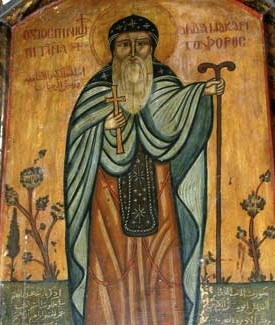
Macarius, a monk from 4th century Egypt, tells us why God sent Jesus, his Son, into a world that’s become a desert, an empty house, an unused path. One reason monks like him preferred to live in the desert was their belief that a redeeming God could make a desert  flower again.

“When a farmer prepares to till the soil he must put on clothing and use tools that are suitable. So Christ, our heavenly king, came to till the soil of humanity devastated by sin. He assumed a body and, using the cross as his ploughshare, cultivated the barren human soul. He removed the thorns and thistles which are the evil spirits and pulled up the weeds of sin. Into the fire he cast the straw of wickedness. And when he had ploughed the soul with the wood of the cross, he planted in it a most lovely garden of the Spirit, that could produce for its Lord and God the sweetest and most pleasant fruit of every kind.”

Artists, like the one who painted Macarius (above),  clothed the desert monks in the finest, brightest clothes, though in real life they were surely quite shabbily dressed. Yet because they were God’s redeemed they were robed in fine cloths, no matter  how their neighbors saw them. They walked in a “lovely garden of the Spirit that could produce for its Lord and God the sweetest and most pleasant fruit of every kind.”

They were signs of a redeemed world.

Falling Churches

Lateran Basilica, 17th century

It’s no secret that today a good number of people don’t go to church to get married, get their children baptized, bury their dead, or to pray. Part of it may be the Covid pandemic, but the trend was there before Covid. Many of our churches are failing because people don’t come to them.

Today’s Feast of the Lateran Basilica in Rome is a good time to think about our churches. That ancient church was often in danger of falling down over the centuries because of its location in the city and the fortunes of the city itself. 

 One critical occasion was when Innocent III was pope in the 12th century. St. Francis of Assisi and 12 companions came to the pope, whose church in Rome then was the Lateran Basilica, to ask his permission to begin a new order for reforming the church.

The pope, they say, had a dream the basilica was falling down and Francis had come to build it up. He gave Francis permission and a great movement for church renewal began. 

I wonder if today Pope Francis has that same sense that the church is falling down and needs renewal and reform? I wonder if that isn’t his goal for the present Synod he’s called. 

The liturgy we celebrate today for the Dedication of a Church offers some beautiful insights into what a church should be. “Zacchaeus, hurry down, I mean to stay with you today.” So beautifully personal. Jesus call to the tax-collector from Jericho is a reminder the church is for people, even outsiders like Zacchaeus, not just for regular parishioners.

The church is  a house of prayer Jesus reminds us when the cleanses the temple. It’s a place never finished, always being built. It’s for living stones, each having a place in the building. 

It’s easy to blame the people who don’t come when a church is falling down. Better to look at those still in it.  

November 8-14: Readings and Feasts

NOVEMBER 8 Mon Weekday Wis 1:1-7/Lk 17:1-6 

9 Tue The Dedication of the Lateran Basilica Feast

Ez 47:1-2, 8-9, 12/1 Cor 3:9c-11, 16-17/Jn 2:13-22 

10 Wed Saint Leo the Great, Pope and Doctor of the Church Memorial

Wis 6:1-11/Lk 17:11-19 

11 Thu Saint Martin of Tours, Bishop Memorial Wis 7:22b—8:1/Lk 17:20-25 

12 Fri Saint Josaphat, Bishop and Martyr Memorial Wis 13:1-9/Lk 17:26-37 

13 Sat USA: Saint Frances Xavier Cabrini, Virgin Memorial Wis 18:14-16; 19:6-9/Lk 18:1-8 

14 SUN THIRTY-THIRD SUNDAY IN ORDINARY TIME Dn 12:1-3/Heb 10:11-14, 18/Mk 13:24-32 

The weekly readings and feasts are a wonderful opportunity to explore our faith. The readings from the Book of Wisdom and St. Luke’s Gospel this week, for example, take us into the Old and New Testaments. The scriptures are a catechism. 

Then, the feasts and saints this week. The Dedication of the Lateran Basilica in Rome (Nov 9), the first of the great churches built after Constantine brought an end to Christian persecutions in the 4th century. Why do we have churches anyway? Is the CoVid epidemic a step towards their disappearance? 

Pope Leo (Nov 10) is called great because he led a church threatened with destruction by barbarian armies. God always provides the leaders we need.

Martin of Tours(Nov 11), the soldier who gave half of his cloak to a freezing beggar, later revealed to be Christ. What are we doing for the poor? November 11 was chosen for his feast because it was when European farmers were butchering their cattle, getting ready for the winter. Martin reminded them to put aside something for the poor. Are we doing that?

Josephat (Nov 12)  was a bishop seeking the unity of Orthodox and Roman Catholic Churches. He suffered martyrdom for his efforts. Keeping our church together is a big task that concerns us all.

Mother Cabrini ( November 13) a dynamic little Italian nun,  championed poor Italian immigrants who came to the United Stats expecting streets paved in gold, but found hard cold cobblestones instead. Who’s championing immigrants today? 

The readings and feasts are our catechism. They ask us questions and we question them. Be part of the liturgy day by day.

32nd Sunday b: Keep Your Eye on the Poor

For this week’s homily please watch the video below.

Keeping Balanced

Picasso, Three Dancers

We have an exercise session every Wednesday here in our community with a very good instructor. He asked the other day what’s the major concern elderly people have about their physical mobility? Keeping their balance, he said. 

Balance is a good thing to pay attention to in many ways, isn’t it? Our instructor is taking us through ways to keep physically balanced, simple exercises to keep the parts of the body supple and in tune. 

Our spirits need balance too. Besides breathing in and breathing out, stretching muscles and limbs, we have to make sure our spirits reach out beyond ourselves. That’s done by prayer, for one thing.

Our own spiritual tradition says that prayer is important and points to the beginning of the day and the end of the day, morning and evening, as special times to exercise that gift. Beginning and ending the day are times favoring prayer.

Jesus prayed in the morning and evening, scripture say. He prayed at other times too, but in the morning and evening he prayed the prayers his people prayed, the psalms. He came to know them by heart. 

There’s a balance in the psalms. They speak for you personally and they remind you of the world beyond yourself. You can walk in this world without fear, but there’s always a danger of falling. Pay attention to the time you have and where you’re going.

Mindfulness is not only for physical movements. We need to be mindful of the signs of the times and the One who sets us in these times. As we do our exercises, our instructor reminds us to keep close to our chair. Grab on to it if you’re losing your balance.

The Lord is my Rock, my fortress, my refuge. In him alone is my hope.