Monthly Archives: March 2020

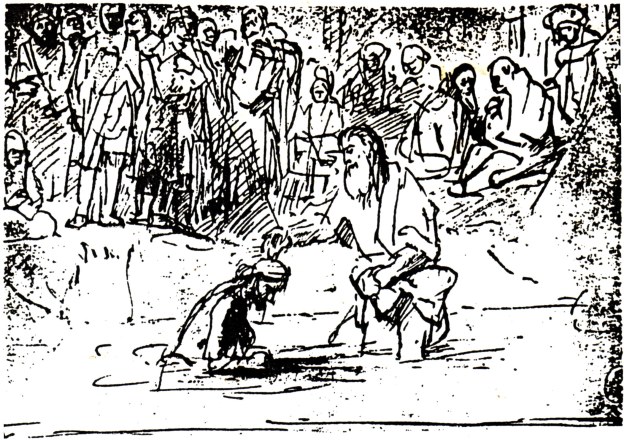
The Baptism of Jesus, by Rembrandt van Rijn

We are at a point along the lowest level of the earth’s surface, at that solemn moment in time when God’s own Son is about to begin his ministry of salvation. 

Along the farther bank, a small group of people are observing the men in the river. Jesus crouches down into the water, head bowed, as John the Baptist pours a shell full of water upon our Lord’s head. John’s face radiates loving admiration, while that of Jesus is one of utter humility.

This, of course, was not the sacrament of baptism. It was a simple ritual washing for repentant sinners who were invited to be symbolically cleansed of their moral defilements.

John’s “baptism” was one of many previous such ritual washings which, in fact, go on to this day in the River Ganges.

We believe that God’s Son, though born of a woman, was sinless. Why, then, did He submit to what must seem an indignity upon His holiness?

He entered the water and submitted to this “baptism,” not to be cleansed (of sin), but, symbolically, to be defiled by it. It was a prophetic action familiar to the non-verbal preaching of the great prophets of Israel.

Jesus was claiming (as far as it was possible to do so) His solidarity with our sinful race, since He was already, through Mary and by the power of the Holy Spirit, one with us in our humanity.

This was as close as Jesus would come to sin—not to be invaded by it, but to share its unhappy consequences in the pain and death He would endure for us.

From Meditations on Some Art I Have Loved

By Fr. Hilary Sweeney, C.P.

Saturday 2nd Week

Lent 1

Luke 15

Scripture Readings
The story of the prodigal son, one of the longest in the gospel, is also one of the most important. It’s not just about a boy who goes astray, of course, it’s about the human race gone wrong.

“Give me what’s mine,” the son says boldly to his father, and he takes off for a faraway country, a permissive paradise that promises power and pleasure, in fact, it promises him everything.

But they’re empty promises, and soon the boy who had so much has nothing and ends up in a pigsty feeding pigs, who eat better than he does.

Then, he takes his first step back. He “comes to himself,” our story says; he realizes what he has done. “I have sinned.”

How straightforward his reaction! Not blaming anybody else for the mess he is in: not his father, or the prostitutes he spent so much of his money on, or society that took him in. No, it’s his own fault.

He doesn’t wallow in his sin and what it’s brought him, either. He looks to the place where he belongs, to his father’s house. It wont be an easy road, but he takes it. He starts back home.

His story is our story too.

How easily we leave your side,
Lord God,
for a place far away.
Send light into our darkness,
and open our eyes to our sins.

Unless you give us new hearts and strong spirits,
we cannot make the journey home,
to your welcoming arms and the music and the dancing.

Father of mercies and giver of all gifts,
guide us home
and lead us back to you.

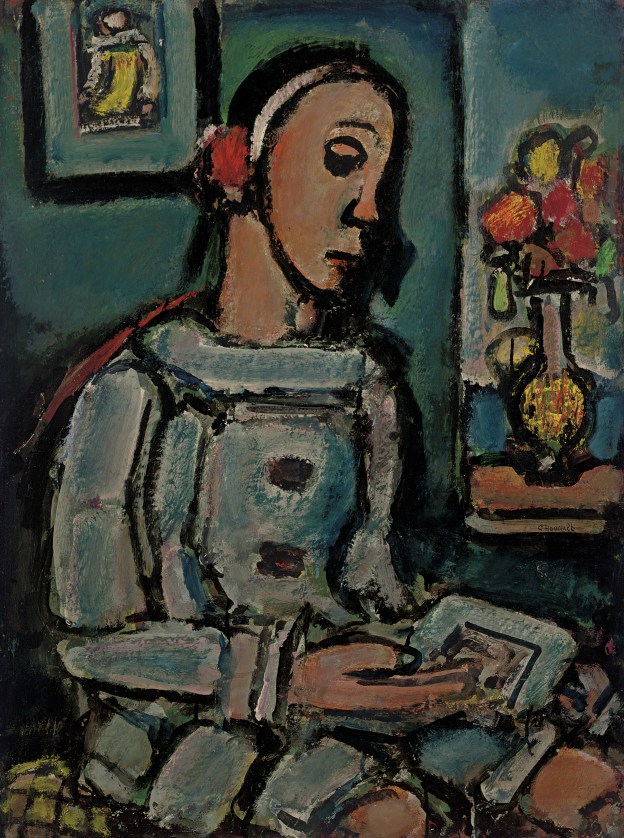
The Wise Pierrot, by Georges Rouault

Is this clown wise because he is reading a book? Are the illiterate necessarily stupid? Are books the best source of truth? Not at all. 

In this life, the true medium of the best message has been, is and always will be—sorrow. Carl Jung and Rollo May are emphatic on this point. Add St. John of the Cross, and Melville too: ‘The truest of men was the Man of Sorrows.’

So don’t pity this sad clown. He is learning, and Shakespeare put it well: ‘Knowledge has a bloody entrance.’

Painless learning is a delusion—especially that learning which must begin with self. ‘Lord,’ cried St. Augustine, ‘May I know myself, may I know Thee.’ A courageous prayer and a necessary one, for anyone who would really know God.

For, to look into one’s heart and search out one’s true motives; to face, as in a mirror, the real blotches, wrinkles and wastes of one’s spirit is not a discipline for a fool. And only he is truly wise who sees himself as nearly as he is, and accepts his gifts without smugness, his handicaps without regret.

Yes, indeed, wisdom is what’s left, when all your courses and readings are forgotten.

From Meditations on Some Art I Have Loved

By Fr. Hilary Sweeney, C.P.
Friday, 2nd Week of Lent

Lent 1


Readings

Rejection is a special kind of pain. Matthew’s gospel today describes the rejection Jesus experienced when he entered Jerusalem before his death. At first, he’s acclaimed by a large crowd as “the prophet Jesus from Nazareth in Galilee.” They spread their cloaks and cast branches before him. “Hosanna to the Son of David. Blessed is he who comes in the name of the Lord.”

Then, Jesus goes into the temple and drives out those who were buying and selling there, a symbolic act that indicates he has come to restore this place of prayer. (Matthew 21, 1-18)

Reacting strongly, the Jewish leaders reject him and question his authority to do such things. He has been sent by God, Jesus says, and responds with a parable that condemns leaders like them who reject prophets sent by God.

Jesus remains convinced of his mission, but conviction does not insulate him from the pain that comes from rejection. Like the prophets before him he suffers from it, and his suffering only increases as the crowds that first acclaimed him fall silent and his own disciples deny and abandon him. All turn against him and he is alone.

The events described in today’s gospel and the parable Jesus told throw light on one suffering Jesus endured in his passion and death¬– rejection. Rejection and death will not be the last word, however: “the stone rejected by the builders will become the cornerstone.”

You went to Jerusalem, Lord,

to announce a kingdom come

a promise of God fulfilled.

a hope beyond any the mind could conceive.

Teach us to keep your dream alive

though we see it denied.

STATIONS OF THE CROSS: Friday is a traditional day. for remembering the Passion of Jesus

Stations of the Cross:   Video  https://www.youtube.com/watch?v=waaMOBJ5e1Q&list=PLLUFZUgOPMFxkmfgBNS4Kfm8XxEwoAd6f&index=11

Stations of the Cross; Text    https://passionofchrist.us/stations-adults/ 

Stations of the Cross for Children: https://passionofchrist.us/stations-of-the-cross-children/

Prayers :  https://passionofchrist.us/prayers/

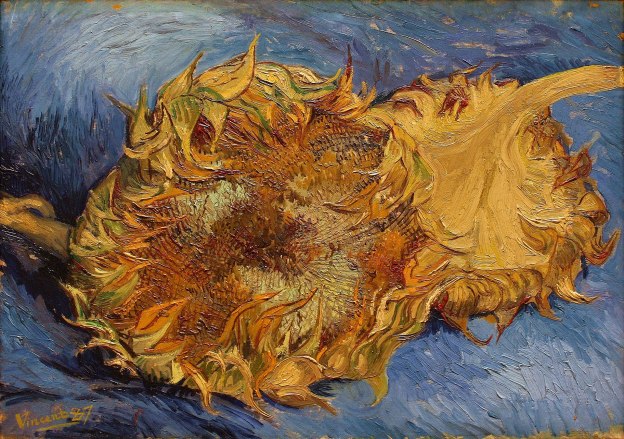
Sunflowers, by Vincent van Gogh

It has always fascinated me that when the giant sunflower plant bursts out to its glorious flower head, it is not long before it droops down (heavy with seed), upon the neck of its thick trunk. So intimately, even in nature, is humility joined to exaltation. “Whoever humbles himself shall be exalted.”

Vincent made many attempts to picture the wondrous sunflower, and here he gives us the plant’s apotheosis and its declension side-by-side. This tells us that the seeds within the flower head do not reach maturity until the plant bows low.

How exalted we’ve all felt, at times, in our youth and in our burgeoning years—to have accomplished something really good. And yet it was only when the weight of that glory (Augustine’s pondus gloriae) made us bow down before God in adoration—that our work was indeed well done. 

I honor the Chinese tradition that finds in the chrysanthemum (the last of summer’s flowers) a symbol of old age. But here in the West, the sunflower serves us even more tellingly.

It is only when life seems to have ended that it really begins. Whoever loses his life keeps it. So, when we are beset with discouragement over the goods we lose or that are taken from us, it is important to remember that Jesus never did so much for this world as when He seemed to be doing nothing—on the Cross.

There is great feeling in this painting. The flowers seem to elicit the reach of your hand, the feel of your fingertips upon their surfaces—those marvelous double helix packages.

From Meditations on Some Art I Have Loved

By Fr. Hilary Sweeney, C.P.
March 9-15

In Luke’s Gospel, read on Monday, Thursday and Saturday of this week, Jesus reveals the mercy of God and calls for care for the poor,. Luke’s story of the Prodigal Son is the gospel reading for Saturday.

Matthew’s Gospel for Wednesday reminds us that temptations about power, so obvious in the story of Jesus’ temptations, can also be seen in his disciples, like James and John.

On the 3rd Sunday of Lent in cycle a, the story of Jesus and the Samaritan woman is read, a key story on the Lenten catechesis. 

March 9 Mon Lenten Weekday

[Saint Frances of Rome, Religious]

Dn 9:4b-10/Lk 6:36-38 

10 Tue Lenten Weekday

Is 1:10, 16-20/Mt 23:1-12 

11 Wed Lenten Weekday

Jer 18:18-20/Mt 20:17-28 

12 Thu Lenten Weekday

Jer 17:5-10/Lk 16:19-31 

13 Fri Lenten Weekday

Gn 37:3-4, 12-13a, 17b-28a/Mt 21:33-43, 45-46 

14 Sat Lenten Weekday

Mi 7:14-15, 18-20/Lk 15:1-3, 11-32 

15 SUN THIRD SUNDAY OF LENT

Ex 17:3-7/Rom 5:1-2, 5-8/Jn 4:5-42 or 4:5-15, 19b-26, 39a, 40-42 

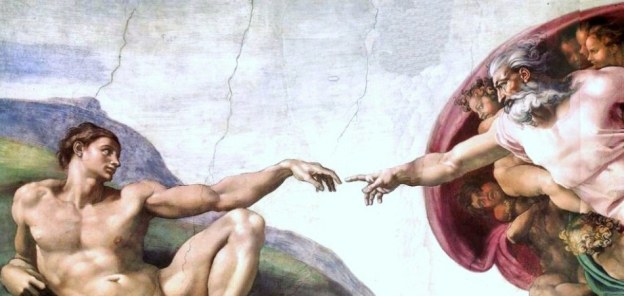
The Creation of Man, by Michelangelo

It was a stroke of genius to have left a space between Adam’s reach and His Maker’s. For, if it is man’s innate need to reach for God, it is in God’s power alone to satisfy that need.

Man, at his best, strives. He is most truly himself when he reaches beyond himself—to God. And yet the space between man and God is never so little that it is not infinite.

Man lives upon spaces, pauses. He can breathe and speak in no other way. And no matter how earnestly he strives, he must learn that waiting is the only way to meet God. For God comes to us, not we to Him.

Before completing His work of creating Mankind, God put Adam to sleep. In a sense, then, rest is the Creator’s visible signature upon our flesh. For sleep, or rest is an interval between nothing and something. And no truer description of man’s way to God was ever made than the Psalmist’s cry—“Wait for the Lord.” Nor did anything more truly describe our Lord’s humanity than the need He felt to wait for ‘the hour’ appointed by the Father—a waiting which Jesus described as an ordeal. (Luke 12:52)

It is very human to think: ‘If only there were something to hope for, I could be patient.’ But Paul reveals how far God’s ways are from ours, when he writes, ‘We wait for hope with patience.’ (Romans 8:25) So—patience first, then hope!

Let’s not put limits on God, Whose designs are beyond our measuring, while our own were limited before they began. (Psalm 139)

Be patient, then, when your situation seems hopeless—even as, in Faith, you believe what you do not see, and in Charity, you love what is naturally unlovable. Such is the nature of any virtue worthy to be called ‘theological’, that is, a virtue whose object is God Himself.

From Meditations on Some Art I Have Loved

By Fr. Hilary Sweeney, C.P.
The Transfiguration of Jesus

For this week’s homily please play the video below.