Monthly Archives: October 2018

St. Paul of the Cross

OLYMPUS DIGITAL CAMERA

October 20th, we celebrate the feast of  St. Paul of the Cross in the United States.

A saint leaves a legacy, a blessing for the church and especially for members of communities he founded or inspired. What legacy did the saintly founder of the Passionists leave?

Paul of the Cross died October 18, 1775, a year before our American Revolution and fourteen years before the French Revolution. Twenty three years after his death, the French revolution spilled over into neighboring Italy and the Papal States. Napoleon imprisoned the pope, Pope Pius VI, religious houses and church resources were taken over by French forces; the Catholic Church in Italy, like the Catholic Church in France, was seemingly crushed by the French general and his powerful army.

In May of 1810 the situation got worse. Napoleon declared an end to the Papal States and ordered the new pope Pius VII to be imprisoned in Savona, Italy. His police led thousands of religious from their religious houses back to their homes and told to start another life. Among them were 242 Passionists, the community Paul of the Cross founded in the previous century.

The old church was dead, the emperor said. He would replace it by a new one of his own. In that thinking, the Passionists too were dead; they would hardly have a role in Napoleon’s church. Of course, the church didn’t die and neither did the Passionists.

Historians usually credit the brilliant diplomacy of Cardinal Consalvi, the pope’s secretary of state, for keeping the church alive and getting it on its feet again after Napoleon’s defeat in 1814. But diplomats weren’t the only ones responsible for the church’s restoration. Most of the credit belonged to ordinary believers who kept the faith and remained loyal.

The same was true for the Passionists. We certainly gave the church an inspirational figure at the time, St. Vincent Strambi, the Passionist bishop and first biographer of Paul of the Cross. Before Napoleon’s troops invaded Rome in 1798 Pius VI asked Vincent to preach in the city’s four major basilicas to strengthen the Roman people. After Napoleon’s defeat, Pius VII called Strambi to Rome again to preach a 9 day retreat of reconciliation–not everybody stood up to the French invaders.

But besides Strambi, what kept the Passionists alive were certainly those ordinary religious who were driven from their monasteries and came back to continue the work that St. Paul of the Cross envisioned a century before. They were the faithful ones, faithful to what they learned from him.

Paul of the Cross not only preached the mystery of the Passion of Jesus; he lived it. He held on to his dreams through hard times. Humanly speaking, the Passionists, the community he founded, should have gone out of existence many times, from its tenuous beginnings to the years it waited for acceptance by the church. The mystery of the Cross was present in its birth, its growth and its life.

Now as then, the Passion of Jesus brings life, not death.
Today’s Saints


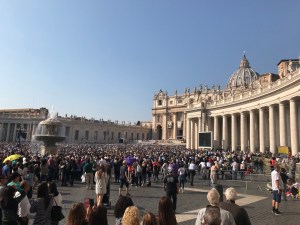
I was in St. Peter’s square yesterday when Pope Francis canonized five saints, two of them well known, Paul VI, who was pope as the Second Vatican Council ended and Archbishop Romero of San Salvador who was shot to death while celebrating Mass at the Hospital of Divine Providence on March 24, 1980.

Pope Francis, a believer in symbols, wore the blood stained cincture that Bishop Romero wore when he was shot and celebrated the Mass with Paul VI’s favorite chalice and carried the pastoral cross he carried on his pastoral journeys.

The square was filled on this bright sunny day, the crowd spilling over to the neighboring streets. You can see more here.

I remembered in the square yesterday Blanca and Julio who lived in El Salvador at the time the archbishop was murdered and revere him as a holy man and so I took some pictures of the many who came from their country to honor Romero as a national and even an international hero who spoke for the justice for the poor. Blue was everywhere.

I’m sure Pope Francis was delighted to canonize Romero. We need bishops like him.

And what about those saints canonized yesterday not so well known? The pope said in his homily that holiness takes different forms. The saints not well known are just as important and those that are. That’s true.

28th Week of the Year. b

October 14  TWENTY-EIGHTH SUNDAY IN ORDINARY TIME 

Wis 7:7-11/Heb 4:12-13/Mk 10:17-30 or 10:17-27 (143) 

15 Monday Saint Teresa of Jesus, Virgin and Doctor of the Church 

Memorial 

Gal 4:22-24, 26-27, 31—5:1/Lk 11:29-32 (467) 

16 Tuesday

[Saint Hedwig, Religious; Saint Margaret Mary Alacoque, Virgin] 

Gal 5:1-6/Lk 11:37-41 (468) 38 

17 Wednesday Saint Ignatius of Antioch, Bishop and Martyr 

Memorial 

Gal 5:18-25/Lk 11:42-46 (469) 

18 Thursday Saint Luke, Evangelist 

Feast 

2 Tm 4:10-17b/Lk 10:1-9 (661) 

19 Friday USA: Saints John de Brébeuf and Isaac Jogues, Priests, and Companions, Martyrs 

Memorial 

Eph 1:11-14/Lk 12:1-7 (471) 

20 Saturday

[USA: Saint Paul of the Cross, Priest; BVM] 

Eph 1:15-23/Lk 12:8-12 (472)

28th Sunday b: The Rich Young Man

For this week’s homily please play the video file below.

“My Joe, with the Pope.”

fol pope

October 11th is the feast day of Saint John XXIII,

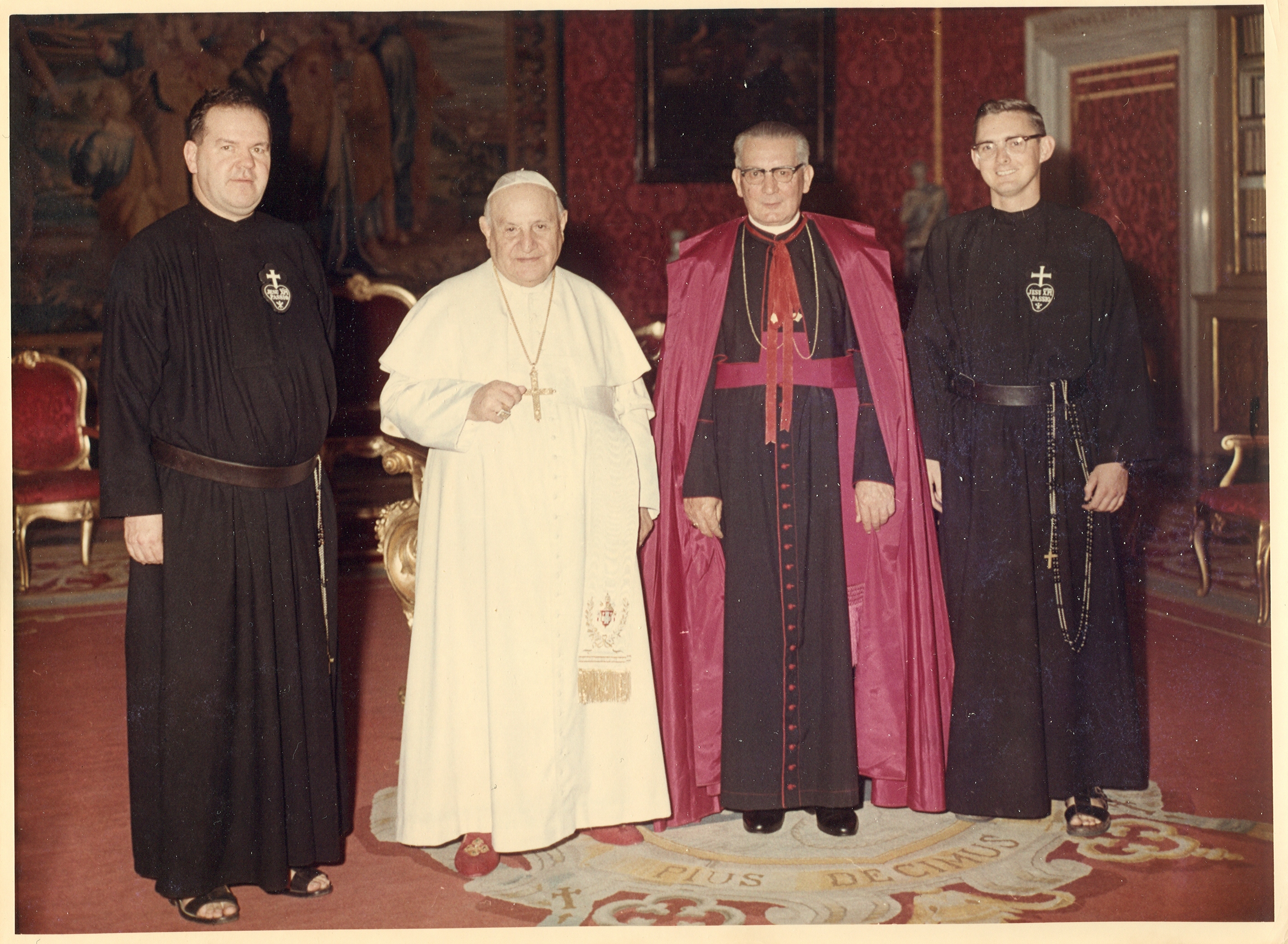
In the fall of 1962, when I was studying in Rome. Bishop Quentin Olwell, a Passionist from Brooklyn, was made bishop of Cotabato in the Philippines and was visiting Pope John XXIII on his first “ad limina” visit.

Fr. Theodore Foley, then assistant to the Passionist superior general, came to my room and said. “Get a briefcase; we’re going over to the Vatican. We’ll be Bishop Olwell’s secretaries for the day. Sometime they let you in to see the pope.”

And that’s what happened. At the end of the bishop’s visit, they invited us into the pope’s library. He received the bishop’s “secretaries” quite genially, we shook his hands and got our picture taken with him.

I remember he asked me where I was from. I told him the United States. Then he said to me “Be like St. Gabriel,” a young Italian Passionist student who died at 24, close to my age then.

Pope John was named Time Magazine’s “Man of the Year” that year, I think, but my mother, who always carried this picture in her purse and would show it to anyone she could, would say; “This is my Joe, with the pope.”

Today, I am in Rome again, at the 47th General Chapter of my community, and during this time we will be visiting Pope Francis at the Vatican. What will he say to us? Pope John, now Saint John XXIII, inspired the Second Vatican Council, which is still “in session”, in my opinion. A revolutionary event that’ s still unfolding.

I hope it will unfold in the meeting I’m part of these days.

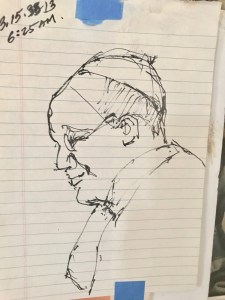
Pope Francis (Sketch by Duk Soon)

27th Sunday of the Year b


OCTOBER 7 SUNDAY TWENTY-SEVENTH SUNDAY IN ORDINARY TIME
Gn 2:18-24/Heb 2:9-11/Mk 10:2-16 or 10:2-12 (140)

8 Monday
Gal 1:6-12/Lk 10:25-37 (461)

9 Tuesday
[Saint Denis, Bishop, and Companions, Martyrs; Saint John Leonardi, Priest]
Gal 1:13-24/Lk 10:38-42 (462)

10 Wednesday
Gal 2:1-2, 7-14/Lk 11:1-4 (463)

11 Thursday
[Saint John XXIII, Pope]
Gal 3:1-5/Lk 11:5-13 (464)

12 Friday
Gal 3:7-14/Lk 11:15-26 (465)

13 Saturday
[BVM]
Gal 3:22-29/Lk 11:27-28 (466)

27th Sunday b: Two Become One Flesh

For this week’s homily please play the video below:

A Church with a Mission

241SsGiovanniPaolo

Ss. Giovanni e Paolo 

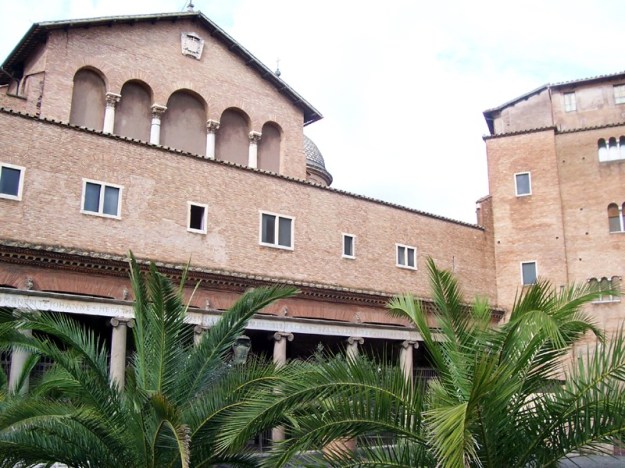
A few days ago we celebrated the feast of St. Jerome, the great 4th century scripture scholar and controversialist. I’ll be staying through October in a place well known to him in Rome– the Caelian Hill and the church of Saints John and Paul.

In Jerome’s day Rome’s rich and powerful lived on the Caelian Hill, across from the Palatine Hill and the Roman forum. Jerome had prominent friends among them. Pammachius, the ex- Roman senator who built Saints John and Paul, the noblewoman Paula and her daughter Eutochium, who later joined Jerome in his venture in Bethlehem to study the scriptures, her other daughter Blaesilla and others.

Interest in the scriptures ran high among well-off Caelian Christians then, but they also were keen for gossip and religious controversies. Jerome loved the scriptures, but he also loved the fight. His relationship with Paula and her family was part of the gossip that  probably figured among the reasons he left Rome for the Holy Land. Following him there, Paula created a monastic community in Bethlehem and she and her daughter undoubtedly played  a bigger part in Jerome’s scriptural achievements than they’re credited for.

Jerome’s a saint, but I appreciate why so many artists picture him doing penance for his sins. He needed God’s mercy.

FullSizeRender

Excavations, Saints John and Paul

Underneath Pammachius’ Church of Saints John and Paul are remains of Roman apartments going back to the 2nd-4th centuries, probably the best preserved of their kind in the city and a favorite for tourists.

Years ago, when I studied here, one of the rooms in the excavations was pointed out as part of a house church with Christian inscriptions , now archeologists are not so sure.. That doesn’t mean Christians didn’t meet or worship in these buildings, only they didn’t create a special liturgical space for meeting or worship.  Christian evidence, however, says a “house church” was here early on.

Why then did Pammachius in the fourth century build the imposing basilica of Saints John and Paul here on the edge of the Coelian Hill facing the Palatine Hill and the Roman forum ? Many retired soldiers settled on the Caelian Hill then. Did he wish to win them to Christianity through the example of two soldier saints, John and Paul, who were honored in this church? Their remains are still found under the church’s main altar today.

Is there another reason? According to Richard Krautheimer, an expert on Rome’s early Christian churches, the emperor Constantine built St. John Lateran, St. Peter, St. Paul, St. Lawrence, the first Christian churches, on the edge of the city most likely in deference to the sensibilities of the followers of Rome’s traditional religions. He didn’t want any Christian church in the “show areas” of the city, near the Roman forum or the Palatine hill.

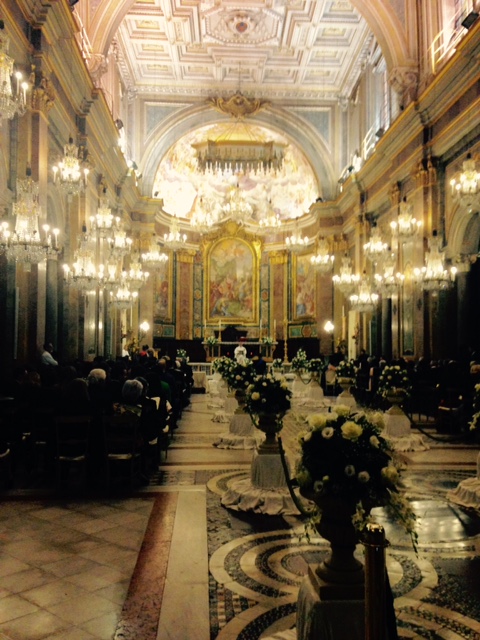
Saints John and Paul, Interior


By Pammachius’ time Christianity was more assertive. Was Pammachius’ church a statement to the city that Christianity had arrived and wished to speak its wisdom here at the heart of traditional Roman religion, near the Palatine Hill and the Roman forum? Jerome’s new translations and commentaries, along with the works of St. Augustine and others, gave them something to say.

So was this a church with a mission? A lesson for the church of today? Speak to the world of your time.

DSC01053

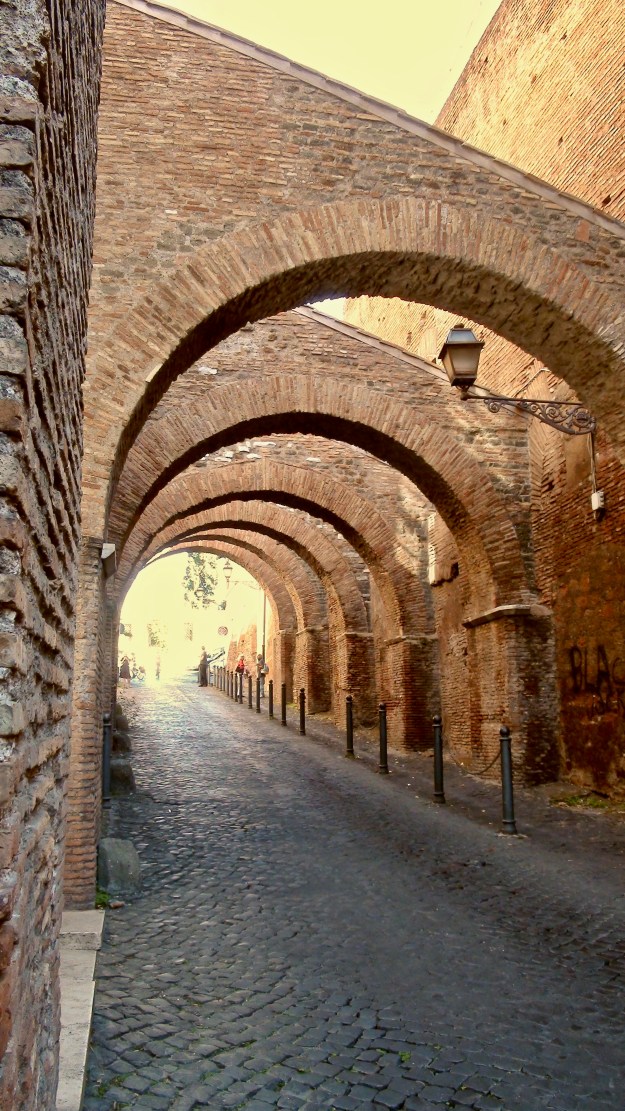
Clivo di Scauri