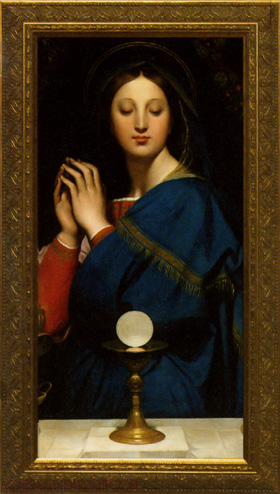
Jean Auguste Dominique Ingres, “Virgin Adoring the Host” ca. 1850s
.
Lord God, how is it You fit in such small spaces?
The Creator of all, the Maker of all things, He who knows every hair on every head—how is it Lord You fit in such small spaces?
The Light of Light, the King of Kings—the Heaven, the Earth, and all their Glory—how is it Lord You fit in such small spaces?
How is it Father that You fit in a cradle?
How is it Lamb of God that You fit in a host?
How is it Author of Life that You fit in a word?
How is it my Lord and my God You fit in such small spaces?
.
—Howard Hain
.
 The Victor's Place
Our God of largess slips into thin places. Ancient Celts called them Caol Áit (a ‘thin place’) is the feeling of being caught in a holy moment, or in a certain place where God’s presence feels so tangible that the veil between heaven and earth appears to be barely perceptible. When a thin place is understood in geographic terms, it is a transition zone. Thin places are what might be called the numinous in the landscape. They are places that feel as if they are filled with a presence of divinity, or where one might encounter the divine. These “thin places” are often found on the edge of something – a mountaintop, where the earth meets the sky; or the shoreline, where the land meets the ocean. On a spiritual plane, where God enters into the dailyness of life, enlarging our hearts with love.
LikeLike