Tag Archives: Year of Mercy

3rd Sunday of Advent C: The Year of Mercy

Audio homily here:

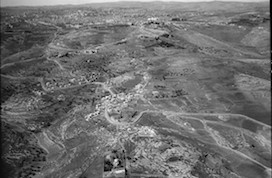
In the time of Jesus when pilgrims from Galilee came up to Jerusalem to pray in the temple, they came a number of ways. Many came down the Jordan Valley, a journey of 90 miles. When they reached the city of Jericho they turned eastward onto a steep, winding road that ascended for 3500 feet and went on for 15 miles to the city of Jerusalem. I have a picture taken from an airplane in the 1930s showing that winding, climbing road through the desert. It had to be the hardest part of their journey.
Bethany 2

In the bible the journey to Jerusalem, especially the last part up that steep winding road through the desert, became a symbol of the journey to God we all make. We’re pilgrims on our way to meet God, and that way, our life journey, can seem hard. It’s not always easy. I think that’s why John the Baptist went into the desert to preach, where the hard winding road began.

John’s father, Zachariah, a priest in the temple in Jerusalem, told John at his birth: “You, my child shall be called a prophet of the most high, for you will go before the Lord to prepare his way.” (Luke 1) Where precisely did John prepare the way? We can’t be sure, but many think it was at the River Jordan near Jericho where he welcomed weary pilgrims and invited them into the refreshing waters of the river, that they might be strengthened for the last part of their journey. But more importantly, he strengthened for the journey of life they were living.

In today’s gospel, we see ordinary people, soldiers and tax-collectors among them. John spoke to each of them, not eloquently, but simply. He told them to do God’s will all their lives. If they did that, God would bring them into his presence.

Certainly, John would use the words of Prophet Isaiah, as we do all through Advent. Isaiah also knew the road to Jerusalem and saw it as a hard journey, but God would make sure we would make it, he said. God would lead the blind on that road, the deaf, the lame– no one was too weak or too small. God would help the lost sheep to make that journey. The weakest of humanity would make the journey by God’s mercy.

This week we began, as Pope Francis has asked, the Year of Mercy. He opened the door of St. Peter’s Basilica on the Feast of the Immaculate Conception of Mary to begin the year.

We might see this year as simply a Catholic event, but it’s more than that. Right now, our world needs to hear of God’s mercy.

In his encyclical Laudato Si, on the care of our common home. The pope mentions that for almost 200 years, since the beginning of the Industrial Revolution and the time of the Enlightenment, our world has been convinced of the unlimited progress of human power and potential. Unlimited human progress. We can do anything. But there are signs in our world now, ominous signs, that our world is weak and blind and lame. There’s increasing skepticism, increasing fear, an increasing option for violence. We’re worried about the way ahead. We’re worried about the future.

We have to open the door of our own minds, in this year of God’s mercy, to know that this is God’s world. Yes, the journey isn’t going to be easy. It’s a winding, wearying, road where the end isn’t in sight. We don’t have all the answers, but we have the one important one. God is with us and he is with our world, weak and blind and lame as it is.

God is our hope.

What is Mercy?

Prodigal son
“Be merciful as your Father is merciful,” Jesus says. What does the word “mercy” mean? Where does it come from? The Russian religious writer Anthony Bloom points to the Greek word “eleison,” a word still used in our liturgical prayers: “Kyrie eleison,” “Lord, have mercy.” “Eleison” has the same root as the word “elaion,” which means olive tree and the oil it provides.

The olive tree has an important role in scripture, beginning with the story of Noah,in the Book of Genesis. “After the flood Noah sends birds, one after the other, to find out whether there is any dry land or not, and one of them, a dove – and it is significant that it is a dove – brings back a small twig from an olive tree. This twig conveys to Noah and to all with him in the ark the news that the wrath of God has ceased, that God is now offering man a fresh opportunity. All those who are in the ark will be able to settle again on firm ground and make an attempt to live, and never more perhaps, if they can help it, undergo the wrath of God.”

God’s mercy is offered to the whole human race, the story of Noah says. Mercy is not just for some, it’s for all. We’re all in the same boat. It brings a new beginning, a fresh opportunity, another chance, the storm is over.

“In the anointing of kings and priests in the Old Testament, olive oil is poured on the head as an image of the grace of God that comes down and flows on them (Ps I33:2) giving them new power to fulfill what is beyond human capabilities.” (Bloom)

In the New Testament, in the parable of the good Samaritan, the man who comes upon the victim beaten and robbed and left by the road, pours olive oil into his wounds to soothe and heal him. Mercy soothes, heals our wounds. Jesus turns to so many, like Bartimaeus, the blind man, whom he calls to follow him “up the road,” and Zacchaeus, the tax collector, whose house is changed by his presence. He is the “merciful face of God.”

Good Shepherd Parish, Rheinbeck, NY

IMG_1516
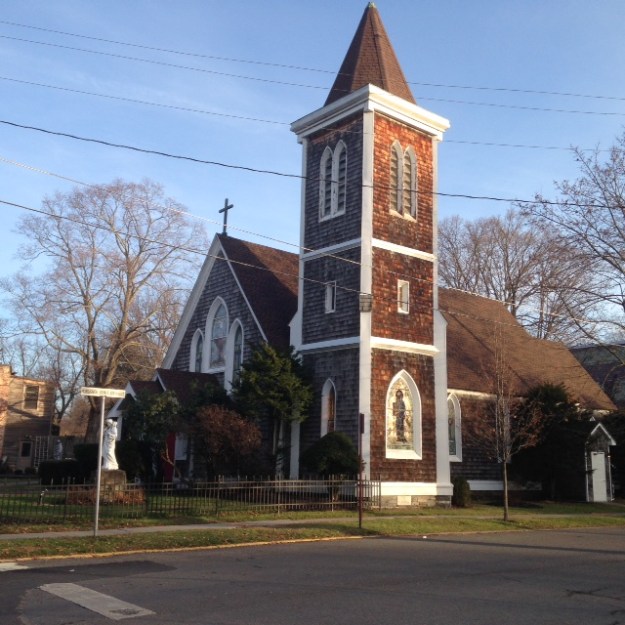
I’m preaching a parish mission at Good Shepherd Parish, Rheinbeck, New York, December 5-9. The theme of the mission is “Be merciful, as your Father is merciful,” the theme of the Holy Year of Mercy that Pope Francis called for last March.

The holy year begins December 8th and ends November 20, 2016, “the Sunday dedicated to Our Lord Jesus Christ, King of the Universe–and the living face of the Father’s mercy.”

Each evening, from Monday to Wednesday, I’ll be preaching on God’s mercy.

Monday: Jesus the Living Face of the Father’s Mercy. In Luke’s gospel Jesus is truly “the living face of the Father’s mercy” from his birth till his death and resurrection. His miracles and encounters with many during his lifetime, like the blind man and Zacchaeus, the tax collector, reveal his gift for changing people and bringing them joy. We experience the mercy of God in the Eucharist and the Sacrament of Penance through Jesus Christ, our Lord.

Tuesday: Mary, Mother of Mercy. “Hail holy Queen, Mother of Mercy, our life, our sweetness and our hope.” God’s gift of grace enabled Mary to be what Jesus asked: “Be merciful, just as your Father is merciful.” It enabled her to embrace so many mysteries of God’s hidden plan, especially the mystery of suffering and death. We, “banished children of Eve,” cry out to her; she is “our life, our sweetness and our hope.”

Wednesday: Jesus, the Bread of Life. In his encyclical, Laudato Si, Pope Francis invites us to see in the Eucharist a call to care for the earth, our common home. “The Eucharist joins heaven and earth; it embraces and penetrates all creation. The world which came forth from God’s hands returns to him in blessed and undivided adoration: in the bread of the Eucharist, ‘creation is projected towards divinization, towards the holy wedding feast, towards unification with the Creator himself’. Thus, the Eucharist is also a source of light and motivation for our concerns for the environment, directing us to be stewards of all creation.” (LS 230)