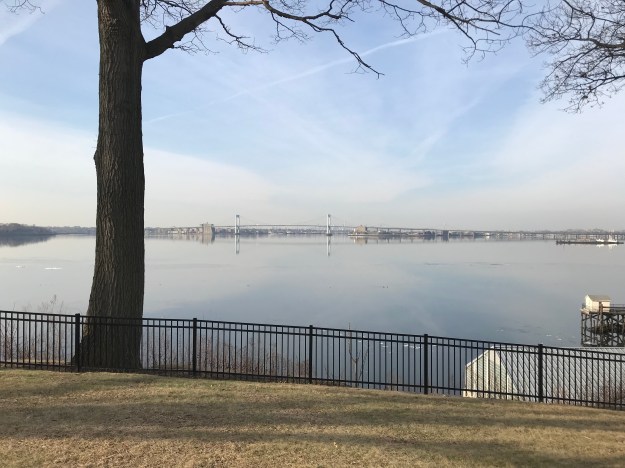
Kings Point, New York
Like the Christmas feast, we can pass over the Feast of the Epiphany too easily. It can become a quaint story of no significance.
I spoke about the meaning of the Epiphany on Sunday at the Maritime Academy in Kings Point, New York, where young men and women are being trained for service on the ships that sail our seas and waterways. This feast should mean something to them.
The only gospel that records this story is the Gospel of Matthew, so why is it there?
Matthew’s gospel was written for Jewish Christians in Galilee and Syria some time after the temple in Jerusalem was destroyed by the Romans in the year 70. We can’t imagine how shocked they were by the complete destruction of the temple and the city itself. These were places where God’s promises would be fulfilled, they thought. The Messiah would appear there. This was where Jesus would come again. All nations would stream to Jerusalem, prophets like Isaiah foretold. Now they were gone.
Matthew’s gospel reminds his hearers–and us too–that Jesus must be known by all nations before he comes again. “Go and make disciples of all nations,” Jesus says in his final words in Matthew’s gospel, “baptizing them in the name of the Father and of the Son and of the Holy Spirit, teaching them to observe all that I have commanded you. And behold, I am with you always, until the end of the age.” (Matthew 28, 18-20)
Matthew’s story of the Magi is a reminder that even as Jesus is born, messengers, strangers, wise men from afar, want to know and acknowledge him as their king and God.
Jesus Christ came, our gospel says, not for only one people or nation, but for all. Though his ministry was first to the Jews, Jesus wishes to make the world one. God doesn’t wish to save a few. He wants to save all– all the world.
The Magi came, our story says, from the east. Could that be from Iran or Yemen; two places we hardly view positively today in our country? More and more, as we look at the world only through the lens of politics and economics; we fear the stranger, we reject the immigrant, we create enemies, we reject people not like us. We’re becoming tribal instead of global. We’re falling into individualism. As the old song said, we’re looking for “perfect peace, where joys never cease, and let the rest of the world go by.”
But we can’t let the rest of the world go by and we won’t be safe behind walls. We’re living in a big world that God wants to be one. That’s what the story of the magi tells us. We’re all commissioned on this Feast of the Epiphany, which is followed next Sunday by the Feast of the Baptism of Jesus, to go out into the whole world, “ baptizing them in the name of the Father, and of the Son, and of the Holy Spirit,” teaching them to observe all that Jesus commands. And he will be with us, even to the end of time.
I told the young men and women at Kings Point on Sunday that they’re commissioned as people of the sea. The oceans and waterways are highways uniting this world of ours. They shouldn’t be looked at only through the eyes of economics or politics. They’re meant to connect peoples, they’re bridges that make us one.
As I left the chapel, I met some people who are “furloughed” by the current government shut-down. We don’t have to look far to see how dangerous it is to see the world only through the eyes of politics and economics. We need a brighter star.
 The Victor's Place