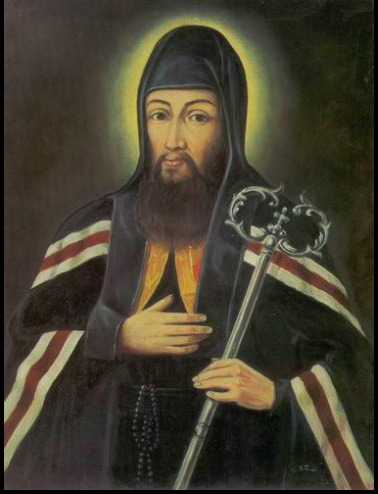
The Eastern Catholic Church of the Ukraine will be celebrating the feast of St. Josaphat (1580-1683) on November 12. They’re celebrating him as a holy ecumenist who worked tirelessly to bring unity among the Eastern Christian churches of Eastern Europe. He gave his life for it.
Josaphat was born in Voldymyr, a Ukrainian city the Russians targeted early in their current invasion of the country. Raised Orthodox, he joined the Ruthenian Catholic church, became a monk, then was made archbishop of Polotsk. At the time, Polish and Lithuanian armies conquered this disputed territory – the land has been continually fought over.
St. Sophia Cathedral, Polotsk
Religion entered the fight. Some Orthodox churches wished to be aligned to Rome after the Polish-Liithuanian conquest, so the authorities ordered some Orthodox churches be turned over to the Eastern Catholic Church. That triggered a violent reaction. Mobs sought out Josaphat in his cathedral, beat him, put him to death and threw his body in the Daugava River.
His body was retrieved and brought to his cathedral for burial. Later, it was interred in St. Peter’s Basilica in Rome.
Relations between the church of Rome and the Orthodox churches were strained then; they’re strained now. Political battles, historic feuds and rivalries have only increased tensions between the churches. For Josaphat they caused his death, at the hands of fellow Christians.
The Second Vatican Council in its document Orientalium Ecclesiarum affirmed the right of the Eastern churches to their own liturgy, theology and organization. As we appreciate their history and spirituality more, respect needs to grow. Members of churches in communion with Rome can share in the sacraments with one another.
Josaphat’s experience points to the difficult path to Christian unity, in this case between the church of Rome and many of the Eastern Orthodox churches. Presently, there are 23 Eastern Churches and about 18 million members united to the Roman Catholic Church. The Eastern Orthodox number about 300 million. The churches originate in Middle East, Eastern Europe, North Africa and India
Efforts towards Christian unity among the churches of the east and west need a patient, steady faith that looks more on God’s grace than human skills. Jesus commands we be one.
St.Josaphat reminds us to respect the Eastern churches and the rich liturgical and spiritual traditions they offer. Much of Roman Catholic liturgy and spirituality, especially our feasts of Mary, comes from the churches of the east. Josaphat had a keen appreciation of the common treasure we all share. We need that appreciation today.
Our liturgical calendar, honoring Josaphat, recognizes the universal call to holiness in saints who are from every age and nation. “Holiness is not bound by time and place.” (The Roman Calendar. Text and Commentary, 1976) We’re called to recognize the church as universal, catholic, existing everywhere..
The feast of St. Jerome, the great biblical scholar, is a good time to look at the history of the bible itself. Where does it come from? I happen to be staying today in a place Jerome knew well, the Celian Hill, in Rome.
Our Christian bible comes from two closely related religious traditions: Judaism and Christianity. The first books of any Christian bible come from the Jews, the Jewish scriptures. The rest of the writings found in a Christian bible– gospels, letters– come from Christian writers.
It’s good to remember that before printing was invented in the 15th century, the various writings of the bible were copied on papyri and parchment, materials too limited at first to be bound together in one book. “When you come,” Paul writes to Titus, “bring the cloak I left with Carpus, the papyrus rolls and especially the parchment.” ( Titus 4:13)
Paul does not have a complete bible, but only individual writings. Luke’s Gospel describes Jesus in the synagogue at Nazareth taking a scroll of the Prophet Isaiah to read. Unrolling the scroll, he read a passage from Isaiah, probably in Aramaic or Hebrew, then he rolled back the scroll, handed it an attendant, and began to teach. (Like 4:16-30) Something like this:
Ancient scroll Byzantine Museum Wiki Commons
That’s how the scriptures were read in early Christian liturgies, from papyri and parchment copies of individual Christian gospels and letters and various books from the Jewish scriptures.
The first Christians read the books of the Old and New Testament in Greek, the language of the Mediterranean world. Only in the 2nd century did Latin versions of the scriptures begin to appear in Roman North Africa as people began speaking Latin instead of Greek. Versions in other languages, like Syriac, Coptic and Armenian, also appeared as Christianity spread through the world.. Jerome was responsible for the Latin translation.
Codexes or books of the complete Christian Bible appear only towards the 4th century, as printing methods evolved. Only towards the 9th century did complete copies of the Bible become commonplace in the latin Christian world. These complete “books” of scripture were mainly located in a church; some copies might circulate among the wealthy.
Until the 9th century copies of the scriptures were found in mostly in churches, monasteries, and church libraries of western and eastern Christianity . Complete copies of the scriptures were marked for use in the liturgies and feasts of the church. Often the scriptures appeared in lectionaries specifically designed for use in the liturgy. The ordinary Christian heard the Word of God proclaimed and then commented on in a church.
Gospel of Mark. Vulgate
St. Jerome began his important translation of the scriptures from Greek and Hebrew into latin and wrote his commentaries from 382 till his death in 420. His translations, known as the vulgate, were sponsored by friends in Rome, especially Pope Damasus, who looked for a fresh translation of the various latin versions currently in use in the western church.
The Roman church then was experiencing a spiritual revival, and Roman Christians, especially women from the wealthy families on the Caelian and Aventine hills, found Jerome writings and translations from the original Greek and Hebrew inspiring. Like all languages, latin was a developing language and Jerome produced the scriptures in a language they appreciated. Some of his wealthy friends produced copies of his translations and commentaries, which they circulated among themselves.
The Roman senator, Pammachius, whom Jerome called “ my old fellow-learner, companion and friend”, was one of the advocates of the new translations. Like other Roman Christians, he hoped to convert the followers of Rome’s traditional religion through the wisdom of the scriptures. What better resource to win them over than fresh translations of the Christian scriptures from the original Greek and Hebrew and commentaries of a brilliant scholar like Jerome?
Pammachius built an impressive basilica on the Caelian Hill in sight of the Roman Forum, Saints John and Paul. Until then, no Christian church was built in this area in deference to the sensibilities of Rome’s traditional religion firmly established in the temples and monuments of the forum.
Saints John and Paul was the first Christian church to be built in this sensitive area, according to Richard Krautheimer, an expert on Rome’s early Christian churches. The church not only honored two Roman Christian martyrs but it brought the Christian message to the spiritual heart of Rome, the Roman Forum.
Gutenberg Bible. New York Public Library. Wiki commons
Jerome’s latin translations of the scriptures, the vulgate, remained the scriptures western Christians read until the printing press revolutionized communication in the western world in the 15th century. The Gutenberg Bible, an edition of the latin vulgate printed in the 1450s, ushered in the mass production of bibles. No longer for a few, the bible became available for all.
The Protestant Reformation benefitted especially from new versions of the scriptures quickly produced in the languages of western Europe. The Catholic Church reacted defensively, fearing that the faithful, uninstructed in the scriptures, would question the traditional teachings of faith. Instead of a biblically grounded spirituality fostered by the flow of printed bibles, the church turned to a spirituality nourished by devotions.
Thanks to the work of Catholic biblical scholars in the last century following in the footsteps of St. Jerome, the Catholic Church recognized the importance of the scriptures at the Second Vatican Council (1962-1965 ). In its Constitution on Divine Revelation the church professed her veneration for the scriptures “just as she venerates the body of the Lord, since, especially in the sacred liturgy, she unceasingly receives and offers to the faithful the bread of life from the table both of God’s word and of Christ’s body.”
The scriptures are “together with sacred tradition, the supreme rule of faith… Therefore, like the Christian religion itself, all the preaching of the Church must be nourished and regulated by Sacred Scripture.” They are “the food of the soul, the pure and everlasting source of spiritual life.” (DV 21)
“Easy access to Sacred Scripture should be provided for all the Christian faithful. That is why the Church from the very beginning accepted as her own that very ancient Greek translation of the Old Testament which is called the septuagint; and she has always given a place of honor to other Eastern translations and Latin ones especially the Latin translation known as the vulgate. But since the word of God should be accessible at all times, the Church by her authority and with maternal concern sees to it that suitable and correct translations are made into different languages, especially from the original texts of the sacred books. And should the opportunity arise and the Church authorities approve, if these translations are produced in cooperation with the separated brethren as well, all Christians will be able to use them. “ (DV 22)
The council also decreed that a treasure of scripture be available in the liturgy of the church.
St. Jerome and later scripture scholars were recognized at the Second Vatican Council, but the task of creating a biblical spirituality in the Catholic Church remains to be done. For Jerome it was not an easy task. His letters reveal that in his day critics strongly questioned his scholarly efforts. Even prominent teachers like St. Augustine were not altogether in favor of Jerome’s new translations, but favored versions they were used to.
Fostering a biblical spirituality today is not an easy task. St. Jerome, pray for us.
For a history of the Bible, see the Bible: A Global History, by Bruce Gordon, , Basic Books, New York 2024
Something strange is happening – there is a great silence on earth today, a great silence and stillness. The whole earth keeps silence because the King is asleep. The earth trembled and is still because God has fallen asleep in the flesh and he has raised up all who have slept ever since the world began. God has died in the flesh and hell trembles with fear.
He has gone to search for our first parent, as for a lost sheep. Greatly desiring to visit those who live in darkness and in the shadow of death, he has gone to free from sorrow the captives Adam and Eve, he who is both God and the son of Eve. The Lord approached them bearing the cross, the weapon that had won him the victory. At the sight of him Adam, the first man he had created, struck his breast in terror and cried out to everyone: “My Lord be with you all.” Christ answered him: “And with your spirit.” He took him by the hand and raised him up, saying: “Awake, O sleeper, and rise from the dead, and Christ will give you light.”
I am your God, who for your sake have become your son. Out of love for you and for your descendants I now by my own authority command all who are held in bondage to come forth, all who are in darkness to be enlightened, all who are sleeping to arise. I order you, O sleeper, to awake. I did not create you to be held a prisoner in hell. Rise from the dead, for I am the life of the dead. Rise up, work of my hands, you who were created in my image. Rise, let us leave this place, for you are in me and I am in you; together we form only one person and we cannot be separated. For your sake I, your God, became your son; I, the Lord, took the form of a slave; I, whose home is above the heavens, descended to the earth and beneath the earth. For your sake, for the sake of man, I became like a man without help, free among the dead. For the sake of you, who left a garden, I was betrayed to the Jews in a garden, and I was crucified in a garden.
See on my face the spittle I received in order to restore to you the life I once breathed into you. See there the marks of the blows I received in order to refashion your warped nature in my image. On my back see the marks of the scourging I endured to remove the burden of sin that weighs upon your back. See my hands, nailed firmly to a tree, for you who once wickedly stretched out your hand to a tree.
I slept on the cross and a sword pierced my side for you who slept in paradise and brought forth Eve from your side. My side has healed the pain in yours. My sleep will rouse you from your sleep in hell. The sword that pierced me has sheathed the sword that was turned against you.
Rise, let us leave this place. The enemy led you out of the earthly paradise. I will not restore you to that paradise, but I will enthrone you in heaven. I forbade you the tree that was only a symbol of life, but see, I who am life itself am now one with you. I appointed cherubim to guard you as slaves are guarded, but now I make them worship you as God. The throne formed by cherubim awaits you, its bearers swift and eager. The bridal chamber is adorned, the banquet is ready, the eternal dwelling places are prepared, the treasure houses of all good things lie open. The kingdom of heaven has been prepared for you from all eternity.


 The Victor's Place