Tag Archives: the Passion of Jesus

Our Lady of Sorrows: September 15

DSCN0299

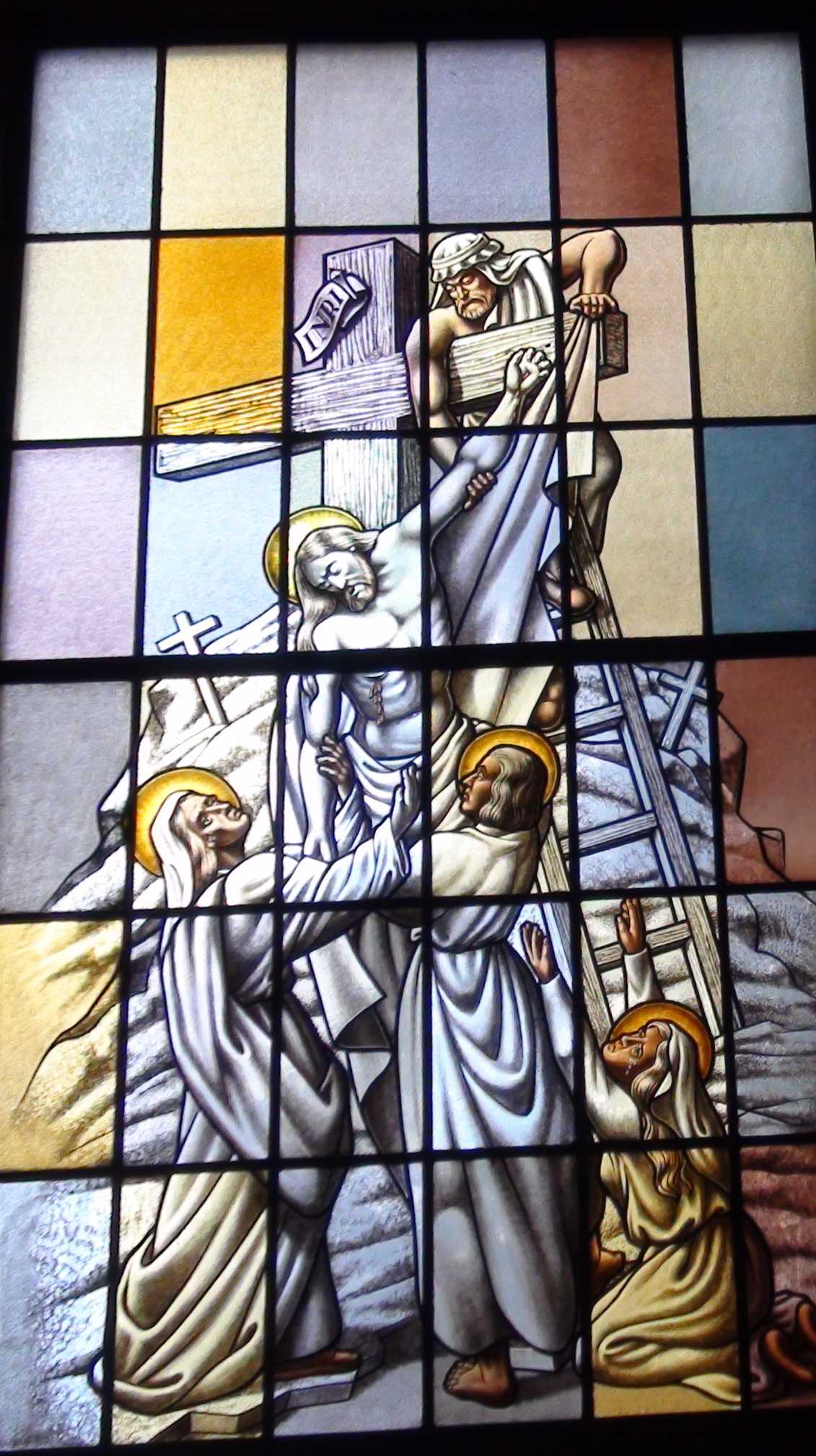
The Memorial of Our Lady of Sorrows is celebrated the day after the Feast of the Exaltation of the Cross (September 14). Eight days after Mary’s birth (September 7) her sorrows are recalled, her lifelong sorrows. 

The old man Simeon spoke of her lifelong sorrows when he  told Mary a sword would pierce her heart when Jesus was born. Her greatest sorrow, of course, came when she stood beneath the Cross of her Son.

What, then, were her lifelong sorrows? The gospels indicate some of them, but perhaps more important was Mary’s experience of the sorrow every human being experiences. An infant cries as it enters this world. “Our life is over like a sigh. Our span is seventy years, or eighty for those who are strong. And most of these are emptiness and pain.” (Psalm 90) Everyone experiences the human sorrow the psalms describes. Mary experienced that human sorrow.

The sword of sorrow struck Mary most deeply at the death of her Son. Some of Jesus followers stood at a distance when he was crucified. But John’s gospel describes Mary as the first of those standing close by, beneath the cross itself. “Standing by the cross of Jesus were his mother and his mother’s sister, Mary the wife of Clopas, and Mary Magdalene.”

Mary stands by the Cross of Jesus, close by, not at a distance. She’s not absorbed in her own suffering, not afraid to see. Her closeness to the Cross is significant. She enters the mystery of her Son’s suffering through compassion. 

She stood by him. Compassion doesn’t experience another’s suffering exactly, and it may not take another’s suffering away. Compassion enters suffering to break the isolation suffering causes. It helps someone bear their burden.  The sword, the spear, the sorrow, pierces both hearts, in different ways.

Our prayer for today’s feast says that when her Son “was lifted high on the Cross” his mother stood by and shared his suffering. “Grant that your Church, participating with the Virgin Mary in the Passion of Christ, may merit a share in his Resurrection.

For a commentary on John’s Gospel see here.

For a study on Mary on Calvary see here.

For readings for the feast and the Stabat Mater see here.

Ready for Lent?

Lent 1
Communicating isn’t easy. Before the Olympics a Russian writer wrote an article in one the papers about how hard it is for Russians and Americans to understand each other. She gave as an example the simple phrase “How are you?” If you ask an American “How are you?” the answer might be “I’m great,” “Wonderful,” the writer said. But if you ask a Russian “How are you?” you’ll likely get a litany of complaints about health, the government, the neighbors, and everything else that’s going wrong.

I was with some of priests the other day, one is from Ireland the other from Argentina. If you ask the Irish priest “How are you?” his answer usually is “Not too bad.” That seems to be somewhere between the American and the Russian. The Argentinian priest told me that a friend of his was flying to America on an American carrier and he had a bad accident and had to cancel his flight. He called for a refund for his ticket, but was told it was a “non cancellation” ticket. You’re out of luck. After realizing he was getting nowhere his friend said: “OK, Goodbye.” The American agent on the line said. “Goodbye. And have a wonderful day!”

If human communication can be difficult, so is our communication with God. For the last few Sundays we’ve been reading from the Sermon on the Mount from St. Matthew’s Gospel, chapters 5-8. Jesus goes up a mountain and calls his disciples to himself and begins to teach them. He calls them “the salt of the earth,” “the light of the world.” The Sermon on the Mount is a summary of Jesus’ teaching, and what he teaches can bring flavor and light to our world.

Jesus’ words are not always easy to understand, however. So much of the Sermon on the Mount sounds beautiful, but we find ourselves asking What do you mean by that? What do you mean when you say “Don’t worry about your life, what you will eat or drink, what you will wear?” I have to pay bills, keep my job, take care of my family. I worry about them. Is that bad? What do you mean when you say, “Love your enemies, do good to those who hate you.” “Turn the other cheek… give someone your cloak…give to everyone who asks. Go the extra mile.”

The Lenten season begins this week. It’s a time to turn to God and ask what’s he saying to us and to our world? Let’s go up the mountain and listen to him.

Lent is a time to imitate the way God acts. From the mountain where he taught Jesus came down and cured a leper, according to Matthew’s Gospel. His miracles of healing and kindness reveal a God who heals and comes to the aid of the poor. Lent’s a time to imitate God’s way of acting through acts of kindness towards those in need.

Lent is a time to see how God acts towards us. He ascends another mountain at the end of Lent and dies for us. That vivid sign is something we need to look at again and again. What are you saying to me and to the world? Do you really love us that much?

Going Home

Today’s the end of the retreat for sisters at St. Francis Center for Renewal.

My first observation: thank God for these good religious women. Strong believers, they are the best of our church.

During this week we read from the gospel narratives of the Passion, mostly from St. Matthew; it’s evident as you read how involved women were in the Lord’s Passion then. They still are now. Surely, most of what happened there we know from them.

The last few days we read the Resurrection stories from the various gospels, each offering its own perspective. Women figure prominently in that story too. They’re the first at the tomb and they, not angels, carry the message to those shut up in the Upper Room.  “The Lord is risen!” they say. They’re the first believers.

We need to read and reflect on these great stories of our faith and be refreshed by them, for they hold what we believe and mirror our present experience. They probe the great mysteries of life.

We read from an article by Fr.Don Senior from Origins on the bodily resurrection of Jesus, which he wrote in response to a TV presentation claiming Jesus’ family tomb had been found with an ossuary containing his bones.

With his usual wide ranging wisdom, Don looks at the implications of Jesus’ bodily resurrection. Rising bodily from the tomb, Jesus embraces both our humanity and all creation. He gives new life to all.  His bodily resurrection has implications in the way we care for the world, our view of social justice, our understanding of the sacraments and our own relationship to others and to our own bodies.

Most of my homilies for the retreat are summarized in previous blogs.

The Passion of Jesus

Wednesday evening: Mission at Plainville, CT

The writers of the gospels are like painters, not photographers. They tell stories of Jesus with their own purposes in mind. They tell them with great artistry and beauty. Even though they spoke languages that we may not understand, and their world is so different, we are moved when we hear them today.

Last Sunday we heard the story of the blind man given the gift of sight by Jesus, a dramatic story that involved the blind man’s parents, his neighbors, the pharisees and Jesus and his disciples, all interacting with one another. The story is told in John’s gospel with great skill.

The greatest story in the gospels is the story of Jesus’ passion, death and resurrection. That story would never have been written if Jesus had not recalled it to his disciples after his resurrection. When he appeared to them on Easter Sunday, “he showed them his hands and his side.” It was a story they wanted to forget.

But he reminded them of what happened to him, even though they want to forget it. The story was not to be forgotten; it was to be remembered. It was the first story of the gospels to be written. It’s a book of many lessons. The rest of the stories of the gospel cluster around this one.

At this evening’s service we listen together to the Passion of our Lord according to St. Mark.

Then we pray that the Lord whose presence continues in Bread and in us will show us his hands and his side and, like the disciples, we will  rejoice.