Tag Archives: the Mother of Jesus

Our Lady of Guadalupe

December 12th is the feast of Our Lady Guadalupe, which recalls the appearance of Mary on a hilltop near Mexico City to Juan Diego, a humble Mexican laborer, in 1591, ten years after the Aztec Empire was crushed by the colonial armies of Spain. Mary appeared dark skinned, with native features and in native dress, not at all like someone from the colonial powers. In appearing like them, Mary helped many of the native peoples accept Christianity.

Keep this story in mind when the next discussion on immigration comes up.It’s a strong reminder of Isaiah’s ancient call in our Advent readings: God wishes all to be his children.

Pope John Paul II said this about St. Juan Diego Cuauhtlatoatzin, whose feast is celebrated December 9th:

“He has lifted up the humble. God the Father looked down onto Juan Diego, a simple Mexican Indian and enriched him not just with the gift of rebirth in Christ but also with the sight of the face of the Blessed Virgin Mary and a role in the task of evangelizing the entire continent of America. From this we can see the truth of the words of St Paul: those whom the world thinks common and contemptible are the ones that God has chosen – those who are nothing at all to show up those who are everything.

“This fortunate man, whose name, Cuauhtlatoatzin, means “the eagle that speaks,” was born around 1474 in Cuauhtitlan, part of the kingdom of Texcoco. When he was an adult and already married, he embraced the Gospel and was purified by the waters of baptism along with his wife, setting out to live in the light of faith and in accordance with the promises he had made before God and the Church.

“In December 1531, as he was travelling to the place called Tlaltelolco, he saw a vision of the Mother of God herself, who commanded him to ask the Bishop of Mexico to build a church on the site of the vision. The bishop asked him for some proof of this amazing event.

“On 12 December the Blessed Virgin Mary appeared to Juan Diego once more and told him to climb to the top of the hill called Tepeyac and pick flowers there and take them away with him. It was impossible that any flowers should grow there, because of the winter frosts and because the place was dry and rocky. Nevertheless Juan Diego found flowers of great beauty, which he picked, collected together in his cape, and carried to the Virgin. She told him to bring the flowers to the bishop as a proof of the truth of his vision. In the bishop’s presence Juan Diego unfolded his cape and poured out the flowers; and there appeared, miraculously imprinted on the fabric, the image of the Virgin of Guadalupe, which from that moment onwards became the spiritual centre of the nation.

“The church was built in honor of the Queen of Heaven. Juan Diego, moved by piety, left everything and dedicated his life to looking after this tiny hermitage and to welcoming pilgrims. He trod the way to sanctity through love and prayer, drawing strength from the eucharistic banquet of our Redeemer, from devotion to his most holy Mother, from communion with the holy Church and obedience to her pastors. Everyone who met him was overwhelmed by his virtues, especially his faith, love, humility, and other-worldliness.

“Juan Diego followed the Gospel faithfully in the simplicity of his daily life, always aware that God makes no distinction of race or culture but invites all to become his children. Thus it was that he enabled all the indigenous peoples of Mexico and the New World to become part of Christ and the Church.”

Pope John Paul II

Feast of The Immaculate Conception

Why does Mary, the Mother of Jesus, have such a big place in our church? The words of the angel in Luke’s gospel, words we often repeat in prayer, are an answer: “Hail, full of grace, the Lord is with you.”

Mary is filled with God’s grace, gifted with unique spiritual gifts from her conception, because she was to be the mother of Jesus Christ, God’s only Son.

She would be the “resting place of the Trinity,” and would give birth to, nourish, guide and accompany Jesus in his life and mission in this world. To fulfill that unique role she needed a unique gift. She would be free from original sin that clouds human understanding and slows the way we believe God and his plan for us.

“How slow you are to believe” Jesus said to the two disciples on the way to Emmaus. Jesus made that complaint repeatedly as he preached the coming of God’s kingdom. “How slow you are to believe!” “What little faith you have!” “Do you still not understand!” Human slowness to believe didn’t end in gospel times. We have it too.

Mary was freed from that slowness to believe. “Be it done to me according to your word,” she immediately says to the angel. Yet, her acceptance of God’s will does not mean she understood everything that happened to her. “How can this be?” she asks the angel about the conception of the child. “The Holy Spirit will come upon you.”  But the angel’s answer seems so incomplete, so mysterious.

Surely, Mary would have liked to know more, but the angel leaves, never to return. There’s no daily message, no new briefing or renewed assurance by heavenly messengers. The years go by in Nazareth as the Child grows in wisdom and age and grace, but they’re years of silence. Like the rest of us, Mary waits and wonders and keeps these things in her heart.

That’s why we welcome her as a believer walking with us. She is an assuring presence who calls us to believe as she did, without knowing all. She does not pretend to be an expert with all the answers. She has no special secrets she alone knows. “Do whatever he tells you,” is her likely advice as we ponder the mysteries of her Son.

The feast of the Immaculate Conception is celebrated 9 months before the feast of the Birth of Mary (September 8). The feast  was extended to the universal Church by Pope Clement XI in 1708.

 Pope Pius IX solemnly proclaimed the Dogma of the Immaculate Conception in 1854: “We declare, pronounce, and define that the doctrine which holds that the most Blessed Virgin Mary, in the first instance of her conception, by a singular grace and privilege granted by Almighty God, in view of the merits of Jesus Christ, the Savior of the human race, was preserved free from all stain of original sin” (Ineffabilis Deus, 1854)

Do Whatever He Tells you

Feast of the Birth of Mary (September 8)

st.ann basilica

After consulting local traditions, the Emperor Constantine and his successors built churches over important biblical sites in Jerusalem and the Holy Land in the 4th century. One of the churches, built near the ancient pool of Bethesda, just north of the Jewish temple in Jerusalem, was associated with Mary, the mother of Jesus.

It was built on a spot pointed out in John’s gospel:  “Now there was in Jerusalem at the Sheep Gate, a pool in Hebrew Bethesda, with five porticoes. In these lay a large number of the blind, lame and crippled,”  (John 5,2) Jesus healed a paralyzed man at this healing place, where pagan gods  like Asclepius and Serapis were honored.

Third century traditions concerning Mary, the Mother of Jesus, were associated with the church built over the ancient healing site. The traditions claimed that Mary’s birth and early life took place in this area. By the 5th century, Mary’s birth was celebrated here September 8. Christian pilgrims, returning home, began ti celebrate the feast of her birth on this day.

Barnett - 771
Ruins of Bethesda and ancient church
Paralytic

In the last century archeologists uncovered the ancient healing pool with its porticoes, parts of an ancient church and ruins of a temple of Asclepius (2nd-4th century) ..

Jerusaelm streets
Ruins of the Temple of Serapis

The early traditions said that Mary’s mother was Anne and her father Joachim. He provided sheep for the temple sacrifices. They were looked down upon as old and childless, but angels came and told them they were to conceive a daughter. Like Abraham and Sarah, their faith was rewarded.

Stories of Mary’s birth and her childhood strongly influenced the spirituality and devotional life of the early Christian churches of east and west. The feast of her birth is still celebrated by all the ancient churches on September 8 . Her parents are honored September 9 by the Greek Church. The Roman Church celebrates their feast July 26th.

When the Crusaders conquered the Holy Land in the 11th century they rebuilt the small church over the healing pool, which had fallen into ruins, and also built a new, larger church honoring St. Anne, the mother of Mary, southeast of the pool.

The present Church of St. Anne is one of the most beautiful of Jerusalem’s churches today. A favorite destination for pilgrims, it stands overlooking the remains of the old church and the ancient healing pool.

Readings for today’s feast see Mary’s birth awaited by all her ancestors. The gospel, St.Matthew’s genealogy of Jesus, begins with Abraham whose hopes and the hopes of generations before him were fulfilled when Mary brought Jesus Christ into the world. “We commemorate the birth of the blessed Virgin Mary, a descendant of Abraham, born of the tribe of Judah and of David’s seed,” (Antiphon, 1st Vespers, Roman rite)

“This feast of the birth of the Mother of God is the prelude, while the final act is the foreordained union of the Word with flesh. Today, the Virgin is born, tended and formed and prepared for her role as Mother of God, who is the universal King of the ages…
Today the created world is raised to the dignity of a holy place for him who made all things. The creature is newly prepared to be a divine dwelling place for the Creator.”
(St. Andrew of Crete, bishop, Office of Readings, Roman rite)

The Birth of Mary is the first great feast in the Orthodox Church calendar which begins in September. Their calendar ends with the feast of Mary’s Dormition, on August 15th.

The Orthodox liturgy sees Mary as the mysterious ladder that Jacob saw in a dream reaching from earth to heaven. (Genesis 28,10-17) She is the way the Word came down to earth’s lowest point, death itself, and returns to heaven having redeemed humanity. The Orthodox liturgy also associates  Mary with the miracle of the paralyzed man at the Pool of Bethesda. She has a role in healing our paralyzed humanity.

May your Church rejoice, O Lord, for you have renewed her with these sacred mysteries, as she rejoices in the Nativity of the Blessed Virgin Mary, the hope and the daybreak of salvation for all the world. Through Christ our Lord.

St.Mary Major: August 5

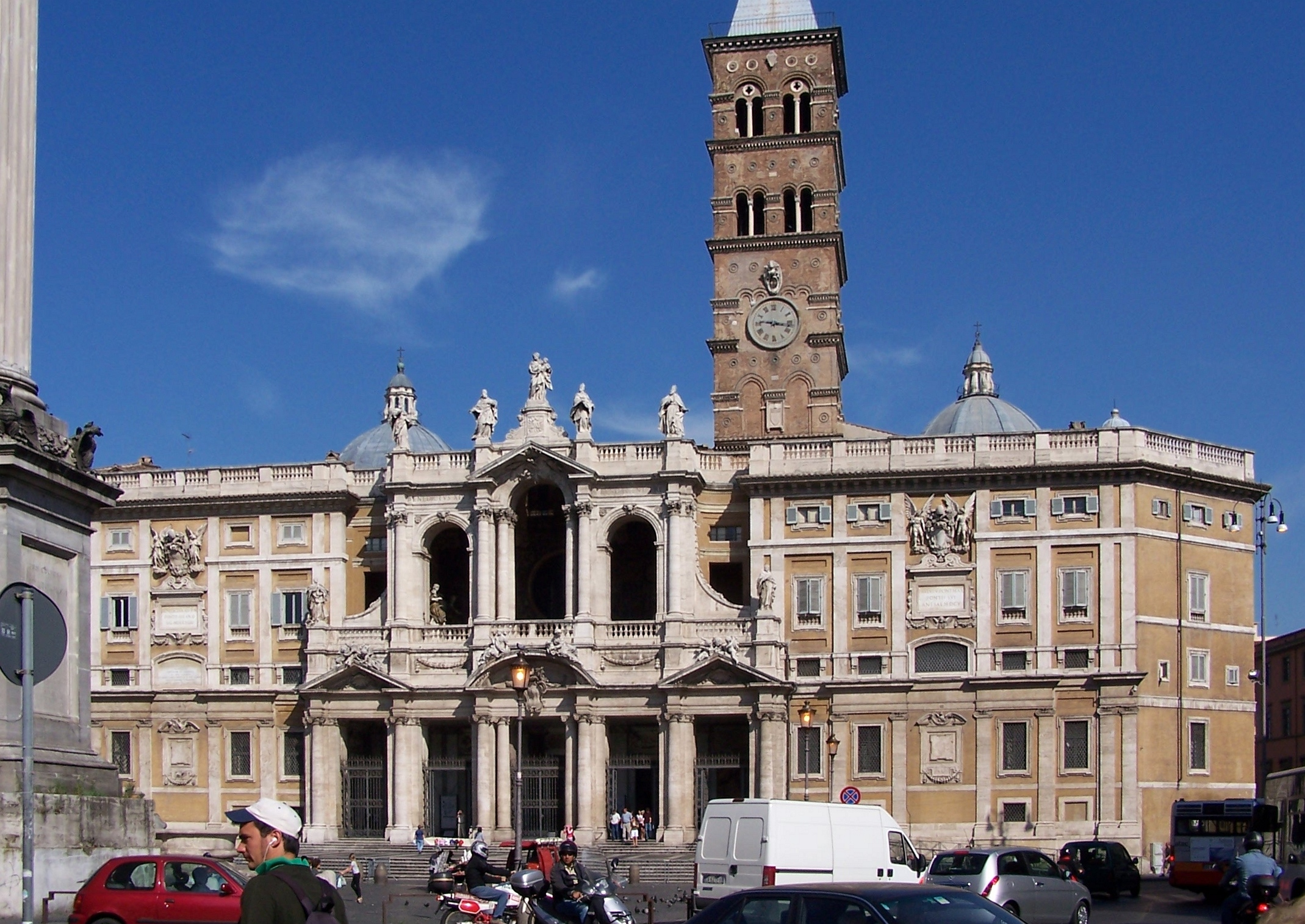
Basilica of St. Mary Major

On the summit of the Esquiline Hill, a short distance from the Lateran Basilica, is the church of St. Mary Major, begun in the early 5th century and completed by Pope Sixtus III (432-440.)

Salus Populi Romani, c 5th century

Mary, the mother of Jesus, is honored here as the Mother of God. .  In 431, the Council  of Ephesus repudiated Nestorius, the patriarch of Constantinople, for refusing to call her “Mother of God.”

The title is important because it safeguards Christian belief in the mystery of the Incarnation: Jesus is God and man, the council said. For the Christian world Mary is the defender of Jesus, her son, who was both human and divine.

Devotion to Mary ran high in the Christian world after the Ephesus council, and churches dedicated to Mary arose everywhere. In the city of Constantinople alone, 250 churches and shrines in her honor were built before the 8th century. Pictures, icons of Mary holding her divine child multiplied, especially in churches of the East, where they became objects of special devotion.

Mary’s title, Mother of God, does not make her a goddess, otherwise how could she have given birth to Christ who is truly human? Yet, she can be called Mother of God, because Jesus who is truly her human son is truly Son of God from all eternity as well.

The 5th century, however, was hardly a good time to build a church in Rome. In 410, Alaric and his Goths shocked the Roman world by sacking a city all thought invincible. In 455 the Vandals under Genseric vandalized Rome. Twice more in the century other barbarian tribes invaded.

In far off Palestine St. Jerome cried out in disbelief at Rome’s misfortunes, which he saw heralding the end of the world. In Africa St. Augustine wrote “The City of God” in response to the followers of Rome’s traditional religions, who said Christian weakness caused the city’s devastation. Christians were not the cause of the city’s misfortunes, St. Augustine wrote; two loves are at work in the world building two cities. One love builds an evil city; Christianity builds the City of God, promoting love and justice.

The English historian Edward Gibbon called this period a time of decline and fall, the end of the Roman Empire. God’s plan does not lead to decline and fall, they say, but to triumph in Christ. God’s plan does not lead to decline and fall, they say, but to triumph in Christ. God’s plan does not lead to decline and fall, this church says. On the walls of St. Mary Major has stories from the Old and New Testaments calling for courage and hope.

In the church of St. Mary Major, Mary appears as Jesus’ mother and closest disciple. To use a phrase of St. Pope John Paul II, this church is “a school of Mary” who teaches mysteries she has learned. A noticeable number of women from the Old and New Testaments surround her: she represents those who seem powerless, but are empowered by God.

The great 13th century mosaic in the church’s apse of Mary crowned by Jesus Christ as heaven’s queen proclaims God’s triumph in her, but also his triumph in the church as well. She is taken up to heaven “to be the beginning and pattern of the church in its perfection, and a sign of hope and comfort for your people on their pilgrim way.” (Preface of the Assumption)

It shouldn’t surprise us that many of the mysteries in which Mary had a special role were first celebrated  here as liturgical feasts. The Christmas liturgy, especially the midnight Mass on December 25th ,  began in this church  in the 5th century and spread to other churches of the west.

A replica of the cave under the church of the Nativity at Bethlehem, the traditional site of Jesus’ birth, was constructed here early on.. After the Muslim conquest of the Holy Land in the 7th century,  Christian refugees placed relics here purported to be from the crib that bore the Christ Child and relics of St.Matthew, an evangelist who told the story of Jesus birth.

Relics of the Crib from Bethlehem

Besides the Christmas liturgy, other great Marian feasts, such as her Immaculate Conception and Assumption, developed their liturgical forms in this church.

Built on a hill where all could see it, near Rome’s eastern walls so often threatened by barbarian armies, St. Mary Major affirms Christianity’s ultimate answer to its enemies. It is not military might, but the power of faith and love that triumphs in the end.

Visiting St.Mary Major

The church’s 18th century façade was built to enhance the appearance of this important church at a time when many visitors, especially  from England and Germany, were traveling to Rome on the Grand Tour to visit its classical and religious sites.

The church’s interior, with its splendid 5th century mosaics along the upper part of the nave, retains its original form better than any other of the major basilicas of Rome.

The Sistine Chapel at the right hand side of the nave was built to house a silver reliquary with relics of the crib brought from the Holy Land in the 8th century. Two popes, Sixtus V and Pius V are buried there.

The Borghese Chapel at the left hand side of the nave honors the ancient icon of the Virgin and Child,”Salus populist Romani”, that Roman Christians have reverenced for centuries. A reproduction of the icon is a nice remembrance to bring home. Pope Francis has requested to be buried here.

The magnificent 13th century mosaic in the apse of the basilica presents the Coronation of Mary in heaven. It’s surrounded by 5th century mosaics depicting scenes from the birth of Jesus and the life of Mary.

Website:

http://www.vatican.va/various/sm_maggiore/index_en.html

Now and at the Hour of our Death

DSC00169

In the Hail Mary we ask Mary to pray for us sinners, “now and at the hour of our death.” These are the two most important moments in life. We have the past and the future, for sure, but they’re far less important than now and the hour of our death.

“Now” is the time we live in, the present moment. Whether it’s a time of joy or sorrow, a time of satisfaction or disappointment, a time of sickness or health, it’s the time we have to love, to give, to endure, to act, to live.

“The hour of death” is God’s time, when God brings us from this life to the next. It may be instantaneous or prolonged, but it’s the time when God who gave us life takes this life away.

Both of those moments benefit from faith. Mary, the Mother of Jesus, was a believer who trusted in the power and presence of God through these same moments of life. They’re challenging moments.

After the angel left Mary in Nazareth, no other angel came; she walked by faith from the Child’s birth to the death and resurrection of her Son. As we face the mysteries of life, we ask her in our weakness to be with us as a believer and a mother, who knows the goodness and power of God as it is revealed in Jesus Christ her Son.

“Pray for us sinners, now and at the hour of our death.”

Mary, Mother of Ordinary Time

Mother and ChildThe pope raised some eyebrows a month or so ago when he saw a little baby crying in its mother’s arms as he was going through the crowds in St. Peter’s Square in his pope mobile. “Give the baby something to eat, Madam,” he was reported to have said to the baby’s mother. Breast feeding in St. Peter’s Square! It seems he did the same thing last week on the Feast of the Baptism of Jesus in the Sistine Chapel when he baptized 35 infants. “If your baby is hungry, don’t be afraid to feed it,” he said to the mothers there according to reports.

In one of the magazines, an art historian wrote asking why should we be surprised at the pope’s words. Catholic artists have pictured nursing Madonnas for centuries. That’s what Mary did.

I spoke about Mary to priests on retreat from the Austin diocese this morning. We easily forget Mary’s fundamental role in the life of Jesus.

“Blessed is the womb that bore you and the breasts that nursed you.” “Blessed is the fruit of your womb, Jesus.”

Her role meant more than giving him birth. The apocryphal gospels often picture Jesus as showing signs of divine powers growing up, but the church condemned them because they negate the role of Mary and Joseph and the whole extended family that raised him in Nazareth.

Mary especially raised him as his mother. She did all those things a mother does for an infant, a young child and an adolescent. She fed him and took care of his basic needs. Her motherly care embodied a spirituality that’s still fundamental for the advance of human life.

The church makes her motherly spirituality its own.

If you extrapolate Mary’s spirituality to a wider arena, as I think Pope Francis does, you have to be concerned with the children of God in our world who hunger. We have to feed them. We can’t let poverty weigh them down with worries and cares. We have to relieve global poverty.

In Mary’s image, the church is a mother.