Tag Archives: Synod of Bishops

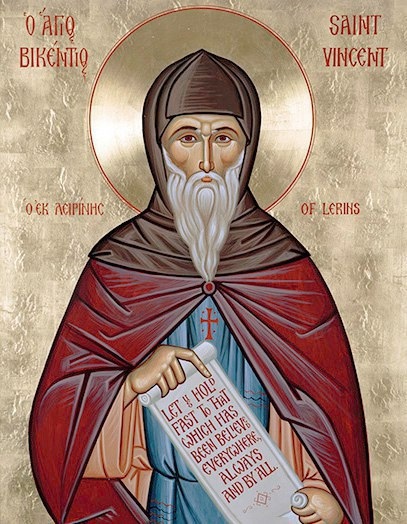
St. Vincent of Lerins Speaks to the Modern Church

By Gloria M. Chang

As the Synod on Synodality proceeds in Rome, we can all participate as the listening Church, the Bride of Christ, sitting at Jesus’ feet like Mary of Bethany (Luke 10:38). Enveloped in his peace, we can attune our hearts and minds to the Spirit of truth sent to us from the Father by the Son (John 15:26). 

In a world of distracting noise, the Lord invites us to listen to his voice in Sacred Scripture, the Holy Mass, the Liturgy of the Hours, and personal prayer. Heard in the silence of the Spirit, the ancient words resonating from centuries past speak to the present generation with striking relevance. May the Lord grant us “ears to hear” his voice amid the din of the latest buzz (Matthew 11:14).

In a recent passage from the Office of Readings (October 11, 2024), St. Vincent of Lerins, a fifth-century French monk, seemed to jump out of the pages to address the Synod in Rome during its second week. In his vision, the organism of the Church grows and matures like a child to an adult, but preserves her essential form. Human skeletal structure, facial features, limbs, and organs develop with maturity but do not evolve into another species. The Body of Christ, the Church, in its heavenward journey also grows in the Holy Spirit into the perfect image of the Incarnate Son of God and not a distortion (2 Corinthians 3:18). May the Blessed Virgin Mary, Mother of the Church, guide her sons and daughters in the Spirit to her Son, who is the Way, the Truth, and the Life.

From the first instruction by Saint Vincent of Lerins, priest

The development of doctrine

Is there to be no development of religion in the Church of Christ? Certainly, there is to be development and on the largest scale.

Who can be so grudging to men, so full of hate for God, as to try to prevent it? But it must truly be development of the faith, not alteration of the faith. Development means that each thing expands to be itself, while alteration means that a thing is changed from one thing into another.

The understanding, knowledge and wisdom of one and all, of individuals as well as of the whole Church, ought then to make great and vigorous progress with the passing of the ages and the centuries, but only along its own line of development, that is, with the same doctrine, the same meaning and the same import.

The religion of souls should follow the law of development of bodies. Though bodies develop and unfold their component parts with the passing of the years, they always remain what they were. There is a great difference between the flower of childhood and the maturity of age, but those who become old are the very same people who were once young. Though the condition and appearance of one and the same individual may change, it is one and the same nature, one and the same person.

The tiny members of unweaned children and the grown members of young men are still the same members. Men have the same number of limbs as children. Whatever develops at a later age was already present in seminal form; there is nothing new in old age that was not already latent in childhood.

There is no doubt, then, that the legitimate and correct rule of development, the established and wonderful order of growth, is this: in older people the fullness of years always brings to completion those members and forms that the wisdom of the Creator fashioned beforehand in their earlier years.

If, however, the human form were to turn into some shape that did not belong to its own nature, or even if something were added to the sum of its members or subtracted from it, the whole body would necessarily perish or become grotesque or at least be enfeebled. In the same way, the doctrine of the Christian religion should properly follow these laws of development, that is, by becoming firmer over the years, more ample in the course of time, more exalted as it advances in age.

In ancient times our ancestors sowed the good seed in the harvest field of the Church. It would be very wrong and unfitting if we, their descendants, were to reap, not the genuine wheat of truth but the intrusive growth of error.

On the contrary, what is right and fitting is this: there should be no inconsistency between first and last, but we should reap true doctrine from the growth of true teaching, so that when, in the course of time, those first sowings yield an increase it may flourish and be tended in our day also.


Reference

The passage from St. Vincent of Lerins can be found in the Office of Readings for Friday of the 27th Week in Ordinary Time.

30th Sunday: Pope Francis’ Synod


To hear the audio of today’s homily please select the audio slider below:

“Love God and love your neighbor as yourself,” Jesus says. The question then is: How do we love God and neighbor in the world we live in, for example, in our families? That’s the question the recent Synod of Bishops considered, the synod convened by Pope Francis who invited church leaders from around the world to join him in looking at the times in which we live, “the signs of the times,” and see how we can adapt to the changing conditions of society.

For two weeks in Rome, leaders of the Catholic church studied reports they received previously from all parts of the world, shared their reflections and made some preliminary recommendations. Now, the pope asked them to bring their reflections home to be discussed by their local churches and then return to Rome to continue the process with him next year.

It’s a long, extended process, over two years; it’s not finished yet.

You can read about the synod in your diocesan paper or online, and I hope you do, because it gives us an interesting look at family life in all parts of the world. You can find the working paper from the synod on the Vatican website.

http://www.vatican.va/roman_curia/synod/documents/rc_synod_doc_20140626_instrumentum-laboris-familia_en.html#Difficult_Pastoral_Situations

http://press.vatican.va/content/salastampa/en/bollettino/pubblico/2014/10/13/0751/03037.html

Let me mention a few things from the working paper for the synod. As you might suspect, it reflected on the family from the perspective of the bible and church tradition, but then in Part II it takes up the challenges a family faces today.

One is a perennial challenge: lack of communication in families. Husband and wife not talking to each other, children not talking to parents. Where there’s no communication in a family, there’s a loss of meaning and an experience of love. (64)

Families can also be torn apart by violence and abuse, an abuse that can be psychological, physical or sexual. Families can be damaged by addictions to alcohol and drugs. The synod then mentions some dangers today from the social media and the internet, particularly pornography. (66)

Let me quote from its document: “… Television, smart phones and computers can be a real impediment to dialogue among family members, leading to a breakdown and alienation in relationships within a family, where communication depends more and more on technology. In the end, the means of communication and access to the Internet replace real family relationships with virtual ones. This situation runs the risk of leading to not only the disunity and breakdown of the family but also the possibility that the virtual world will replace the real one.” (68) The people on television, video games, become more real than the people in your home.

The economy and work also influence families. Let me quote again: “The pace of work can be fast and sometimes even exhausting…and increasingly hectic life leaves little opportunity for moments of peace and family togetherness…Increasing job insecurity, together with the growth of unemployment and the consequent need to look for work elsewhere, have taken their toll on family life. “ (70)

There’s a need for governments and businesses to make sure there are decent jobs and just wages, as well as programs that assist families and children. (71)

I think you can see from these few examples that the synod is looking at real life situations.

The 3rd chapter of the synod document gets most attention in the media. “Difficult Pastoral Situations.” The first difficult situation it mentions is the increasing number of couples, particularly in North America and Europe who are living together, without getting married. They do this for different reasons, the surveys say. Sometimes its because of “financial need, unemployment and lack of housing.” Sometimes it the “fear of making a commitment and the idea of having children. They don’t want to make definitive decisions or have responsibilities that come with marriage. The leaders of the church are asking–and we all have to ask– how can we help young people enter into the long term relationship which is marriage? (82)

Another difficult situation, “especially in Europe and across America is the very high number of people who are separated, divorced or divorced and remarried.” Because of their situation, many of them can’t receive Holy Communion. The questions being asked is what can we do to help these people and how can we make them and their children feel at home in the church?  (86)

The final difficult situation is about same sex marriage. The synod is rejecting the view that homosexual unions are the same as the traditional union of man and woman. “Yet, at the same time, we need to make clear that men and women with homosexual tendencies ‘must be accepted with respect, compassion and sensitivity.’” (110)

There’s an opposition, then, to “redefining” marriage between a man and a woman through laws permitting a union between two people of the same sex. We’re trying to find a balance between the Church’s teaching on the family and a respectful, non-judgmental attitude towards people living in such unions. (113)

I began with the simple words of Jesus, “You shall love God and your neighbor. Not easy in a complex world, but we’re called to do just that.

When Pope Francis called for the synod he asked the bishops to consult their people and listen to them. He asked for transparency in discussing these issues. He recognizes there will be different ideas and different solutions concerning these challenges. He said we are on a journey. It’s a unique process the pope has begun and I hope we all can enter into it.