Tag Archives: St. Paul of the Cross

Catholic Scholars Visit the Mary Garden

Photos: Gloria M. Chang

“What is theology?” asked Professor Andrea Florendo to a group of young Catholic Scholars in the Passionist Monastery Chapel.

“The study of God,” responded a sophomore brightly in the front row. 

“Yes, and where does theology begin?” Professor Florendo continued. Looking at each of the young faces, she exclaimed, “In a garden!” Following the creation account in Genesis, the story of God and humankind unfolds in the Garden of Eden. Flowers, trees, rocks, soil, animals, sun, moon, sky, water, humans—the whole natural world—declare the glory of God. Prayer and liturgy burst forth among flowering plants and birdsong in God’s garden of paradise. 

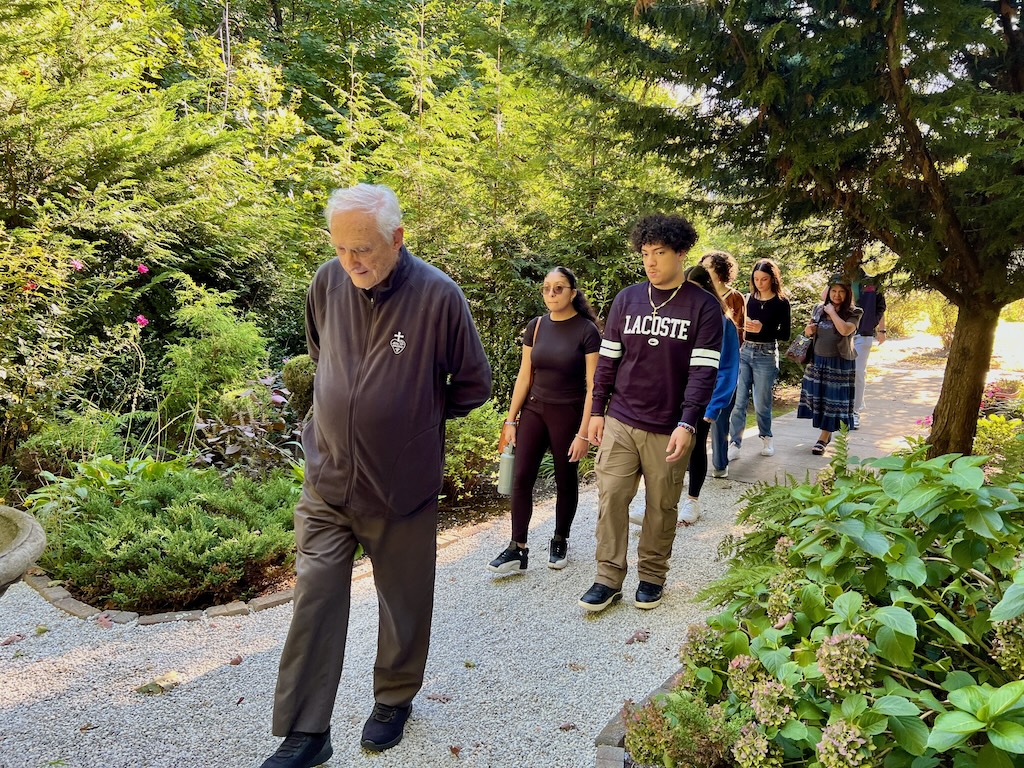
On Sunday, October 6, 2024, seven Catholic Scholars from St. John’s University visited the Mary Garden at the Passionist Monastery in Jamaica, NY. Fr. Victor Hoagland, C.P., Professor Andrea Florendo, and Gloria Chang, founders of the Mary Garden Guild at the Passionist Monastery, welcomed the students warmly. 

Fr. Victor, who has traveled extensively throughout the world on pilgrimages and missions, shared the global Passionist charism with the Catholic Scholars, who are preparing for a life of faith-inspired leadership. The Passionists, who received their mission from St. Paul of the Cross to keep alive in the world the love of Jesus Crucified as seen in His Sacred Passion, have expanded their charism to include the care of creation as taught by Pope Francis in his encyclical Laudato Si. Inspired also by Fr. Thomas Berry, C.P. (1914-2009), a pioneer in ecology, the Passionists have redesigned their retreat center in Jamaica, NY, in his name. 

Andrea Florendo, a retired theology professor at St. John’s University and designer of the Mary Garden, gave a tour, pointing out the significance of the enclosed garden as a symbol of Mary’s virginal womb, the fountain as Christ’s “fountain of living waters,” and the cross path as the four rivers in the Garden of Eden. 


Photo: Gloria M. Chang

Our visit in the Mary Garden ended in praise and thanksgiving to God with prayers from Scripture and a reading from the Book of Genesis. May the Lord bless our Catholic Scholars abundantly with faith and grace as they continue their studies and formation at St. John’s University.

How great is your name, O Lord our God,
through all the earth!

Psalm 8:1

St. Gabriel Possenti and Theodore Foley, CP

St. Gabriel PossentiToday is the feastday of St. Gabriel Possenti, the young Italian Passionist who died in 1862 and was canonized in 1920. I’m interested in his connection with Fr. Theodore Foley (1913-1974), an American Passionist whose cause for canonization was recently introduced in Rome. As a young boy of 14, Theodore read about  St. Gabriel and decided to become a Passionist;  other young men joined the community in the early 1920s and 30s also influenced by the young Italian saint.

What was St. Gabriel’s appeal ?

The cause for beatification of Father Theodore Foley, C.P. (1913-1974) opened officially on May 9, 2008 in Rome, just two years after the North American Passionist Province of St. Paul of the Cross and affiliate members met in a provincial chapter, which endorsed a proposal requesting that Father Theodore, a member of St. Paul of the Cross province and former superior general of the community, be considered as a candidate for canonization. Appreciation for him has grown steadily over time, for Father Theodore exemplifies the quiet, steady loyal holiness needed today– rooted firmly in the past and reaching with Christian hope to the future. In his preface to Saint Gabriel, Passionist, a popular biography by Fr. Camillus, CP published in 1926, the powerful archbishop of Boston ,William Cardinal O’Connell, denounced the “flood of putrid literature which, for the past ten years of more, has deluged the bookshelves and libraries of our great cities, fueling disappointment and emptiness in a false romanticism.” He urged young Catholics to reject this falseness and live in the real world, like St. Gabriel:

“To live a normal life dedicated to God’s glory, that is the lesson we need most in these days of spectacular posing and movie heroes. And that normal life, lived only for God, quite simply, quite undramatically, but very seriously, each little task done with a happy supernaturalism,-that such a life means sainthood, surely St. Gabriel teaches us; and it is a lesson well worth learning by all of us.”

Young Theodore Foley took Gabriel’s path. He followed the saint into the undramatic life of the Passionists.

Gabriel Possenti’s decision to enter the Passionists has always been something of a mystery, even to his biographers. Did he choose religious life because he got tired of the fast track of his day? And why didn’t he enter a religious community better known to him, like the Jesuits, who could use his considerable talents as a teacher or a scholar? Why the Passionists?

Gabriel–and Theodore Foley after him– was attracted to the Passionists because of  the mystery of the Passion of Christ. It was at the heart of God’s call.

The Passionists were founded in Italy a little more than a century before Gabriel’s death by St. Paul of the Cross, who was convinced that the world was “falling into a forgetfulness of the Passion of Jesus” and needed to be reminded of that mystery again. Paul chose the Tuscan Maremma, then the poorest part of Italy, as the place to preach this mystery, and there he established his first religious houses for those who followed him. He chose the Tuscan Maremma, not to turn his back on the world of his day, but because he found the mystery of the Passion more easily forgotten there.

When Gabriel became a Passionist, the community like others of the time, was recovering from the suppression of religious communities by Napoleon at the beginning of the century. In one sense, it had come back from the dead .  The congregation was now alive with new missionary enthusiasm. Not only were its preachers in demand in Italy, but it had begun new ventures in England (1842) and America (1852).

Paul of the Cross, the founder, was beatified in 1853. Ten years earlier, the cause of St. Vincent Strambi, a Passionist bishop, was introduced. Dominic Barbari, the founder of the congregation in England, would receive John Henry Newman into the church in 1865; the English nobleman, Ignatius Spencer, who became a Passionist in 1847, began a campaign through Europe in the cause of ecumenism. New communities of Passionist women were being formed.

Respected for their zeal and austerity, the Passionists were a growing Catholic community, and their growth in the western world continued up to the years when Theodore Foley became their superior general and then saw its sharp decline.

Success was not what drew Gabriel–and Theodore Foley after him–to the Passionists. Their charism–the mystery of the Passion of Christ– was at the heart of God’s call.

As a boy growing up, Gabriel Possenti understood this mystery, even as he danced away the evening with his school friends. Twice he fell seriously ill and, aware that he might die, promised in prayer to serve God as a religious and take life more seriously. Both times he got better and forgot his promises. Then, in the spring of 1856, the city of Spoleto where he lived at the time was hit by an epidemic of cholera, which took many lives in the city. Few families escaped the scourge. Gabriel’s oldest sister died in the plague.

Overwhelmed by the tragedy, the people of Spoleto gathered for a solemn procession through the city streets carrying the ancient image of Mary, the Mother of Jesus, who stood by the Cross. They prayed that she intercede for them and stop the plague, and they also prayed that she stand by them as they bore the heavy suffering.

It was a transforming experience for Gabriel. Mysteriously, the young man felt drawn into the presence of the Sorrowing Woman whose image was carried in procession. Passing the familiar mansions where he partied many nights and the theater and opera that entertained him so often, he realized they had no wisdom to offer now. He took his place at Mary’s side. At her urging, he resolved to enter the Passionists.

Can we speculate, then, how the life of the Italian St. Gabriel drew the young American Theodore Foley to the Passionists? What similarity was there between them? What grace led him on?

Brought up in a good family and a strong religious environment , Theodore Foley still felt  “dangers and temptations” around him. No, he didn’t experience the social life that tempted Gabriel Possenti a century before. But he did experience the new mass media then sweeping the country.  By 1922 movies, and to a lesser extent the radio, became powerful influences in people’s lives, and Hollywood’s heroes preached a new gospel of fun and success. Through the new media, the “Roaring Twenties” came to Springfield as it did to other prosperous parts of America when Theodore Foley was growing up. Did it bring the  “the dangers and temptations” he feared?

Theodore Foley must have sensed the selfishness, the carelessness about others, the failure to appreciate suffering and weakness and sin in this new gospel. It promised life without the mystery of the Cross, but that was not real life at all. Only 14, he entered the Passionists.

Saturday, First Week of Lent: Loving Enemies

Lent 1

“Jesus said to his disciples: ‘You have heard that it was said,

You shall love your neighbor and hate your enemy.

But I say to you, love your enemies,

and pray for those who persecute you,

that you may be children of your heavenly Father,

for he makes his sun rise on the bad and the good,

and causes rain to fall on the just and the unjust.” (Matthew 5: 43-48) 

When people talk about love today,  they’re usually focused on romantic love, “falling in love”, or loving yourself. Not much talk about loving others or loving your enemies today.

 “Love your enemies”, Jesus says in today’s gospel. Have a love that imitates God’s love,  our heavenly Father “who makes his sun rise on the bad and the good and causes rain to fall on the just and the unjust.”

Is that love beyond us?

We’ve been told from earliest years that there are some people you can’t trust; they’ll take advantage of you; they’ll harm you. You have enemies in this world. Be careful.

Certainly Jesus doesn’t condemn reasonable caution. He had enemies too and he was careful what he said and how he dealt with them. Evil exists. Rather, Jesus warns against  a pessimism that leads us to condemn someone or some groups absolutely. We see no possible goodness or possible change in them, only intractable evil.

We don’t see as God sees when we think like that. The sun of God’s goodness shines on this world; the rain of his mercy softens its hardest places. His love changes people for the good.

We can’t just reason our way to a love of enemies, we must pray to grow in this love.  Jesus not only taught us, but showed us by his own example how to love our enemies. Look at him in his Passion, says St. Aelred:

“Listen to his wonderful prayer, so full of warmth, of love, of unshakeable serenity – Father, forgive them.  Is any gentleness, any love, lacking in this prayer?
 
  Yet he put into it something more. It was not enough to pray for them: he wanted also to make excuses for them. Father, forgive them, for they do not know what they are doing. They are great sinners, yes, but they have little judgement; therefore, Father, forgive them.
 
They are nailing me to the cross, but they do not know who it is that they are nailing to the cross: if they had known, they would never have crucified the Lord of glory; therefore, Father, forgive them.
 
They think it is a lawbreaker, an impostor claiming to be God, a seducer of the people. I have hidden my face from them, and they do not recognise my glory; therefore, Father, forgive them, for they do not know what they are doing.”
 

Teach us, Lord, a love like yours,
that never gives up or draw limits,
or settles for those in its small circle.
Help us to love like the sun and the rain
that reach everywhere.

A Book for Lent

St. Paul Cross

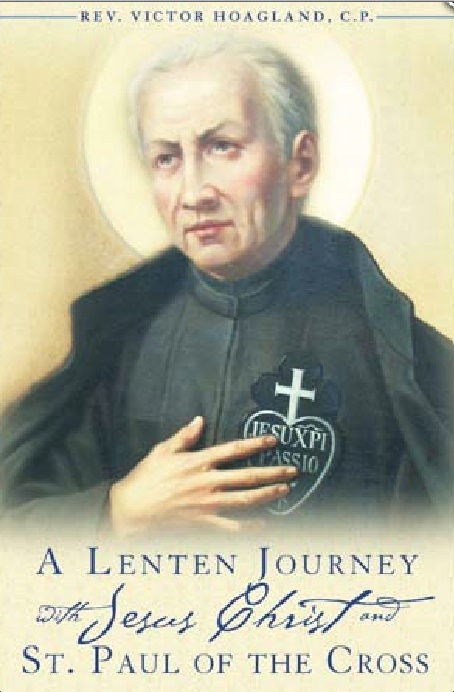
Lent begins next Wednesday, February 14th. Some years ago a publisher asked me to write a book entitled A Lenten Journey with Jesus Christ and St. Paul of the Cross, to be part of a series of reflections on the daily lenten gospels that included thoughts of saints of different religious orders. The book has just been translated into Japanese.

I was initially skeptical about the project. From early on I’ve seen lent as a time to give up something and take up some devotional practice like the Stations of the Cross. Yes, Lent was a journey with Jesus, and I appreciate the daily scriptures that take us through the season with him, but where does a saint come in, even a saint important to me, like St. Paul of the Cross, the 18th century founder of my community the Passionists ?

Working on the book made me see lent differently. First, for St. Paul of the Cross lent was a time to leave the quiet mountain at the edge of the Mediterranean Sea where he lived and prayed and go to work in the Tuscan Maremma, then a swampy, malaria infested region of Italy, overrun with robbers and desperately poor. All through lent, carrying a cross and a bible Paul went from village to village preaching God’s love to people whose lives were often on edge with fear and lost hope.

Lent isn’t a time for turning inward, away from world you live in, Paul reminds me. Lent is a time to go out to the wounded world before you.

Secondly, Paul engaged his world, the world of the Tuscan Maremma, in the light of the gospel, especially the Passion of Jesus Christ. For him that mystery was not limited to a time long ago, when Jesus suffered on a Cross; it was there in the people before him. From village to village, he held up a Cross to anyone who would hear as a mirror of their reality and a pledge of the great mercy of God. Jesus died and rose again.

The Passionists celebrate two feasts immediately before Ash Wednesday to prepare for Lent. Last Friday we celebrated the Commemoration of the Passion of Jesus Christ. Tomorrow, Tuesday before Ash Wednesday, we celebrate the Prayer of Jesus in the Garden. Both feasts come from our missionary founder.

I can see him packing his bags for his lenten journey down the quiet mountain for the villages and towns of the Tuscan Maremma. He must remind himself what he will see. He must pray so he doesn’t forget.

“May the Passion of Jesus Christ be always in our hearts.”

Saturday, 5th Week of Lent

Lent 1

Readings

Our readings today set the stage for Holy Week

After Jesus raises Lazarus from the dead, some Jewish leaders raise the prospect of his death. (John 11,45-59) Their meeting anticipates the final meeting of the Sanhedrin, which will seek the death sentence from Pilate, the Roman procurator, before the feast of Passover.

The meeting was unlikely a cabal of his enemies. Some who favored Jesus must have also been there. From them news of this meeting must have gotten to Jesus. He had his friends among the Jewish leaders. 

Caiaphas, the high priest, sees political consequences if Jesus isn’t stopped– the Romans will step in at the slightest sign of a political troublemaker. But John’s gospel sees divine consequences– evil is pitted against good. 

The high priest unknowingly predicts God’s reversal of it all John’s Gospel says:: “ he prophesied that Jesus was going to die for the nation, and not only for the nation, but also to gather into one the dispersed children of God.”

Good always triumphs.

The passion and resurrection of Jesus is God’s great sign that good triumphs over evil. God has the last word; we’re called to believe in his power over evil, difficult as that is.

Today’s readings also prepare for what’s coming tomorrow– Palm Sunday, when Jesus enters Jerusalem. While leaders plot in the temple area, Jews in that same place, who have come to Jerusalem for the feast– many from Galilee we would suspect– wonder whether Jesus will come there. “What do you think? That he will not come to the feast?”

He will come.

.

Lord, in our day we wonder

“Will you come?”

God of all, help us all,

Come to us today in our need..

Deliver us from all evil. Amen.

,

Silent Clay

The daily Mass readings for Eastertime, from the Acts of the Apostles and the Gospel of John, are so different in tone. The Acts of the Apostles is a fast-moving account of a developing church spreading rapidly through the world through people like Paul of Tarsus and his companions. Blazing new trails and visiting new places,  they’d be frequent flyers today, always on the go.

The supper-room discourse of Jesus from the Gospel of John, on the other hand,  seem to move slowly, repeating, lingering over the words of Jesus to his disciples. Listen, be quiet, sit still, they say. Don’t go anywhere at all.

St. Paul of the Cross, the founder of the Passionists, was inspired by St. Paul, the Apostle, to preach and to teach. Many of his letters end telling readers he has to go, he’s off to preach somewhere. He was a “frequent flyer.”

But the Gospel of John also inspired him; it was the basis for his teaching on prayer. Keep in God’s presence, in pure faith, he often said. Enter that inner room and remain there. Don’t go anywhere.

“It’s not important for you to feel the Divine Presence, but very important to continue in pure faith, without comfort, loving God who satisfies our longings. Remain like a child resting on the bosom of God in faithful silence and holy love. Remain there in the higher part of your soul paying no attention to the noise of the enemy outside. Stay in that room with your Divine Spouse…Be what Saint John Chrysostom says to be: silent clay offered to the potter. Give yourself to your Maker. What a beautiful saying! What the clay gives to the potter, give to your Creator. The clay is silent; the potter does with it what he wills. If he breaks it or throws away, it is silent and content, because it knows it’s in the king’s royal gallery.”  (Letter 1515)


St. Paul of the Cross

OLYMPUS DIGITAL CAMERA

October 20th, we celebrate the feast of  St. Paul of the Cross in the United States.

A saint leaves a legacy, a blessing for the church and especially for members of communities he founded or inspired. What legacy did the saintly founder of the Passionists leave?

Paul of the Cross died October 18, 1775, a year before our American Revolution and fourteen years before the French Revolution. Twenty three years after his death, the French revolution spilled over into neighboring Italy and the Papal States. Napoleon imprisoned the pope, Pope Pius VI, religious houses and church resources were taken over by French forces; the Catholic Church in Italy, like the Catholic Church in France, was seemingly crushed by the French general and his powerful army.

In May of 1810 the situation got worse. Napoleon declared an end to the Papal States and ordered the new pope Pius VII to be imprisoned in Savona, Italy. His police led thousands of religious from their religious houses back to their homes and told to start another life. Among them were 242 Passionists, the community Paul of the Cross founded in the previous century.

The old church was dead, the emperor said. He would replace it by a new one of his own. In that thinking, the Passionists too were dead; they would hardly have a role in Napoleon’s church. Of course, the church didn’t die and neither did the Passionists.

Historians usually credit the brilliant diplomacy of Cardinal Consalvi, the pope’s secretary of state, for keeping the church alive and getting it on its feet again after Napoleon’s defeat in 1814. But diplomats weren’t the only ones responsible for the church’s restoration. Most of the credit belonged to ordinary believers who kept the faith and remained loyal.

The same was true for the Passionists. We certainly gave the church an inspirational figure at the time, St. Vincent Strambi, the Passionist bishop and first biographer of Paul of the Cross. Before Napoleon’s troops invaded Rome in 1798 Pius VI asked Vincent to preach in the city’s four major basilicas to strengthen the Roman people. After Napoleon’s defeat, Pius VII called Strambi to Rome again to preach a 9 day retreat of reconciliation–not everybody stood up to the French invaders.

But besides Strambi, what kept the Passionists alive were certainly those ordinary religious who were driven from their monasteries and came back to continue the work that St. Paul of the Cross envisioned a century before. They were the faithful ones, faithful to what they learned from him.

Paul of the Cross not only preached the mystery of the Passion of Jesus; he lived it. He held on to his dreams through hard times. Humanly speaking, the Passionists, the community he founded, should have gone out of existence many times, from its tenuous beginnings to the years it waited for acceptance by the church. The mystery of the Cross was present in its birth, its growth and its life.

Now as then, the Passion of Jesus brings life, not death.

Thursday: Second Week of Lent


Readings for Today

https://player.vimeo.com/video/208578963

Follow the commentary of the Passion at wwwpassionofchristus

Monday: 2nd Week of Lent

Readings for Today

https://player.vimeo.com/video/207871897

IMG_0210

Prayers and reflections of the Passion of Jesus http://www.passionofchrist.us


Tuesday, 1st Week of Lent

Todays Readings

https://player.vimeo.com/video/206306839

IMG_0210

Learn about the Passion of Jesus at http://www.passionofchrist.us