Tag Archives: St. James

St. James, Son of Zebedee. July 25

James the greater

The mother of the sons of Zebedee approached Jesus with her sons
and did him homage, wishing to ask him for something.
He said to her,
“What do you wish?”
She answered him,
“Command that these two sons of mine sit,
one at your right and the other at your left, in your Kingdom.”
Jesus said in reply,
“You do not know what you are asking.
Can you drink the chalice that I am going to drink?”
They said to him, “We can.”
He replied,
“My chalice you will indeed drink,
but to sit at my right and at my left, this is not mine to give
but is for those for whom it has been prepared by my Father.”
When the ten heard this,
they became indignant at the two brothers.
But Jesus summoned them and said,
“You know that the rulers of the Gentiles lord it over them,
and the great ones make their authority over them felt.
But it shall not be so among you.
Rather, whoever wishes to be great among you shall be your servant;
whoever wishes to be first among you shall be your slave.
Just so, the Son of Man did not come to be served
but to serve and to give his life as a ransom for many.” (Matthew 20:20-28)

James and John were sons of Salome and Zebedee, the gospels say, and at the Sea of Galilee Jesus called them to follow him. They were fishermen, relatives of Jesus. The gospels mention James first; he may have been the oldest.

The two brothers are described as quick-tempered and ambitious about restoring Jewish independence. They became part of the innermost circle of Jesus’ companions. They heard him teach, saw him transfigured in glory, then shaking with fear in the garden of Gethsemane before his death.

Our first reading at Mass for the Feast of St. James is a good description of James and John. “We hold this treasure in earthen vessels, that the surpassing power may be of God and not from us.” (2 Corinthians, 4,7) James and John were earthen vessels indeed, as our gospel describes them, using their mother Salome as their intermediary, looking for a big place in the kingdom they hope Jesus will bring. Earthen vessels break easily.

Jesus asks them if they can drink from the chalice that he will drink from, the chalice of serving others, no matter what the cost. “We can,” they say.

His brother John and his mother Salome stood near the cross of Jesus, but James must have fled immediately when Jesus was seized in the garden. Yet, God’s “surpassing power” filled him with treasures of faith, and James drank from the cup he asked to drink.

According to the Acts of the Apostles, James spoke bravely about Jesus risen from the dead to the people of Jerusalem and to the Jews visiting the Holy City from all parts of the world at Pentecost. He became a leader of the Jerusalem church but probably still clung to dreams of Jewish independence. Long held dreams don’t easily disappear.

In the year 41, Herod Agrippa, the grandson of Herod the Great, became king of Judea and ruled in Jerusalem. Educated in Rome, he knew how to favor the emperors of his time and he also knew how to please the powerful Jewish ruling class that had a key role in his kingdom. Were they also concerned about James’ continued political hopes for a Jewish kingdom?

When the Jewish Sanhedrin accused Christians of threatening the peace of Jerusalem, Herod sent his soldiers to seize James, the son of Salome and Zebedee, and had him executed by the sword. Strike the shepherd, Herod reasoned, and the sheep will scatter.

James, son of Zebedee, was the first of the apostles to die a martyr’s death. “My cup indeed you will drink,” Jesus promised, and his promise came true.

On the list of apostles there is another James, son of Alphaeus, commonly called James the Less. He is thought to be the son of Mary of Clopas, a sister of Mary, the mother of Jesus, who stood beneath the cross of Jesus with Mary Magdalen. (John 19: 25) His feast, along with the Apostle Philip is May 3. He was head of the church in Jerusalem and was martyred there in 62.  
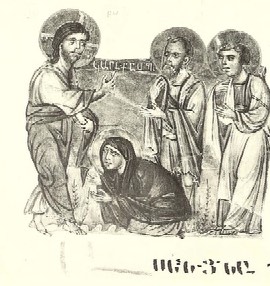
A Mother’s Plans for James and John

On today’s feast of St. James, the apostle,  Matthew’s gospel describes Salome, the mother of James and John, asking Jesus to give her sons privileged places in his kingdom. “Command that these two sons of mine sit, one at your right and the other at your left, in your kingdom.”

I’m not sure Salome would have fallen at Jesus’ feet as she’s pictured in the illustration above. They were related, after all, and she was a senior relative of his. She probably reminded Jesus that James and John were his cousins, and remember, I know your mother. Family ties always help people get ahead.

Jesus doesn’t dismiss her altogether, but he reminds her that his followers are to serve and not be served. It’s a service that will cost them, even their lives. Following him doesn’t mean that they and their family would gain. Like the Son of Man James and John will  have to give their lives “for many.”

They’re called by God to reach out, and reaching out can be hard, sometimes painful. It means going beyond those we call our own, our families and friends. It means reaching out to those we don’t know, even to those we don’t like. It means going beyond what we’re used to.

Later stories say that James and John went to places far beyond the Sea of Galilee where they fished with their father Zebedee and were cared for by a mother who had their interests at heart. Our church is a missionary church. It reaches out to the whole world. That’s what  Jesus last words in Matthew’s gospel says to do:  “Go out to the whole world, baptizing and teaching.”

That’s still his word today. Go out to the whole world, even if the world is changing and the future is uncertain. “I am with you all days,” Jesus says.

James, brother of John, is also known as  James the Greater, to distinguish him from James the Less, the other disciple mentioned in the New Testament. James was the first of the apostles to die for Christ; he was beheaded in Jerusalem by King Herod Agrippa in 42 AD.

Later Traditions About James

Some 4th century Christian writers say that one of the apostles went to Spain and a 6th century source identifies the apostle as James, who preached briefly in Spain and converted only a few before returning to Jerusalem and his death.

Modern scholars are divided about the truth of the tradition. Relics said to be of St. James were discovered in Compostela in Galicia in northwestern Spain in the 9th century, a major event in Spanish history. His shrine at Compostella became a major pilgrimage center for the people of Spain and Europe, rivaling even Rome and Jerusalem in its popularity.

From the 9th century onward, James was patron of the Spanish peoples and a rallying cry in their fight to free their land from the Moors. At four battles – Clavijo (9th c.), Simancas (10th c.), Coimbra (11th c.) and Las Navas de Tolosa (1212) – legends say he appeared as a warrior astride a great white horse with a sword in his hand. Throughout the Middle Ages, soldiers and knights  came as pilgrims to Compostela to seek the saint’s protection.

In 1492, when Spain was finally free of Moorish domination, King Ferdinand and Queen Isabella came to Compostela to give thanks to St.James in the name of the Spanish people.

How old are the relics of St.James? Pilgrims from Galicia were frequent visitors to the Holy Land as early as the 4th century and may have brought the relics back to their native land. Colorful legends from medieval times, however, brought the story back further to the time of the apostle himself, saying that disciples of James fled with his body after he was beheaded and, escaping by boat, drifted to the coast of Spain where, after many adventures they buried him. These legends about James appear frequently in medieval art and in numerous churches built in his honor in France, England, and later in the Spanish colonies of the New World. Cities such as Santiago, Chile, Santiago, Cuba,San Diego, California, are named after him. The feast of St.James is July 25.