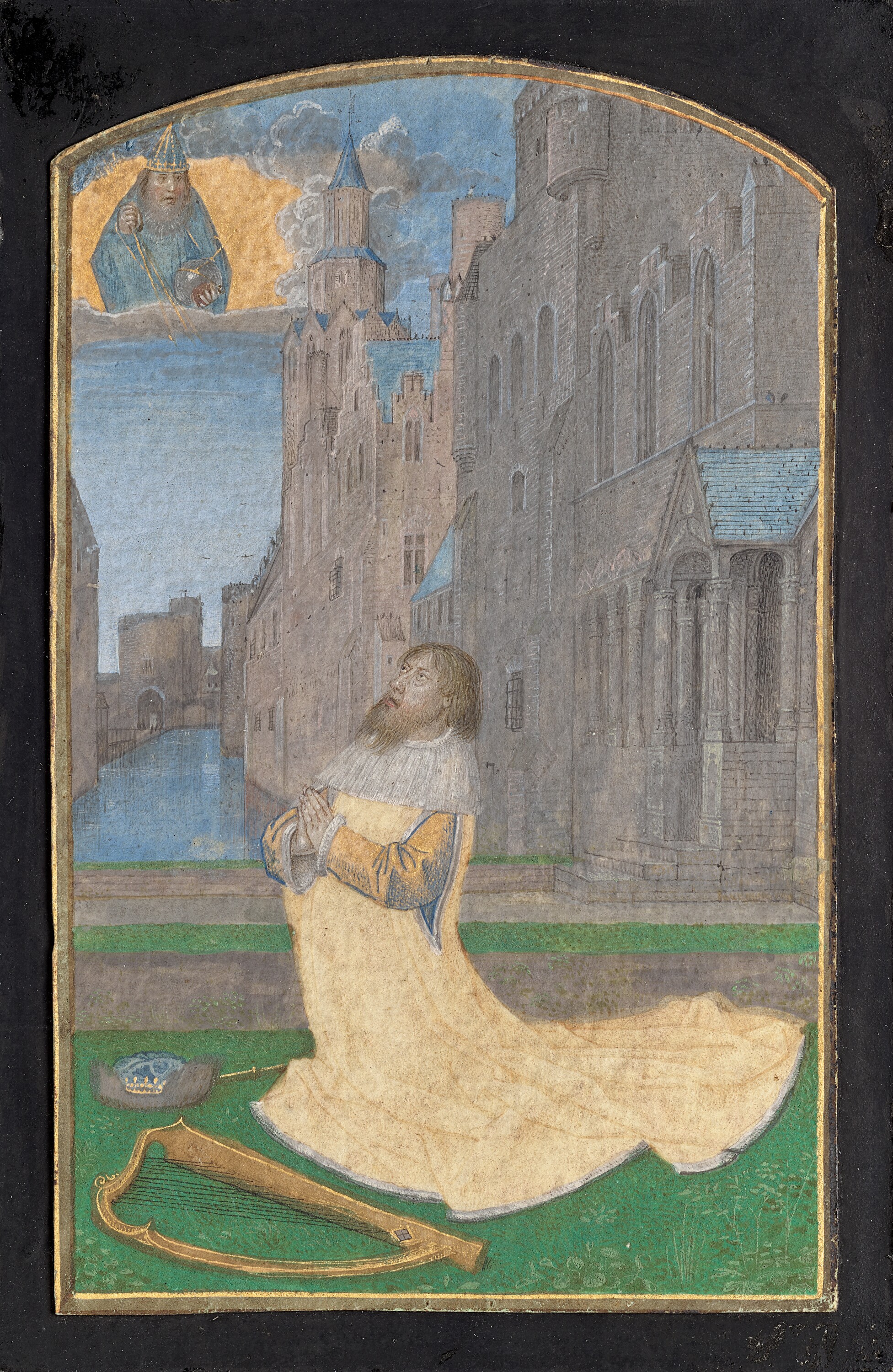
We’re reading at Mass from the Second Book of Samuel. The first 8 chapters describe David’s accomplishments as an ideal king. .
Chapters 9-20 of Second Samuel describe the darker side of David, culminating in his murder of Uriah and taking his wife Bathsheba. The Prophet Nathan accused him of sin, promised him God’s mercy, but also told him he must face the consequences of sin.
The consequences? David’s own son Absalom betrays him and turns the people against him. Pursued by his son he escapes from Jerusalem over the Mount of Olives and meets a relative of Saul who curses him and throws rocks at him. The king humbly accepts it all.
A penitent David recognizes his own sin and its consequences in this incident. In refusing to stop the man David recognizes he must bear the burden of sin, not only his sin, but the sin of the world:
‘Suppose the LORD has told him to curse David; who then will dare to say, ‘Why are you doing this?…Perhaps the LORD will look upon my affliction and make it up to me with benefits for the curses he is uttering this day…’ David and his men continued on the road, while Shimei kept abreast of them on the hillside, all the while cursing and throwing stones and dirt as he went.”
We read the Old Testament to hear the promises God makes to Israel in spite of her sinfulness and infidelity. Yet, let’s not forget sin has consequences, as this story makes clear. Do the consequences there match the bad news we face in our time. Like David our penance is to believe in God’s mercy, but also to bear hopefully sin’s consequences .
The church makes David’s prayer for mercy its own:
Have mercy on me, God, in your kindness.
In your compassion blot out my offence.
O wash me more and more from my guilt
and cleanse me from my sin.
My offences truly I know them;
my sin is always before me.
Against you, you alone, have I sinned;
what is evil in your sight I have done.
That you may be justified when you give sentence
and be without reproach when you judge,
O see, in guilt I was born,
a sinner was I conceived.
Indeed you love truth in the heart;
then in the secret of my heart teach me wisdom.
O purify me, then I shall be clean;
O wash me, I shall be whiter than snow.
Make me hear rejoicing and gladness,
that the bones you have crushed may revive.
From my sins turn away your face
and blot out all my guilt.
A pure heart create for me, O God,
put a steadfast spirit within me.
Do not cast me away from your presence,
nor deprive me of your holy spirit.
Give me again the joy of your help;
with a spirit of fervour sustain me,
that I may teach transgressors your ways
and sinners may return to you.
O rescue me, God, my helper,
and my tongue shall ring out your goodness.
O Lord, open my lips
and my mouth shall declare your praise.
For in sacrifice you take no delight,
burnt offering from me you would refuse,
my sacrifice, a contrite spirit.
A humbled, contrite heart you will not spurn.
In your goodness, show favour to Sion:
rebuild the walls of Jerusalem.
Then you will be pleased with lawful sacrifice,
holocausts offered on your altar.
Glory to the Father and to the Son,
and to the Holy Spirit:
as it was in the beginning, is now,
and will be for ever. Amen.
 The Victor's Place