Tag Archives: Sea of Galilee

St. James, Son of Zebedee. July 25

James the greater

The mother of the sons of Zebedee approached Jesus with her sons
and did him homage, wishing to ask him for something.
He said to her,
“What do you wish?”
She answered him,
“Command that these two sons of mine sit,
one at your right and the other at your left, in your Kingdom.”
Jesus said in reply,
“You do not know what you are asking.
Can you drink the chalice that I am going to drink?”
They said to him, “We can.”
He replied,
“My chalice you will indeed drink,
but to sit at my right and at my left, this is not mine to give
but is for those for whom it has been prepared by my Father.”
When the ten heard this,
they became indignant at the two brothers.
But Jesus summoned them and said,
“You know that the rulers of the Gentiles lord it over them,
and the great ones make their authority over them felt.
But it shall not be so among you.
Rather, whoever wishes to be great among you shall be your servant;
whoever wishes to be first among you shall be your slave.
Just so, the Son of Man did not come to be served
but to serve and to give his life as a ransom for many.” (Matthew 20:20-28)

James and John were sons of Salome and Zebedee, the gospels say, and at the Sea of Galilee Jesus called them to follow him. They were fishermen, relatives of Jesus. The gospels mention James first; he may have been the oldest.

The two brothers are described as quick-tempered and ambitious about restoring Jewish independence. They became part of the innermost circle of Jesus’ companions. They heard him teach, saw him transfigured in glory, then shaking with fear in the garden of Gethsemane before his death.

Our first reading at Mass for the Feast of St. James is a good description of James and John. “We hold this treasure in earthen vessels, that the surpassing power may be of God and not from us.” (2 Corinthians, 4,7) James and John were earthen vessels indeed, as our gospel describes them, using their mother Salome as their intermediary, looking for a big place in the kingdom they hope Jesus will bring. Earthen vessels break easily.

Jesus asks them if they can drink from the chalice that he will drink from, the chalice of serving others, no matter what the cost. “We can,” they say.

His brother John and his mother Salome stood near the cross of Jesus, but James must have fled immediately when Jesus was seized in the garden. Yet, God’s “surpassing power” filled him with treasures of faith, and James drank from the cup he asked to drink.

According to the Acts of the Apostles, James spoke bravely about Jesus risen from the dead to the people of Jerusalem and to the Jews visiting the Holy City from all parts of the world at Pentecost. He became a leader of the Jerusalem church but probably still clung to dreams of Jewish independence. Long held dreams don’t easily disappear.

In the year 41, Herod Agrippa, the grandson of Herod the Great, became king of Judea and ruled in Jerusalem. Educated in Rome, he knew how to favor the emperors of his time and he also knew how to please the powerful Jewish ruling class that had a key role in his kingdom. Were they also concerned about James’ continued political hopes for a Jewish kingdom?

When the Jewish Sanhedrin accused Christians of threatening the peace of Jerusalem, Herod sent his soldiers to seize James, the son of Salome and Zebedee, and had him executed by the sword. Strike the shepherd, Herod reasoned, and the sheep will scatter.

James, son of Zebedee, was the first of the apostles to die a martyr’s death. “My cup indeed you will drink,” Jesus promised, and his promise came true.

On the list of apostles there is another James, son of Alphaeus, commonly called James the Less. He is thought to be the son of Mary of Clopas, a sister of Mary, the mother of Jesus, who stood beneath the cross of Jesus with Mary Magdalen. (John 19: 25) His feast, along with the Apostle Philip is May 3. He was head of the church in Jerusalem and was martyred there in 62.  

The Land Where Jesus Lived

photo
Bethany, outside Jerusalem

“To what shall we compare the Kingdom of God,
or what parable can we use for it?”  ( Mark 4, 30)  Jesus turned to the land where he lived and the life around him to answer that question.

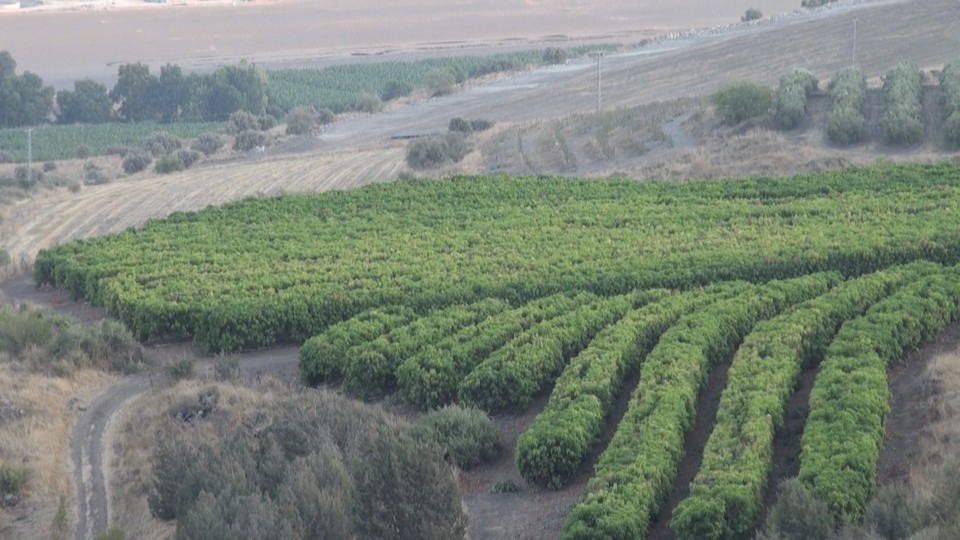
So what was the land where he lived like? It was a land of olive trees near Bethany outside Jerusalem, but if you went eastward to Jericho and the Dead Sea, it was mostly a barren desert. Then, from Jericho to Galilee the land turns from desert to lush farmland. A changing land.

IMG_0467
Jordan Valley

Jesus experienced a changing land from Nazareth to the Jordan River and then the Sea of Galilee. Like us, he was influenced by the place and life around him.

In a book written in the 1930s Gustaf Dalman, an expert on the geography and environment of Palestine, observed that when Jesus went from the  highlands of Nazareth, 1,100 feet above sea level to the fishing towns along the Sea of Galilee, 680 feet below sea level, he entered a different world.

For one thing, he ate better – more fish and nuts and fruits were available than in the hill town where he grew up. He looked out at the Sea of Galilee from the towns he visited. Instead of the hills and valleys around the mountain village of Nazareth, he saw a great variety of birds, like the white pelicans and black cormorants challenging the fishermen on the lake. He saw trees and plants and flowers that grew abundantly around the lake, but not around Nazareth.

Instead of the chalky limestone of Nazareth, Jesus walked on hard black basalt, which provided building material for houses and synagogues in the lake region. They were sturdy structures, but they were dark and drab inside. They needed light. Light on a lampstand became one of his parables. (Mark 4,21)

Basalt also made for a rich soil where everything could grow. “… here plants shoot up more exuberantly than in the limestone district. Where there are fields, they yield a produce greater than anyone has any notion of in the highlands.” (Dalman, p123)

DSC00027
Farmland in Galilee

The volcanic soil on the land around the lake produced a rich harvest. The Jewish historian, Josephus, praised that part of Galilee for its fruitfulness, its palm trees, fruit trees, walnut trees, vines, wheat. But thistles, wild mustard, wild fennel grew quickly too and could choke anything else that was sown. The land around the Sea of Galilee was fertile then; even today it has some of the best farmland in Palestine.

fields
Soil near the Sea of Galilee

The weather in the Lake District was not the same as in the mountains, warmer in winter, much hotter and humid in summer, which begins in May. “It is difficult for anyone used to living in the mountains to work by day and sleep by night…Out of doors one misses the refreshing breeze, which the mountains along the lake cut off…one is tempted to think that Jesus, who had settled there, must often have made occasion to escape from this pitiless climate to his beloved mountains.” (Dalman, p. 124)

You won’t find these observations  in the gospels, of course, but they help us appreciate the world in which Jesus lived and the parables he drew from it.  He was influenced by where he lived, as we are.

And what about us? What wisdom do we draw from the world we live in? What do we see day by day? What’s life like around us? We’re experiencing climate change now, aren’t we? It’s going to influence our spirituality, how we see, how we live, how we react to life.

May we gain wisdom from our time and place.

Magdala: “a nearby village”:Mark 1:33-36

DSC00630


After a tumultuous first day of ministry in Capernaum, Jesus left the following day for other places in Galilee, Mark’s Gospel says.

“Rising very early before dawn, he left and went off to a deserted place, where he prayed. Simon and those who were with him pursued him and on finding him said, ‘Everyone is looking for you.’ He told them, ‘Let us go on to the nearby villages that I may preach there also. For this purpose have I come.’ So he went into their synagogues, preaching and driving out demons throughout the whole of Galilee.” (Mark 1,36-39)

Was one of the nearby villages Magdala?

DSC00640

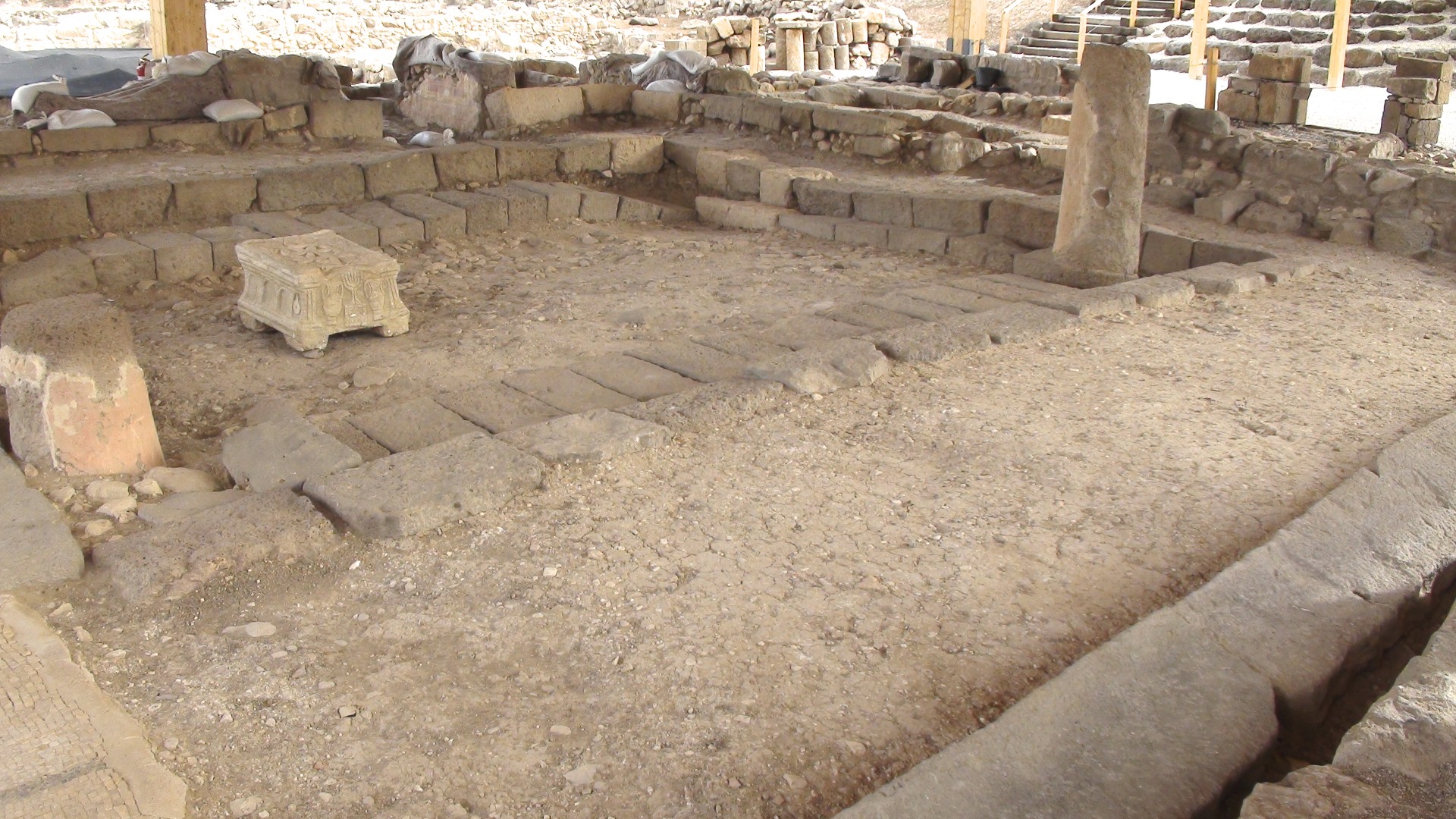
Magdala, or Migdal, a prosperous Jewish port city in the first century. was just five miles south of Capernaum on the south-western part of the Sea of Galilee. Some of the city has been uncovered recently by archeologists and the discovery opens another window into the gospel story.

Magdala’s economy was built on fishing and, in fact, it was the center of a highly developed industry on the Sea of Galilee in Jesus’ day. Written sources have it that salted fish from Magdala was sold in the surrounding areas and even as far as Rome;  recent findings offer a further look at Magdala’s economy and its sophisticated techniques for storing and preparing fish for market. As a flourishing Jewish center on the Sea of Galilee, it was an obvious place for Jesus to visit.

The Jewish historian Josephus may be exaggerating when he says there were 40,000 people in Magdala, but certainly it had a good-sized, prosperous population in the time of Jesus. Christians recognize it as the home of Mary Magdalen.
DSC00653

New excavations in Magdala and also in Bethsaida on the northern tip of the Sea of Galilee help us understand the world of Jesus and what he did there. For example, there are two newly excavated synagogues at Magdala from his time.  Did he stand in a place like this and teach and cure? Probably.

The recent findings also invite us to look again at Jesus’ disciples. What kind of people were Peter, Andrew, James and John, and the other Galilean fishermen whom Jesus called to follow him? They’re often described as “poor” “ignorant” fishermen, tagging along, open-mouthed, before the wonders Jesus worked and the words he spoke.

But Galilean fishermen seem more resourceful and knowledgeable than that. They knew the world around the Sea of Galilee. That world  was more complex than we might think.  On its western shore were mostly Jewish communities; on its eastern shores were the gentile cities of the Decapolis.

Jesus goes first to the lost sheep of the house of Israel, but then he crosses over to gentile world. Who takes him to this different world but savvy fishermen who know the places and the peoples around the sea?

They were certainly not ignorant. At one point in Mark’s Gospel, Jesus tells Peter that he’s thinking like a human being, trying to dissuade him from going to Jerusalem to face suffering and death. In fact, Peter and the rest were quite good at human thinking, quite confident in their own opinions and thoughts. In the gospel Jesus constantly challenges their “human thinking” with the thinking of God. .
Mary Magdalene

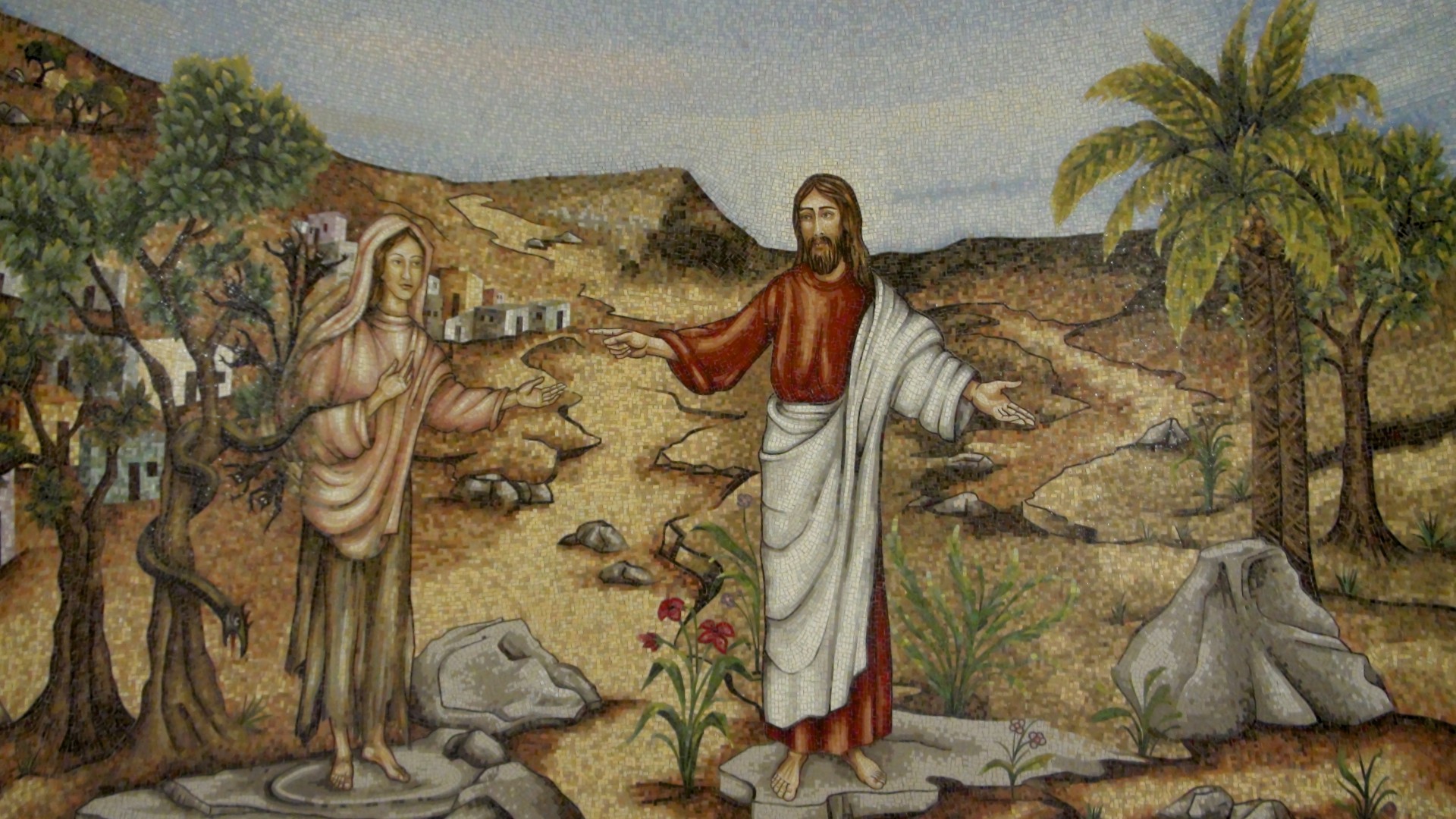
Where did he meet them? Mark’s gospel says it was along the Sea of Galilee. A mosaic of the call of the disciples in the new center at Magdala suggests it may have happened here. Another mosaic suggests that the raising of the daughter of Jairus, the ruler of the synagogue, may also have taken place here.

Speculation, maybe.  It’s a good guess that Jesus met  Mary Magdalene here and released her from the seven devils  that messed up her life. She became a disciple.

Mark’s gospel doesn’t limit the followers of Jesus to twelve. He only mentions the twelve once in his gospel. In Mark’s and Luke’s gospels, a wide range of people become followers of Jesus, from the fishermen of Galilee, tax-collectors like Matthew, to women like Mary Magdalene and Johanna, the wife of Herod’s steward Cusa. Women were with  the twelve, Luke’s gospel says:

“Accompanying him were the Twelve and some women who had been cured of evil spirits and infirmities, Mary, called Magdalene, from whom seven demons had gone out, Joanna, the wife of Herod’s steward Chuza, Susanna, and many others who provided for them out of their resources.” (Luke 8,1-3)

Herod Antipas’ capitol, Tiberias, was only a few miles from Magdala.

Like so many ancient cities, Magdala had its good days and days of decline. It was probably destroyed during the Jewish revolt in 68 AD. Only a few places in the city were left standing when the Crusaders arrived in the 12th century, then it disappeared in the earth.

The Legionaires of Christ bought the property along the Sea of Galilee in 2004 intending  to build a 300 room hotel on the site, but in preparing the building site they uncovered the ruins of ancient Magdala. Construction stopped and the archeologists stepped in.

“For the Rev. Juan M. Solana, it was the spiritual equivalent of striking oil,” a New York Times article from May 14, 2024 said. “When he set out to develop a resort for Christian pilgrims in Galilee, he unearthed a holy site: the presumed hometown of Mary Magdalene and an ancient synagogue where experts say Jesus may well have taught.”

5th Sunday C Deep Waters


To listen to the audio for today’s homily, select the audio file below:

I usually go out fishing a couple of times a year at the Jersey Shore with a friend of mine who has a boat equipped with radar that tracks fish. I notice, though, he also has some old maps he has marked where the fish usually are; he also looks around to check where the party boats are. They’re the fishermen who are out there day after day and night after night. They make their living off the sea and so if they aren’t catching anything, nobody is.

In our gospel, Peter and his friends are professional fishermen, night and day, everyday fishermen. If they don’t know the waters, nobody does. One recent archeological investigation on the Sea of Galilee, at Magdala on its northwestern shore, close to Capernaum where Peter docked his boats, seems to confirm that at the time of Jesus, the fishing industry in Galilee was quite sophisticated. They had elaborate methods for storing and preserving fish in order to bring them to market at the right time. They had developed a dark blue netting for night fishing. They were good at it.

And so, when Peter tells Jesus, “We have worked hard all night and caught nothing,” he’s a professional talking. Experience is behind him; reason and human skill are behind him. “But at your word I will lower the nets.” Because he accepts the word of Jesus he gets a reward bigger than he could ever expect– a catch so great that their boats were in danger of sinking.

Later on in Mark’s gospel, Jesus asks Peter: “Who do people say I am?” “You are the Messiah,” Peter answers. But when Jesus goes on to say he will be arrested and put to death and rise again, Peter doesn’t want to hear it. That’s not reasonable. “Don’t think about that,” he says. And Jesus calls him Satan. “You’re not thinking like God, you’re thinking like human beings do.”

As he did on the Sea of Galilee, Jesus asks Peter to go beyond human thinking. When God speaks and reveals things we have to go beyond our reasonableness and calculations.

Peter is not the only one who has to go beyond human thinking. We’re also asked to do that too, if we want to be people of faith. In our 2nd reading today the Apostle Paul asks us to believe.

“Brothers and sisters,

I handed on to you as of first importance what I also received:

that Christ died for our sins

in accordance with the Scriptures;

that he was buried;

that he was raised on the third day

in accordance with the Scriptures;

that he appeared to Cephas, then to the Twelve.

Last of all, as to one abnormally born,

he appeared to me, and

so we preach and so you believed.”

Paul wants his hearers to believe in God, the creator of this world. This world did not just happen. Jesus Christ is God’s Son, born of Mary, suffered under Pontius Pilate, died and rose again.

We’re called to follow him, to be with him, to be his companions, his friends, to listen to his words, to hope in his promises, to love others as he has loved us.

“Put out into the deep water and lower your nets for a catch,” That’s what we do when we come to Mass. This is the deep water where we lower our nets to catch those graces God wishes to give us. Surprising graces, more than we imagine, greater than we could expect. This is the sea where believers are blessed.


The Storm at Sea: 19th Sunday A

You can hear the homily here: 

I visited Magdala along the Sea of Galilee a few months ago and since then I think differently about the apostles, especially  fishermen apostles like Peter and Andrew, James and John. Magdala, the city of Mary Magdalen, was a center for the fishing industry in Galilee in Jesus’ time, according to archeologists who recently uncovered the city.

It evidently was a prosperous place, and so far from being “poor and ignorant” many of the Galilean fishermen were well-off, savy businessmen who knew their way around.

Did Jesus choose them and the tax-collector, Matthew, because they knew the territory well and would be good guides to  the places he wanted to visit? They knew where to go and how to get there: the Sea of Galilee was their usual highway

But a storm like that described in our gospel today (Matthew 14,22-33) would shake anybody, even the most self-asssured.

When we read a miracle story like the calming of the sea and someone walking on water, we shouldn’t just stop in amazement at the power of Jesus. There’s a lesson to be learned in the story. What’s the lesson here?

Perhaps  like Peter and the rest of the disciples we can easily fall into thinking that there are some things beyond God’s power–and ours– to do. These were confident men, yet their faith was shaken, like ours often is. When told by Jesus to walk on the water, Peter believed up to a point, then he said, “This can’t be; it’s not possible; it’s beyond his power and mine to do.” In fear and doubt he began to sink.

Doesn’t this happen to us too? We believe, up to a point, and then we doubt. Our doubts about God’s power can be brought about by major events in our world, as ovewhelming as a storm at sea. Wars, terrorist attacks, global warming. How quickly we throw up our hands as if this is all beyond God’s power and ours.

We are all in the same boat. Take a look at the boat on the Sea of Galilee–it’s  the world on the sea of history, it’s the church in time. In storms, they may both look like they’re going to sink. But they wont. Jesus is in the boat.

That’s what the mystery of the Incarnation tells us.

Hunger

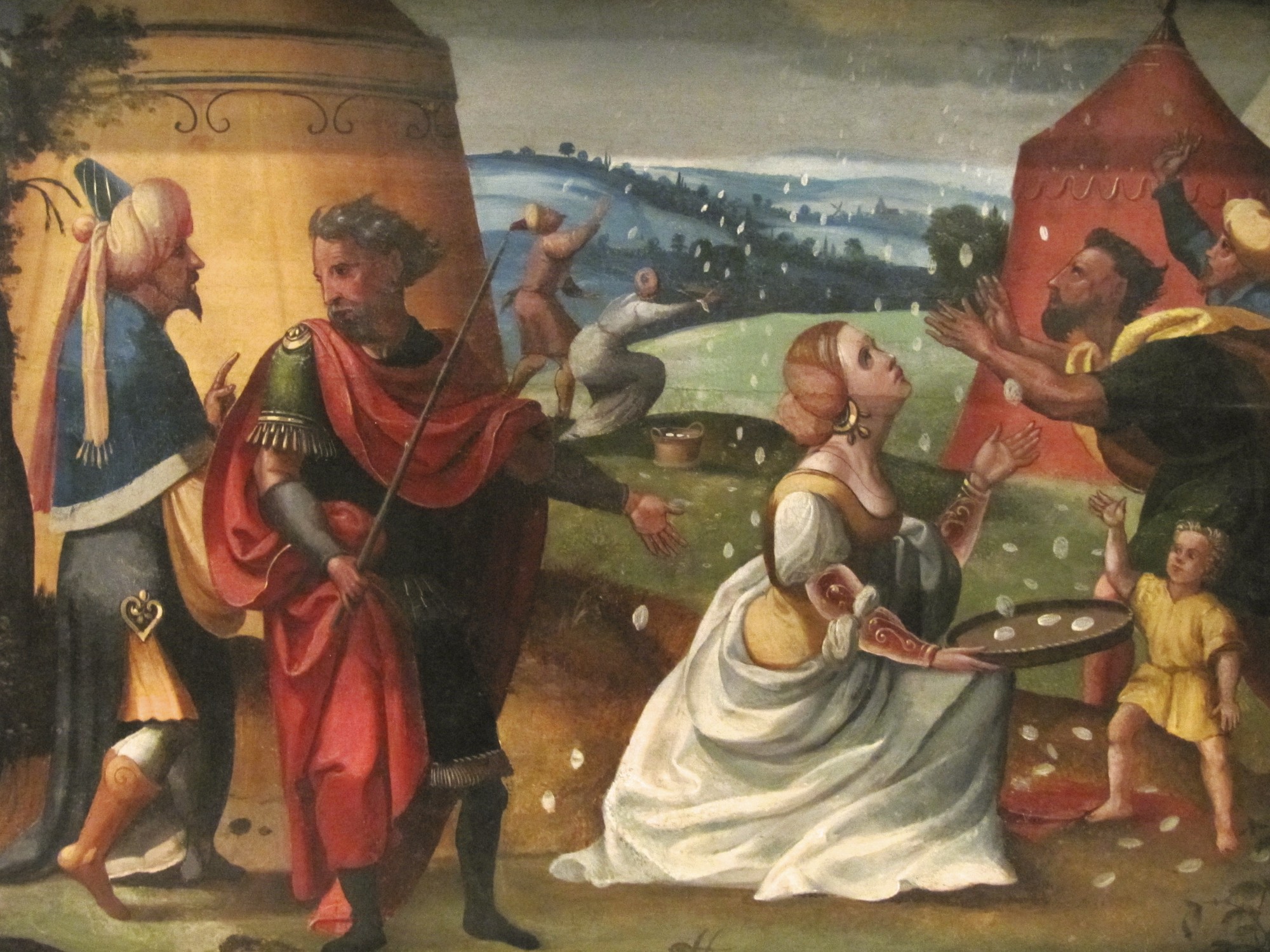
Manna in the Desert

The next five Sundays we’ll read from the 6th chapter of St. John’s gospel, beginning this Sunday with the miracle of the loaves and the fish. All four gospels recall this miracle, Mark and Matthew report it twice. The miracle and Jesus’ words that follow it in John’s gospel are about the Holy Eucharist. Jesus, the Bread of Life, is the answer to our hunger.

The miracle takes place across the Sea of Galilee, in a “deserted place,’ as Matthew’s gospel describes it. There’s no place to buy food for a hungry crowd.

There’s only five barley loaves and two fish a small boy has. Barley loaves were the ordinary food for the poor.

Jesus initiates this miracle by pointing out to his disciples  a hunger in the crowd. They seem hardly aware of it and have no answer what to do, except to say “We don’t have enough!”  Taking what’s there, the five barley loaves and two fish, Jesus multiplies this food and feeds a multitude. John notes the Passover is near; it’s spring and green grass has grown up in this deserted place. Not only is it enough, but fragments are left over as the crowd has its fill.

Keep in mind the basic reality the miracle addresses: hunger. It’s bodily hunger, yes, but hunger of all kinds is addressed here. Like the disciples, we may be hardly aware of it. Humanity is hungry, this gospel says. Only God can fill its silent, hidden hunger, this miracle says. Only Jesus can.

Hunger

“I come among the peoples like a shadow,

I sit down by each man’s side,

None sees me,

but they look on one another and know that I am there

My silence is like the silence of the tide that buries the playground of children

Like the deepening of frost in the slow night, when birds are dead in the morning.

Armies travel, invade, destroy with guns roaring from earth and air.

I am more terrible than armies.

I am more feared than cannon, kings and chancellors

I give no command to any, but I am listened to more than kings

and more than passionate orators

I unswear words and undo deeds,

Naked things know me.

I am more the first and last to be felt of the living.

I am hunger. “

Lawrence Binyon

Follow Me

Galilee shore

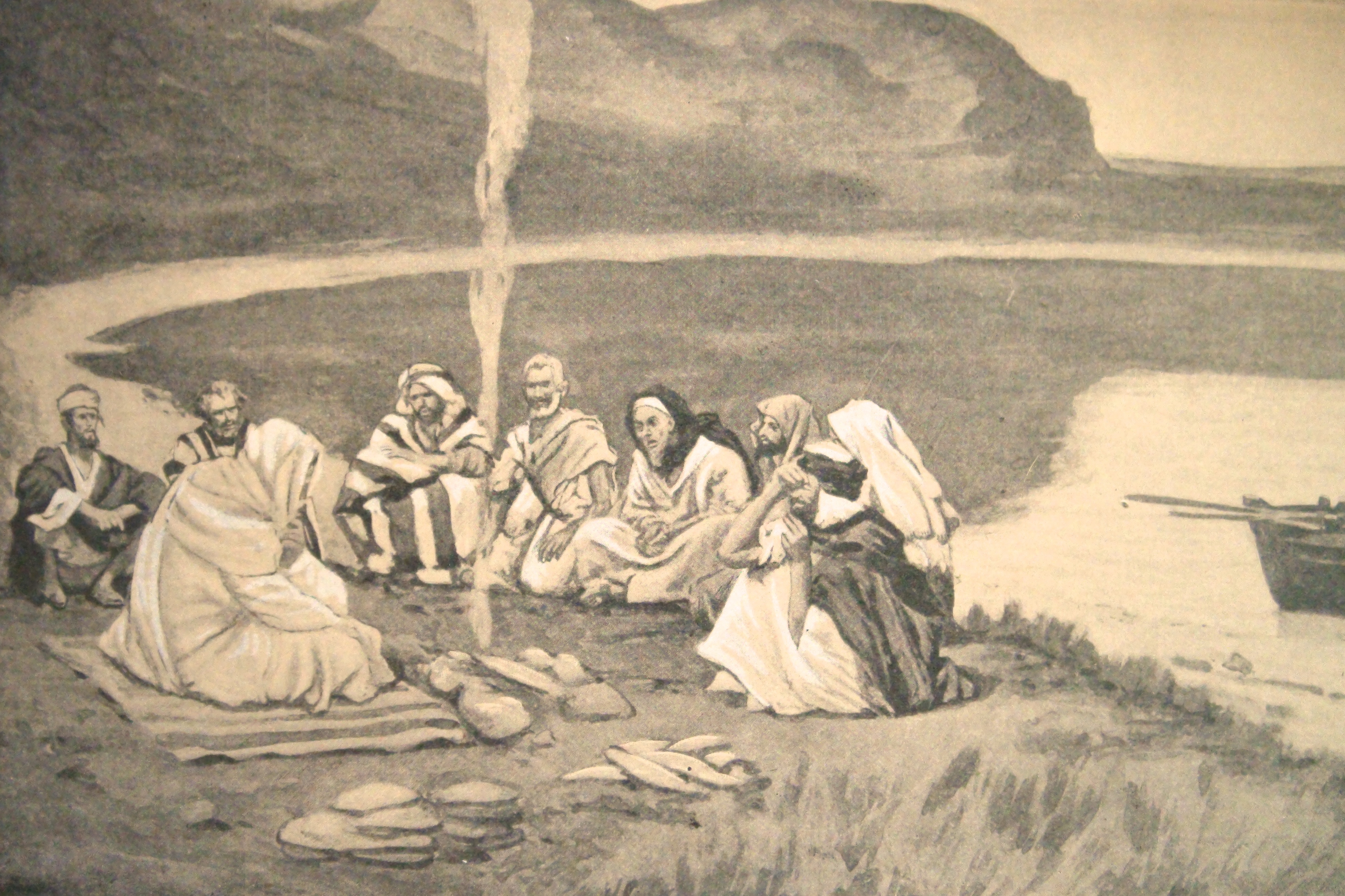
The gospel of John is read at Mass these last days before the Feast of Pentecost. We’re brought to the Sea of Galilee where the Lord first called Peter and John and others to follow him. Now, from the shore the Risen Jesus calls them again. They’ve fished all night and caught nothing. Not only are their boats empty; some days earlier in Jerusalem they deserted the One they promised to follow forever. Their spirits are empty.

From the shore Jesus tells them to cast their nets into the sea again and an abundant catch of fish pours into their boats. Calling them ashore, Jesus feeds them some loaves and fish. As he did in the supper room the night before he died, Jesus offers them his life-giving love.

Taking Peter aside, he asks the disciple who denied him three times “Do you love me?” “Yes, Lord, you know I love you,” Peter answers three times. “Feed my sheep,” Jesus tells him.

Then, renewing the invitation he made at this same shore at the beginning of his ministry, Jesus says to his disciple, “Follow me.”

The Feast of Pentecost is a feast for a church that has failed, for disciples facing their weakness and broken promises, for those who work and have nothing to show for it. The Holy Spirit, whom Jesus breathed upon the disciples after his resurrection, comes to our world as he promised, to renew the face of the earth. “Come follow me,” the life-giving Spirit says.