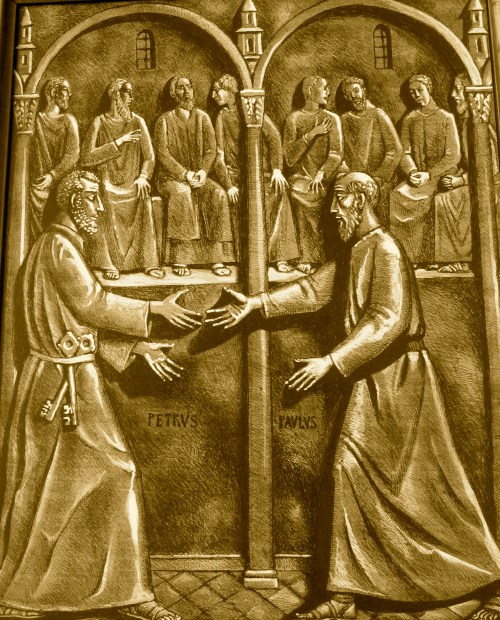
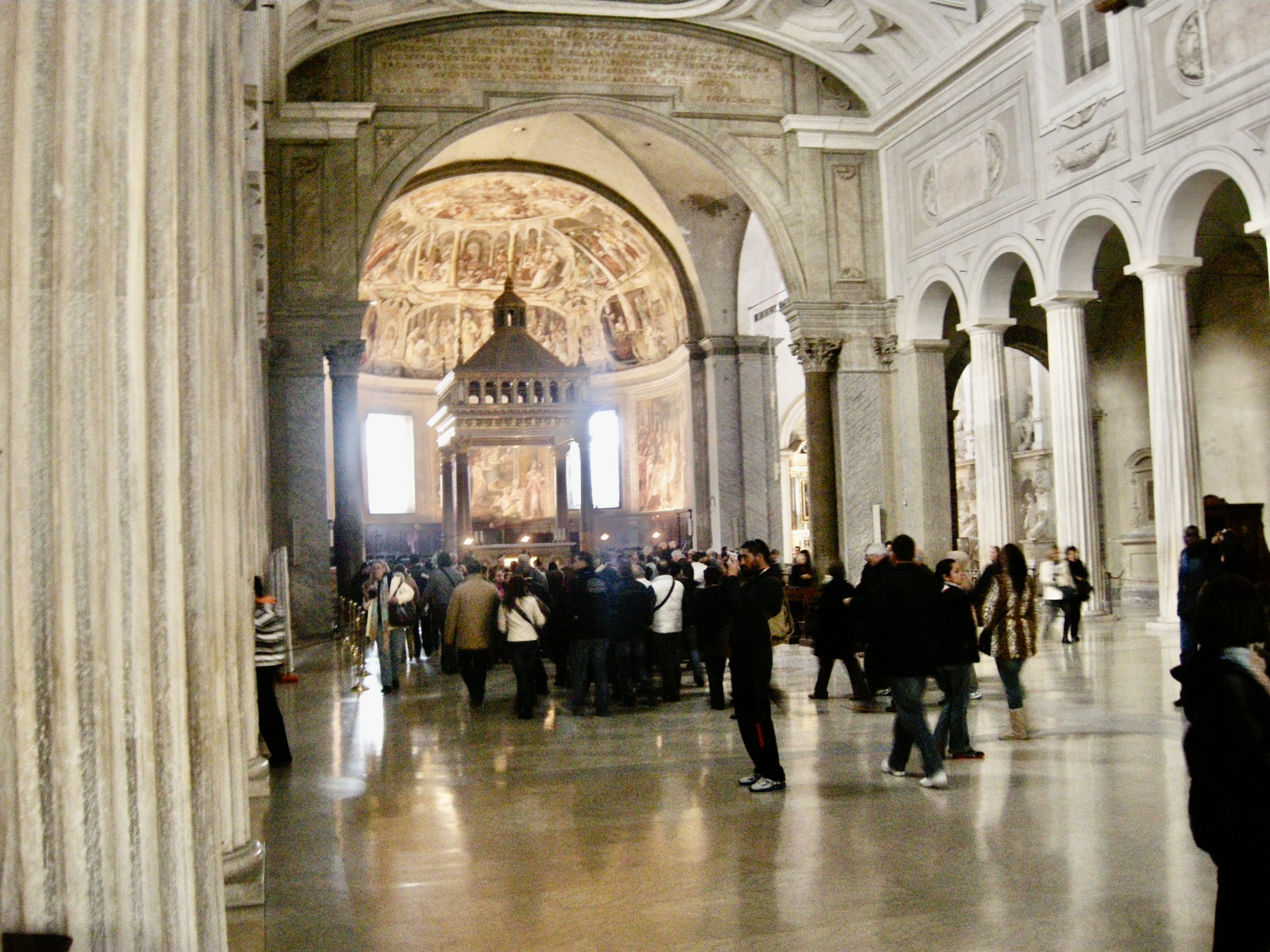
On November 18th, we honor the great apostles, Peter and Paul, remembering the dedication of the two ancient churches built over their graves. Peter is honored in the Vatican Basilica of St. Peter; Paul is honored in the Basilica of St. Paul, outside the Aurelian Walls along the Via Ostiense. The two apostles are founders and teachers of the Roman church.
Constantine built churches over the apostles’ graves in the middle of the 4th century. Besides honoring the apostles Peter and Paul, the churches were part of a wider plan of prayer, instruction and pilgrimage still seen in the Holy Year pilgrimages to Rome today. An early example of evangelization and catechesis.
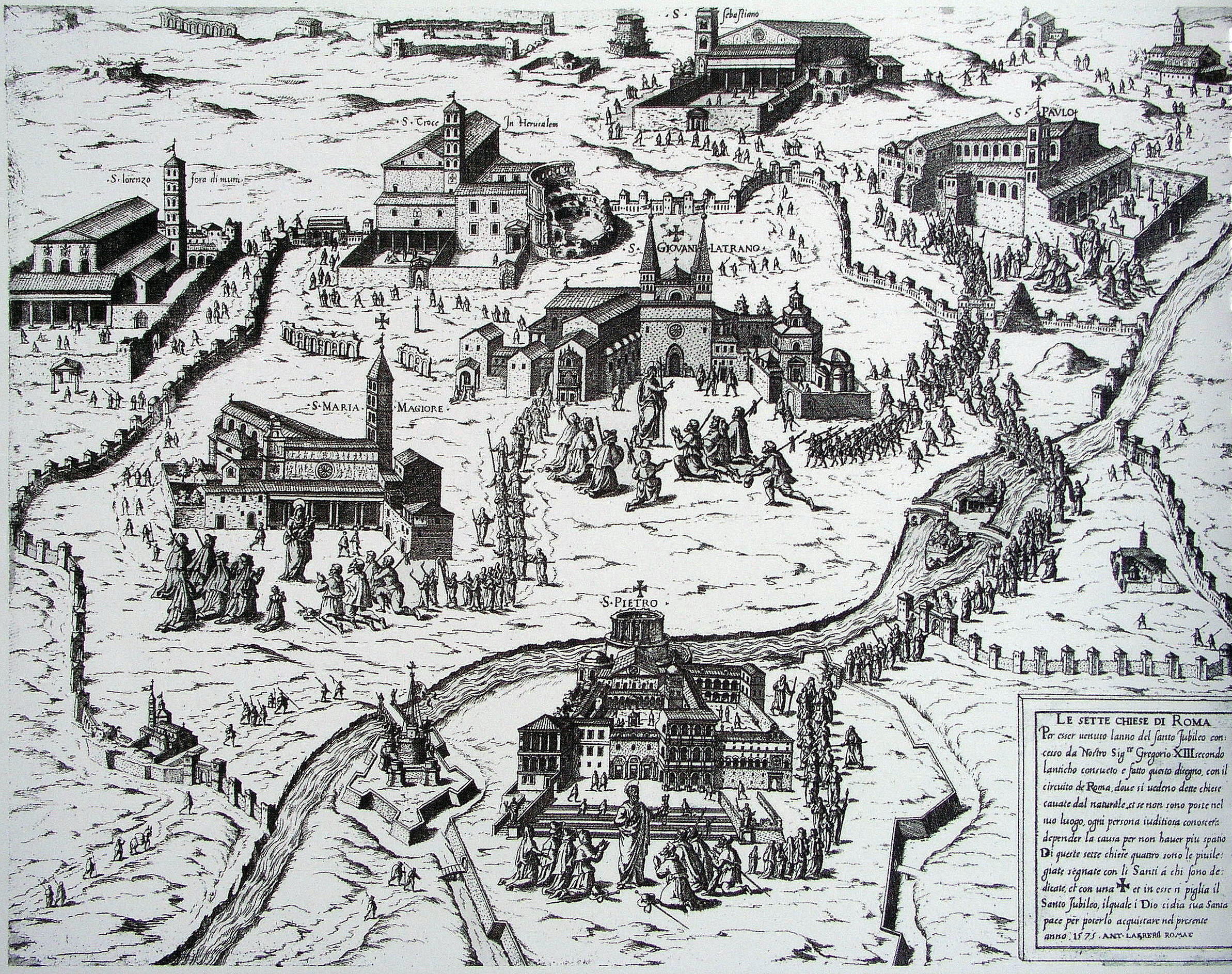
From earliest times pilgrims followed a path from one church to the other, visiting a number of other Christian shrines – St. Agnes and St. Lawrence, for example–on their way. A later pilgrim map based on that ancient pilgrimage journey offers an example.
Pilgrim Map, 17th century, Wikipedia Commons
Peter was crucified on the Vatican Hill in 64 near the obelisk not far from the circus of the emperors Caligula and Nero and was butried nearby. Constantine erected a basilica over his burial site in 326, while Sylvester was pope. Later in 1626 the present basilica replaced Constantine’s church. It’s in the process of reconstruction in the illustration above. Recent excavations have confirmed Peter’s burial place under the papal altar of this church.
Paul, tradition says, was beheaded on the Ostian Way, outside the ancient city walls, in 67. Constantine built a shrine church over the gave in 325; it was enlarged by Theodosius I in386. The church was rebuilt after a fire in 1823, according to its original measurements. The apostle’s grave lies before the main altar of the church.
Defend your Church, O Lord, by the protection of the holy Apostles, that, as she received from them. the beginnings of her knowledge of things divine, so through them she may receive, even to the end of the world, an increase in heavenly grace. Through our Lord Jesus Christ, your Son. (Collect for the feast)
We’re celebrating the Dedication of the Lateran Basilica today. The Lateran Basilica was the parish church of Rome and the actual residence of the popes for many centuries. A magnificent baptistery was an essential part of Constantine’s church, dedicated in 325. As the reading from Ezekiel for the feast of its dedication indicates the church was a place of baptism for Rome’s Christians. Waters from this church – and all other churches, in fact– bless the world.
The Lateran Basilica has been an important destination for pilgrims to the Holy City since the 4th century. It was on the route early pilgrims took to pray at the shrines of martyrs buried on Rome’s outskirts, beginning with the place where Peter was buried, the Vatican Basilica. The pilgrim route ended in the church where the Apostle Paul was honored on the other side of Rome.
Pilgrimage to Rome’s shrines began shortly after Constantine brought freedom to the Christian church in 315. We know some of them. The popular shrine church of St. Lawerence, north of the Lateran Basilica, was part of the pilgrim route. Nearby Helena, the mother of Constantine, enshrined relics of the Cross from the hill of Calvary in the great hall of her residence.
Pilgrims came to Rome in great numbers to celebrate their faith and visit the Roman martyrs’ shrines. In the late 4th century, Pope Damasus placed about 40 inscriptions in Rome’s shrines, guiding pilgrims on their journey. St. Jerome was among the early pilgrims. He found faith and was drawn to being baptized on his journey.
Early sources say that Constantine built a palace for the pope and a royal staircase leading to the papal quarters and his personal chapel at the Lateran site. The chapel was known as the Sancta Sanctorum, the Holy of Holies. An earthquake in the 1277 leveled the palace and chapel with its many relics.
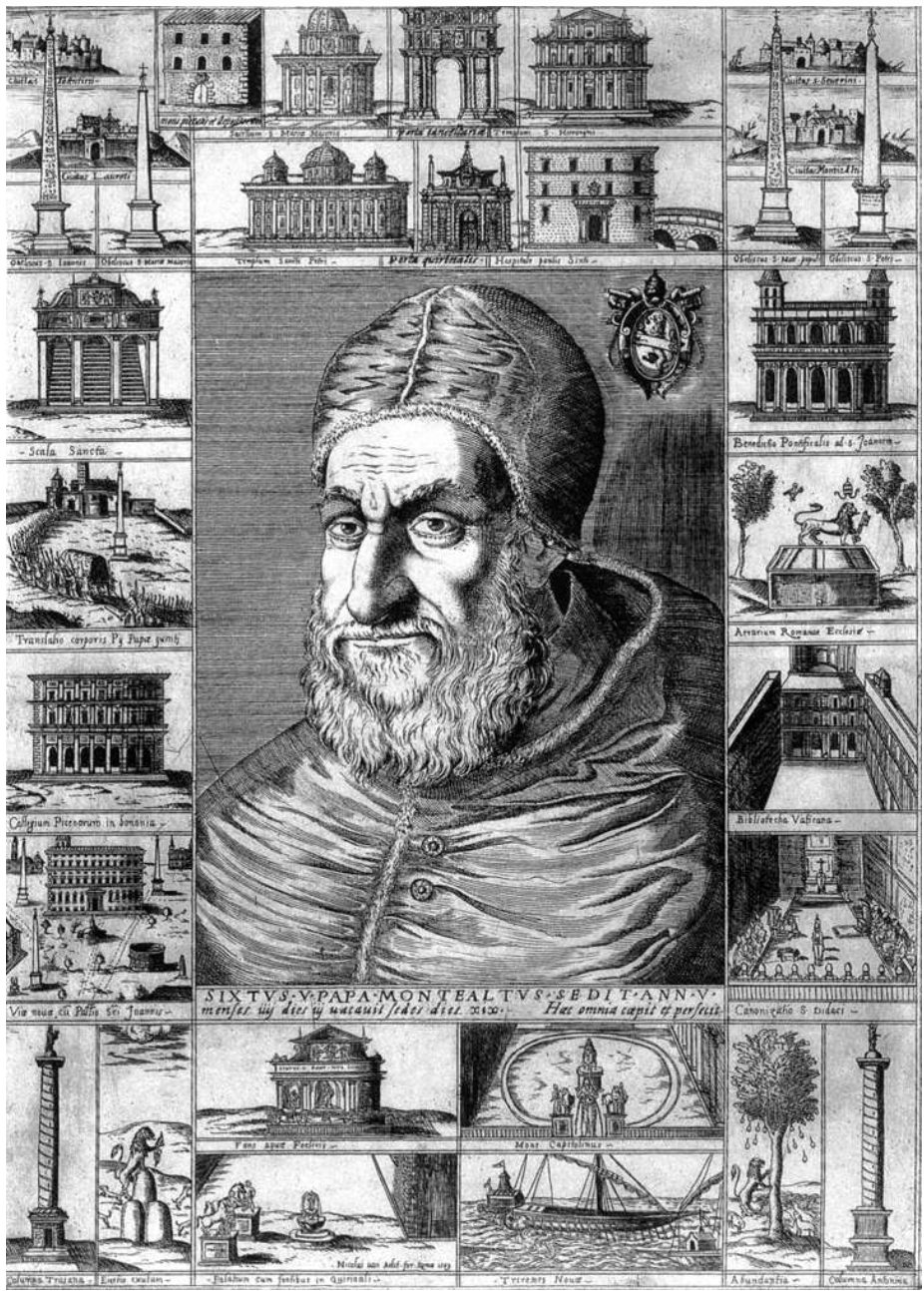
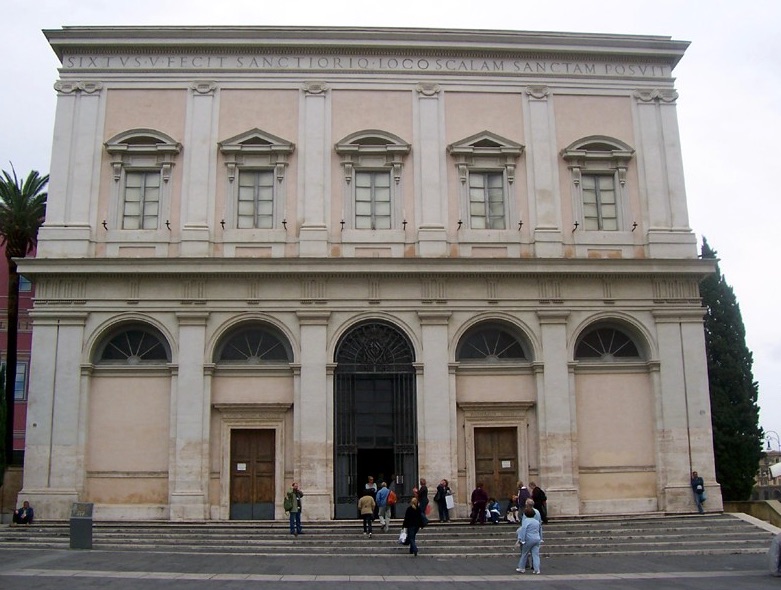
The chapel was rebuilt in magnificent style by Pope Nicholas III in the 13th century. Pope Sixtus V demolished most of the papal buildings in the 16th century but left the chapel alone in a free standing building, reached by a staircase of 28 steps. He claimed the stairs were from Pilate’s palace in Jerusalem on which Jesus walked to be judged. Historians and archeologists today say the stairs may be the stairs from the pope’s residence built by Constantine.
The site, known today as the Scala Sancta, the Holy Stairs, was restored in 2019. It is a UNESCO site. Pilgrims traditionally ascend the stairs on their knees. Pope Pius IX entrusted the shrine to the Passionists in 1853.
Two friends of mine ascended the stairs recently. Here they are.
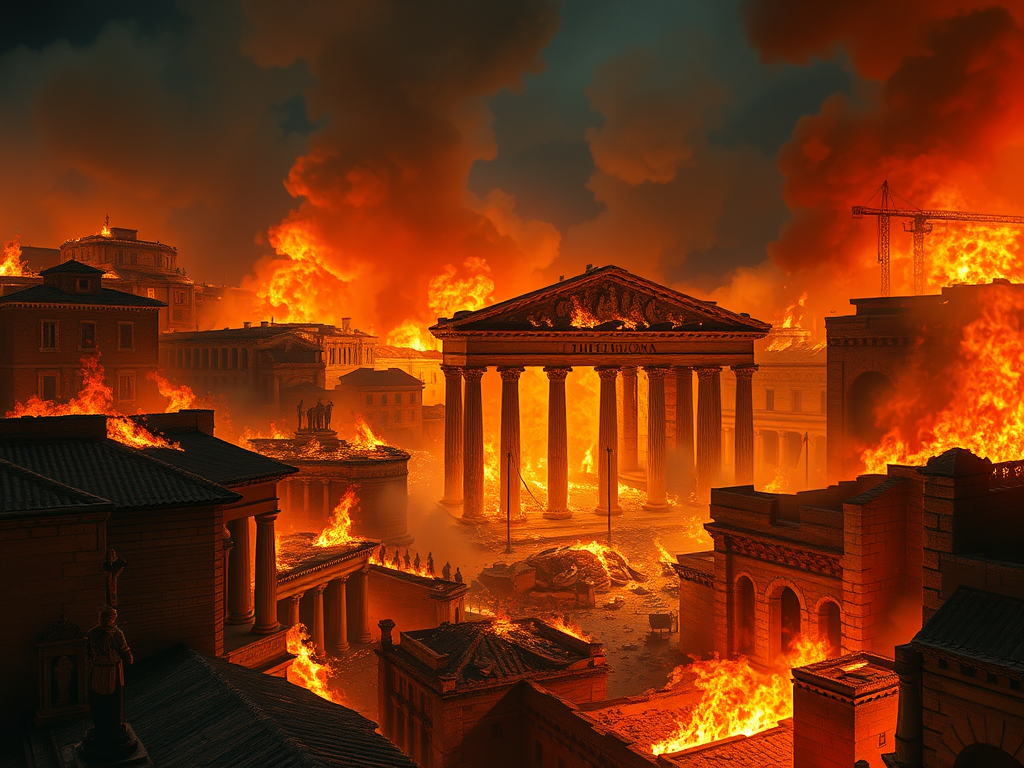
Today is the feast of the early Roman martyrs who suffered in Nero’s persecution along with the apostles Peter and Paul. The persecution began with an early morning fire on July 19, 64, that broke out in a small shop by the Circus Maximus and spread rapidly to other regions of Rome, raging for nine days through the city’s narrow streets and alleyways, where more than a million people lived in apartment blocks of wooden construction.
Only two areas escaped the fire; Trastevere, across the Tiber River, which had large Jewish population, was one.
Nero was at his seaside villa in Anzio when the blaze began, but he delayed returning to the city. They say that when he heard the news, he began composing an ode comparing Rome to the burning city of Troy. His absence caused resentment among the people. Rumors began that Nero himself set the fire in order to rebuild the city from his own plans.
To quell the rumors, Nero decided to blame someone else, and he chose a group of renegade Jews called Christians, who had caused trouble before, and had a bad reputation in the city. Earlier, about the year 49, the Emperor Claudius had banished some of them from Rome for starting upheavals in the city’s Jewish synagogues with their disputes about Christ.
“Nero was the first to rage with Caesar’s sword against this sect,” wrote the early-Christian writer, Tertullian. “To suppress the rumor,” the Roman historian Tacitus says, “Nero created scapegoats. He punished with every kind of cruelty the notoriously depraved group known as Christians.” Just how long the process went on and how many were killed, the Roman historian does not say.
The early Roman Christians came mostly from the 60,000 Jewish merchants and slaves with strong ties to Jerusalem. Even before Peter and Paul arrived in Rome, Jewish-Christians, clearly identified as followers of Jesus Christ, were counted among the city’s Jews.
At the time of the fire Jewish Christians had become alienated from the larger Jewish community and began separating from it. Where they lived and met was well known. The authorities, following the usual procedure, seized some of them, brought them to the Prefecture and forced them by torture to give the names of others.
“First, Nero had some of the members of this sect arrested. Then, on their information, large numbers were condemned — not so much for arson, but for their hatred of the human race. Their deaths were made a farce.” (Tacitus)
Instead of executing the Christians immediately at the usual place, Nero executed them publicly in his gardens and in the circus on Vatican hill. “Mockery of every sort accompanied their deaths. Covered with the skins of beasts, they were torn by dogs and perished, or were nailed to crosses, or were doomed to the flames and burnt, to serve as a nightly illumination, when daylight had expired.” (Tacitus)
Most thought Nero went too far. “There arose in the people a sense of pity. For it was felt that they (the Christians) were being sacrificed for one man’s brutality rather than to the public interest.” (Tacitus)
We celebrate the memory of the victims of Nero’s persecution, our ancestors in faith, on June 30th, following the feast of Saints Peter and Paul.
Further Reading
It would be good to have two New Testament writings in mind as we celebrate this feast– the Gospel of Mark and the First Letter of Peter.
Many scholars believe the Gospel of Mark was written in Rome following Nero’s persecution and before the destruction of Jerusalem in 70. Roman Christians, reeling from persecution and fearing troubles ahead, learned from this gospel.
Most belonged to a Jewish community that enjoyed extensive privileges under Rome’s emperors; they felt safe and secure– until Nero’s reign. There were brave martyrs, but there were others who betrayed their fellow Christians.
Mark’s Gospel presents the Passion of Jesus as a stark, brutal martyrdom that can’t be explained. How appropriate for Christians facing absurd, unmerited suffering meted out by a capricious emperor. At the same time, more than other gospels, Mark portrays Peter as a disciple who fails his Master and then receives mercy. He seems to remind Rome’s Christians that not only the strong, but the weak are part of their church.
Mark’s Gospel is meant for hard times. Jesus Crucified calls his disciples to follow him to the Cross.
First Letter of Peter
Another New Testament writing offered a similar message to the Roman community and Christians beyond the city. Like Mark’s Gospel, the First Letter of Peter, written in Rome, calls for courage in suffering, even unjust, absurd suffering.
“Christ suffered for you, leaving you an example that you should follow in his footsteps. He committed no sin and no deceit was found in his mouth. When he suffered he did not threaten; instead he handed himself over to the one who judges justly.” (1 Peter 2, 21-23)
The followers of Jesus should stay the course when suffering comes, Peter says. Stay where you are, the letter says, and “maintain good conduct among the Gentiles,” (1 Peter 2:12) “give honor to all, love the community, honor the king.”(1 Peter 2:17)
Following the Neronian persecution, many Jewish Christianss fled Jerusalem before Titus’ advancing legions. Seeing a sign of the last times, they prepared for the end. Rome’s Christians stayed where they were, it seems, and with their neighbors rebuilt their burnt city, waiting in hope for God’s kingdom to come.
They must have wondered whether to stay in this city, an evil city like Babylon. Should they go to a safer, better place? The Christians remained in the city. I wonder if the “Quo Vadis?” story was a story prompted by questions like these ?
The martyrs of Rome strengthen us to stand where we are and do God’s will, inspired by the Passion of Christ.
The Vatican Basilica where Peter the Apostle is buried is a prime destination for pilgrims to Rome today, but another important place dedicated to the memory of the apostle is the Church of St. Peter in Chains. It was built in the 5th century by the Empress Eudoxia on the western slope of the Esquiline Hill, next to the site of the early Roman Prefecture, not far from the Colosseum and the Roman Forum.
Justice was still being dispensed at the Roman Prefecture in Eudoxia’s day. Rome’s main prison was also nearby, where suspected criminals were tortured, questioned and judged. Not far away, just outside the city, those condemned were beheaded or strangled.
I would guess that Eudoxia was inspired to build this church next to the Roman Prefecture by the dramatic story we read today from the Acts of the Apostles of Peter being freed from his chains from a Jerusalem prison. (Acts 12:1-11) I imagine she saw the Prefecture as the place where judgment was carried out for so many Christians, even Peter and Paul.
Eudoxia gathered chains from the prisons in Jerusalem and Rome and placed them under the altar of this church she built, according to reports. Modern visitors usually turn to Michelangelo’s famous statue of Moses, located in the same church, but they should keep the chains in mind. They represent the imprisonment of Christian martyrs like Peter and Paul, and so many others.
A strong tradition among early Christian communities — affirmed today by many historians and archeologists — says that Peter met his death at Nero’s circus on the Vatican and Paul was beheaded along the Via Ostia near the place where Constantine later built a church in his honor. The apostles Peter and Paul, were martyred late in the persecution. Many details of their martyrdom are unknown, but like others they must have been arrested, put in chains, questioned, and sentenced before being executed.
Were Peter and Paul and many of the Christian martyrs who died in Nero’s persecution arrested, enchained and sentenced here?
There are later legends, of course. One says Peter and Paul were imprisoned in the Mamertime Prison, near the Capitoline Hill, where they converted and baptized their jailers. Peter, freed from his chains, escaped and fled along the Via Appia until he reached the place where the chapel, Domine, Quo Vadis? now stands. There he met Jesus coming into the city. “Where are you going, Lord?” Peter asked. When Jesus told him he was going to join those suffering, the apostle turned to embrace the same fate.
In the apse of the church of St Peter in Chains there’s a 16th century painting of Eudoxia presenting the chains to the pope. According to some 8th century homilies, one is from a Jerusalem prison. The other is from a Roman prison, possibly the one nearby? Eudoxia was a woman who listened to the scriptures with her imagination and saw connections. Good example for us who listen to the scriptures today.
Basilica di s.pietro in vincoli, A.P.Frutaz, Rome ?
The Roman Catacombs and Their Martyrs, l. Hertling SJ and E.Kirschbaum,SJ, Milwaukee, USA 1956
June 24, three months after the angel announces to Mary that Elizabeth is six months pregnant (March 25) John the Baptist is born.
From his birth John the Baptist was destined by God, not to follow Zachariah his father as a priest in the temple, but to go into the desert to welcome the Messiah, Jesus Christ. John is the last of the Jewish prophets, the first to recognize Jesus. His birth and death are celebrated in our church calendar.
It may have changed, but there’s an interesting Sunday walk in Rome I’d recommend. Go out the city gate at the Porta di San Sebastiano and walk south along one of the oldest roads in the world, the Via Appia, to the catacombs and church of San Sebastiano. Outside the city gates, you’re in what the ancient Romans called the “limes,” the limits, the world beyond the city, a different world altogether.
To the ancient Romans the “limes” was the end of civilized, reasonable life. No place to live, they thought. Get where you’re going as soon as you can. “Speed limit” comes from the word. Go beyond the limit and you can lose your life.
Few people today are usually on that road, deserted fields all around. The only sound you can hear is the sound of your own breathing and your footsteps.
The last line of St. Luke’s gospel for today’s feast says of John:
“The child grew and become strong in spirit, and he was in the desert until the day of his manifestation to Israel.”
How did John become strong in a desert? Centuries before, God told Abraham to go into a land he would show him. He led Jews from Egypt into the desert, and with no map or provisions, to a world unknown. They were in the hands of God, their strength.
Most of us stay within our limits; we don’t go to live in physical deserts. Yet, try as we may, we face them anyway in things we didn’t expect, like sickness or death or separation or divorce or the loss of a job or lost friends or lost places we know and love. The desert’s never far from any of us.
The Via Appia brings you to the catacombs, the great underground tunnels where early Christians buried their dead. They buried them there, I think, not to hide them, but because this place was an image of a new unknown world. The “limes,” marked the end of this life and foreshadowed a new life. The dead no longer belonged in the city; they were going to a new city.
Life holds its doubts, fears, uncertainty. But we don’t face limits alone. In the “limes” God alone has you in his hands. God gives you strength and brings you where you’re meant to be. God is there. God is there.
Like other ancient church feasts, the Nativity of John the Baptist, June 24, is tied to cosmology. Three months after the angel announces to Mary that Elizabeth is six months pregnant (March 25) John the Baptist is born.John’s birth coincides with the summer solstice. He begins to decrease to make way for the one who will increase. Jesus will be born December 25. The Feast of the Nativity of John the Baptist is celebrated by all the ancient Christian churches. The Orthodox Church celebrates it June 24.
Birth of John the Baptist. Orthodox Church of America.
Philip Neri, whose feast is May 26th, helped rejuvenate the Catholic church in the city of Rome following the Protestant reformation in the 16th century. He’s an important example of the way reform takes place in the church.
Philip came to Rome as a young man, became a priest, and fell in love with the city’s history, its churches and holy places. He roamed the catacombs of St. Sebastian where early Christians were buried and was a regular guide for pilgrims searching for their roots. He promoted pilgrimages to the great churches of St.Peter’s, St.Paul outside the Walls, St. Lawrence, St. Sebastian, Holy Cross, St. John Lateran and St. Mary Major, which are still the major pilgrim churches of the city.
Philip was also a familiar figure on the Roman streets where he engaged ordinary people, especially the young, with cheerfulness and simple conversation. People listened to him and he listened to them. He made people aware of the beauty and joy of an ancient faith.
Philip inspired saints like Ignatius Loyola, Charles Borromeo and Pius V.
In his day Protestants were turning to history to back up their claims against the Catholic Church. At the same time Philip encouraged Catholic scholars and historians like Caesar Baronius to look into the history of their church with fairness and accuracy. Baronius said of him: “I love the man especially because he wants the truth and doesn’t permit falsehood of any kind.” He supported Galileo: “The bible teaches the way to go to heaven, not the way the heavens go.”
In promoting an honest study of church history and archeology Philip was influential in helping the Catholic Church examine its traditions and roots. At a time when fierce controversy between Protestants and Catholics was the norm, Philip brought gentleness, cheerfulness and friendship and a search for truth to Christian reform. He believed reform would best come about by showing the beauty of faith in art, music and tradition. He was an unassuming man. A biographer said “ his aim was to do much without appearing to do anything.”
He died in Rome on May 26, 1595, at eighty years of age.
The great Christian scholar John Henry Newman, attracted to Philip Neri, entered the religious society he founded, the Oratorians.
Here’s one of his prayers I like: ” Let me get through today, and I won’t worry about tomorrow.”
God our Father, you are continually raising to the glory of holiness those who serve you faithfully.In your love, hear our prayer: let the Holy Spirit inflame us with that fire with which, in so admirable a way, he took possession of Saint Philip’s heart.Through our Lord Jesus Christ, your Son, who lives and reigns with you in the unity of the Holy Spirit, one God, for ever and ever.Amen.
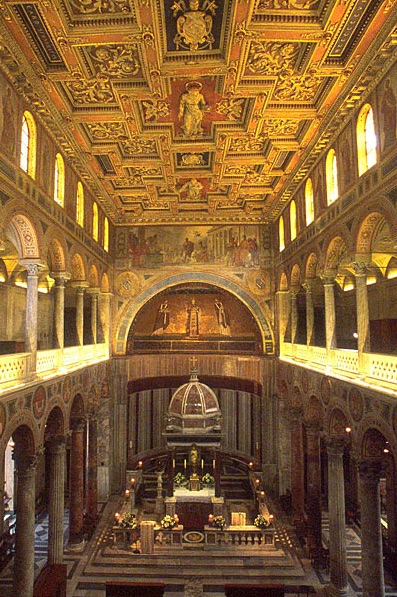
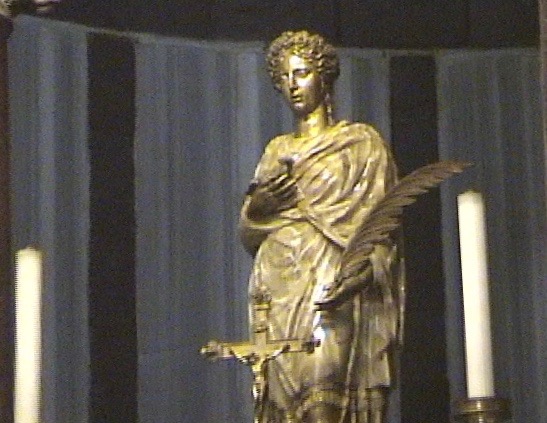
Agnes, a popular Roman woman martyr of the 3rd century, ranks high among the seven women mentioned in the First Eucharistic Prayer. “Agnes, Cecilia, Anastasia…”
That prayer goes back to St. Gregory the Great in the 6th century. Some say his mother and aunt may have promoted the women, all strong women who died for their belief. They come from all parts of the church of their time. Felicity and Perpetual are from North Africa, Agatha and Lucy from Sicily, Agnes and Cecilia from Rome, Anastasia originally from Greece.
Details of the story of Agnes, from 5th century sources, may be questioned, but the essential facts about her are true.
St. Agnes, Via Nomentana
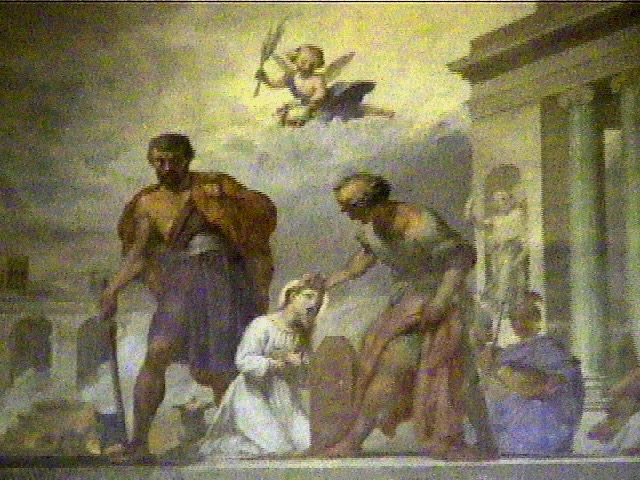
A young Roman girl of 13 or so, Agnes was put to death because she rejected the offer of a highly placed Roman man to become his bride. Incensed, he tried to force Agnes to change her mind; eventually she died for continuing to refuse him.
Women were expected to marry young in those days, to marry men chosen for them, and to have two or three children. They were to produce children for Rome, especially soldiers needed for the empire’s many wars.
Agnes’ refusal then to marry one of Rome’s elite was a dangerous decision. With no support from family or friends, alone in a male-dominated society, at a time suspicious of Christians and their beliefs, the little girl sought strength in Jesus Christ. She was a martyr put to death for her faith.
The Golden Legend, a favorite saint book from the Middle Ages, says that Agnes was true to her name. She was a lamb (Agnus) who followed the Good Shepherd. Though young, she followed truth, never turning away from it. God gave her strength beyond what’s expected for her years.
The story says they put Agnes among the prostitutes found near the racecourse then on the Piazza Navona in Rome. God warded off those who tried to rape her. A church in her honor stands today in the busy piazza; another church over her grave is on the Via Nomentana in Rome. (above)
They finally killed her with a knife to her throat. Heavenly signs surrounded Agnes even then, her story says, assuring her that her faith was not in vain. The One she loved was with her as she struggled.
Agnes, the prayer for her feast says, is an example of how God chooses “what is weak in this world to confound the strong.” The young girl was stronger than her powerful killers. “May we follow her constancy in the faith, through our Lord Jesus Christ, who lives and reigns with you, in the unity of the Holy Spirit, one God, forever and ever. Amen.”
St. Gregory the Great, one the greatest of the popes, was called to that position in the 6th century, when Rome was under siege and in decline. He didn’t want the job and for spiritual guidance he read from the Book of Job. We would never know the greatness of Job, if suffering didn’t reveal it, he said. Here are a few lines from his commentary on Job, our first reading this week:
“Paul saw the riches of wisdom within himself though his outward body was corruptible, and so he says ‘ We have this treasure in earthen vessels. In Job, then, the earthen vessel had gaping sores, while an interior treasure of wisdom remained unchanged. Gaping outward wounds did not stop a treasure of wisdom from welling up within, for he said: ‘If we have received good things at the hand of the Lord, shall we not receive evil?’
By good things Job means the good things given by God, both temporal and eternal; by evil he means the blows he presently suffers.
When we’re afflicted, let’s remember our Maker’s gifts to us. Suffering will not depress us if we quickly remember the gifts we’ve been given. As Scripture says, ‘In the day of prosperity do not forget affliction, and in the day of affliction, do not forget prosperity.’”
The love of God for us was proven through the death of his Son, Jesus Christ who, like Job, was tested by suffering and death.
April 25th is the Feast of St. Mark, author of one of the gospels. We may forget that real people wrote the gospels, but the medieval portrait above shows the evangelist real enough as he adjusts his spectacles and pours over a book, surely his gospel. A lion looks up at him, the powerful voice of God.
He’s an old man, his eyes are going, He has to be old if he’s a disciple of Peter, as tradition claims. (cf. 1 Peter 5:14) Mark’s gospel appears shortly before or after the destruction of the Jewish temple in Jerusalem by the Romans in 70 AD. If he’s the author of the gospel, as it’s said, he’s in his 70s at least.
He may have written his account in Rome, where he came with Peter, who calls Mark in his 1st Letter “my son.” In 64 AD, Roman Christians experienced a vicious persecution at the hands of the Emperor Nero. Peter and Paul died in that persecution. For years afterwards, Christian survivors were still asking themselves, no doubt, why it happened.
They say Mark wrote his gospel in answer to that dreadful experience. He would have heard Peter’s witness to Jesus many times; he knows his story.
Yet Mark was not just a stenographer repeating Peter’s eyewitness account; he’s adapted the apostle’s story, adding material and insights he had gathered on his own. For a long time Mark’s gospel was neglected by the church, thought to be simply a synopsis of Matthew’s gospel. Today scholars admire it for its simplicity and masterful story telling. It’s the first gospel written and Matthew and Luke derive much of their material from it.
I like the wonderful commentary: The Gospel of Mark, in the Sacra Pagina series from Liturgical Press, by John Donohue,SJ and Daniel Harrington, SJ (Collegeville, Min. 2002). A great guide to this gospel and its rich message. We read Mark in the lectionary from the Feast of Baptism of Jesus up to Ash Wednesday, the beginning of Lent.
Mark’s Gospel offers a unique wisdom. It does not flinch before the mystery of suffering and does not try to explain it away. There’s a darkness about this gospel that makes it applicable to times like ours. We’re disciples of Jesus who must follow him, no matter what.
Our gospel for the feast is the final commission Jesus gives to his disciples, according to Mark. “Go into the whole world and proclaim the Gospel to every creature. Whoever believes and is baptized will be saved; whoever does not believe will be condemned. These signs will accompany those who believe: in my name they will drive out demons, they will speak new languages. They will pick up serpents with their hands, and if they drink any deadly thing, it will not harm them. They will lay hands on the sick, and they will recover.”
Like Jesus, his disciples will drive out demons and speak new languages. They’ll pick up serpents and drink poison, yet be unharmed. They will even believe, without understanding everything. In answer to Jesus’ command, tradition says Mark went to Egypt and founded the church in Alexandria.
Father, You gave St. Mark the privilege of proclaiming your gospel. May we profit by his wisdom and follow Christ more faithfully. Grant this, through Christ, your Son.
Mary is an important figure in the events of Advent and Christmas Time. The angel visits her at Nazareth, she visits her cousin Elizabeth, the birth of Jesus in Bethlehem, the coming of the Magi, the flight into Egypt, the presentation of the Child Jesus in the temple, the finding of the Child Jesus in the temple after his loss for three days. All events in Luke and Matthew’s gospels where Mary has a role.
We remember her especially on her feast during Christmas time: the Feast of Mary, the Mother of God. (January 1st)
Because they focus on Jesus, the gospel writers touch lightly on Mary, but she is an important witness to his humanity and divinity just the same. “For us and our salvation he came down from heaven, and by the Holy Spirit was incarnate of the Virgin Mary and became man.” (Creed)
Through her, the Christmas liturgy reminds us, Jesus took “a body truly like our own.” (Collect, Monday of Christmas Time) Jesus “accepted from Mary the frailty of our flesh.” (Collect, Monday of Christmas Time) She’s the way the Word became flesh. The First Letter of John, read in Christmas Time, calls this a fundamental truth of faith.
By taking a body “truly like our own” and accepting “from Mary the frailty of our flesh,” Jesus humbled himself, assuming the limitations that come from being human. Mary is his way, giving him birth, nursing him as a infant and raising him as a child.
“Can anything good come from Nazareth?” For 30 years Jesus led a silent hidden life in that small town in Galilee, and Mary was his mother. “I confess I did not recognize him,” John the Baptist says twice when Jesus comes to the Jordan to be baptized. (John 1,29-34) His own in Nazareth did not recognize him either.
He went unrecognized, and so did Mary, who shared his hidden life. She performed no miracles, did not publically teach; no angel came again after the first announcement to her.
We can pass over the Hidden Life that Jesus embraced too quickly, even though the Christmas mystery invites us to keep it in mind. We forget that to be transformed into glory means accepting “the frailty of our flesh,” which Jesus did.
“…though invisible in his divine nature, he has appeared visibly in ours; and begotten before all ages, he has begun to exist in time; so that, raising up in himself all that was cast down, he might restore unity to all creation and call straying humanity back to the heavenly kingdom.” (Preface II of the Nativity)
St. Mary Major is the main church in Rome dedicated to Mary, the Mother of God. You can visit it in the video above. It was built in the 5th century to honor Mary’s role as witness to his divine and human natures. The church is also called “Bethlehem in Rome” because many of the Christmas mysteries were first celebrated there; relics from Bethlehem were brought there after the Moslem invasion in the 8th century.
The great mosaic of Mary in heaven crowned by Jesus, her Son, stands over the altar in the church as its focal point. Companion in his hidden life, she was raised up by her Son, who was human and divine, through the mystery of his resurrection.